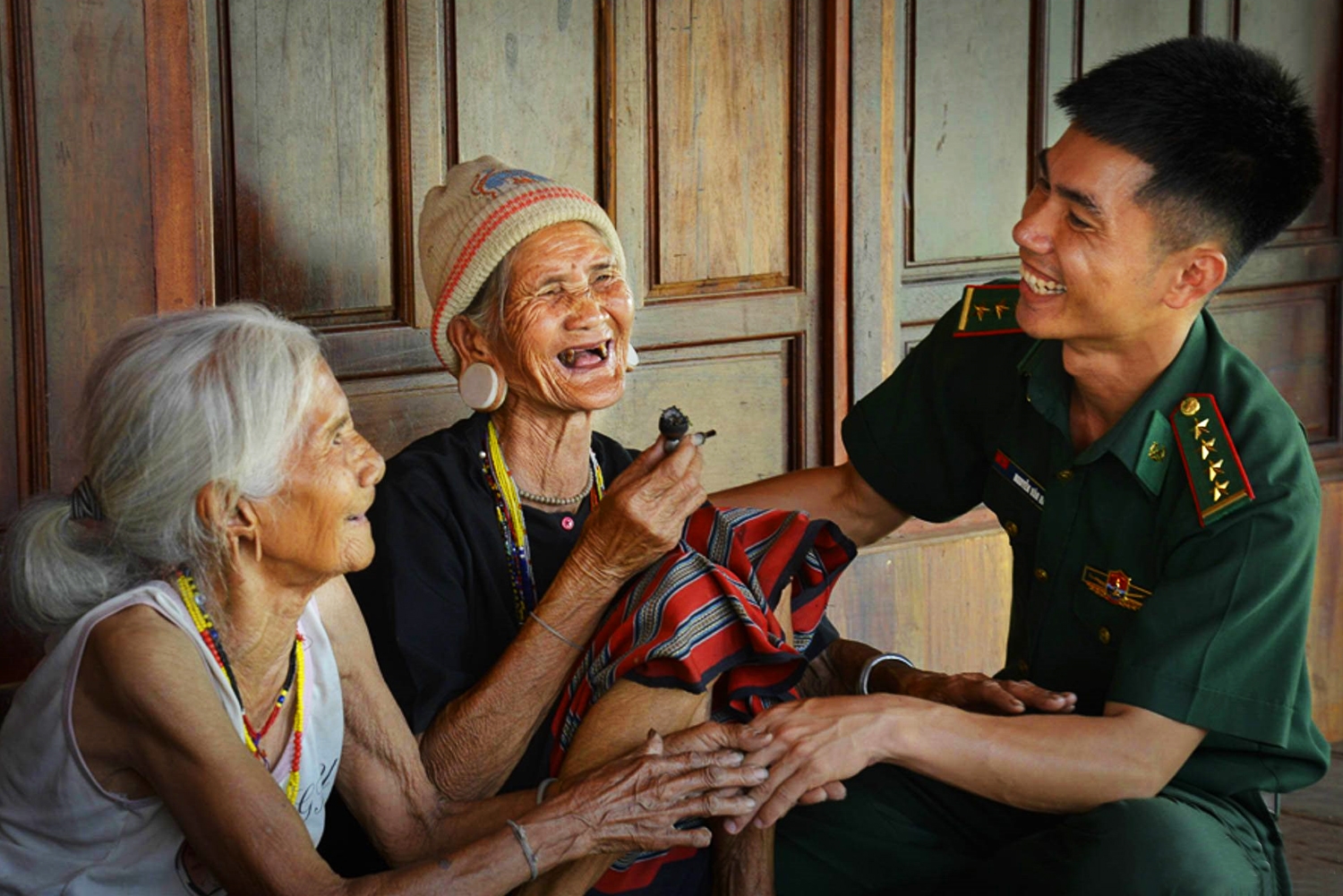
 Border Guard Forces and ethnic minority communities in the Central Highlands
1. Identifying plots and tactics that exploit religion for subversive purposes
Firstly, they frequently distort the guidelines and policies of the Party and the laws of the State regarding belief and religion. They deliberately misrepresent the actual situation, level false accusations against Vietnam and offer one-sided, non-objective assessments claiming, for instance, that “Vietnam suppresses religion”, “Vietnam violates freedom of belief or lacks such freedom entirely”, “restricts human rights”, or “persecutes ethnic minorities based on their religion”. This inaccurate information is frequently and deliberately repeated to ensure it is picked up by international media and subsequently used by certain human rights organizations and foreign lawmakers to exert diplomatic pressure on Vietnam. They conflate the legal action taken against unlawful conduct with so-called “religious persecution”, aiming to foster a distorted perception among the international public.
Exiled reactionary organizations and dissident elements both within and outside the country exploit reports on human rights and religious freedom issued by certain nations and international organizations. These reports, which are constructed using distorted, unverified and unsubstantiated information often based on fabricated evidence are maliciously targeted at Vietnam. Such groups use these reports to manipulate public sentiment, fostering a vague belief in the prospect of external intervention. In doing so, they mislead segments of the public who lack access to accurate information, encouraging them to pin their hopes on assistance or intervention from these foreign powers and ultimately drawing them into activities aimed at opposing and undermining the state. One such example is the annual report (particularly from 2022 onwards) by the United States Commission on International Religious Freedom (USCIRF), which contains numerous claims, assessments, and citations that are unverified, unsubstantiated, and based on one-sided or fabricated information. These contents are being fully exploited by hostile forces, reactionary elements, and political opportunists to undermine Vietnam, most notably through the report’s recommendation to designate Vietnam as a “country of particular concern” about religious freedom.
Secondly, they seek to establish connections, build networks, and secure support for their subversive activities. Hostile elements frequently monitor and exploit issues related to land, religious practices, ethnic minorities or other complex incidents to rally forces and incite opposition. Through these actions, they call upon Western political circles and human rights organizations to intervene and exert political or diplomatic pressure on Vietnam; they also urge the public to engage in protests, with the ultimate aim of destabilizing society and undermining public order and security.
Thirdly, they exploit scientific and technological advancements, digital media platforms and social media to carry out subversive activities. Reactionary and hostile elements extensively leverage cyberspace to disseminate false information regarding the religious situation in Vietnam. Through digital platforms and social media such as Facebook, YouTube, TikTok, personal blogs and various reactionary websites, they frequently post content, commentary, and misinformation, as well as speeches, reports and biased or inaccurate rankings, all aimed at criticizing the state of human rights protection and religious freedom in Vietnam.
They exploit digital media platforms to post and disseminate erroneous, hostile, and negative content originating from individuals or groups who style themselves as “democracy activists” or “human rights defenders”. They actively establish various associations and groups under guises such as “civil society organizations,” “advocates for the nation and the people”, “patriotic brotherhoods” or “patriotic intellectuals” to circulate articles and videos containing distorted information and manipulated imagery. Their objective is to incite discontent and sow skepticism among the general public, while building an extensive, interconnected network of accounts that reinforce one another and drive mutual engagement.
Fourthly, exploiting ethnic issues in connection with religion to incite separatism and demands for autonomy in certain strategic areas with large ethnic minority populations, notably in the Central Highlands, the Northwest and the Southwest region. They provide support to illegal organizations and incite the establishment of a “separate state” operating under the guise of religious groups. They use this cover to propagate superstition, reject local authorities, lure individuals into unlawful activities, and instigate acts of sabotage, thereby complicating the situation regarding security and social order while promoting common narratives such as “religious freedom in the Central Highlands” and “the Central Highlands belong to the indigenous people”…
2. The practice of people-to-people diplomacy by religious organizations
Firstly, it serves as a promotional channel and a bridge for enhancing international understanding of Vietnam. Religion is universal and transnational in nature, possessing an extensive network of connections across the globe. Through religious exchanges, interfaith dialogue, humanitarian cooperation, cultural interactions, and participation in international forums, the international community is able to gain direct insight into the reality of religious life in Vietnam rather than relying on one-sided, incomplete, unverified or biased information. This serves as a highly persuasive basis for refuting distorted claims regarding the religious situation in Vietnam.
In reality, most religious organizations in Vietnam have increasingly gained prestige and standing within the regional and global religious communities, while also cultivating extensive international relations. The fact that their international exchange and cooperation activities have become increasingly deep, broad and diverse is a direct result of the support and favorable conditions provided by the State.
The Vietnam Buddhist Sangha maintains relations with Buddhist communities across Asia and the region; it is a founding member as well as an active member of numerous reputable international and global Buddhist organizations. The Catholic Church in Vietnam maintains relations with the Vatican and with Catholic communities in countries across Europe, Asia, Latin America, and Oceania. Protestant churches in Vietnam have ties with their counterparts in Western Europe, Northern Europe, North America and South Korea. The Muslim community in Vietnam engages with Islamic communities in Southeast Asia (ASEAN), the Middle East, Western Asia, North Africa, South Asia…
Successfully hosted and organized numerous international religious events and activities of global and regional significance attended by prominent religious leaders, high-ranking clergy from various countries, and heads of state which have earned high praise from the international community. Notable examples include events organized by the Catholic Church in Vietnam, such as the plenary assemblies of the Federation of Asian Bishops’ Conferences (in 2012 and 2023), the General Chapter of the Order of Preachers (Dominicans) (in 2019), the 2020 Asia-Oceania regional conference of the Congregation of the Most Holy Redeemer (Redemptorists), an order known for having many extremist clergy members who engage in opposition and the 2024 East Asia-Oceania regional conference of the Salesians of Don Bosco… The Vietnam Buddhist Sangha has hosted the United Nations Day of Vesak four times (in 2008, 2014, 2019 and 2025), while the Protestant community has marked the 100th anniversary of the arrival of Protestantism in Vietnam...
Secondly, build consensus and garner international public support by engaging religious dignitaries, officials, clergy and respected within religious communities. These individuals constitute a vital force in people-to-people diplomacy; they are individuals with social standing, significant influence within the religious community and extensive connections to international religious organizations. Given this unique standing, they go beyond merely carrying out religious activities, they also serve as “ambassadors” in the realm of people-to-people diplomacy.
Through international exchange, dialogue and cooperation, religious dignitaries, officials, and practitioners contribute to: enhancing mutual understanding between Vietnam and the international community; promoting the religious policies and guidelines of the Party and the State; projecting a positive image of Vietnam and its people.
In many instances, the voices of religious dignitaries and clergy carry significant social persuasiveness, helping to build trust and international consensus about Vietnam’s religious policies. This represents a unique advantage of religious diplomacy compared to purely administrative forms of public outreach.
Currently, religious groups in Vietnam maintain a significant presence abroad comprising clergy, religious functionaries, monastics, followers, organizations and places of worship and share close ties with the approximately 5 million Vietnamese people of various faiths living across 130 countries and territories worldwide.
Among these, Buddhism includes 22 affiliated Vietnamese Buddhist associations and 400 Vietnamese temples across 33 countries and territories, served by hundreds of clergy members. Catholicism has approximately one million Vietnamese followers, organized into 300 communities across 39 countries, with hundreds of priests and religious figures. Protestantism comprises 530 Vietnamese churches and fellowship groups abroad. Cao Dai has 32,000 clergy members and followers, who practice at 59 places of worship overseas (primarily in the United States)…
Between 2011 and 2022, approximately 2,000 instances of religious individuals traveling abroad to participate in religious-related studies, conferences, and seminars were recorded; meanwhile, nearly 500 delegations from abroad comprising over 3,000 people visited Vietnam for exchanges and cooperation in the religious sphere... [4].
Furthermore, religious organizations and individuals in Vietnam actively participate in regional and global religious conferences and forums (such as the Asia-Europe interfaith dialogue, held 5 times, and the Asia-Pacific interfaith dialogue, held 6 times). They have also successfully engaged 72 organizations either faith-based or affiliated with religious groups to operate in Vietnam, focusing on areas such as healthcare, education and training, child welfare and support for socio-economic development programs [4];...
Thirdly, contribute to combating and refuting distorted claims regarding freedom of belief and religion, thereby safeguarding the Party’s ideological foundation. Hostile forces exploit religion through various methods and increasingly sophisticated tactics, some of which have been identified above. Their objective is not merely to distort religious policy; more profoundly, it is to incite political instability, sow division within the great national unity, and erode the people’s trust in the Party and the State. In this context, leveraging the role of religion in people-to-people diplomacy is not only a requirement for religious affairs work but also a vital task in safeguarding the Party’s ideological foundation, as well as protecting the nation’s image and its national interests.
The number of religious organizations, their affiliated bodies, and training institutions for clergy is steadily increasing; the ranks of clergy, monastics and adherents are growing; and religious sites are increasingly being granted land for new construction, while existing facilities are being renovated, expanded and improved. In 2003, there were 15 religious organizations across 6 religions in the country, with 20.6 million followers. By 2025, this had grown to 41 state-recognized religious organizations spanning 16 religions, with approximately 27,382,746 followers. Between 2018 and 2025, competent state authorities granted recognition to 3 religious organizations and approved the establishment of 5 religious training institutions, bringing the total number of such institutions to 63…
Major religious holidays not only attract large numbers of clergy, followers, and members of the general public, but also draw tens of thousands of foreign clergy, religious officials, monastics and believers; many of these observances have evolved into shared celebrations for the entire community.
Religious activities of foreigners legally residing in Vietnam are facilitated and protected. Since the Law on Belief and Religion (2016) came into effect, more than 125 instances of foreign religious dignitaries entering Vietnam to provide religious guidance to groups of foreign believers have been recorded [4].
Relations between Vietnam and the Holy See have seen positive progress. To date, the Holy See has established a Resident Representative in Vietnam; furthermore, for the first time, the Holy See has sent its Foreign Minister to visit Vietnam (in 2024)…
Religious groups actively participate in social welfare, charitable and humanitarian endeavors, healthcare, and education. These activities are carried out not only within the country but also abroad, for instance: Towards the end of 2025, the Vietnam Buddhist Sangha visited Sri Lanka to provide financial support for the people there to recover from the aftermath of Cyclone Ditwah. The Sangha has also participated in relief efforts for victims of the tsunami in Southeast Asia and the earthquake in Nepal, supported the construction of schools in Vientiane (Lao People’s Democratic Republic) andthrough its overseas temples offered free traditional medicine consultations and organized classes for the impoverished…
The achievements in safeguarding the right to freedom of belief and religion, alongside the robust development of international religious exchange and cooperation, serve as vivid and indisputable proof of the freedom of belief and religion in Vietnam. They also expose the true nature of the hostile forces, namely their tendency to distort, fabricate and level false accusations that Vietnam violates human rights and religious freedom. Taking action against individuals who exploit religion to violate the law is intended to safeguard social order, discipline and the common interests of the nation; it does not constitute “religious persecution”.
3. Certain tasks and solutions in the new situation
Firstly, continuing to review and refine the guidelines, policies, and laws concerning belief and religion, ensuring they align with the country’s practical realities and the trend of international integration; guarantee the people’s right to freedom of belief and religion in accordance with the law. Expedite the issuance of a decree providing detailed regulations and guidance for the implementation of the Law on Belief and Religion (2026), while simultaneously conducting timely outreach and dissemination regarding the Law before it takes effect on January 1st, 2027.
Secondly, effectively leveraging the positive resources of religion, as well as the international connections of religious organizations and individuals; at the same time, continue to create conditions for these organizations and individuals to engage in international exchanges and showcase Vietnam’s achievements in ensuring the right to freedom of belief and religion.
Thirdly, it is essential to promptly counter the schemes of hostile forces and refute distorted narratives regarding the religious situation in Vietnam, particularly in the online space. Competent authorities should work closely with religious organizations to disseminate information and provide official, accurate accounts, thereby helping the public to clearly recognize harmful, toxic and distorted content propagated by hostile forces.
Fourthly, strengthening international cooperation in monitoring and information sharing to prevent hostile forces, reactionary elements and criminals from exploiting religion to engage in subversion, terrorism, money laundering and other such activities…
Fifthly, continuing to strengthen the great national unity and inter-religious solidarity; focus on socio-economic and cultural development; and improve the material and spiritual well-being of the people, especially those in ethnic minority areas and regions with large religious populations, thereby limiting the opportunities for hostile forces to incite opposition or subversion.
4. Conclusion
Accurately identifying the schemes and tactics of reactionary elements, while simultaneously leveraging the positive role of religious communities in people-to-people diplomacy, not only strengthens the great national unity but also plays a vital role in countering false narratives and distortions regarding the state of freedom of belief and religion in Vietnam. This should be viewed as a form of “defending the Fatherland early and from afar” on the fronts of ideology, culture and external communication and constitutes a strategic requirement for safeguarding national interests in the current context.
* Deputy Director of the Department of Ethnic and Religious Affairs, Central Commission for Propaganda and Mass Mobilization
References
1. The National Assembly of the Socialist Republic of Vietnam (2016, 2026), Law on Belief and Religion and Law on Belief and Religion (amended).
2. Central Commission for Mass Mobilization (2022), Some Theoretical and Practical Issues Regarding Mass Mobilization Work in the New Situation, National Political Publishing House, Hanoi.
3. Ministry of Foreign Affairs (2023), Comprehensive and Modern Vietnamese Diplomacy for Peace and Sustainable Development, National Political Publishing House, Hanoi.
4. Government Committee for Religious Affairs (2022), Religion and Religious Policy in Vietnam, Religious Publishing House.
5. Le Minh Khanh, MSc (2026), Religious Diplomacy in Vietnam and Issues Arising for Mass Mobilization Work, Journal of Ethnic and Religious Studies - Issue 6 [9], p.2730.
6. Compiled based on Report No. 3257/BC-BDTTG, dated December 31st, 2025, from the Ministry of Ethnic and Religious Affairs, about the review of the implementation of the Law on Belief and Religion.
7. According to the Report on Scheme 354 (2024), spearheaded by the (former) Central Commission for Mass Mobilization.
