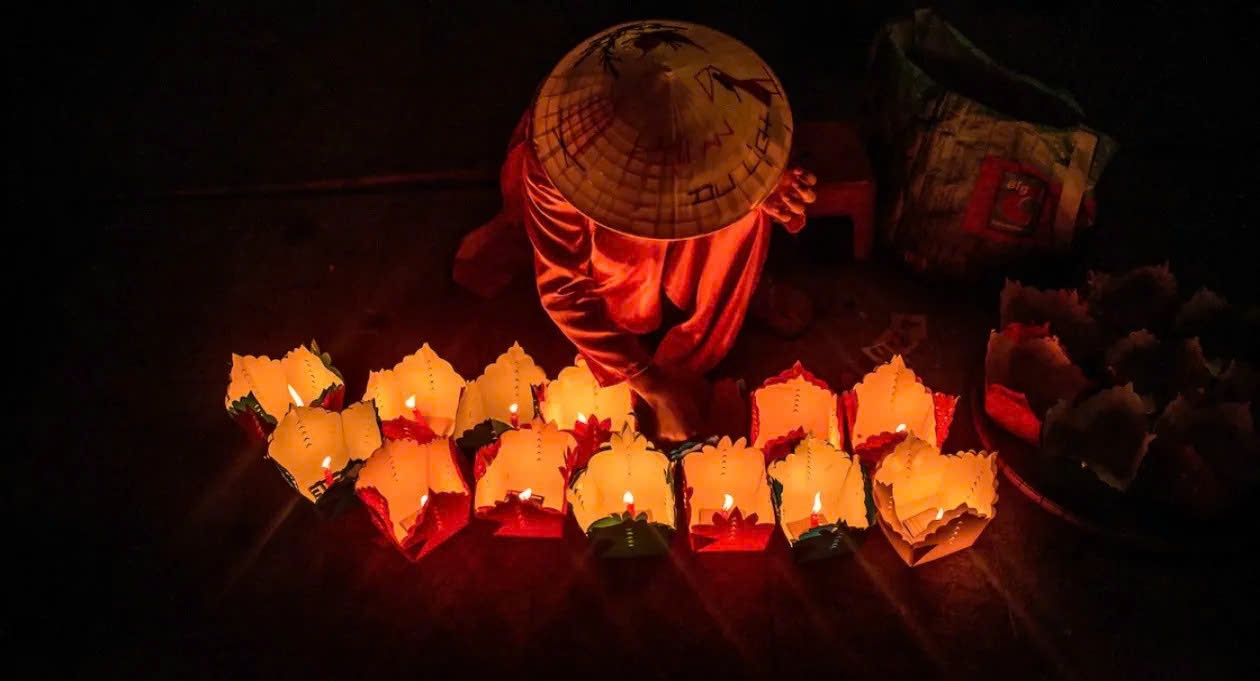
 The Vu Lan ceremony is like an awakening bell, calling each person back to their own spiritual home
Keywords: Vu Lan Filial Piety; Filial piety; Vietnamese Buddhism; Spiritual culture; Words of filial piety; Cultural acculturation.
1. The origins and philosophy of filial piety in Buddhism
1.1. The legend of Maudgalyayana and the origin of the term of “Vu Lan Bon”
The term “Vu Lan” is an abbreviation of “Vu Lan Bonn”, a transliteration of the Sanskrit word “Ullambana”. The original meaning of this word is relieving the agony of being suspended upside down. This is a profound metaphor for the extreme pain of sentient beings in the realm of hungry ghosts (hungry ghosts) caused by the evil karma of greed and stinginess from past lives.
The Vu Lan Festival originates from a short Mahayana Buddhist scripture, the “Ullambana Sutra” which recounts the story of the supremely filial Bodhisattva Maudgalyayana saving his mother from the realm of hungry ghosts. The Venerable Maudgalyayana was one of the Buddha’s few exceptional disciples, possessed of boundless spiritual powers.
Upon attaining the six supernormal powers and the eye of wisdom, he immediately thought of his mother, Lady Thanh De. Using his eye of wisdom to survey the four directions, he saw her suffering in hell as a hungry ghost, a state of extreme hunger and misery resulting from the many evil deeds she had committed in her past life. Out of love for his mother, he used his supernatural powers to descend to the realm of hungry ghosts and offer her food. Having endured prolonged starvation, Lady Thanh De used one hand to shield her bowl of rice while eating, fearing that other wandering spirits might come to snatch it away. Because she still harbored greed, hatred, and delusion, the food turned into blazing fire the moment she raised it to her lips, rendering it inedible. Overcome with anguish and unsure of how to save his mother, he immediately returned to the World-Honored One to seek guidance. Upon witnessing this, the Buddha taught: “Even the supernatural powers of heavenly beings and earthly spirits cannot save your mother from her transgressions! Only through the combined spiritual power of the Sangha - following their three-month summer retreat of diligent, pure practice and focused chanting, might her karmic burden be transformed, allowing her to escape her suffering. Upon hearing this, the Venerable Maudgalyayana earnestly implored the World-Honored One: “World-Honored One, how can I possibly invite the Sangha from the ten directions to receive offerings all at once like that?” The Buddha replied: Vu Lan is the day of Pavarana (the ceremony of self-reproach and confession) for the Sangha; you should therefore prepare offerings for this occasion. On this day, regardless of whether the monastics have been immersed in deep meditation, practicing walking meditation beneath the trees or actively guiding people in the world, they all gather to perform the Pavarana ceremony and offer prayers for your mother, thereby enabling her to be liberated from suffering. Venerable Maudgalyayana earnestly followed the World-Honored One’s teachings. During that year's Ullambana ceremony, he succeeded in rescuing his mother from the realm of hungry ghosts and liberating all the spirits imprisoned in the underworld.
Then, the Venerable Maudgalyayana, filled with great joy, made this request: “If, in the future, any sentient being wishes to cultivate a heart of filial piety and prays for their parents to be liberated from suffering and attain happiness, may they do as I have done?” The World-Honored One replied: “By performing such acts on the day of Pavarana (the conclusion of the rains retreat), one can secure liberation and salvation for the souls of one’s parents both from this life and from past lives. Thus, Buddhism established a practice observed during the Ullambana and Pavarana festivals to help deceased ancestors attain liberation and rebirth in realms of peace and happiness. Since then, anyone wishing to express filial piety toward their parents has followed this same method (the Ullambana practice).
1.2. The philosophy of filial piety in the Buddhist worldview
Many Western scholars and early Confucianists have characterized Buddhism as an otherworldly religion, one that entails leaving home, severing worldly attachments, and forsaking one’s parents in pursuit of liberation and have therefore deemed it unfilial. However, a deep examination of the scriptural canons of both the Southern (Pali) and Northern (Mahayana) traditions reveals that filial piety holds a supreme position.
In the Anguttara Nikaya, the Buddha declares: “Monks, there are two people whom I say it is impossible to fully repay. Who are these two? One’s mother and father”. He illustrates that even if one were to carry one’s father on the left shoulder and one's mother on the right shoulder for a hundred years, traveling far and wide while providing for them with every precious thing, it would still not be enough to repay the debt of gratitude for their having given birth to and raised one. In the Sutra on Forbearance, it is declared: There is no greater virtue than filial piety, and no greater evil than unfilial conduct. Buddhism even elevates parents to the same level as the Supreme Being, holding that having one’s parents present is akin to having the Buddha himself in the world.
However, the filial piety of a Buddhist does not stop at the material level such as providing food, clothing, and medicine but places special emphasis on the spiritual and intellectual dimensions. The Sutra on Birth (Phat Thuyet Sinh Kinh) and the Sutra on the Profound Kindness of Parents and the Difficulty of Repaying, it clearly state: The greatest act of filial piety is to guide one’s parents toward the path of goodness encouraging them to renounce the taking of life and greed, take refuge in the Three Jewels and cultivate wisdom. For while nourishing the physical body ensures their well-being for only a single lifetime, saving their wisdom-life and consciousness liberates them from the cycle of birth and death spanning countless eons.
Buddhist filial piety also possesses a universal and egalitarian nature. Through the lens of reincarnation and the law of karma, Buddhism views all beings in society as having been one another’s parents and kin across countless past lives. Consequently, filial devotion toward one’s current parents expands into compassion for all sentient beings. Thus, the Vu Lan Festival is not merely an occasion to pray for the salvation of one's own parents across seven generations; it is also a time to show compassion and offer prayers for lonely, wandering souls beings with no one to tend to their memory.
Among all human connections, the bond between parent and child is arguably the most sacred. This sanctity stems not only from the ties of genetics and blood but also from the human connection, the educational influence, and the moral values shared between the two generations, the one that gives life and the one that receives it. A child who shatters this sacred bond by acting with filial impiety, becoming a burden or a source of harm to their parents, tarnishing the family’s honor and noble traditions or engaging in illegal activities ceases to be a child in the true sense of the word; instead, they become nothing more than a culpable wrongdoer. Furthermore, individuals not only cherish gratitude toward those who have nurtured and supported them but also honor the memory of the departed such as ancestors, fallen soldiers, and compatriots who perished recognizing those who sacrificed their lives and blood for the nation's independence and freedom, thereby enabling future generations to live in peace and prosperity. Among the four great debts of gratitude in Buddhism, the debt owed to one’s country, community and nation stands out as a sacred and noble obligation that is difficult to fully repay.
2. From the Indian Ullambana to Vietnamese filial piety
When Buddhism was introduced to Vietnam in the early Common Era via the Luy Lau center, it did not eradicate local beliefs but instead achieved a perfect cultural synthesis. Originating as a ritual deeply rooted in Indian philosophies of liberation and karma, the Vu Lan festival rapidly merged into the cultural undercurrents of the Vietnamese people, which are imbued with a spirit of humanism.
Before the introduction of Buddhism or Confucianism, the ancient Vietnamese possessed a solid foundation of belief rooted in an agricultural mindset and the practice of ancestor worship. They believed that death was not an absolute end but rather a transition to another realm referred to in ancient terms as “mon” or “muong”, or simply the spirit world. The deceased maintain a close connection with the living, offering protection or meting out reprimand; therefore, the worship and commemoration of parents and ancestors constitute the most sacred duty of a child.
When the Vu Lan Festival arrives, bearing its message of filial piety and the power to deliver the souls of parents from suffering, the Vietnamese people embrace it as a potent spiritual means to fulfill their desire to honor their forebears. The rituals of chanting the Vu Lan Sutra and offering petitions for the salvation of seven generations of ancestors blend seamlessly with traditional ancestral memorial rites.
Notably, the Vietnamese people have integrated the Vu Lan festival, an occasion for filial piety toward one’s parents with the Festival of Wandering Souls, an expression of compassion for lost spirits. This represents a unique creation of the Vietnamese mindset. Consequently, the full moon day of the seventh lunar month in Vietnam embodies two parallel spiritual dimensions: an inward-looking perspective focused on family and lineage, and an outward-looking, inclusive perspective embracing the community and society at large, offering solace even to the most unfortunate of souls.
Every year, on the full moon of the seventh lunar month, Buddhists everywhere emulate the filial piety of Bodhisattva Maudgalyayana and reflect on their duty to repay the profound debt of gratitude owed to their parents; they solemnly observe the Vu Lan Festival, invoking the spiritual power of the Triple Gem to pray that living parents find peace and happiness in the True Dharma and that deceased parents attain rebirth in auspicious realms. No matter who they are, what they do, or where they may be, people long to visit the temple to observe the Vu Lan Festival, a time to honor and repay the debt of gratitude to one’s parents. They come to light incense and offer heartfelt prayers, seeking spiritual liberation for their parents whether in this life or past lives and wishing for peace and happiness in the present for those still living, through the merit of this act. It is this sentiment that imbues the full moon of the seventh lunar month with the profound meaning of a “season of filial piety”, a time for every child to honor their parents. ooted in the nation’s cultural traditions of filial piety and gratitude encapsulated by the sentiment of “drinking water while remembering its source” and the Vietnamese spiritual practice of ancestor worship, the Buddhist Vu Lan festival has blended with the philosophies and customs associated with the full moon of the seventh lunar month to form the Vietnamese Vu Lan Festival of Filial Gratitude.
3. Manifestations and values of Vu Lan in contemporary Vietnamese culture
In today's modern society amidst waves of urbanization, globalization, and the rise of a materialistic lifestyle, the Vu Lan Festival has not lost its significance; on the contrary, it increasingly reveals its core humanistic values, serving as a “cultural anchor” that prevents people from drifting away from traditional values.
3.1. Dimensions of the Vietnamese practice of the Vu Lan ritual
Currently, the practice of Vu Lan to show filial piety by Buddhists and Vietnamese people takes place in three complementary spaces.
At Buddhist monasteries and pagodas, the atmosphere has been filled with devotion since the beginning of the seventh lunar month, as ceremonies have commenced nationwide for the chanting of the Ullambana and filial piety Sutras. People visit these sacred sites to pray for the well-being of their living parents, submit petitions for the salvation of their ancestors, and participate in events such as the “Rose-Pinning Ceremony” and candle-lighting tributes. These spaces foster a sense of spiritual resonance, helping individuals relieve psychological stress and find inner peace.
The family setting: the family is the cradle of filial piety. On the full moon of the seventh lunar month, Vietnamese families whether wealthy or modest prepare a proper ceremonial meal. This offering is typically divided into three parts: one for the Buddha, one for ancestors and one for wandering spirits outside the gate. In particular, the trend of preparing vegetarian feasts for the Vu Lan Festival is gaining popularity, reflecting the Buddhist spirit of compassion and the avoidance of taking life in order to accumulate merit for one’s parents. It is also an occasion for family members to gather, check on the well-being of their grandparents and parents and strengthen family bonds after busy periods.
In the social sphere, filial piety today extends beyond the mere care of one's own parents. Emulating the compassionate vows of the Buddha and the Venerable Maudgalyayana, many Buddhists translate the spirit of the Vu Lan festival into concrete actions such as engaging in charity work, distributing free meals at hospitals, visiting and caring for the lonely elderly in care centers and donating blood. They believe that performing good deeds and dedicating the resulting merit to their parents constitutes the most practical and noble expression of filial piety.
3.2. The educational and social-shaping values of Vu Lan
Viewed through the lens of the functional theory of religion, the Vu Lan festival serves as a regulator of moral behavior and a highly effective means of instilling family values.
Fostering gratitude: Modern psychology demonstrates that gratitude is the foundation of a happy and healthy character. The Vu Lan festival compels us to pause and reflect on our origins, recognizing the silent sacrifices and hardships endured by our parents and thereby awakening a sense of gratitude. A child who knows how to bow their head and pin a rose onto their parents’ lapel on Vu Lan Day is unlikely to grow up to be an unruly or ungrateful person.
Strengthening and healing family relationships: Modern life, with its generation gaps and the intrusion of technology, often strains the bond between parents and children. Vu Lan serves as a therapeutic moment of quiet reflection. Through teachings on filial piety delivered by venerable masters, children come to understand their parents' hearts, while parents gain empathy for the pressures their children face. Many family conflicts have been resolved amidst the tears shed during the Rose-Pinning Ceremony.
Extending the spirit of gratitude to the nation and society: In Vietnam, the full moon of the seventh lunar month marking the Vu Lan Festival coincides remarkably closely with major national observances, such as Invalids and Martyrs’ Day on July 27th. The societal spirit of gratitude and indebtedness harmoniously blends with the spirit of filial piety embodied in the Vu Lan Festival. Buddhists visit martyrs' cemeteries to offer incense and pray for the repose of the souls of heroes who sacrificed their lives for the Fatherland. In this context, filial piety becomes synonymous with loyalty, patriotism and a sense of civic responsibility.
4. Conclusion
Throughout the ebb and flow of history, the Vu Lan festival of Filial Piety has demonstrated its enduring vitality by transcending the confines of a single religion to become the very soul of Vietnamese family and social ethics. It represents a perfect synthesis of Buddhist compassion, wisdom and liberation with the Vietnamese spirit’s humanistic values and deep-rooted emphasis on sentiment, righteousness and filial devotion.
Between a turbulent modern world, where people are preoccupied with chasing after dazzling material values, the Vu Lan Festival emerges as a wake-up call, summoning each individual to return to their own spiritual home. Whether pinning a flower to one’s chest, lighting incense at the ancestral altar, or simply preparing a vegetarian meal for one’s parents, each such act serves as a brick contributing to the construction of the nation’s enduring tower of morality. Preserving and upholding the beauty of the Vu Lan tradition of filial piety means safeguarding the roots of cultural strength, helping people live with greater compassion and a stronger sense of responsibility toward their families and communities.
References
1. Vietnam Buddhist Sangha (2015), “The Ullambana Sutra and The Sutra on the Profound Gratitude Owed to Parents” (Translated by Most Venerable Thich Tri Tinh), Religious Publishing House, Hanoi.
2. Nguyen Hong Duong (2004), The Relationship Between Buddhism and Vietnamese Traditional Beliefs, Social Sciences Publishing House, Hanoi.
3. Tran Ngoc Them (1997), In search of Vietnamese cultural identity, Ho Chi Minh City Publishing House, Ho Chi Minh City.
4. Thich Minh Chau (Translation, 2012), Anguttara Nikaya (The Numerical Discourses), Religious Publishing House, Hanoi.
5. Nguyen Lang (2000), A History of Vietnamese Buddhism, Literature Publishing House, Hanoi. 6. Veritable Records of Dai Nam: Main Compilation, First Reign, Part III, History Publishing House, Hanoi, 1963.
