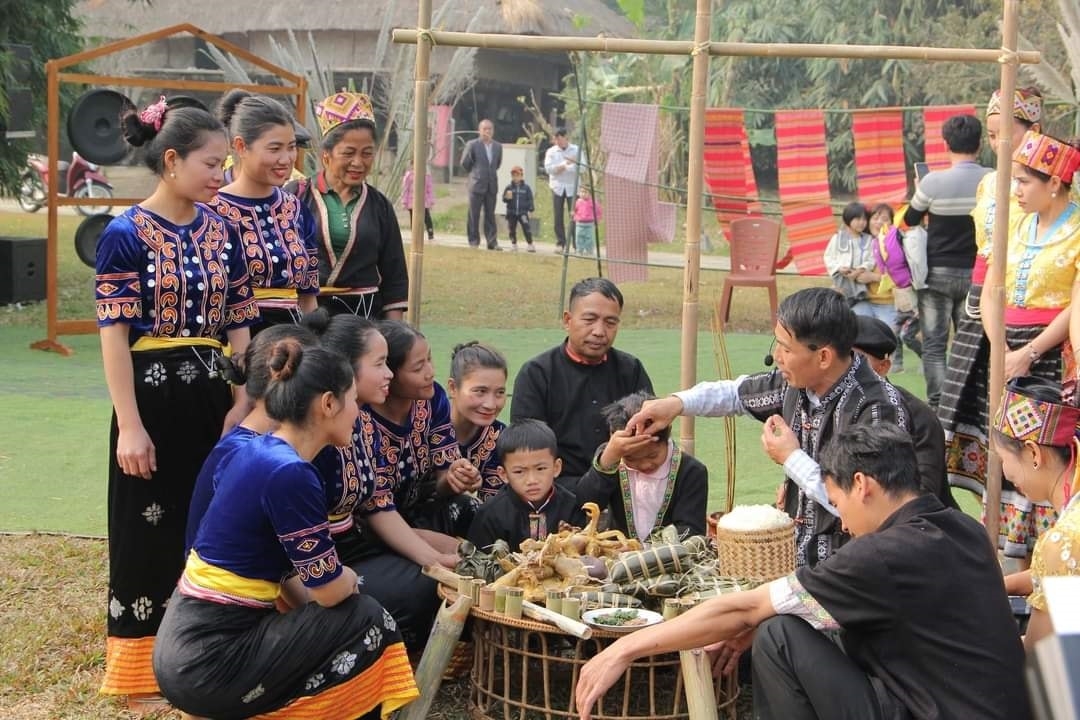
 Re-enactment of the Kho-mu people’s Go ro’s Tet festival from Nghe Anprovince at the Vietnam National Village for Ethnic Culture and Tourism
Keywords: Cultural institutions; Cultural policy; Ethnic minority; Resolution of the 14th National Congress; Resolution 80-NQ/TW.
1. Introduction
At the 14th National Party Congress (January 2026), our Party assessed: “Promoting the value of cultural heritage means harnessing endogenous strength for the country’s prosperous and sustainable development”.
Vietnam is home to 53 ethnic minority groups, each possessing its own distinct cultural identity. Consequently, the cultures of these ethnic minorities constitute a vital component that contributes to the richness, diversity and unity of Vietnamese culture. In light of the perspective set forth in the Resolution of the 14th National Congress, the cultural heritage of ethnic minority groups constitutes a vital endogenous resource contributing to the country’s sustainable development, as well as a form of “soft power” in foreign affairs and international integration.
The country is entering a new stage of development, and Resolution No. 80-NQ/TW dated January 7th, 2026, of the Politburo on the development of Vietnamese culture has established an innovative mindset regarding cultural development, based on the following perspective: “Fundamentally and comprehensively innovate the mindset regarding the mobilization of all resources for cultural development, wherein state resources play a leading role, while social and private sector resources serve as key drivers; institutions play a pivotal role, particularly through breakthrough mechanisms and policies designed to effectively mobilize and utilize investment resources for culture.” [2].
This study aims to reassess the landscape of national cultural institutions for the period of 2021-2025 and outline key solutions for reforming the institutions and policies governing national cultural development in Vietnam for the period of 2026-2031, thereby realizing the Party's new perspectives as articulated in the 14th National Congress documents and Resolution No. 80-NQ/TW.
2. Progress in establishing institutions and policies for ethnic culture during the period of 2021-2025
During the period of 2021-2025, ethnic cultural work has been implemented against the backdrop of the Party and State placing special emphasis on issuing numerous strategic and comprehensive guidelines and policies that build upon past foundations while fostering further development. Of particular note are the perspectives on cultural development articulated in the documents of the 13th National Party Congress, the National Cultural Conference (2021), and Politburo Conclusion No. 65-KL/TW dated October 30th, 2019, regarding the continued implementation of Resolution No. 24-NQ/TW dated March 12th, 2003, of the Party Central Committee on ethnic affairs... The guidelines and policies of the Party and the State have clearly defined the direction for preserving and promoting national cultural values, while guiding a new approach that places culture on an equal footing with the political, economic and social sectors and recognizes it as a resource for national development.
In implementation of the Party’s resolutions and conclusions, this period marks a turning point in policy design thinking, as ethnic minority policies have for the first time been integrated into the National Target Program for socio-economic development in ethnic minority and mountainous areas in the period of 2021-2030, with Phase I covering 2021-2025. This includes Project 6, which focuses on preserving and promoting the fine traditional cultural values of ethnic minority groups in conjunction with tourism development. Innovating the mindset behind policy design holds strategic significance, as it establishes a clear, comprehensive system of goals and specific targets regarding ethnic culture, alongside the concentrated allocation of resources and synchronized organizational mechanisms to achieve them.
From the perspective of the state management agency for culture, the Ministry of Culture, Sports and Tourism has issued an action plan to implement the Government’s Resolution No. 10/NQ-CP (dated January 28th, 2022) regarding the Strategy on Ethnic Minority Affairs for the period of 2021-2030 with a vision to 2045. It has also developed and approved the National Target Program on Cultural Development for the period of 2025-2035, which encompasses numerous tasks and initiatives related to preserving and promoting traditional cultural values, cultural spaces and the traditional villages and hamlets of ethnic minority groups…
The Ministry has developed and issued several circulars stipulating economic-technical norms and costs in the field of ethnic cultures, such as Circular No. 05/2024/TT-BVHTTDL dated July 17th, 2024, prescribing cost norms for living allowances at the Vietnam National Village for Ethnic Culture and Tourism; Circular No. 19/2025/TT-BVHTTDL stipulates economic-technical norms for services related to organizing events and activities serving political missions at the Vietnam National Village for Ethnic Culture and Tourism. Numerous important projects and schemes have been issued and implemented, including Project 6 under the National Target Program on socio-economic development in ethnic minority and mountainous areas for the period of 2021-2030 (Phase I: 2021-2025); Project on “Preserving and promoting the value of ethnic minority folklore by 2030”; Project on “Organizing periodic regional and national festivals and exchanges regarding culture, sports, and tourism for ethnic minority communities during the period of 2021-2030”; Project on “Preserving and promoting the value of ethnic minority folk songs, dances, and music in conjunction with tourism development during the period of 2021-2030”. These specialized projects and initiatives have helped translate the guidelines of the Party and the State into concrete action, establishing a policy framework that spans a wide range of areas from folklore, folk songs and folk dances to grassroots cultural institutions. Consequently, the approach to preservation has undergone a distinct shift: moving beyond mere safeguarding to a model closely integrated with community-based tourism development and sustainable livelihoods.
Specifically regarding Project 6, the Ministry of Culture, Sports and Tourism has issued phased and annual implementation plans, ensuring close alignment with the overall objectives, content, and schedule. The plans are designed with a focus on key priorities and clearly delineate the responsibilities of the respective units. Based on this, localities are to proactively formulate plans, allocate resources, and integrate efforts with relevant programs and projects to implement activities such as preserving and restoring traditional festivals, developing cultural villages, supporting artisans and strengthening grassroots cultural institutions. The “conservation linked with development” approach is being progressively realized through the establishment and replication of community-based cultural tourism models, thereby helping to generate livelihoods, boost local incomes and enhance the value of cultural heritage in contemporary life.
3. Identify institutional limitations
The practical implementation of institutional frameworks and policies for ethnic cultural development during the period of 2021-2025 has revealed certain shortcomings and limitations, such as: (i) The pace of fund disbursement, particularly regarding operational funding has been slower than planned in some localities. This reflects the rigidity of current financial regulations, which are not truly suited to the specific characteristics of remote, isolated and border areas. (ii) Some local cultural preservation models remain dependent on state funding even after receiving support, lacking mechanisms for long-term maintenance and development. The integration of cultural preservation with livelihood development and market engagement remains weak in certain areas, limiting the effectiveness of these initiatives. (iii) Digital transformation in the field of ethnic culture is proceeding slowly. Efforts to build databases, digitize forms of ethnic culture, and apply technology to the management, preservation, and promotion of traditional culture remain in their infancy and do not yet meet development requirements. (iv) The workforce dedicated to ethnic cultural affairs at the grassroots level is currently limited in number and lacks specialized training and professional development; personnel often hold these responsibilities alongside other duties, and professional competence varies, which impacts the quality of advisory work as well as the organization, implementation and sustainability of local ethnic cultural activities…
Difficulties and limitations in national cultural work in the period of 2021-2025 come from both objective and subjective causes, intertwined and impacting each other during the implementation process.
About objective reasons, first of all, because the implementation areas are mainly remote and border areas, socio-economic conditions are still difficult, infrastructure is not synchronized and limited transportation has directly affected the organization of national cultural preservation activities, implementation of models and access to investment resources. Driven by the powerful forces of the market economy, urbanization, and cultural exchange, certain traditional cultural values, particularly forms of intangible cultural heritage, traditional crafts and indigenous knowledge face the risk of erosion or rapid transformation. Shifts in lifestyles, livelihoods and public needs also present significant challenges to preserving and promoting traditional cultural values in contemporary life.
Regarding subjective factors, although the system of mechanisms and policies has been gradually refined, inconsistencies arose during implementation, necessitating frequent adjustments and additions; this impacted the progress and stability of rollout efforts at the local level. Implementation capacity in some localities remains limited, particularly at the grassroots level. The workforce dedicated to ethnic cultural affairs is understaffed with most personnel holding concurrent roles and lacking extensive practical experience, resulting in advisory, implementation and management activities that fall short of requirements…
The above reasons pose an urgent need to identify appropriate solutions to improve the effectiveness of preserving and promoting the traditional cultural values of ethnic minorities in the new development context.
4. Continuing to reform institutions and policies regarding cultural development
The cultural sector is poised for a breakthrough in development in the coming years, as the documents of the Party’s 14th National Congress emphasize: “Culture plays an increasingly prominent role in sustainable development; it is deeply permeating the spheres of production and business, generating new material values and is itself becoming a vital economic sector for many nations. Against this backdrop, Vietnam’s global integration creates opportunities to foster the development of a modern culture that remains rich in national identity” [3].
Accordingly, the Resolution of the 14th Party Congress affirms: “Promoting the value of cultural heritage means harnessing endogenous strength for the country’s prosperous and sustainable development.” Resolution No. 80-NQ/TW, dated January 7th, 2026, of the Politburo on the development of Vietnamese culture also mandates: “Emphasis must be placed on preserving and promoting the traditional values and fine cultural identities of ethnic minority groups” [2].
To institutionalize the Party's viewpoints, the Minister of Culture, Sports and Tourism approved the National Target Program on Cultural Development for the period of 2025-2035 (Phase I: from 2025-2030), in which the preservation and promotion of ethnic cultural heritage values constitute one of the program’s ten component areas. The Minister of Agriculture and Environment issued Decision No. 417/QĐ-BNNMT dated January 31st, 2026, approving the National Target Program on New Rural Development, Sustainable Poverty Reduction, and Socio-Economic Development in Ethnic Minority and Mountainous Areas for the period 2026-2035 (Phase I: from 2026-2030), which includes a second component: Specific socio-economic development initiatives for ethnic minority and mountainous areas have also set forth goals regarding the preservation and promotion of ethnic cultural identities.
Implementing the Party’s guidelines and policies for the period of 2026-2031 requires breakthrough solutions that focus on core areas:
Firstly, institutionalizing the prioritization of resources. At the closing session of the 1st Session of the 16th National Assembly (April 24th, 2026), the National Assembly voted to adopt a Resolution on a number of breakthrough mechanisms and policies for the development of Vietnamese culture; under this Resolution, the State guarantees annual cultural expenditure of at least 2% of total state budget spending, with gradual increases aligned with development requirements to implement the guidelines and policies of the Party and the State during each specific period; there are mechanisms and policies for the preservation of ethnic minority cultures, folk arts, traditional arts, national treasures and rare antiquities, focusing on the task of preserving and promoting the value of national cultural heritage.
State management agencies need to focus on formulating and issuing guidelines for the implementation of activities related to ethnic culture within the National Target Programs on New Rural Development, Sustainable Poverty Reduction, and Socio-Economic Development in Ethnic Minority and Mountainous Areas for the period of 2026-2035 (Phase I: 2026-2030). Deploying the development of key, long-term strategic projects such as: Project “Preserving and promoting traditional values and fine cultural identities of ethnic minorities associated with tourism and economic development in the new era”; Project to periodically organize festivals and cultural exchanges; Initiatives for digital-based cultural experiential education; projects focused on cultural product development and digital transformation, laying the foundation for the sustainable development of the ethnic cultural sector.
Secondly, reforming the mechanisms for mobilizing, allocating, and utilizing resources within National Target Programs. Investment policies should prioritize forms of cultural heritage at high risk of disappearing and focus on areas facing extreme hardship. There is a legal framework mandating the allocation of a portion of tourism revenue for reinvestment into community-based heritage preservation funds, thereby reducing the reliance of cultural conservation models on state budgets and enhancing community self-reliance.
Thirdly, innovating policies regarding the recognition and support of artisans while promoting the central role of the community. This entails implementing policies that provide direct financial support and healthcare for folk artisans, village elders, village heads and respected community figures, individuals who safeguard ethnic culture and play a vital role in its preservation and development. Promulgate legal regulations to create space for artisans who hold folk knowledge and traditional craft secrets to participate in educational and cultural teaching activities. Developing a clear benefit sharing mechanism for the community to directly enjoy economic benefits from cultural and ecological community tourism models.
Fourthly, accelerating digital transformation and the development of the cultural economy. It is necessary to establish legal regulations guiding the application of technology and the digitization of ethnic minority cultural materials, as well as to build a unified, interconnected cultural database spanning from the grassroots to the central level. Implement support mechanisms for the development of distinctive cultural products such as handicrafts, folk arts and cuisine linked to intellectual property rights, supporting brand building and the expansion of both domestic and international markets.
Fifthly, strengthen management decentralization and enhance local implementation capacity. Provincial and municipal People’s Committees must proactively issue specific mechanisms within their authority and effectively integrate lawful resources to realize the Party’s guidelines.
5. Conclusion
The preservation and promotion of ethnic minority cultural identities cannot be sustainable without a system of institutions and policies that foster development. In light of the Resolution of the 14th National Congress and Resolution No. 80-NQ/TW, the institutional and policy framework for ethnic cultural development during the period of 2026-2031 must be designed to drive breakthroughs. The key to success lies in maximizing resource allocation, placing the community at the center and integrating traditional culture into the economic development ecosystem. Only through a cohesive and practical legal framework can realize the dual goal of successfully safeguarding heritage values at risk of fading away while simultaneously unleashing internal potential transforming national culture into an intrinsic force that contributes to the country’s sustainable development.
References
1. Ministry of Culture, Sports and Tourism (2025), Decision No. 3399/QĐ-BVHTTDL dated September 23rd, 2025, of the Minister of Culture, Sports and Tourism approving the National Target Program on Cultural Development for the period of 2025-2035, Phase I: 2025-2030.
2. Communist Party of Vietnam (2026), Resolution No. 80-NQ/TW dated January 7th, 2026, of the Politburo on the development of Vietnamese culture, https://thuvienphapluat.vn/van-ban/Van hoa-Xa-hoi/Nghi-quyet-80-NQ-TW-2026-phat-trien-van hoa-Viet-Nam-689327.aspx
3. Communist Party of Vietnam (2026), Documents of the 14th National Party Congress, Vol. 2, National Political Publishing House of Truth, Hanoi, p.251.
