Keywords: Fertility level; Ethnic minority; Population policy.
1. Introduction
Fertility levels serve as a key indicator reflecting population dynamics and the quality of social development. For ethnic minority communities, fertility is not merely a demographic matter; it is also closely linked to economic conditions, cultural factors, marriage and family customs, and access to basic social services. As the country enters a phase characterized by the maintenance of replacement-level fertility and an aging population, fertility rates among ethnic minority groups exhibit notable disparities, a situation that necessitates more flexible and targeted policy adjustments.
2. Research results and discussion
The third survey on the socio-economic status of 53 ethnic minority groups conducted in 2024 by the General Statistics Office (under the Ministry of Finance) and the Committee for Ethnic Minority Affairs, with results to be published in November 2025 highlights several issues of concern regarding the fertility rates among ethnic minority populations, when compared to the findings of the second survey in 2019.
Firstly, the total fertility rate is declining, though not uniformly. In 2024, the total fertility rate among ethnic minority women stood at 2.25 children per woman, a decrease of 0.1 from 2019. Despite this downward trend, the figure remains higher than the national average (1.91 children per woman) and exceeds the replacement-level fertility rate (2.1 children per woman). This indicates that the decline in fertility within ethnic minority communities is progressing more slowly than in the country as a whole.
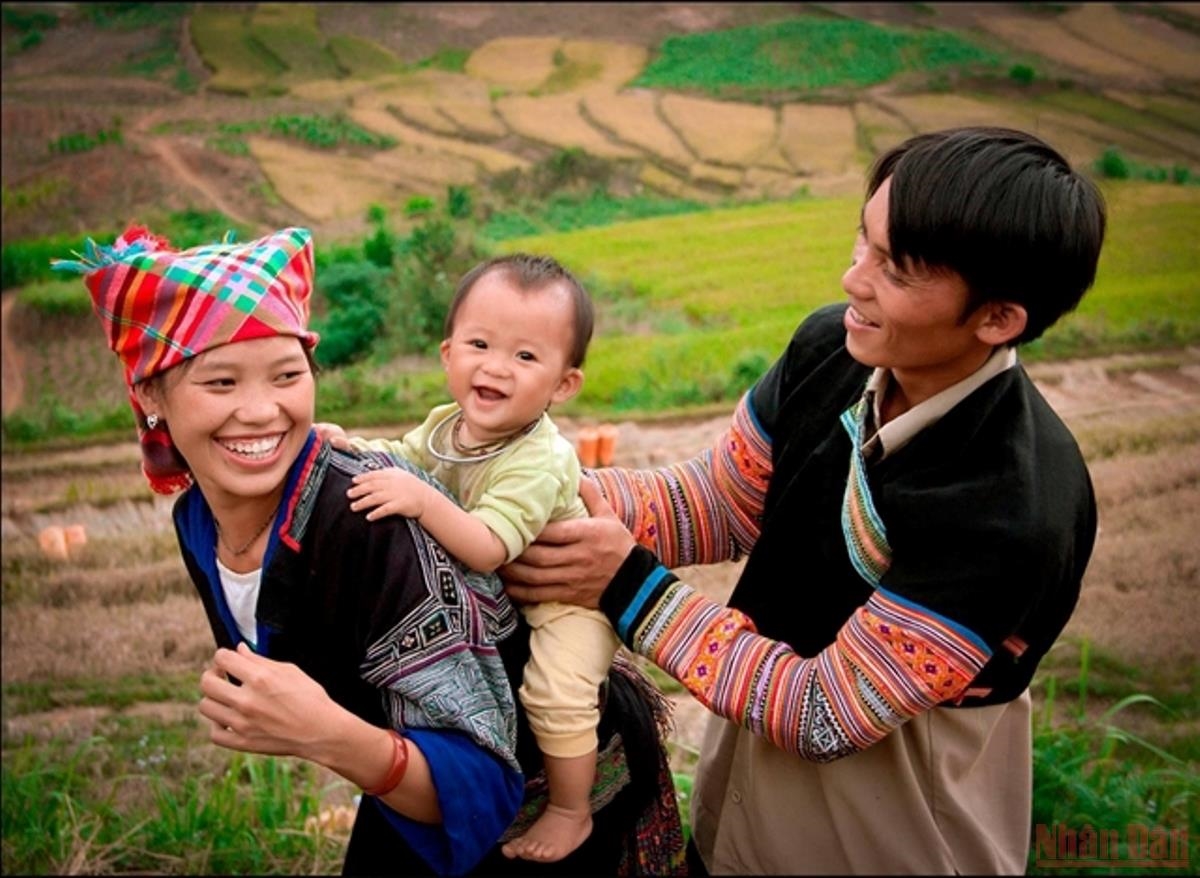 The issue of the population in ethnic minority areas must be addressed within the broader context of national development, with the aim of transforming the advantage of a young population into a high-quality human resource
Another notable aspect is the uneven pattern of change. The 2024 survey reveals that 15 ethnic minority groups have experienced an increase in fertility rates, most significantly among the Pa Then (an increase of 0.66 children per woman), the Co Lao (0.61) and the Giay (0.54). This raises a question: why do these hotspots of rising fertility persist despite an overall downward trend? The answer likely lies in the interplay of factors such as the custom of early marriage, a desire for larger families and limited access to family planning services.
In contrast, the Mang, Xo-dang, and Gia-rai ethnic groups experienced the sharpest declines in fertility rates by 0.93, 0.42, and 0.37 children per woman, respectively. Previously, these groups belonged to a category with very high fertility rates, making them primary targets for intervention programs such as public awareness campaigns, the provision of contraceptives and the deployment of grassroots health workers directly to their villages… As birth control measures begin to take effect, the decline in fertility rates tends to be more rapid and pronounced compared to groups that are already at an average level. Furthermore, in the Central Highlands, home primarily to the Xo-dang and Gia-rai ethnic groups, there have been notable improvements in recent years regarding infrastructure, schools, and communication. As girls and women gain better access to education, marry at a later age and become more aware of the costs associated with raising children, fertility rates generally tend to decline…
Secondly, when examining fertility rates in relation to population size, a paradox emerges: population size is not directly proportional to fertility. Among ethnic minority groups with large populations (exceeding 1 million people), this disparity is quite evident. The Mong, one of the most populous groups, exhibit the highest fertility rate (3.57 children per woman), whereas other groups such as the Tay, Thai, Muong and Khmer have fertility rates hovering around or below the replacement level (e.g., 1.83 for the Khmer and 1.93 for the Thai). Conversely, there are five ethnic minority groups with small populations that maintain very high fertility rates: the Co Lao (4.32 children per woman), Chut (4.22), Mang (4.04), Pa Then (3.63), and La Hu (3.41).
Thus, population size is not the determining factor for fertility rates. Instead, fertility is influenced by socio-economic development, educational attainment, access to healthcare services, and the cultural and marital norms specific to each community. Ethnic groups residing in disadvantaged or isolated areas where access to healthcare is limited, often maintaining high fertility rates, regardless of whether their total population is large or small. This reflects the reality that fertility levels among ethnic minority groups vary more in relation to their level of development than to the size of their population.
Thirdly, a prominent and consistent characteristic among ethnic minority groups is early childbearing. Fertility patterns for ethnic minority women peak in the 20-24 age group, with age-specific fertility rates reaching approximately 152 births per 1,000 women (in 2019) and 148 births per 1,000 women (in 2024). The number of births drops sharply in subsequent age groups. For the 25-29 age group, the fertility rate declines significantly by about 32%, whereas this age range typically represents the peak childbearing years for Vietnamese women as a whole, with a rate of 125 births per 1,000 women. Notably, the fertility rate among ethnic minority women aged 15-19 stands at 83 births per 1,000 women, significantly higher than the national average of 26 births per 1,000 women, reflecting the persistent issue of child and early marriage. Consequently, ethnic minority women tend to begin childbearing much earlier than the general population, with their fertility rates dropping sharply from the age of 25 onwards. This pattern not only leads to a higher number of children but also entails health risks for both mothers and infants, while limiting educational and employment opportunities for young women.
3. Factors influencing the fertility levels of ethnic minority women
Based on survey data and a comparison with real-world conditions, it is evident that the factors influencing the fertility levels of ethnic minority women do not operate independently; rather, they are intertwined and mutually reinforcing, shaped by specific regional and ethnic characteristics.
Firstly, socio-cultural factors serve as the foundation that shapes reproductive behavior. Within many ethnic minority communities, children are still perceived not only as a source of emotional fulfillment but also as a labor resource, a form of old-age security, and a symbol of prosperity. This perspective undermines the motivation to limit family size. Notably, early marriage remains a socially accepted practice in some areas. A younger age at marriage extends the reproductive span, which in turn increases the likelihood of having more children. Furthermore, the pressure to “have children early” and the desire to “have a son” continue to reinforce traditional reproductive patterns, making it difficult for modern population-related messages to gain traction among certain ethnic minority groups.
Secondly, there is the economic factor, driven by a logic of “procreation for survival.” For the vast majority of ethnic minority households, whose livelihoods remain heavily dependent on small-scale agriculture and forestry, family labor serves as the primary resource. Consequently, for many of these families, having many children is a deliberate economic calculation, a way to secure more labor and enhance their resilience against risks. In regions lacking formal social safety nets, children effectively become an “informal insurance” policy for the elderly among ethnic minority populations.
It is important to emphasize that when the costs of raising children are low, due to limited access to high-quality education and healthcare relying on economic arguments to encourage smaller family sizes is unlikely to be effective among ethnic minority communities. This creates a paradox: the greater the poverty, the stronger the pressure to have many children as a means of securing a livelihood, a paradox that evolves into a vicious cycle, persisting across generations.
Thirdly, accessing to services remains a major bottleneck. Although the primary healthcare network has been expanded, access to family planning and reproductive healthcare services in many remote and isolated areas remains limited in terms of geographical distance, quality and cultural appropriateness. Differences in language, customs, and beliefs result in 2.5% of ethnic minority women still choosing to give birth at home without the assistance of a qualified healthcare professional. Among certain ethnic groups namely the Mang, Chut, La Chi, Lo Lo and Mong, there is a relatively high incidence of home births occurring without the assistance of qualified medical professionals, with rates of 23.2%, 19.3%, 14.1%, 12.8%, and 10.8%, respectively. Furthermore, factors such as a reluctance or unwillingness to utilize modern contraceptive methods, combined with the fact that some grassroots healthcare workers lack the necessary skills to operate effectively within a multicultural environment, have diminished the impact of communication efforts and interventions.
Fourthly, the factor of education. Education for women has the most profound and lasting impact on fertility rates. Higher levels of schooling, which grant greater access to information, better employment opportunities, and increased autonomy within the family, fundamentally alter reproductive behavior. However, in many ethnic minority regions, early school dropout, particularly at the secondary level remains common. When a young person’s education is interrupted, early marriage often becomes the default path, leading to early childbearing and larger family sizes. Conversely, areas that have successfully improved school attendance rates for girls typically see a marked decline in fertility.
Overall, cultural, economic, service-related, and educational factors do not operate in isolation; rather, they interact closely, driving variations in fertility rates across different ethnic groups and regions. This implies that policy interventions targeting only a single factor are unlikely to achieve sustainable results. Consequently, addressing fertility rates among ethnic minority populations requires an integrated approach, one in which shifts in reproductive behavior are coupled with improvements in living conditions and the enhancement of community development capacity.
4. Fertility rates among ethnic minority women in the context of national population aging
Vietnam is entering a phase of rapid population aging. The issue of fertility rates is no longer a simple matter of increasing or decreasing; rather, it concerns the equitable distribution of fertility across different regions and ethnic minority groups. In this context, early childbearing among ethnic minority women emerges as a double-edged phenomenon: while it contributes to maintaining population size, it also poses significant challenges for the quality of human resources and sustainable development.
Currently, the practice of giving birth at a young age remains common among many ethnic minority communities, with high fertility rates observed in the 20-24 age group. This contributes to the replenishment of the young population and helps slow the aging process, a trend becoming increasingly evident in urban areas and the lowlands, where fertility rates have remained consistently low. In other words, ethnic minority and mountainous areas, characterized by higher fertility rates and earlier childbearing, are helping to partially offset the fertility deficit seen nationwide. However, viewing early childbearing solely as a demographic resource is a one-sided approach. The core issue lies in the quality of the resulting population. Early childbearing is frequently linked to child marriage, low levels of education, a lack of vocational skills, and limited access to healthcare services. Consequently, a cycle characterized by poverty, high fertility, and low population quality, risks being perpetuated across generations. This not only diminishes the quality of local human resources but also hinders structural economic transformation and impedes efforts to narrow the development gap between ethnic minority regions and the rest of the country.
From a policy perspective, early childbearing among ethnic minority populations cannot be considered a solution to an aging society. Relying on high fertility rates in these regions to offset labor shortages elsewhere without simultaneously improving the quality of the population will lead to long-term negative consequences, exacerbating inequality and placing strain on social security systems. Strategically, the demographic situation in ethnic minority areas must be addressed within the broader context of national development; these regions require investment to transform their “youth dividend” into a high-quality human resource base. Only then can the contribution of ethnic minority areas toward adapting to an aging population become truly sustainable and meaningful in the long term.
5. Some policy implications
Firstly, policies should be categorized based on fertility levels. For ethnic minority groups with high fertility rates, the priority must be to reduce fertility by strengthening family planning services and promoting behavioral change, specifically by curbing and eventually eliminating child marriage, while also delaying the age at which individuals marry and have their first child. This is a foundational approach that directly influences fertility patterns and population quality. For ethnic minority groups that have already reached low fertility levels, the focus should shift toward maintaining an appropriate fertility rate to avoid the risks associated with prolonged low fertility.
Secondly, investing in education, particularly secondary education and vocational training and in the empowerment of women. Practical experience demonstrates that education is the most effective lever for influencing fertility rates. It is essential to reduce early school dropout rates and expand opportunities for vocational training and employment for girls and women from ethnic minority groups. When girls and women have access to education and employment, the tendency toward early marriage and early childbearing naturally declines.
Thirdly, developing and improving access to reproductive health services in a manner that is culturally appropriate for specific ethnic groups, ensuring that ethnic minority women have sufficient information and the necessary conditions to make informed choices about the timing of childbirth.
Fourthly, integrating population policy with economic development. As livelihoods improve, the desire to have many children will naturally adjust. Therefore, population policy must go hand in hand with poverty reduction, job creation and infrastructure development.
Fifthly, strengthening data collection and monitoring. Periodic surveys should be maintained and expanded to closely track fertility trends among different ethnic groups and across various localities.
6. Conclusion
Results from surveys conducted in 2019 and 2024 indicate that fertility rates among ethnic minority groups in Vietnam are generally declining; however, this trend is uneven and varies significantly across different ethnic groups. While some ethnic minority groups have reached or are nearing the replacement-level fertility rate, others continue to maintain high fertility rates, in some cases, even showing an upward trend. The pattern of early childbearing remains prevalent, which extends the reproductive span and increases the average number of children born to ethnic minority women.
As Vietnam enters a period of population aging, the fertility rates among ethnic minority groups present two sides of the same issue. On one hand, higher fertility rates and a younger demographic structure in these areas help replenish the labor force, thereby slowing the pace of national population aging. However, if high fertility rates are coupled with early childbearing, low levels of educational attainment, and limited access to social services, then the advantage of a large population size is unlikely to translate into an advantage in terms of human resource quality. In such a scenario, ethnic minority regions would not only fail to serve as a “pillar” for adapting to an aging population, but would also risk exacerbating development pressures and inequality.
This reality necessitates a shift toward a more flexible and differentiated population policy, one tailored to specific ethnic groups and localities, rather than relying on a uniform, “one-size-fits-all” approach. The focus should move beyond merely controlling fertility rates toward fostering more rational reproductive behaviors: delaying early childbearing and improving the quality of births. This entails expanding access to education, enhancing livelihoods and ensuring that reproductive health services are accessible and culturally appropriate for the specific ethnic groups they serve.
References
1. Statistical Office, Committee for Ethnic Minority and Religious Affairs, Results of the Survey on the Socio-Economic Situation of 53 Ethnic Minority Groups in 2024, Economics and Finance Publishing House, 2025, Hanoi.
2. Committee for Ethnic Minority Affairs and General Statistics Office, Results of the Survey on the socio-economic situation of 53 ethnic minority groups in 2019, Statistical Publishing House, 2020, Hanoi.
