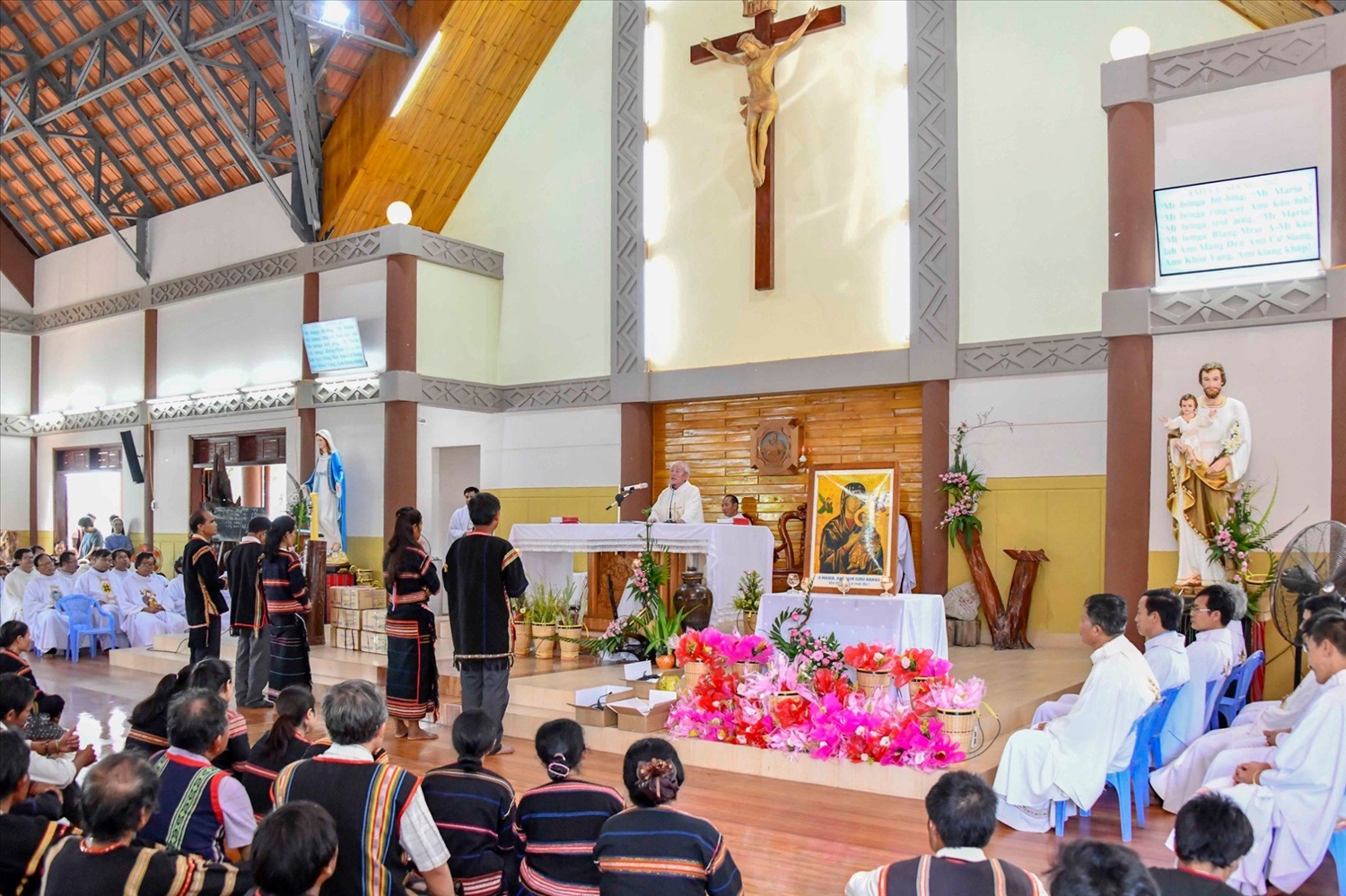
 Ethnic minority communities in the Central Highlands have embraced Catholicism, making it part of their daily spiritual lives
Keywords: Central Highlands; Local beliefs; Engaged religion; Cultural intersection; Cultural acculturation; Ethnic minority.
1. Introduction
Within the mindset of the ethnic minority communities in the Central Highlands, the spiritual realm does not exist in isolation as a peripheral entity; rather, it serves as the lifeblood nourishing their entire system of social institutions and cultural practices. For the Gia Rai, E-de and Ba Na peoples, every mountain, stream or patch of forest is not merely a natural resource, but the dwelling place of the Yang or Giang (the divine). The existence of this animistic system has fostered a sustainable socio-ecological balance over the centuries. Within this realm, people treat nature with reverence and humility, as any action that disturbs the tranquility of the spirits could bring about consequences for the entire community.
However, as modern history unfolded from the mid-19th century onwards, the influx of religions introduced a new power structure to this spiritual landscape, challenging the exclusive dominance of local deities. This incursion transformed the objects of worship and the rhythms of village life. The sounds of gongs, once the sole medium of communication between humans and the divine have now adapted to resonate within a new setting: the church. Meanwhile, the processes of modernization and urbanization, alongside the shift in farming practices from traditional swidden agriculture to a market-oriented economy, have fractured the spiritual ecosystem that was once inextricably linked to the forest landscape. As the ancient forests recede, the deities dwelling within them gradually lose their place in the consciousness of the younger generation. This transformation presents an urgent research issue: the Central Highlands is no longer a static cultural region, but an entity actively adapting through the process of cultural acculturation. Analyzing spiritual space amidst the currents of change not only sheds light on the survival of a faith but also clarifies how ethnic minority groups strive to preserve their ethnic identity. It is a journey toward finding harmony between ancestral heritage and the spiritual needs of modern people in a rapidly changing world.
2. Characteristics of local beliefs and reception
Firstly, the primary factor facilitating its acceptance was the openness and polytheistic nature of the Yang system. In the local worldview, the world is not governed by a single deity but by a hierarchical system of spirits, ranging from the supreme creator god to the spirits of rivers, streams, mountains and forests, as well as ancestral spirits. Precisely because they lack a rigid, exclusive doctrine, the peoples of the Central Highlands tend to readily embrace “new deities” from the outside if they believe these gods possess greater protective power or are better suited to new historical circumstances. When Catholicism or Protestantism introduced the Christian God, the local people did not experience a complete conceptual rupture; instead, they adopted the new deity by placing Him at the pinnacle of their existing spiritual hierarchy.
Secondly, a philosophy of life deeply rooted in the community is a key characteristic that fosters compatibility. Belief systems in the Central Highlands are not individualistic in nature; every ritual from the New Rice Festival to the Grave-Abandoning Ceremony aims to strengthen solidarity and maintain social order. Engaged religions, particularly Protestantism have operated very effectively upon their introduction by leveraging community-based structures. Gatherings, communal prayers and mutual aid activities within the congregation have filled the void left by old customary practices as traditional structures began to loosen under the impact of the market economy. The new religion offers a new form of super-community, helping ethnic minorities find solace and direction in a rapidly changing world.
Thirdly, it is necessary to examine the aspects of symbolism and ritual. Belief systems in the Central Highlands place immense importance on performative and visual practices; the sounds of gongs, the imagery of the rong house (traditional rong communal house) and xoang dances are not merely forms of art but serve as mediums for communicating with the divine. Religions engaging with the community have incorporated gongs into religious services, designed churches modeled after rong houses and translated the Bible into local languages, thereby resonating with the local reverence for symbolic expression. By embracing the new faith through familiar imagery, local people have integrated it into their everyday spiritual lives.
Ultimately, the customary laws and ecological ethics inherent in local beliefs laid the groundwork for religious moral values. The people of the Central Highlands respect customary law, a system of strict behavioral regulations designed to avoid offending the spirits and the community. This seriousness creates a mindset of submission to lofty moral standards, so when approaching the ten commandments or Christian canons, they easily adapt and comply voluntarily. The new religion at this time transformed folk taboos into systematic and cultural religious moral values.
In short, the pluralistic, community-oriented and highly symbolic nature of beliefs in the Central Highlands serves as a robust spiritual foundation; these beliefs actively engage with, selectively adopt and integrate into world-engaging religions to forge a vibrant new form of faith, thereby helping ethnic minority groups maintain a spiritual anchor amidst the changing currents of the times. The reception of religion in the Central Highlands is, therefore, a process of internalizing external values based on an inherent spiritual identity.
3. Mechanism of interplay and harmonization
In the initial stage of contact, conflict was the dominant state. This conflict arose from the fundamental opposition between, on the one hand, a polytheistic and animistic belief system rooted in customary law and sacrificial rituals, and on the other, monotheistic religions (Catholicism and Protestantism) characterized by strict canonical laws and an exclusive claim to truth. In the eyes of the early missionaries, many local practices such as worshiping gods, wearing charms, or buffalo stabbing festivals were considered superstitious or evil gods. On the contrary, local people also saw new religions as a threat that would break the connection between them and the Ancestors and the Yangs (Giang). Abandoning a traditional ritual is not merely a matter of changing one's faith; for the people of the Central Highlands, it signifies the loss of protection from local deities, giving rise to fears of calamity and disease. Such conflicts sometimes lead to deep divisions, creating a rift between those who uphold tradition and those who have adopted a new religion.
However, the mechanism of interaction began to shift significantly as both sides adopted adaptive strategies. For their part, engaged religions gradually realized that they could not completely eradicate local cultural foundations if they wished to take deep, lasting root. Consequently, the strategy of cultural integration emerged, a pivotal mechanism for transforming conflict into harmony. Missionaries began studying languages, customs and ethnic psychology to translate Western theological concepts into local symbolism. God is no longer a strange god from the West, but is expressed as the supreme Yang, the creator of heaven and earth, a concept that already exists faintly in the mythology of ethnic groups such as Gia-rai and Ba Na. Allowing the use of gongs in churches, using wine in community rituals, or building cathedral architecture that simulates a soaring communal house are decisive steps to reduce the distance and novelty of the new religion.
As for the recipients, ethnic minority communities employed mechanisms of selection and syncretism. Possessing an inherently empirical mindset, the people of the Central Highlands adopted new elements based on the tangible benefits these brought to their daily lives. Upon realizing that embracing the new religion granted them access to healthcare, literacy, and a civilized way of life and notably, spared them the exorbitant costs associated with elaborate sacrificial rituals, they began to open their hearts. This harmony manifests in a way where people retain the essence of their spiritual identity while practicing their faith according to new teachings. In the mindset of an E-de or Mnong believer, one might pray to God on Sundays yet still maintain reverence for the spirits of the deceased through the traditional “grave-abandoning” ritual. They view these practices as complementary. The new faith offers hope for future salvation, with the old beliefs sustain a connection to their roots and ancestors.
This harmony is ultimately reflected in the emergence of a localized religious identity. By this stage, the adopted religion has become an integral part of cultural life in the Central Highlands. Religious observances such as Christmas and Easter have evolved into village festivals celebrated with the same enthusiasm as the traditional new rice ceremonies of the past. The sound of gongs within the church represents the heartfelt expression of the people offered up to the Creator. This mechanism of harmony is, in essence, a process of ceaseless cultural negotiation: traditional values are refined to suit the modern era, while modern religion is softened to resonate with the deepest recesses of the ethnic soul. The result of this process of cultural interplay does not erase local identity; on the contrary, it breathes new vitality into Central Highlands culture amidst integration, enabling ethnic minority communities to establish a steadfast spiritual footing in the face of the upheavals of modern society. This process of inculturation has resulted in churches designed to resemble rong houses such as the Kon Tum Wooden Church and the incorporation of gongs and T’rung instruments into the liturgy. The Bible has been translated into ethnic minority languages, utilizing local terminology to express complex theological concepts; rituals for well-being and new rice celebrations have been integrated into the Church’s liturgical calendar.
4. Effects of interference
The interplay between local beliefs and introduced religions in the Central Highlands has comprehensively restructured the socio-cultural lives of the region’s ethnic groups. This process has fostered the creation of new civilizational values but simultaneously posing challenges to traditional heritage.
About social structure, the most significant impact has been the shift in the systems of power and community leadership. In traditional society, the village elder was the central figure in all decision-making, spanning economic matters, customary laws and spiritual affairs. However, the arrival of Catholicism and Protestantism introduced priests, pastors and evangelists. Religious dignitaries not only possess spiritual powers but also modern knowledge and the ability to connect with the world outside the village. In many places, the customary governance of village elders gradually gives way or goes hand in hand with the moral and lifestyle guidance of religious dignitaries. This enables the community to adapt more quickly to social changes, yet it simultaneously weakens the bonds of kinship and customary law that once formed the backbone of traditional Central Highlands villages.
About lifestyle and the economy, engaged religions have brought about a revolution in the way life is lived. These religions often go hand in hand with the rejection of backward and costly outdated customs. In the past, large-scale buffalo sacrifices during ceremonies such as the buffalo-stabbing ritual or the grave-abandonment rite often plunged many families into debt and financial ruin. Religious intermingling has helped to moderate these rituals or replace them with simpler, more economical forms. Furthermore, values regarding hygiene, health and a thirst for learning were vigorously promoted through religious boarding schools and the research of the Bible. This creates a new generation of dynamic ethnic minorities who know how to calculate commodity economics, helping them escape the cycle of poverty and complacency of economic self-sufficiency.
However, the impact on intangible culture is far more nuanced. On one hand, this cultural interplay gives rise to unique hybrid art forms such as the sound of gongs resonating within a sanctuary, hymns set to the melodies of local folk songs or churches featuring soaring rong house-style roofs. This represents a revival of cultural symbols within a new space of expression. On the other hand, the risk of cultural rupture is very real. Many forms of folk performance linked to polytheistic beliefs such as epic storytelling (Khan, Hri), fertility dances and folk festivals that once nurtured ethnic identity are at risk of being overlooked. When a segment of the faithful came to view traditional symbols as pagan, they inadvertently severed their connection to the past. The disappearance of waterfront landings, spirit forests and elaborately carved buffalo-sacrificial posts represents not merely the loss of physical objects, but the vanishing of a system of collective memory.
Furthermore, this interplay profoundly influenced the ethnic psyche, shifting the mindset from one of fear regarding supernatural forces (Yang/Giang) to one of greater confidence in salvation and compassion. This form of engaged religion offered the people of the Central Highlands a broader worldview, enabling them to feel part of the wider human community rather than isolated within the deep forest. However, this newfound confidence sometimes leads to internal conflict among population groups within the same village due to differences in faith. Such rifts can easily erode the intrinsic strength of national unity.
In summary, the impact of religious interplay in the Central Highlands is a process that sheds elements no longer compatible with modernization, at the same time simultaneously regenerating new, more modern cultural forms that still bear the profound imprint of the great highlands’ spirit. This interplay remains a ceaseless flow, shaping the face of a Central Highlands that is modern in mindset yet deeply rooted in a legendary identity.
5. Conclusion
Viewing holistically, the interplay between local beliefs and introduced religions in the Central Highlands represents an inevitable historical transformation for ethnic minority groups as they integrate into the mainstream of modern civilization. Animist beliefs were not eradicated but rather transformed, permeating organized religions. The people of the Central Highlands have infused Catholicism and Protestantism with the spirit of the great forests, the resonance of gongs and the warmth of jar wine. This stands as a testament to the vibrant vitality and enduring adaptability of ethnic cultures. In this new era, the Central Highlands faces a significant opportunity to become a model of harmonious coexistence between traditional and modern values. The Central Highlands exudes confidence in its harmonious identity, a place where the tolling of church bells and the resonance of gongs blend together beneath the soaring roofs of rong houses amidst the vast, green wilderness.
References
1. Dang Nghiem Van (2003), Theories on religion and the religious situation in Vietnam, National Political Publishing House, Hanoi.
2. Nguyen Duy Hinh (2005), The beliefs of the Tutelary God in Vietnam, Social Sciences Publishing House (Section analyzing the syncretism of beliefs).
3. Dournes, Jacques (2006), Pơtao, A Theory of power among the Gia-rai of Indochina, Tri Thuc Publishing House (Translated by Nguyen Ngoc).
4. Ngo Van Le (2012), Culture of Vietnam’s ethnic minorities, Education Publishing House, Ho Chi Minh City.
5. Catholic Bishops’ Conference of Vietnam (2010), Documents of the Congress of the People of God in Vietnam: Orientations for Inculturation.
