Keywords: Songkran; Theravada Buddhism; Intangible cultural heritage; Thailand; Purification ritual; Cultural transformation.
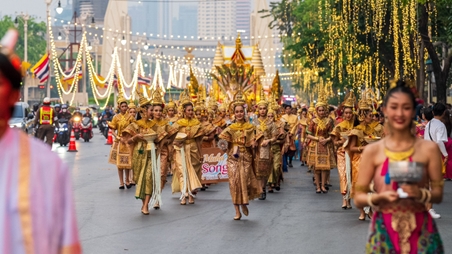 The Maha Songkran Water Festival is one of the most important events of the year for the people of Thailand
1. Songkran plays an essential role in an agricultural society like Thailand, where favorable weather is crucial to people’s lives. Songkran is an occasion for people to express their wishes and pray for a prosperous new year.
Originally, Songkran was a milestone in the biological cycle of rice-farming civilizations. In Thailand, April is the harshest time of year, the peak of the dry season, when the scorching heat cracks the fields; Songkran emerges as a prayer in action. During this period, water held a purely survival significance. The initial water-splashing ritual consisted of small, clean drops of water sprinkled on the shoulders or arms as a blessing, at the same time as a symbol of hope for an upcoming rain to begin a new planting season. This is the time when farmers express their reverence for Mother Water and Mother Earth. During this period, Songkran is a way for people to reconcile with nature, apologize for encroaching on the land and pray for the nature's forgiveness for a year of favorable weather.
The origins of Songkran and the birth of the Songkran virgins are described in a Buddhist sermon called “The Maha Songkran Sermon”, which is known to Mon, Thai, Lao and Myanmar monks, among others. The legend of Songkran and its associated rituals arrived in Thailand through the influence of the Burmese during the reign of King Anurudha (11th century). From that point onwards, the New Year festival began to be celebrated in the Lanna Kingdom (Northern Thailand) and gradually spread to other regions of Thailand. Thus, Songkran has been adopted by the Thai people in Thailand, at least since the beginning of the 11th century. Researchers suggest that the most appropriate meaning of the word Songkran is “progress”, while its Sanskrit root means “to create”. Furthermore, Sangkrati in Sanskrit or Sankhara in Pali means the movement of the sun from one side of the ecliptic, so the Songkran festival is calculated based on the movement of the sun and the Thai New Year celebrations usually fall in April.
According to recognized and documented traditions in Chiang Mai province, home to the former capital of the Lanna Kingdom, the New Year festival officially lasts for six consecutive days: The first day is called Wan Sangkhan Luang, the day Sangkhan (Songkran in Northern Thailand) visits; Wan Nao Day is the second day of the year, a day to bid farewell to all the impurities of the old year and to prepare for the new day - the first day of the new year; Wan Phya Wan, the third day of the year is the day when people show respect and offer gifts to their parents, grandparents, elders and the deceased; Wednesday is Wan Pak Pi, the first day of the year; Thursday is Wan Pak Duan, the first day of the month; Friday is Wan Pak Wan, the day of the week. The first four days of the new year are dedicated to people paying their respects to their revered ancestors, the Earth goddess, the Rice goddess and all the spirits of the household. Currently, in Thailand, Songkran is celebrated on April 13th, and the main events of the festival take place over three days: Wan Sangkhan Luang (April 13th), the day of farewell to the old year, people clean their houses, pagodas and purify their living spaces; Wan Nao (April 14th), the transitional day is traditionally a day when one should refrain from speaking harsh or angry words, and people prepare food and offerings for the following day; Wan Phya Wan (April 15th), the first day of the new year, is when religious rituals reach their peak with offerings and the building of sand stupas at pagodas. From an astronomical perspective, according to calculations by Thai state agencies, the first day of Songkran (April 13th), also known as Wan Maha Songkran is the day the sun approaches a new year; The second day (Wan Nao Day) is the day the sun touched the new year; Tuesday (Wan Thalerng Sok), the day the sun entered the new year. Thus, from six days in the past, nowadays, Thai people only celebrate Songkran for three days
2. Songkran reflects the harmonious and natural blend of folk beliefs such as the worship of spirits (ghosts), ancestor worship, agricultural beliefs… with Buddhism.
Up to now, Thai people still recount a similar legend about the origin of their New Year. Legend has it that, long ago, there was a clever and studious young man named Dhammaban (known as Tham Maban in Laos), who even knew the language of birds. The young man’s reputation for talent reached the ears of Maha Songkran (Brahma, the king of the gods in the heavens). The god came to the young man and posed a riddle to test his intelligence and also to make a bet: If he did not answer correctly within seven days, he would lose his head. Conversely, if the answer is correct, the god will also lose his head. The riddle is: “Where does a person’s pride lie in the morning, afternoon and evening?” Nearly seven days had passed and the young man still hadn’t found the answer. Saddened, he wandered aimlessly and eventually entered the forest. When he was tired and dozing under a large tree, the young man overheard the pair of eagles talking to each other about their bet. During that conversation, the wife told her husband the answer. On the appointed day, the young man answered the riddle of the king of the gods as follows: “In the morning, a person’s pride lies in their face”. “Therefore, they wash their faces every morning; in the afternoon they lie down on their bodies, so people usually bathe in the afternoon; “And at night, they lie on their feet, so every night, before going to bed, everyone washes their feet”. Having lost, the god Maha Songkran had to be beheaded. However, the god's head is sacred and possesses tremendous power; if it touches the ground, the ground will be scorched, if it falls into the sea, the sea will dry up... In order to prevent disasters from befalling the world, the god summoned his seven daughters and instructed them: “You must keep your father’s head in a cave on Mount Krailas, the Kailas mountain of the New year of Songkran, one of you will bring your father’s head out so that the gods can carry it around the mountain to bring good fortune to mankind”.
Legend describes the head of the god Maha Songkran as resembling the sun; And the procession carrying the head of the deity represents the image of the Sun appearing in certain parts of the world. The time when the sun is at its most magnificent is in the spring in northern India, the birthplace of the Songkran tradition. Meanwhile, in Southeast Asia, April marks the peak of the dry season, when the sun shines most directly, making it the hottest and brightest. At this time of year, fields and small streams usually dry up, farmers are idle with no farm work to do. This transitional period between seasons is ideal for Southeast Asians to hold major festivals, with Songkran being the largest and most important of them all.
Legend reveals that the soul of Songkran lies in the seamless blend of Theravada Buddhist philosophy and folk legends. In the legend of Thao Kabila Phrom, the story of the god who lost a battle of wits with a clever young man and had to decapitate himself is at the core of the “Songkran Goddess” symbolism. The god’s seven daughters take turns carrying their father’s head in their procession each year. This is how the Thais personify time, transforming natural phenomena into entities with souls to be revered and feared. The Buddhist philosophy of impermanence and rebirth is reflected in rituals such as bathing the Buddha statue. In the Thai psyche, water is a symbol of purity. Pouring water over Buddha statues is a form of mindfulness practice, a reminder to cleanse the inner self, to let go of greed, anger and delusion to begin a new cycle with a pure mind. It’s no coincidence that the Thais call the New Year festival the water festival. During the Lunar New Year holidays, people also go to riverbanks or pagodas to build sand pagodas as a way to do good deeds and accumulate merit. Each sand tower is decorated with colorful flags, flowers and incense sticks. From the perspective of indigenous mythology, sand towers also serve as temporary dwelling places for ancestral spirits and protective deities. The act of decorating sand towers with vibrant colors is a way for people to connect with the afterlife and pray for protection for their villages. According to local beliefs, building sand towers during the Lunar New Year brings as much merit as building actual temples and pagodas on ordinary days; therefore, building sand towers has become a lively and joyful activity, like a grand festival. Throughout the centuries, the Thai people’s New Year has retained its core values. In addition, the Songkran festival is also notable for the ritual of building sand towers, which carries a profound humanistic philosophy about karma and retribution. Thai people believe that every time they leave a pagoda, they inadvertently carry grains of sand from the soles of their shoes. Bringing sand back to the temple and building it into a stupa is a way to repay debts and replenish the sacred site, symbolizing the accumulation of merit and the rebuilding of the community. This is a lesson about gratitude and responsibility towards the community, taught gently through the form of a festival.
3. Songkran reflects the moral values of the close ties between family and society, between the individual and their family and society.
Because it was the Lunar New Year, in the days leading up to it, every household and every person had to clean their house and village, burning all the discarded items. Everyone believes that all the filth of the old year will bring bad luck to people in the new year. When the morning of the first day of the new year arrives, people go to the temple to offer food to the monks, performing the ritual of bathing the Buddha statue and bathing the head monk of the pagoda. The Songkran festival is a time to encourage each individual to live and act in accordance with their position within the family and in society, this is the best way to preserve Songkran as a cultural heritage of the Thai people.
For families, Tet (New Year) is a time for reunion and strengthening bonds among all family members. During Tet, young people have the opportunity to express their respect for their elders; And the elders bestow blessings and good wishes upon their descendants… For the community, New Year is an opportunity and a condition to strengthen the spirit of cohesion and cooperation among community members. For society, Tet is an occasion for people to remember the importance of the living environment and to make it cleaner and more beautiful through cleaning their homes, pagodas, public places and releasing captive animals. For religion, Tet (New Year) is an occasion for believers to accumulate merit and strengthen their faith by offering gifts to pagodas, listening to sermons, washing Buddha statues,… During the Songkran festival, the following activities usually take place in Thailand: Cleaning houses and public places; Performing meritorious deeds and giving alms; Releasing birds and fish; Performing the ritual of bathing Buddha statues; Show respect to elders by pouring water on their hands and asking for their blessing; Splashing water on each other; Cultural and artistic activities such as singing, dancing and games are held in communities. Recently, the Songkran festival has seen the emergence of another activity: the Nang Songkran beauty contest. Interestingly, this new activity not only meets the needs of modern society, especially the younger generation, but also aligns with one of the key imagery of Songkran: the Songkran maidens (daughters of the god Songkran). Besides this new activity, some Songkran traditions, especially the water-throwing festival have also been modified to suit modern life. Nowadays, in cities, people use water trucks, pumps and water guns to splash each other, mix perfume into the water, sing modern songs and dance European dances…
4. Conclusion
The ritual structure of Songkran is a journey from individual consciousness to communal identity. The shift in cultural space from the family home to temples and streets has allowed Thai people’s moral and religious values to spread more widely. It is this harmonious transition between the “sacred” and “secular” spaces that prevents Songkran from being confined within the walls of old pagodas, instead allowing it to pulsate with vitality throughout Thailand. This is the fundamental reason why Songkran is a living heritage, an inseparable part of Thai people’s identity and a cultural treasure of humanity.
References
1. Ngo Van Doanh (2009), Southeast Asian Culture, National Political Publishing House.
2. Mai Ngoc Chu (Editor, 2012), Thai Culture, National University of Hanoi Publishing House.
3. Phan Ngoc (2004), Understanding Southeast Asian Culture, Education Publishing House.
4. Tran Thi Thu Luong (2015), Traditional Festivals in Tourism Development in Thailand and Lessons Learned for Vietnam, Ho Chi Minh City Journal of Social Sciences, 2015.
5. Nguyen Huy Hoang (2018), The Soft Power of Thai Culture Through Traditional Festivals, Journal of Southeast Asian Research.
6. Pham Duc Thanh (2010), Religion and Culture in Thailand: The Fusion of Buddhism and Indigenous Beliefs, Journal of Religious Research.
7. Institute of Southeast Asian Research, Vietnam Academy of Social Sciences (2023), Specialized Information: Contemporary Thailand Culture and Society.
8. Embassy of Thailand in Hanoi (2024), Cultural Documentation: Songkran - Intangible cultural Heritage of humanity.
