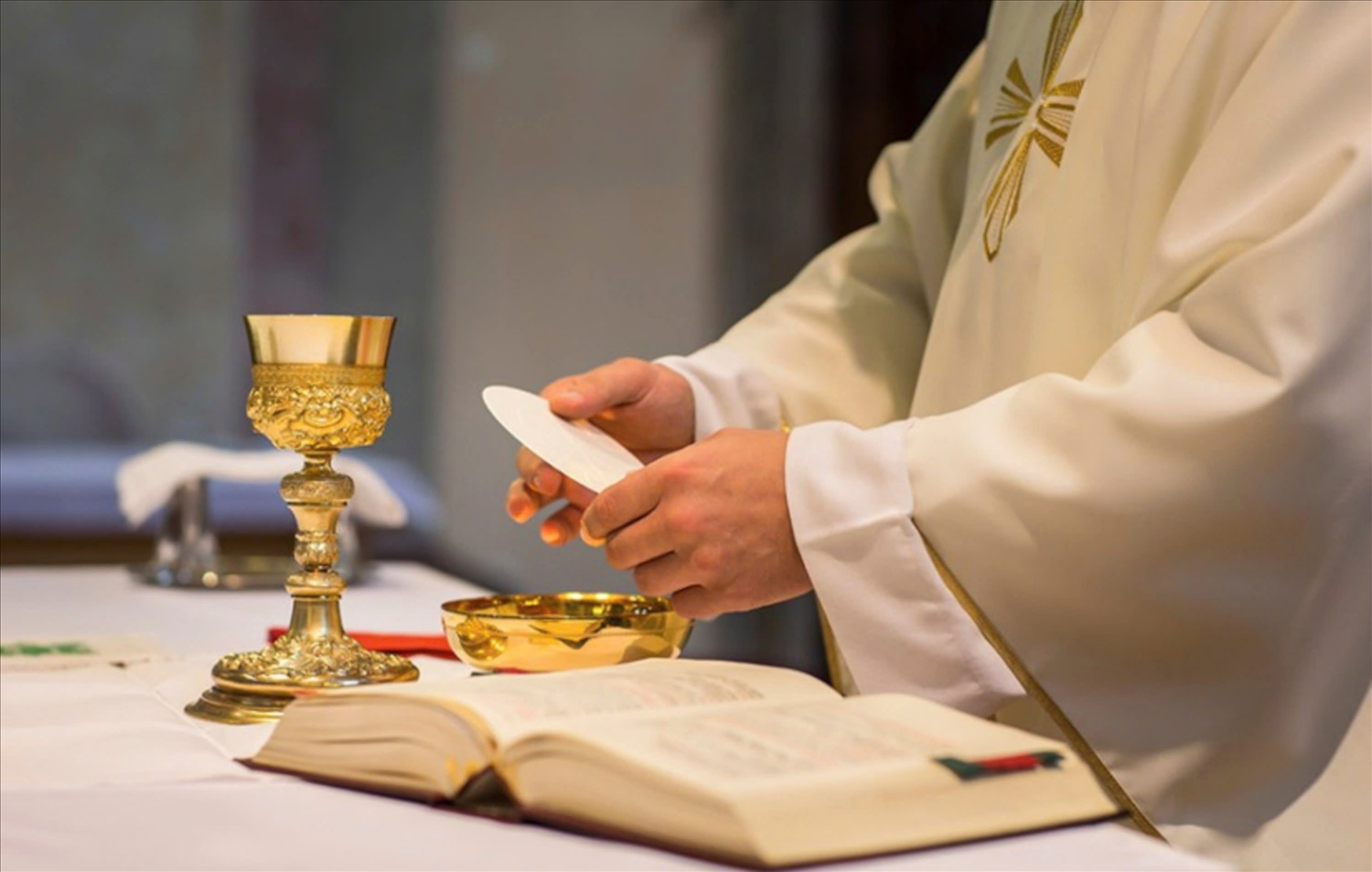
 The real presence of Jesus in the sacrament under the forms of bread and wine
In the early days of Christianity, the bread and wine of the Eucharist were revered in a special way. Around the 1st-3rd centuries, many symbols of the Eucharist were found in frescoes excavated in the caves beneath the city of Rome. The most distinctive symbol is the basket of bread and fish. This image recalls the miracle of Jesus multiplying the loaves and fish to feed the people. Or in the cave of the pagan church of Pope Callistus, there still remains the image of a large fish next to a basket. On the basket were several round loaves of bread. In front of the basket was a cup of red wine. Or, as in the Grotto of Saint Priscilla, archaeologists discovered carved loaves of bread with the image of a cross on them. Looking at these sculpted loaves of bread, one is immediately reminded of the sign of salvation, as the Lord himself promised long ago, “Whoever eats this bread will have eternal life”. Even today, devotion to the Eucharist is still depicted in paintings such as The Last Supper.
In the early centuries, the sole purpose of preserving the Blessed Sacrament after Mass was for those who could not attend, such as: The sick, the dying, often called Viaticum - the food on the road, and those imprisoned for their faith. During the persecution, believers were even allowed to keep the Blessed Sacrament at home so they could receive communion daily. At this time, worship is personal in nature and directly linked to acts of communion.
With the understanding that this is the Body of Christ, the Church shows reverence and adoration. Initially, the bishops decreed that the Blessed Sacrament should be kept in the family home in a suitable place. Gradually, the parishioners placed their faith in the presence of Jesus in the Eucharist, and thus they adopted respectful attitudes and gestures such as: Praying before the Blessed Sacrament, prostrating oneself, kneeling before the Blessed Sacrament, singing psalms before the Blessed Sacrament,...
In the 9th century, parishioners often venerated the Eucharist by bowing deeply when passing by the altar. Because the altar is where the Holy Mass is celebrated, it is where Christ invites everyone to participate and receive His Body and Blood. At the end of the 11th century, the monks of Cluny had the initiative to regularly light the sanctuary lamp placed near the Blessed Sacrament. Afterward, the Eucharist was placed in the tabernacle.
In the 11th and 12th centuries, the Church strongly affirmed its belief in the real presence of the Eucharist, from which the need to contemplate Christ began to arise. In 1264, Pope Urban IV established the feast of Corpus Christi (the Feast of the Body and Blood of Christ) for the entire Church, which was spurred on by the vision of Saint Juliana of Liège and the miracle of the bleeding at Bolsena. From here, the Eucharist emerged from the small tabernacle. Grand processions appeared, where the Body of Christ was placed in exquisite moon-shaped palanquins, carried through alleyways to sanctify people’s living spaces. Contemplating the Blessed Sacrament became a form of spiritual communion for the faithful.
By the 16th and 17th centuries, the Catholic Church strongly promoted this adoration, most notably shaping the spiritual landscape of this period through the 40-hour adoration and perpetual Eucharistic adoration. The 40-hour adoration, symbolizing the time Jesus spent in the tomb, is a continuous period of prayer, creating a radiant sacred space with candles and flowers, attracting thousands of believers to pay their respects. The practice of perpetual Eucharistic adoration, organized by religious orders and parishes, involved taking turns adoring the Lord 24/7, transforming the chapel into the sleepless heart of the community, where everyone could come to confide in the Almighty at any time.
The development of Eucharistic adoration also completely changed church architecture. These temporary shelters, which were previously placed in a secluded corner or in the sanctuary, are now moved to the center of the main altar, often crafted from gold, silver and precious stones. In particular, the introduction of the Crescent Moon containing the Blessed Sacrament placed in the center of the radiant sun, is not only a liturgical object but also a theological symbol: Christ is the Sun of righteousness, the light that dispels the darkness of the world; every detail of the carving tells a story of salvation.
In the 20th and 21st centuries, especially after the Second Vatican Council, Eucharistic adoration was re-evaluated and placed in balance with the Mass. The Church emphasizes that Eucharistic adoration does not replace Mass, but rather preparing the heart to participate in Mass more devoutly.
