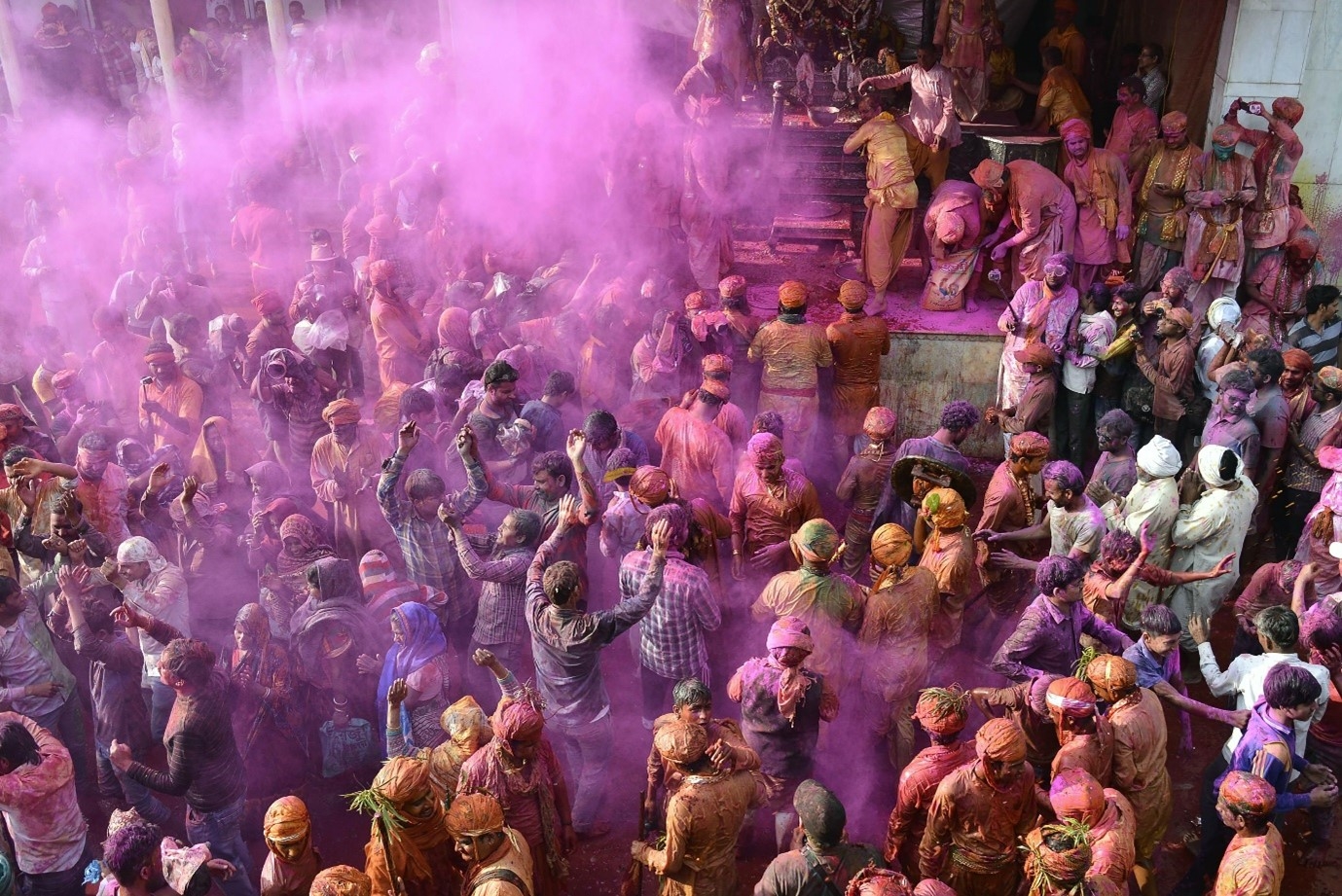
 The Holi festival reminds us that all people are equal beings in the light of the gods
The triumph of good
In order to understand the essence of Holi, one must journey back in time to Hindu mythology. Firstly, this festival is an epic tale of the victory of good over evil. The most famous story associated with Holi is about the evil god Hiranyakashipu and his dutiful son Prahlada. Hiranyakashipu, with his arrogant power, forced everyone to worship him instead of the god Vishnu. However, Prahlada remained steadfastly devoted to Vishnu. Enraged, the evil god sent his sister Holika, who was immune to fire, in order to trick Prahlada into sitting in a burning fire. Thanks to her pure faith, Prahlada emerged from the flames unharmed, while the demon Holika was consumed by the flames. Therefore, on the night before the main holiday, people in India often hold the ritual of Holika Dahan. Large bonfires are lit to symbolize the burning away of evil, purifying the soul before entering the colorful festival.
Dance of colors and love
If the Holika Dahan night was solemn and contemplative, the following day, the main day of the festival was an explosion of emotion. The meaning of throwing colors is not simply a game. In mythology, this is also a commemoration of the eternal love between the god Krishna and the goddess Radha. Legend has it that Krishna had dark blue skin and worried that Radha wouldn’t like him because of this difference. His mother suggested applying color to Radha’s face to erase the difference. From then on, the act of throwing colors became a symbol of unity, love and the bridging of all gaps in appearance or background. During the Holi festival, each type of colored powder is not chosen randomly but carries profound spiritual messages and philosophies of life. Red symbolizes love, prosperity and fertility. Green represents new beginnings, spring and the abundance of nature. Yellow is the color of happiness, knowledge and sacredness. Blue is the color of the gods, symbolizing calmness and spiritual strength.
Throwing colored powder at each other is like a ritual of distributing blessings, wishing each other a new year full of energy and good fortune.
Holi - a pillar of social harmony
What makes Holi truly unique is its classless nature. In India, a country with a complex social stratification system, Holi is a rare moment of tranquility where barriers are broken down. On this day, the concepts of rich and poor, class distinctions, no longer exist. A director might get covered in colored powder by a janitor, and it all ends with a smile, a hug and the words: Bura na mano, Holi hai! (Don’t be angry, it's Holi!). This is the festival's highest humanistic value, reminding us that we are all equal beings under the light of the gods.
Interesting variations across India
Each region in India has its own unique way of celebrating Holi. In Mathura and Vrindavan, the home of the god Krishna, the festival is most fervent and lasts for a whole week. At the Lathmar Holi festival (in Barsana), there is a unique tradition where women are allowed to playfully hit men who tease them with sticks. Gentlemen are only permitted to use shields for protection. In Shigmo (in Goa), there is a subtle blend of Hindu culture and coastal folk dances.
Enjoying the flavor of Holi
The Holi festival wouldn't be complete without its food. People often enjoy Gujiya, a crescent-shaped sweet filled with nuts and yogurt. In particular, Thandai, a refreshing drink made from milk, almonds, melon seeds, and spices, sometimes mixed with Bhang, an extract from wild celery leaves helps participants enter a state of gentle euphoria to fully enjoy the fun. Holi is not just a colorful painting, but a profound spiritual experience of compassion. As the powder faded from their clothes, what remained in each person’s heart was the warmth of kinship and the cleansing of old grudges. Attending the Holi festival gives you the feeling of directly touching the life, beliefs and unconditional love of humanity.
