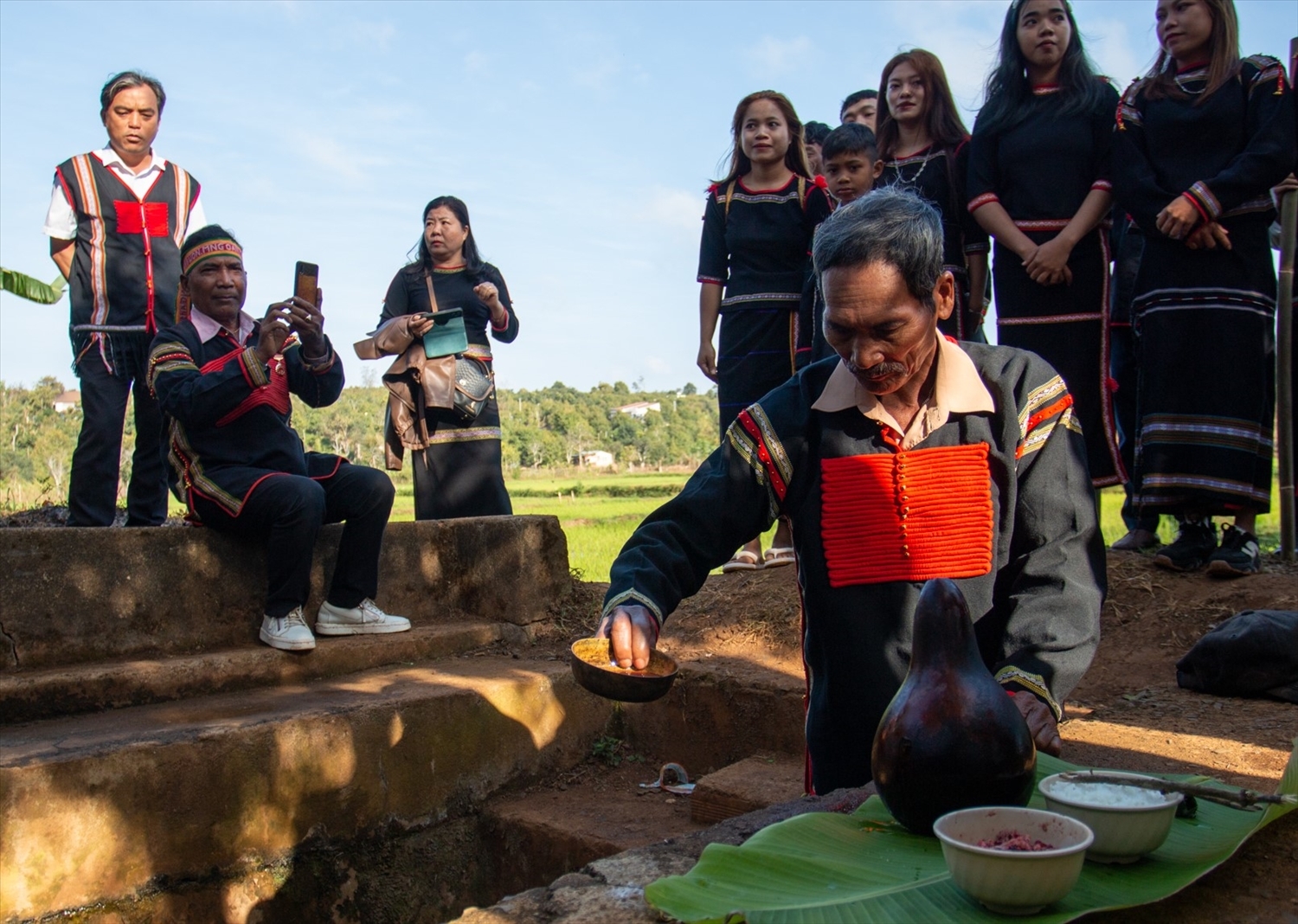
 A ritual in the water-worshiping ceremony of the E-de people
For the E-de people, festivals are closely linked to the production cycle and spiritual life. These could include water-blessing ceremonies, harvest festivals, funeral rites or rituals to thank Giang (Heaven) for protecting the village. Each festival tells a story of gratitude: gratitude to the heavens and earth for providing favorable weather, gratitude to our ancestors for pioneering the land, and gratitude to the community for working together to overcome difficulties. Amidst the deep, resonant gongs and the graceful xoang dance, the Ede people remind each other of the harmonious relationship between humans and nature and between humans themselves.
The most profound value of the festival season lies in the spirit of community. The Ede villages traditionally follow a matriarchal system, with people living together in longhouses. When the festival takes place, every family participates in the preparations: Some contribute jars of rice wine, others contribute pigs and chickens; Young people erect the ceremonial pole, women prepare bamboo-cooked rice and grilled meat. This act of sharing not only creates a lively atmosphere but also strengthens solidarity, an important prerequisite for the sustainable development of the village.
The festival season is also an opportunity to pass on culture. Ancient gong melodies are tuned rhythmically by artisans. Young people learn how to play the gongs, perform the xoang dance and recite epics. The younger generation learns how to play the gongs, performing the xoang dance, reciting epics. In the firelight of the festival night, the elders tell stories about the origins of their village and the difficult times they went through. Thanks to this, the Ede ethnic identity is not lost, but is passed down through generations. Culture becomes a spiritual anchor, helping the people to be more proud and confident in themselves.
Beyond its spiritual significance, the festival season also opens up opportunities for economic development. In recent years, many villages in Dak Lak and Gia Lai provinces have combined traditional festivals with community tourism. Tourists come to experience the atmosphere of the longhouse, enjoy coffee, listen to gong music, and participate in traditional festival rituals. Textile products, agricultural products, local specialties are sold in greater quantities. As a result, many families have increased their income, their material living standards have gradually improved.
Amidst the festive atmosphere, many village elders shared that the villages have changed significantly. Concrete roads extend to every hamlet, the electricity grid is stable, schools are more modern than before. Programs supporting socio-economic development in ethnic minority areas have helped people access production capital and switch to more efficient crops and livestock. In particular, faith in the leadership of the Party, the State, the National Assembly, and the Government is embedded in every prayer, hoping for peace in the village, academic success for their children and an increasingly prosperous life.
Between the resounding gongs, the Ede people not only pray for a bountiful harvest but also express their aspirations for a sustainable future. When forests are protected, water resources are preserved and culture is cherished, villages will have a solid foundation for development. The festival is therefore not only a reenactment of tradition, but also a commitment to the vast forest: in order to live in harmony, preserving identity and working together to build a prosperous and beautiful homeland.
The festival season instills new hope in the E-de villages: hope in the strength of the community, in cultural values, and in the support of the Party and the State on the path to development. Within the extended circle of drums, amidst the resounding gongs echoing through the mountains and forests, the aspiration for prosperity is spreading, like a strong source nourishing the vast Central Highlands region today and in the future.
