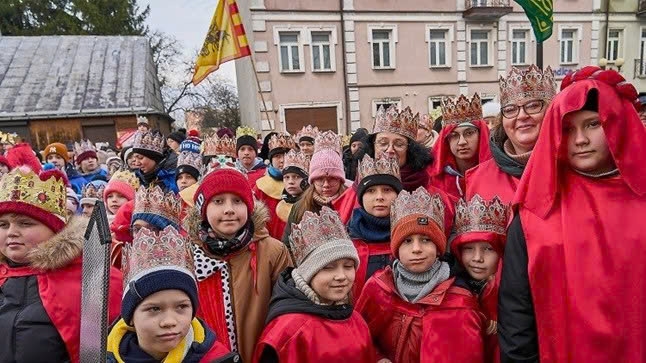
 Polish participates in the procession of the Three Kings
Keywords: Overview of religion; Religious policy; Republic of Poland.
1. Poland and religion in Poland
Poland is the name derived from the Sino-Vietnamese pronunciation of Poland. The land that is now Poland has had communities of people, including Germanic people, since very early times, but it was not until the early Middle Ages, with the arrival of the Slavic peoples that states emerged. Around the 11th century, the small kingdoms of Poland united to form the first state, with Boleslav as its first king. Later, two renowned kings, Boleslav I (early 11th century) and Casimir III (mid-14th century) made significant contributions to expanding the territory and developing Poland, especially in trade. At the end of the 14th century (1386), Poland and Lithuania merged into one country after the marriage between a Polish princess and a Lithuanian Grand Duke, but this only lasted for a short time.
In the 17th century, Poland was drawn into wars with the Russians, Turks, Tatars, Cossacks, Swedes and ultimately Poland disappeared from the map of Europe by the end of the 18th century. In the 19th century, the people of Poland and Lithuania repeatedly rose up in rebellion against Russia, Austria, and Prussia but all failed. It was not until after World War I (1914-1918) that Poland regained its sovereignty. During World War II (1939-1945), Poland’s borders gradually shifted from East to West as the country was once again divided, with a part belonging to Germany and a part to Russia.
In 1945, Poland was liberated by the Soviet Union and became a socialist country (1947) under the name of the People’s Republic of Poland. After World War II, Poland lost territory in the east bordering the Soviet Union but gained territory in the north and west bordering Germany. In the early 1980s, the Solidarity trade union in Poland grew rapidly and exerted a significant influence on society. In 1989, the Solidarity trade union came to power, replacing the Communist Party, leading Poland to a new pluralistic political system and establishing a mixed republic with a bicameral legislature (Lower House and Upper House), also known as the Third Republic. The current constitution was adopted in 1997.
Christianity was introduced to Western Europe earlier than to Eastern Europe. Most Eastern European countries adopted Christianity around the end of the 9th century, with the Polish people converting to Christianity in 966 (the Russians in 988) thanks to the role of their first king, Boleslav. It was King Boleslav who converted to Christianity, initiating the development of Christianity in Poland. Interestingly, after 1054, Christianity split into two branches: Catholicism and Orthodoxy. The vast majority of Eastern European countries, such as Russia, Ukraine and Belarus,… converted to Orthodox Christianity, while Western European countries remained Catholic. Poland remained Catholic. Later, in the 16th century, after the Protestant Reformation, many Western European countries, including Germany, while the majority of the population converted to Protestantism, but Poland remains predominantly Catholic. Catholicism has been intertwined with Polish history from the formation of the state to the present day, spanning various historical periods. Historically, Catholicism in Poland has served as a rallying banner for national forces and a driving force behind uprisings against external aggression. Catholicism also plays a very important role in shaping the culture, lifestyle and morality of this nation.
Besides Catholicism, there are other religious communities in Poland, such as: Orthodox Christianity is associated with Ukrainians, Belarusians,… Protestantism with Germans, Swedes,… and Buddhism with the Vietnamese community.
2. Religious policy in Poland
In terms of the timeframe for laws related to religion, Poland is one of the countries that has addressed religion since the late 18th century. The Polish Constitution of 1791 - the constitution of a constitutional monarchy, influenced by the British and French constitutions. The Polish Constitution of 1791 states: “The official state religion has been and will be the Holy Roman Catholicism with all its privileges and immunities; But this sacred religion also requires us to love our neighbors, therefore we are grateful to everyone regardless of belief, for peace in matters of belief and for the protection of the Government; Consequently, we need to protect all beliefs and religious freedoms and liberties, in accordance with national laws and in all territories”. Thus, from a very early stage, Poland had a constitutional principle of religious freedom.
Prior to 1989, Poland like many other socialist countries in Eastern Europe was directly influenced by the Soviet Union to varying degrees in various fields, including religious matters. However, for various reasons, including the fact that Catholics constitute the vast majority of the population, the 264th Pope, who reigned from 1978 to 2005, John Paul II was born, raised and grew up in Poland.
When the new Republic was established in 1989, during the drafting of the 1997 Constitution, the issue of religion was discussed, creating social debate with two different trends: One trend is left-wing and liberalism that supports a model of religious treatment similar to that of the former Soviet Union and France; One trend, with a majority of Catholic clergy supported by the right wing and Solidarity, reacts against the left-wing trend, arguing that this model has negative impacts on religion. Based on a compromise between political forces, the 1997 Polish Constitution established principles governing the conduct of religion. Specifically:
“1- Everyone is guaranteed the right to freedom of belief and religion.
2- Religious freedom includes the freedom to follow or accept a religion by direct choice and to express one’s will toward that religion, individually or collectively, publicly or privately, through worship, prayer, participation in ceremonies, performing rituals or preaching. The right to religious freedom includes the right to own churches or other places of worship to satisfy individual needs, wherever possible and to benefit from religious activities.
3- Parents have the right to ensure their children receive an education and religious and moral instruction appropriate to their understanding. The provisions of Clause 1, Article 48 shall apply as appropriate.
4- The religion of the church or other legally recognized religious organizations may be taught in schools, but the freedom of religion and other beliefs of individuals shall not be violated.
5- The right to public expression of religion can only be restricted by law and only when necessary to protect national security, public order, health, morals or the liberty and rights of others.
6- No one can be forced to participate in or not participate in religious activities.
7- No one may be compelled by a state authority to express their philosophy of life, their religious beliefs” (Article 53).
Among the aforementioned principles, it is important to note that the State’s respect for the autonomy of religious organizations means allowing religious organizations the right to maintain their own legal systems. Some activities of religious organizations have civil legal value, such as weddings, diplomas from religious schools,… Conversely, the State has an obligation to create conditions for religious organizations to achieve their goals and tasks, such as allowing religious instruction in schools, having chaplains in the military, hospitals,...
In its policy towards religion, the Polish state places great emphasis on encouraging religious organizations to participate in social welfare activities. The largest Catholic social charity is Caritas Polska, with an average annual expenditure of 50 million USD on the unemployed, homeless, elderly without support, orphaned children and others… In the field of education alone, the Catholic Church has 1,240 kindergartens and primary schools with 130,000 students, 420 secondary schools with 83,000 students, and 70 universities with 100,000 students, including some famous universities such as: Catholic University of Lublin, Stefan Wyszynski Catholic University. In the field of healthcare, the Catholic Church has 33 large hospitals, 244 emergency rooms, 267 nursing homes, 538 orphanages,...
3. The relationship between the State and religion
As a predominantly Catholic country, the relationship between the State and the Catholic Church is institutionalized according to the aforementioned principles to ensure effective coordination. The relationship between the Polish state and the Catholic Church exists at two levels: with the Vatican and with the Polish Catholic Church.
Firstly, regarding the relationship between the Polish state and the Vatican. In 1919, shortly after the end of World War I, Poland established relations with the Vatican. However, after World War II, the Vatican did not recognize the People’s Republic of Poland but maintained diplomatic relations with the Polish government-in-exile in Britain until 1958. Since 1971, the People’s Republic of Poland and the Vatican have been conducting negotiations to establish diplomatic relations. And, shortly after the political regime change in 1989, the Government of the Republic of Poland and the Vatican established diplomatic relations at the ambassadorial level. In October 1989, the Polish Prime Minister chose the Vatican as the destination for his first foreign visit in during his term. In 1991, the President of Poland also visited the Vatican. In 1993, Poland signed the Covenant with the Vatican, but for various reasons, it was not ratified by the Polish Parliament and President until 1998.
Poland is a predominantly Catholic country, plays an important role in the universal Catholic Church, and, notably, the 264th Pope, John Paul II, was Polish, thus receiving considerable attention from the Vatican. During his pontificate, Pope John Paul II visited Poland seven times, in 1979, 1983, 1987, 1991, 1999 and 2002. Later, Pope John Paul II was beatified in 2011 and canonized in 2014, further increasing the joy and pride of Polish Catholics. Pope Benedict XVI visited Poland in 2006, and Pope Francis visited Poland in 2016.
Relations with the Polish Catholic Church were also of interest to the Polish State. In 1949, the Polish State and the Polish Catholic Church established a Joint Commission. However, for various reasons, the Joint Committee has been operating at a slow pace and ineffectively. It wasn’t until the late 1980s that the Joint Committee began meeting regularly and started drafting a law on the relationship between the Polish State and the Catholic Church. In 1989, following the establishment of the new political regime, the Polish Parliament passed the Law on Relations between the Polish State and the Polish Catholic Church (collectively known as the Law on State-Church Relations). Along with that, a joint committee was established comprising representatives of the State and representatives of the Church (called the State-Church Committee) to address issues related to the relationship between the two sides.
Following the adoption of the Law on Relations between State and Church and the establishment of the State-Church Commission, the relationship between the Polish State and the Catholic Church was strengthened in a direction of consensus and shared understanding. Many issues were resolved, such as the teaching of religion in schools, social policies related to marriage and family, social insurance for priests and the financial issues of the Catholic Church,... In Poland, there is a religious fund that is used from the state budget and contributions from the Catholic Church to serve the interests of all legally recognized religious organizations (there were approximately 160 legally recognized religious organizations in Poland in 2008). The State’s religious fund is defined by its funding areas, such as: Insurance for religious leaders; Support for social and charitable activities of religions; Supporting training, education, and prevention of social crimes; repairing and restoring religious buildings with cultural heritage value,...
Despite being a predominantly Catholic country, Poland maintains the principle of equality in its relations and interactions with other religions. The 1997 Polish Constitution clearly states: “Churches and religious organizations have equal rights… Relations between the Republic of Poland and churches and other religious organizations are conducted on the principle of respecting each other's autonomy and independence within their respective spheres, as well as on the basis of cooperation for both individual and collective benefit… The relationship between the Republic of Poland and churches, with other religious organizations shall be determined by laws based on agreements concluded between the appropriate representatives of the religious organizations and the Council of Ministers” (Article 25).
In Poland, with its established institutions governing the relationship between the State and religious organizations, especially with Catholicism, the State and Church Committee was formed to manage relations between the State and religion. The State and Church Committee includes: the Minister of Home Affairs (co-chairman), the Head of the Office of the Council of Ministers, the Minister of Education, the Minister of Culture and the Minister of Labor; The Bishops’ Conference consists of an Archbishop (co-chairman) and five bishops as members. The State and Church Committee has its own operating regulations.
4. Conclusion
The Republic of Poland is one of the countries with unique historical, religious, and cultural characteristics. Poland is a Catholic country - a religion that influences every aspect of social life. Along with the development of modern times, Poland has become a religiously diverse country. Religious policy in Poland has evolved through two distinct political regimes, before and after 1989, as evidenced by the provisions of the 1997 Constitution.
Religious policy in Poland has two important aspects: Firstly, respecting and guaranteeing the right to freedom of religion for all people, equality in treatment of religion and especially promoting the role of religion in all aspects of social life...; Secondly, maintaining the relationship between the State and religion, especially with the Polish Catholic Church and the Vatican Curia. The goal is to foster respect, sharing and consensus between the State and religions, and to create conditions for religions to contribute to the stability and development of the country.
* Faculty of Public Relations and Communication, Van Lang University
References
1. Albert P. Blaustein, Jay A. Sigler, Constitutions that make history, National Political Publishing House, Hanoi, 2013.
2. Government Committee for Religious Affairs, Report on the religious situation and religious policy in Poland, Hanoi, 2008.
3. Ministry of Foreign Affairs (European Affairs Department), State-Catholic Church Relations in Several Countries Around the World, Hanoi, 2013.
4. Norman Davies, God’s Playground - History of Poland, Volume 1 (translated by Diep Minh Tam), Tri Thuc Publishing House, Hanoi, 2011.
5. Vietnam Bishops’ Conference, Catholic Church in Vietnam - Yearbook 2016, Religious Publishing House, Hanoi, 2016.
6. Faculty of Law, Vietnam National University, Hanoi, Collection of Constitutions of Several Countries, Hong Duc Publishing House, Hanoi, 2012.
7. Mai Ly Quang (Editor), 252 Countries and Territories in the World, The World Publishing House, Hanoi, 2010.
