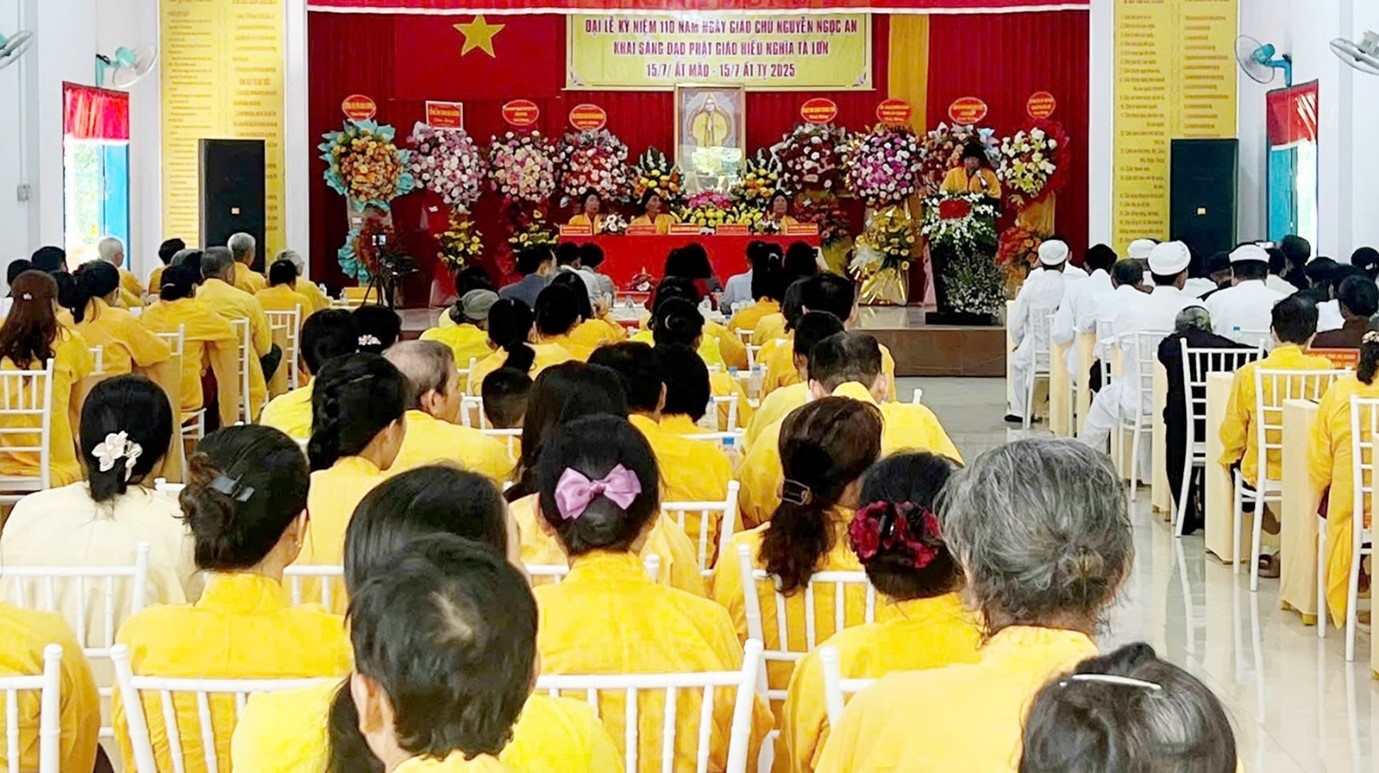
 Celebrating the 110th anniversary of the founding of the Hieu Nghia Ta Lon Buddhist religion
Keywords: Scriptures; Doctrines; Hieu Nghia Ta Lon Buddhism
1. Introduction
Hieu Nghia Ta Lon Buddhism is an indigenous religion of the Mekong Delta, originating in the late 19th and early 20th centuries - a period when numerous religions were formed in the South (Vietnam), such as Buu Son Ky Huong, Tu An Hieu Nghia, Hoa Hao Buddhism, Cao Dai, Pure Land Buddhist Lay Association of Vietnam,... One of the characteristics of these religions is the inheritance and integration of earlier religions and beliefs, most clearly expressed through scriptures and doctrines. The Hieu Nghia Ta Lon Buddhism is no exception. The scriptures, doctrines and religious practices of this religion have influenced the spiritual beliefs of the Three Religions in Vietnam, especially Buddhism, but Mr. Nguyen Ngoc An transformed them into scriptures encouraging spiritual practice for the “lower vehicle”, focusing on the practice of human morality - This is also the core content of the Buddhist scriptures and doctrines of Hieu Nghia Ta Lon.
The Hieu Nghia Ta Lon Buddhist sect was founded by the following religious leaders: Dao Lap (Pham Thai Chung), Cu Da (Nguyen Thanh Da), Ngoc Minh (Nguyen Ngoc Minh), Ngoc Dac (Tran Ngoc Duoc), and Ngoc An (Nguyen Ngoc An). Nguyen Ngoc An officially established his religion in the Mekong Delta in 1921, under the name Hieu Nghia Ta Lon Buddhism, and his followers called him Professor. The formation and development of this religion has spanned nearly a century, primarily in the provinces and cities of Kien Giang (old), Can Tho, An Giang and Dong Thap. In the spirit of “learning Buddhism and cultivating virtue”, the scriptures and doctrines of this religion encourage followers to prioritize self-cultivation and practice the worldly engagement of the Bodhisattva path, following the doctrines of the founder of the Buddhist religion of Hieu Nghia Ta Lon.
2. Characteristics of Hieu Nghia Ta Lon Buddhism
The Buddhist scriptures of Hieu Nghia Ta Lon are not numerous and are mainly extracted from Buddhist sutras, such as: The Sutra of Salvation, the Universal Gate Sutra, the Dharma teachings of Mr. Nguyen Ngoc An in “Philosophy of the Sacred Path”, and the laws in the book “Rules of the Dao”. Some key features of the Buddhist scriptures of Hieu Nghia Ta Lon are as follows:
The Sutra of Relief from Suffering: This includes verses and mantras from the Pure Land and Esoteric Buddhism traditions, but interspersed with chants and prostration rituals of the Filial Piety and Righteousness Buddhist tradition, such as verses for: ringing the bell, opening the sutra, mantra for purifying speech karma, mantra for dispelling calamities and bringing good fortune, mantra for rebirth in the Pure Land, verse for relieving suffering,... However, the Buddhist verses and mantras used in the Sutra of Salvation of the Hieu Nghia Ta Lon Buddhist sect have been somewhat altered in wording, along with supplementary texts compiled by Mr. Nguyen Ngoc An. The prayers, prostrations, incense offerings, especially the “Ten Months of Conception” poem, written in verse, contain content encouraging spiritual practice and teaching believers, expressing filial piety and gratitude to the country and to their ancestors,…
Universal Gate Sutra: The Hieu Nghia Ta Lon Buddhism uses the Universal Gate Sutra as its main chanting ritual, because this religion practices the virtues of relieving suffering, helping those in need and giving alms, such as: Bodhisattva Avalokiteshvara practices the six Paramitas (generosity, morality, patience, diligence, meditation and wisdom - generosity being the foremost because it forms the foundation for all six Paramitas). In the Buddhist scriptures of Hieu Nghia Ta Lon, there are two books taught by Mr. Nguyen Ngoc An that form the backbone for followers’ practice, activities and organization of the religion.
The Sacred Way Philosophy: Written in 1961, it consists of sermons compiled by Mr. Nguyen Ngoc An based on the spirit of Confucianism, which followers use as a basis for living their lives according to the principles of the faith. The main content of the Sacred Way Philosophy consists of teachings and admonitions on fulfilling the duties of a practitioner, including gratitude to heaven and earth, and the ancestors; cultivating personal character; maintaining harmony within the family, among siblings and friends; upholding the proper conduct of father and son, husband and wife, ruler and subject... thus proving worthy of dignity in the universe.
The Buddhist Law: Compiled by Mr. Nguyen Ngoc An in 1968. The original version of the Buddhist Law, written in ink, to be large in size and placed in a prominent location in the main hall of An Binh Temple. The monastic rules record the teachings, regulations and rules within the Hieu Nghia Ta Lon Buddhist organization that each place of worship and each individual follower must adhere to.
Besides the religious laws, the Law Book also contains poems, rhyming essays, rituals and procedures for initiation into the religion. Along with that are the sutras, prayers, and exhortations to remind followers of good deeds, as well as the responses in rituals related to the life cycle of Buddhist followers of Hieu Nghia Ta Lon.
It can be argued that the Law of the Religion is a relatively complete and elaborate set of rules that Mr. Nguyen Ngoc An left for his disciples as a basis for learning and practicing the religion in accordance with the spirit of filial piety and righteousness of this religion.
he Sutra of Salvation, the Universal Gate Sutra, the Noble Path of Philosophy, and the Vinaya are the fundamental scriptures of the Hieu Nghia Ta Lon Buddhism. The main content consists of chanting rituals, offerings and moral teachings passed down by Mr. Nguyen Ngoc An to his disciples. Follow this path to practice filial piety and cultivate virtue along the humane way, which is the core spirit of the Hieu Nghia Ta Lon Buddhism.
In addition to the aforementioned scriptures, the Hieu Nghia Ta Lon Buddhism in also includes the poem “Ten Months of Conception”, written in verse, which speaks of the lifelong care and devotion of parents to their children and the duty of children and grandchildren to live in a way that fulfills their filial piety towards their grandparents and parents. The collection of poems, “Van Ta Lon” and “Lan Thien” by Mr. Cu Da is a valuable document left behind by our predecessors for the religion.
3. The doctrinal characteristics of the Hieu Nghia Ta Lon Buddhism
The guiding principles of the Hieu Nghia Ta Lon Buddhist sect are: “Buddhism - Filial piety - National peace - Compassion - Kindness”. The Hieu Nghia Ta Lon Buddhism prioritizes filial piety. Followers of this sect do not abandon their families or sever ties with their loved ones, but rather fulfill their duties to their families. This religion does not establish a strict system of precepts and there is no distinction or taboo between clergy and followers. Hieu Nghia Ta Lon Buddhism is a synthesis that incorporates and modifies the ideas and some content of several other religions, primarily Buddhism, Confucianism and Taoism, along with folk beliefs of the South (Vietnam). The elaborate rituals and complex forms of practice have been simplified by the Hieu Nghia Ta Lon Buddhism to suit the life and psychology of farmers in the Mekong Delta.
Based on the principle of “learning Buddhism - cultivating virtue”, the Four Gratitudes religion, like other religions, emerged in Southern Vietnam at the end of the 19th and beginning of the 20th centuries. The Hieu Nghia Ta Lon Buddhism presents the concept that: In life, every human being is indebted to their country, grandparents, parents, the Three Jewels (Buddha, Dharma, Sangha) and all sentient beings, therefore must practice to repay these debts of gratitude. Thoughts and people must be guided by moral principles (human morality); the worldview is based on the cycle of birth and death, reincarnation and the law of karma and retribution. Things and people are formed by the interaction of yin and yang, the five elements (Wu Xing) in their generative and destructive cycles. The Hieu Nghia Ta Lon Buddhism encourages people to demonstrate filial piety, in which filial piety is the path of filial devotion: Respect for Heaven, respect for Earth, respect for humanity; and righteousness towards one’s country, righteousness towards one’s fellow human beings... these are the fundamental principles of religious teaching. In the teachings of the Hieu Nghia Ta Lon Buddhism acknowledged that one should practice according to the lower path, meaning practicing according to human principles, only observing a few precepts to correct oneself, because “The lower path is within the realm of humanity. In fact, most of us are of the lower path, some practice within the realm of humanity because they feel indebted to their family, country, homeland, clan, only observing a few precepts to correct their character and discipline their hearts; that is learning Buddhism and cultivating humanity”.
The Hieu Nghia Ta Lon Buddhism considers “learning Buddhism and cultivating virtue” as its core principle, but cultivating virtue is important, and if one wants to learn Buddhism, cultivating virtue is the fundamental goal “learning Buddhism and cultivating virtue” in this religion is also a single principle, not two separate stages of practice. Therefore, it should be understood that the principle of “learning Buddhism - cultivating virtue” is not just about cultivating oneself by “leaving home and cutting off attachments”, but extends to the nation, fellow citizens, and humanity, in the spirit of self-cultivation and practicing generosity according to the Bodhisattva Avalokiteshvara’s teachings. Therefore, in his book “Philosophy of the Sacred Path”, Mr. Nguyen Ngoc An reminded his disciples that:
“The union of the three religions is not far away,
The Buddha’s teachings spread throughout the world.
Cultivating character and refining the mind through Buddhist teachings
The mirror of wisdom transforms into a lotus flower”
Regarding the principle of “learning Buddhism - cultivating virtue”. Firstly, it is about learning Buddhism, the Hieu Nghia Ta Lon Buddhism does not propagate or practice profound Buddhist doctrines. The Buddhist teachings of this religion primarily utilize simple methods of cultivating merit according to the virtues of Bodhisattva Avalokiteshvara, such as giving and patience in order to save people and guide sentient beings. Therefore, in ritual practices, Amitabha Buddha and Avalokiteshvara Bodhisattva are always chanted and worshipped. But to fully understand Buddhism, followers must cultivate themselves, refine their virtues, and practice the “Four Gratitudes”, considering it their duty, this is called “cultivating virtue”.
About the practice of cultivating virtue, followers of the Hieu Nghia Ta Lon Buddhism must cultivate morality, refine their character, do good, avoid evil, accumulate merit, complete their work, live well with others in order to become useful members of society. “Therefore, cultivating virtue is for the purpose of reforming society, to achieve virtuous customs and traditions, the meaning of self-cultivation is to learn the path to immortality, in the past, the sages and saints relied on their ears and eyes to make their names known”. “Studying Buddhism and cultivating virtue” in the Hieu Nghia Ta Lon Buddhism means fulfilling the Four Great Debts (abbreviated as the Four Debts): “1. Debt to the country, 2. Debt to ancestors and parents, 3. Debt to the Three Jewels, Buddha, Dharma, and Sangha, 4. Debt to fellow countrymen and humanity”.
Gratitude to one’s country is the first of the Four Gratitudes in the Hieu Nghia Ta Lon Buddhism. This religion holds that those practicing the humanistic path must first and foremost be loyal to their country and have a duty to defend their homeland whenever there is foreign invasion. In times of peace, we must wholeheartedly dedicate ourselves to building a stronger and more prosperous homeland.
Gratitude to ancestors and parents is ranked second. In the concept of Hieu Nghia Ta Lon Buddhism, the concept of gratitude to ancestors and parents means remembering and repaying the kindness of those who gave birth to and raised you. In the teachings of Hieu Nghia Ta Lon Buddhism, a person who knows how to show gratitude to their grandparents and parents must live a filial life, avoiding actions that displease or negatively affect their ancestors.
Gratitude to the Three Jewels (Buddha, Dharma, Sangha) is ranked third among the four kinds of gratitude. As followers of the Buddhist faith of Hieu Nghia Ta Lon, we must remember the gratitude we owe to the Buddha, the Dharma, and the Sangha by following the Buddha’s teachings. Out of gratitude to the Three Jewels, each believer has the responsibility to spread the teachings to everyone so that they may continue to strive to do good deeds, live compassionately, in order to ultimately reach truth, goodness and beauty.
Gratitude towards fellow human beings and humanity ranks fourth. In the spiritual life, each person owes gratitude to one another; this gratitude extends not only to fellow human beings but to all of humanity. The Hieu Nghia Ta Lon Buddhism teaches its followers to live with care, love, joy, harmony and to share joys and sorrows with all people as brothers and sisters. All people and humanity on earth, regardless of wealth or poverty, social status, skin color, race and even all living beings are relatives and kin. The teachings of Hieu Nghia Ta Lon Buddhism also utilize the Six Harmonies principle of Buddhism, considering it a fundamental aspect of spiritual practice.
Based on the principle of “learning Buddhism - cultivating humanity”, and incorporating ideas from several religions and folk beliefs, Hieu Nghia Ta Lon Buddhism practices a synthesis of many traditional Vietnamese methods of spiritual cultivation. That is, the practice of mindfulness and reverence to the Buddha’s name in Pure Land Buddhism, the mantra practices of Esoteric Buddhism, the cultivation of essence, energy and spirit in Taoism, especially the practice of self-cultivation within the three cardinal principles and five constant virtues of Confucianism. Confucianism, in turn, presents the principles of human morality, known as the Three Cardinal Principles and the Five Constant Virtues. Regarding the Three Religions - Buddhism, Taoism and Confucianism, they are all one, meaning: Buddhism teaches cultivating the mind to attain Buddhahood; Taoism teaches the cultivation of character to become an immortal; Confucianism teaches that one must cultivate a virtuous and filial heart, only those who are loyal, filial, chaste and righteous can become Gods, Immortals, Saints, Buddhas - only an all-powerful, all-encompassing and all-perfect being can attain the ultimate bliss of enlightenment.
Thus, the teachings of Hieu Nghia Ta Lon Buddhism encompass concepts of present and future life. It was passed down through verses and poems in rhyming form, easily understandable and memorable pieces of advice for spiritual practice that resonated deeply with people. This was also a common characteristic in the compilation of scriptures, doctrines, and missionary methods of religions that emerged in the South (Vietnam) in the late 19th and early 20th centuries. With this method of proselytizing, religious doctrines become relevant and close to the traditional Vietnamese concept of cause and effect, with the psychology, character and educational level of honest, simple farmers. Nowadays, despite many changes in life, the teachings on self-cultivation and upholding moral principles are still passed down and maintained by many generations of followers, because these values are highly relevant to the lives of Buddhist followers of Hieu Nghia Ta Lon.
4. Conclusion
Hieu Nghia Ta Lon Buddhism, as an indigenous religion that emerged in the South (Vietnam) in the early 20th century, is a prime example of the process of integration and localization of religious ideologies in Vietnam. Building upon a selective assimilation of Buddhism, Confucianism, Taoism and folk beliefs, this religion has created a comprehensive system of scriptures and doctrines, notably combining religious and social ethical elements.
The Buddhist scriptures of Hieu Nghia Ta Lon, while not extensive are valuable for their practical application and high adaptability to the lives of their followers. Works such as “Sacred Philosophy” and “Buddhist Law” not only served as guidelines for spiritual practice but also established ethical standards and codes of conduct for the community. Through this process, the religion translated religious teachings into concrete moral principles that were easily accepted and practiced in daily life.
In terms of doctrine, the principle of “learning Buddhism and cultivating humanity” holds a central position, clearly demonstrating an engagement with the world and an emphasis on moral conduct. Unlike the renunciation of worldly life in some traditional Buddhist schools, the Hieu Nghia Ta Lon Buddhism emphasizes the cultivation of personal morality in conjunction with responsibility towards family and society. The concept of “Fourfold Gratitude” is not merely an inheritance of traditional moral thought, but a systematization of fundamental human social relationships, thereby forming a value system that is both religious and profoundly humanistic.
It can be affirmed that the outstanding characteristic of the Hieu Nghia Ta Lon Buddhism is the tendency to simplify rituals, emphasize ethical practice and focus on practical life. This very characteristic has enabled religion to adapt flexibly to changing social contexts, while also contributing to the maintenance and strengthening of traditional moral values within the community of believers.
In the current context, studying the Hieu Nghia Ta Lon Buddhism is not only significant in identifying a unique religious phenomenon in the South (Vietnam), but also contributing to clarifying the mechanisms of development, integration and localization of religions in Vietnam. At the same time, the moral values that this religion upholds remain relevant in building cultural and ethical social life, aiming for the sustainable and harmonious development of the community.
* Principal Lecturer, Thai Nguyen Provincial Political School
References
1. Religious Research, No. 11 (2018).
2. An overview of the history of the Hieu Nghia Ta Lon Buddhism.
3. Summary of the Buddhist doctrines and precepts of Hieu Nghia Ta Lon.
4. The Buddhist philosophy of Hieu Nghia Ta Lon.
