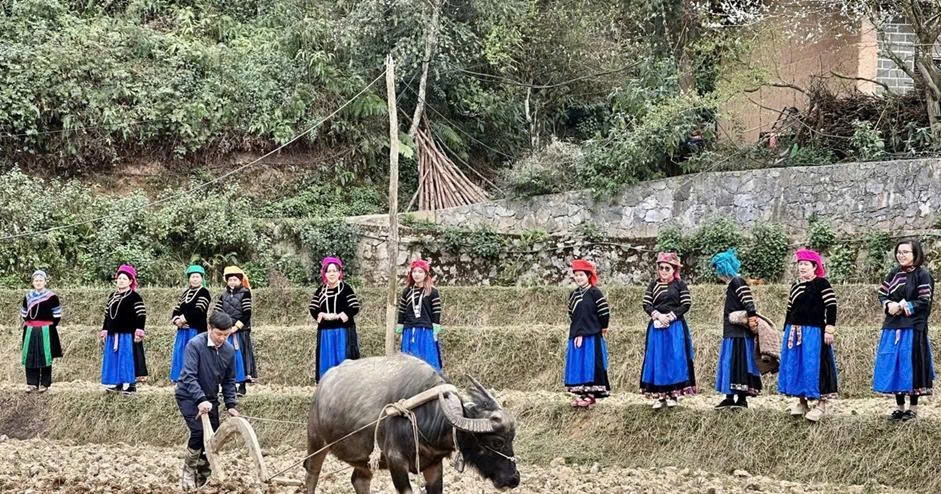
 After the Pat Oong ceremony, the Pu Peo ethnic group begins a new harvest season
Traditionally, the Pat Oong ceremony of the Pu Peo ethnic group is held at the beginning of the new year, usually after the Lunar New Year. This ritual signifies the beginning of the production cycle, marking the moment the community officially enters a new farming season. More than just a customary activity, Pat Oong clearly reflects agricultural beliefs and the concept of the relationship between humans and their ancestors, deities and nature.
According to Mr. Cung Chan Trang, Secretary of the Party Branch of Chung Trai village (Pho Bang commune, Tuyen Quang province), on the 30th day of the Lunar New Year, each Pu Peo family performs the ritual of inviting their ancestors to come home to celebrate Tet with their descendants. After this ceremony, during the first few days of the new year, people refrain from bringing fire out of their homes and from taking farming tools to the fields or up to the hillsides for production. Traditionally, this is considered a sacred time for families to reunite, remember their ancestors and wait for an auspicious day to ask for permission from their forefathers to begin a new cycle of work.
The Pu Peo ethnic group chooses an auspicious day in early spring to perform the Pặt Oong ceremony. During the ceremony, folk artisans - those knowledgeable in customs and possessing traditional prayers will represent the community in performing the ritual of asking the ancestors for permission for the villagers to go to the fields to sow and plant, praying for a year of favorable weather and a bountiful harvest. Besides its significance in praying for a good harvest, the ritual also includes an element of purification: cleansing the water source and lighting a new fire to ward off bad luck and usher in a peaceful beginning for the new year.
The Pat Oong ceremony is held at the home of a folk artist, with offerings prepared by the community in the village, including: Two chickens, banh chung (traditional Vietnamese rice cake), wine and other traditional offerings. After completing the rituals at his own home, the master of ceremonies, carrying a blessed torch, goes to each Pu Peo household in the village to recite blessings and ask permission from the ancestors for each family to officially begin the new production season. The sequence of rituals clearly demonstrates the sense of community and the strong bonds between the members of the village.
At each household, the master of ceremonies recites prayers, asking permission for the people to go to the fields to work and wishing them a new year filled with good health and prosperity.
After visiting families in the village, the master of ceremonies will offer sacrifices to the Forest God at the village’s cultural center. At the end of the ceremony, the villagers will take up their plows and hoes and head to the fields to work and produce, beginning the new planting season.
This year’s Pat Oong festival was organized by the Pu Peo community in Chung Trai village on the 9th day of the 1st lunar month. Immediately after the ceremony, the Pu Peo community, dressed in their traditional clothing, gathered in the courtyard of the village's cultural center to engage in cultural exchange, perform arts and play traditional games.
According to Mr. Nguyen Van Hanh, Vice Chairman of the People's Committee of Pho Bang commune, the Pat Oong ceremony is a beautiful aspect of the Pu Peo ethnic group’s culture, preserved by the local people for many generations, enriching the traditional culture of the ethnic groups in the border commune of Pho Bang. Beyond simply praying for a new year of favorable weather and bountiful harvests, the ritual also serves as a spiritual bond within the Pu Peo community.
“Thanks to promoting fine traditional cultural values, the Pu Peo community in Pho Bang commune has united, overcome difficulties, and competed in labor and production to achieve a more prosperous life. Currently, the village has 46 households, with only 3 remaining classified as poor or near-poor; the villagers have also eliminated outdated customs such as child marriage and consanguineous marriage”, Mr. Nguyen Van Hanh added./.
