Keywords: Grassroots cultural institutions; Ethnic minority and mountainous areas; Ethnic minorities.
 Local authorities have gradually invested in infrastructure and reformed operating methods to improve the spiritual and physical well-being of the people
1. The role of cultural institutions in ethnic minority and mountainous areas
Cultural institutions are a term used to refer to cultural agencies and units established by the State or the community within the framework of laws or regulations of sectors and organizations, aiming to meet the spiritual and cultural needs of the public and contribute to building cultural life in the locality.
Cultural institutions play a crucial role in building and developing the national culture. In any era or social system, cultural institutions are necessary to convey the official culture of the State to all segments of the population, and to organize cultural activities that conform to the standards, ethics, lifestyles and customs of the time and the community.
Our Party and State have always attached great importance to the role of culture. Since 1998, the Resolution of the Fifth Plenum of the Central Committee of the Party, Eighth Term, on “Building and developing an advanced Vietnamese culture imbued with national identity” has affirmed: “Culture is the spiritual foundation of society, serving as both a goal and a driving force for socio-economic development”. This viewpoint has been further refined, improved and affirmed in subsequent Party Congresses.
On January 7th, 2026, on behalf of the Politburo, General Secretary To Lam signed and promulgated Resolution No. 80-NQ/TW of the Politburo on the development of Vietnamese culture. One of the viewpoints stated in this Resolution is: “Developing culture and human resources is the foundation, an important endogenous resource, a great driving force, a pillar and a regulating system for the rapid and sustainable development of the country. Cultural values must be closely and harmoniously integrated into all aspects of social life, from politics, economics, society and the environment to national defense, security, and foreign relations, truly becoming a soft power of the nation in the new era”.
Vietnam is a unified nation with 53 ethnic minority groups, each possessing its own unique cultural identity, these groups are considered a “gold mine” for “developing cultural and human strengths into endogenous resources and driving forces for development”, as outlined in the 2026-2030 development goals and 2045 vision in the Report of the 13th Central Committee on documents submitted to the 14th National Congress of the Party, presented by General Secretary To Lam at the opening session of the 14th National Congress of the Party (January 20th, 2026). To unlock the “gold mine” of ethnic minority cultures, we need “opening grounds”, which are cultural institutions at the grassroots level. Cultural institutions include traditional cultural institutions and contemporary cultural institutions. Contemporary cultural institutions are cultural centers from the village level to the provincial and centrally-administered city levels. Traditional cultural institutions include communal houses, temples, shrines, and palaces in villages and communes; communal houses and communal houses in hamlets, villages and pleis… (Nguyen Chi Ben, 2024).
Cultural institutions have many roles:
Firstly, cultural institutions are places where activities related to the creation, dissemination, practice and enjoyment of cultural values take place; A place for training and improving the aesthetic and physical abilities of all segments of the population, helping Vietnamese people to be physically healthy, mentally beautiful, comprehensively developed in morality, intellect, physical fitness and aesthetics. This is also an important location for preserving and promoting fine traditional cultural values and spreading new cultural values of the era and the nation. In ethnic minority and mountainous regions, cultural institutions are not simply places for community activities, but spaces for preserving cultural memories, local knowledge, customs, traditions, festivals, spoken and written languages and folk performance forms. Through the activities of these institutions, traditional cultural values are passed down between generations, contributing to limiting cultural discontinuities among ethnic groups.
Secondly, cultural institutions can be venues for organizing political and social activities, contributing to shaping the landscape of localities; Playing an important role in organizing activities to disseminate political and social messages. Whether the Party’s viewpoints and guidelines, and the State’s policies and laws reach the vast majority of the people depends, in large part, on the system of grassroots cultural institutions, because this is an important location for communicating policies, bringing the Party’s guidelines and the State's policies and laws to ethnic minority communities through appropriate and easily understandable methods. Cultural institutions have become an effective supplementary channel for disseminating legal information and raising social awareness, especially in ethnic minority and mountainous areas where people have limited access to official information. This is also a place where the people, including ethnic minorities, can strengthen their resistance against false narratives and subversive activities against the revolution, the Party and the State… in the context that our country still needs to increase vigilance and fight against the “peaceful evolution” plot of hostile forces.
Thirdly, cultural institutions are meeting points for dialogue and sharing among the community; places for organizing collective activities, festivals and meetings. Therefore, cultural institutions contribute to community cohesion, promoting understanding, respect, and interaction among different ethnic groups, classes and social strata, thereby strengthening national unity. Since ethnic minority communities mainly live scattered in areas with difficult transportation and communication, the role of cultural institutions becomes even more significant in strengthening social trust, promoting the role of village elders, community leaders and influential people, contributing to maintaining political and social stability at the grassroots level.
Fourthly, cultural institutions contribute to building grassroots cultural life and maintaining social order. The effective functioning of cultural institutions helps to shape a civilized and healthy lifestyle, gradually pushing back against outdated customs and social evils. In many ethnic minority and moutainous areas, cultural institutions also serve as spaces for reconciliation and conflict resolution within the community, based on traditional customs and practices combined with the law, contributing to maintaining security and order at the grassroots level.
Fifthly, cultural institutions are the foundation for the development of the cultural economy and community livelihoods. When properly organized and operated, cultural institutions can become a cornerstone for the development of community tourism, showcasing traditional crafts and local cultural products, creating additional livelihoods for the people. This role is particularly important in the context of implementing socio-economic development programs for ethnic minority and mountainous areas, aiming for sustainable poverty reduction while preserving culture.
Sixthly, cultural institutions contribute to affirming identity and strengthening “cultural resilience”. In the context of today’s strong cultural exchange and transformation, cultural institutions help ethnic minority communities clearly identify their own values, thereby proactively and selectively accepting new things. This is a crucial factor in enhancing “cultural resilience”, avoiding the risk of assimilation, brutal commercialization or distortion of traditional cultural identity. Above all, cultural institutions are crucial for creating a culturally rich living environment for everyone, “contributing to the personal development, satisfaction, and life experiences of each individual, at the same time contributing to the sustainable development and prosperity of society” (Vu Thi Thu Hang, Nguyen Thi Van Anh, 2024).
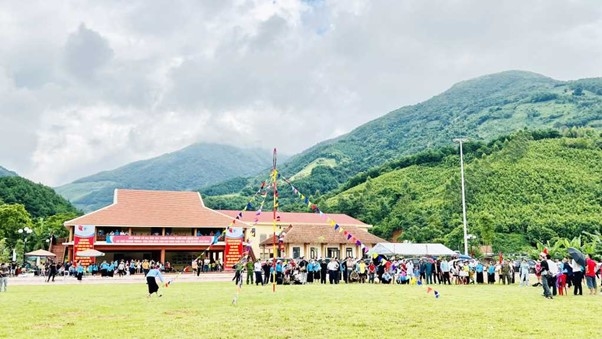 The Ethnic Culture House in Tien Yen commune, Quang Ninh province - one of the venues for the ethnic minority sports Competition
2. Results of developing grassroots cultural institutions in ethnic minority and mountainous areas
In Vietnam, communes and villages are residential areas where all living and working activities of the people take place; they are the most important locations for realizing the directives, resolutions, policies and guidelines of the Party, the laws and regulations of the State. Given the important roles of cultural institutions, at the same time in line with the Party’s policies and guidelines on cultural development, in recent years, all levels and sectors have paid attention to investing in the system of grassroots cultural institutions in ethnic minority and mountainous areas.
The content “Support for investment in the construction of cultural and sports facilities and equipment in villages inhabited by ethnic minority and mountainous areas” is part of Project 6: “Preserving and promoting the fine traditional cultural values of ethnic minorities in conjunction with tourism development”, in the National Target Program for socio-economic development of ethnic minority and mountainous areas for the period of 2021-2030, Phase I from 2021-2025 (the Program) has supported investment in the construction of 3,220 cultural houses and sports facilities in villages and hamlets; Providing support for the activities of 695 folk culture clubs and 5,760 traditional performing arts groups in villages and hamlets; Support for the construction of 907 community libraries in ethnic minority and mountainous areas; 1,189 village-level cultural centers/sports areas received support for equipment, renovation and restoration.
With these results, the target group in the Program on preserving and developing the valuable traditional cultural identities of ethnic groups has achieved two targets: (1) The percentage of villages with community centers and (2) the percentage of villages with cultural and artistic teams and traditional clubs that operate regularly and with quality far exceed the targets assigned by the competent authority and are one of the 6 specific target groups assigned by the National Assembly in Resolution No. 120/2020/QH14 that have basically achieved and exceeded the set targets. Specifically: The percentage of villages with community centers reached 93.8% (target: 80%); the percentage of villages with traditional cultural and artistic clubs that operate regularly and with quality reached 66.1% (target: 50%).
At the commune level, the results of the 2024 survey of 53 ethnic minority groups show that 78.9% of communes in ethnic minority and mountainous areas have cultural centers/houses. The system of cultural institutions has contributed to the development of cultural, artistic and sports movements serving political tasks at the local level, improving the spiritual life of the people; It has a positive impact on the quality of activities of the “National Unity in Building a Culturally Rich Life” movement, building new rural areas helps strengthen traditional cultural identity, create jobs, increase income for local people through tourism services; Comprehensive preservation of the intangible cultural values of 14 ethnic groups facing specific difficulties, including: O Du, Brau, Ro Mam, Pu Peo, Si La, Cong, Bo Y, Co Lao, Mang, Lo Lo, Chut, Lu, Pa Then, La Ha; Encourage ethnic minority communities to play a leading role in culture, with the support of the State, to strive to overcome difficulties, participate in economic development and effectively address social issues.
3. Some solutions to improve the effectiveness of grassroots cultural institutions
Firstly, cultural institutions play a crucial role not only in the cultural field but also impact many other areas such as education, healthcare, gender and media. Therefore, it is necessary to continue investing in building grassroots cultural institutions for ethnic minority and mountainous areas, especially since 19.7% of communes in ethnic minority and mountainous areas nationwide (before mergers) still lack cultural centers. Investment needs to take into account the needs, psychology, customs, traditions and cultural heritage of the local people in order to build institutions that are suitable for the local cultural space and can be integrated with traditional cultural institutions bearing the historical and cultural imprint of the locality. However, the policy approach needs to shift from “building enough” to “operating effectively” by improving the mechanisms for ensuring resources for the regular operation of cultural institutions. Supplement and stabilize funding for the maintenance and upkeep of grassroots cultural institutions. Paying attention to allocating higher funding for organizing activities at cultural centers in particularly disadvantaged communes, villages and hamlets.
Secondly, grassroots cultural institutions should be viewed as dynamic socio-cultural institutions, closely linked to the daily lives of ethnic minority communities. Ethnic minority communities, as cultural subjects, both directly enjoy and absorb new cultural elements, receive information about socio-economic development and implementing it at the local level, therefore, they need to be aware of the need to promote their legitimate rights, interests and obligations in enjoying and creating cultural values at grassroots cultural institutions. The key solution is to empower and facilitate direct community participation in the management and operation of cultural institutions. Only when the role of ethnic minority communities as key stakeholders is strongly promoted will the institution have lasting vitality.
Thirdly, the rapid development of science and technology, especially digital and communication technologies is helping ethnic minority communities access a wide variety of domestic and international cultural products quickly and diversely, leading to changes in their needs and tastes. However, cultural institutions at the grassroots level have not yet kept pace with the changes in content and methods of operation in order to attract the participation of the people. Many commune cultural centers and village cultural houses are primarily used for meetings and monotonous professional activities, thus failing to fulfill their role as centers for community cultural and artistic activities. The majority of personnel working at cultural institutions in communes, villages and hamlets have not received professional training. Therefore, attention should be paid to planning, training, and building a team of cultural workers at the grassroots level who are capable of providing advice and consultation, know ethnic minority languages, have the capacity to manage and organize activities within cultural institutions to maximize the effectiveness of the invested institutions in a practical manner, linked to the specific characteristics of each region and ethnic group. There should be mechanisms to reward, honor, and support artisans and custodians of cultural heritage to regularly participate in the institution’s activities, considering them an irreplaceable resource.
Fourthly, link the activities of cultural institutions with the development of local livelihoods and cultural economy. Grassroots cultural institutions need to be connected with community tourism, traditional crafts and the promotion of distinctive cultural products of ethnic minority communities. Exploitation must be clearly directed, controlled, ensuring a balance between conservation and development, avoiding commercialization that distorts cultural values.
Fifthly, strengthening the role of cultural institutions in policy communication and building grassroots cultural life. Cultural institutions should be promoted as a channel for communicating policies that are close to the people, easily accessible, appropriate to the language and customs of each ethnic group. Through cultural and artistic activities, community dialogue, and cultural institutions, legal awareness is enhanced, civilized lifestyles are built and unity is strengthened at the grassroots level.
Sixthly, strengthening the monitoring and evaluation of the effectiveness of grassroots cultural institutions. Integrate the performance criteria of grassroots cultural institutions into the system for evaluating the implementation of cultural policies in ethnic minority and mountainous areas. Monitoring should not only be based on the number of projects but also on the level of community participation, frequency, quality of activities and specific social impact.
4. Conclusion
Building grassroots cultural institutions in ethnic minority and mountainous areas is an objective necessity, because these institutions have been and will continue to accompany ethnic minority communities in enjoying cultural values, expanding community living spaces, contributing to the close integration of culture into all aspects of social life, becoming a core spiritual foundation with sustainable value, an important internal force participating in socio-economic development and poverty reduction. This is also a necessary requirement for building communes, villages and hamlets in ethnic minority and mountainous areas to meet the criteria of new rural areas, advanced new rural areas, and model new rural areas, in line with the goals of the 14th National Congress on “developing Vietnamese culture and people to meet the requirements of sustainable national development” in the coming years.
References
1. Ministry of Culture, Sports and Tourism (2025), Decision No. 3399/QD-BVHTTDL dated September 23rd, 2025 approving the National Target Program on cultural development for the period of 2025 - 2035, phase I from 2025 to 2030.
2. Government (2025), Report No. 901/BC-CP dated October 10th, 2025, summarizing the National Target Program for socio-economic development of ethnic minority and mountainous areas in the period of 2021-2030, Phase I from 2021-2025.
3. Communist Party of Vietnam (1998). Resolution of the Fifth Conference on “Building and developing an advanced Vietnamese culture imbued with national identity”.
4. Communist Party of Vietnam (2026), Full text of the Report of the 13th Central Committee on the documents submitted to the 14th Party Congress, https://vtv.vn/toan-van-bao-cao-cua-ban-chap-hanh-trung-uong-dang-khoa-xiii-ve-cac-van-kien-trinh-dai-hoi-xiv-cua-dang-100260120093250436.htm.
5. Prof. Dr. Nguyen Chi Ben (2024), Promoting the role of traditional cultural institutions in contemporary society, Hanoi.
6. Dr. Vu Thi Thu Hang, MA. Nguyen Thi Van Anh (2024), Resources for developing cultural and sports institutions in ethnic minority areas, Hanoi.
