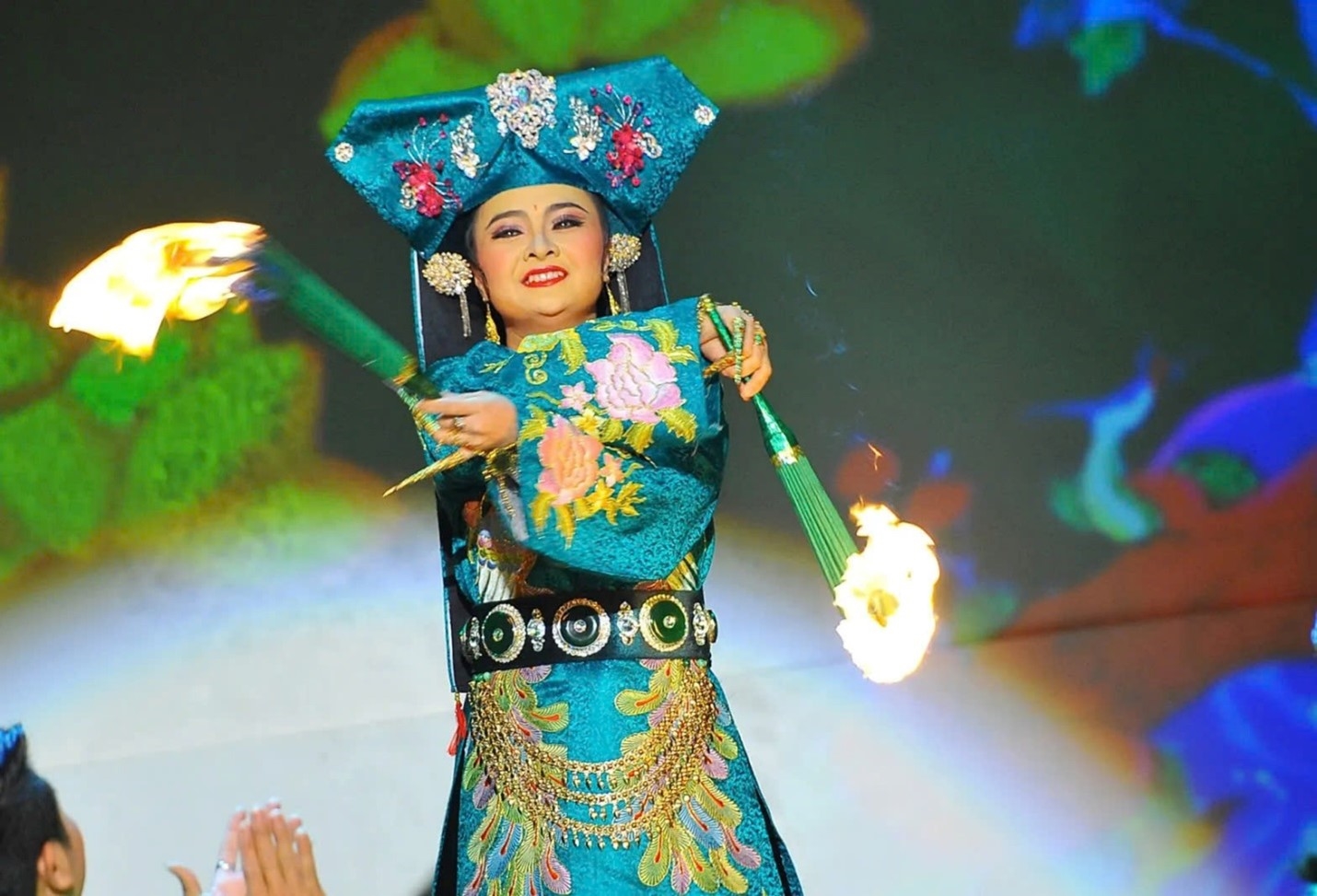
 Spirit mediumship - a ritual in the Four Palaces worship tradition
Keywords: The Four Palaces Belief; Lang Son province; Mother Goddess; Spirit medium ritual; Cultural transformation; Spiritual life.
1. The electrical system and distinct localization
Lang Son province has a high concentration of relics dedicated to the worship of Mother Lieu Hanh, associated with the Four Palaces belief system, making it an important destination for pilgrimages to the Mother Goddess. The relics dedicated to the Four Palaces deities in Lang Son province currently include old relics built before 1945 and new relics mainly constructed from 2005 onwards. A common feature of the groups and clusters of relics dedicated to the Four Palaces in Lang Son province is that most of them are located along National Highway 1A, connected to the locations of railway stations such as Bac Le, Dong Mo, and Dong Dang; Or in densely populated trading centers such as Chi Lang, Lang Son and That Khe. These are hubs where many Kinh people are engaged in business and trade. Thus, the appearance of the Four Palaces temples in Lang Son province may be linked to the presence of Kinh people engaged in trade here from different periods in history. This is related to the fact that Lang Son is a mountainous province with a vital border trade route, especially since the Hanoi-Lang Son railway line was built. According to legend, the predecessor of Bac Le Temple was a shrine dedicated to the Mother Goddess Thuong Ngan, and the process of transforming it into the Four Palaces occurred around the beginning of the 20th century, associated with the construction of Bac Le train station. The temples that have recently appeared are mostly built through the charitable donations of Kinh women who are small-scale traders. The number of new temples is not large, most are dedicated to Saint Tran and the Mother Goddess.
A notable feature of the Four Palaces worship sites in Lang Son province is that they are all renovated or newly built on the basis of small local shrines with different origins, such as: worship of natural deities, worship of meritorious people, worship of female deities, worship of the Earth God and the village delegation. Temples dedicated to natural deities, such as the Ky Cung Temple and the Cua Dong Temple, originated from the worship of the Ky Cung River god. Other temples, such as the West Gate Temple (Ngu Nhac Linh Tu) and the North Gate Temple (Ngu Nhac Tu), originated from the worship of mountain gods; the North Gate Temple also worships the god of the Ky Cung River. Furthermore, the Mother Goddess Temple in Dong Dang originally worshipped the Nine-Layered Mother Goddess, which originated from the belief in worshipping Heaven.
Temples dedicated to meritorious individuals, which make up the majority of the Four Palaces temples in Lang Son province, most notably those dedicated to Saint Tran, originated from small shrines or the village delegation. The oldest of this type of temple is the Bac Le communal temple, associated with the legend of Princess La Binh, daughter of Tan Vien Son Thanh, who secretly assisted Le Loi in defeating foreign invaders. Next are the temples of Chau Bat, Chau Luc, Chau Muoi,… all associated with the legend of worshipping people who contributed to fighting invaders. Additionally, there is the Vinh Trai Temple, dedicated to a general from the early Le Dynasty named Le Cong Chi, or the Ca Phe Temple, whose inner sanctuary is dedicated to the local Mother Goddess named Dang Thi Tuoi, who contributed to the village… All relics belonging to this group are also dedicated to the Four Palaces Mother Goddess.
The temples dedicated to the Goddess are preserved with sacred origins through legends or through their names, such as: Legend says that Suoi Ngang Temple worships a sacred young girl who died prematurely; Or even the names of some temples dedicated to Co Chin Thuong Ngan, such as Co Chin shrine or Co temple, all suggest a worship of young girls who died prematurely; Or the Co Temple in Dong Dang originates from the Co Shrine, and the Co Bo Temple originates from the Co Bo Shrine. Recently, there is a temple called Ba Nang, which is said to worship three sacred young girls who died in war.
The temples were renovated from shrines dedicated to the Earth God and village communal houses, such as the Temple of the Mountain God, which, after the Four Realms transformation, became a place of worship for the Goddess of the Upper Forest (Chua Thuong Ngan). Additionally, there is the case of the Mother Goddess Temple in That Khe, which was initially located on the outskirts of the town. After flooding, the locals relocated it and merged it with a small communal house, transforming it into the current Mother Goddess Temple. The tutelary deity of this temple is Quy Minh Dai Vuong, who was later enshrined in the communal incense burner and during ceremonies, he is still invoked as the tutelary deity Dai Vuong.
If the worship space is the body, then the cultural exchange between the Kinh and the Tay and Nung people is the soul of the Four Palaces belief system in Lang Son province. In Lang Son province, the Four Palaces (Tu Phu) have become a shared asset, an inseparable and harmonious cultural entity. This intermingling is most clearly manifested in the Hau Dong ritual. In the rituals dedicated to the highland deities such as Chau Be Bac Le, Chau Luc or the Then deities, the flourishing of local culture is clearly evident. The costumes of these mediums often mimic the traditional attire of Tay and Nung women, featuring indigo blouses, silver bracelets, sash ornaments and distinctive brocade patterns. Furthermore, the lyrics in these folk songs are not purely the six-eight meter poetry of the Kinh people, but also intertwine Then singing styles, Tinh lute music and even songs in the local ethnic languages. This creates a musical space that is both familiar and unfamiliar, with a strong appeal to both locals and visitors. Furthermore, the deities in the Four Palaces system in Lang Son province are often localized through local legends. The Goddess of the Mountains or the Lady Goddesses, are not merely distant supernatural entities but are regarded by the Tay and Nung people as close mothers and grandmothers, teaching them how to cultivate fields, grow rice and treat illnesses with forest leaves. This intermingling is also reflected in the fact that Then and Tao shamans, cultural figures of the Tay and Nung people, frequently participate in the Four Palaces rituals, creating a unique religious symbiosis. At this time, the Mother Goddess belief played the role of a bridge connecting ethnic groups, blurring the boundaries between lowland and highland areas, between rice-farming culture and slash-and-burn agriculture.
2. The role of the Four Palaces belief in cultural and spiritual life
The Four Palaces belief system in Lang Son province is not simply a system of worship, but has become an underlying cultural current, deeply permeating the lives of the people in this border region. The role of the Four Palaces belief system is manifested in various ways, from soothing individual souls to shaping moral standards, elevating artistic expression and ultimately creating a strong and cohesive community.
The first point in the consciousness of the people of Lang Son province is that the Four Palaces belief system plays the role of a strong spiritual shield. Due to its mountainous, border location, the lives of the people have traditionally been intertwined with the harshness of nature and the fluctuations of trade activities. The image of the Mother Goddess and the Saints in the Four Realms system embodies boundless protection and compassion. People come to Bac Le Temple and Dong Dang Mother Goddess Temple not only to pray for wealth and fortune but, more importantly in order to seek peace of mind. Belief in the protection of the Mother Goddess helps people overcome their fear of the risks of making a living. The presence of deities like Quan Lon Tuan Tranh or Chau Be is not merely supernatural, but also benevolent spirits who are always listening to and protecting their children on every journey, from the deep forests to the borderlands.
Another important role of this belief is its ability to naturally educate people about life. The Four Palaces pantheon is a gathering place for national heroes and those who have contributed to the nation and its people and who have been deified. In practicing their religious beliefs, the people of Lang Son province are reminded of their glorious history through legends about Quan Lon, Ong Hoang and Chau Ba. Honoring these figures is a living embodiment of the tradition of “drinking water and remembering the source”. Through folk songs recounting the achievements of pioneering and fighting foreign invaders, the belief system has awakened national pride and a sense of responsibility towards the community. The Mother Goddess religion teaches people to live virtuously, to be filial to their parents and to be fair in their dealings with others, thereby contributing to maintaining social moral order.
The Hau Dong ritual is the soul of Tu Phu, where the role of belief is sublimated into a unique synthetic art form. In Lang Son province, Hau Dong is not only a ritual but also a unique space for performing 66 different folk arts. The combination of music (traditional Vietnamese singing), dance, costumes and installation art created a multi-sensory cultural feast. The sound of the Tay people’s Tinh lute blends with the rhythmic drums and clappers of the lowland musicians, creating the distinctive melodies of the border region. Each spirit medium ritual is a spiritual theatrical performance, where the medium embodies the Saints, recreating their demeanor, personality and achievements. This sublime experience not only brings aesthetic joy but also has a powerful psychological therapeutic effect, helping people shed fatigue and anxiety to immerse themselves in a world of fairies, thereby regenerating their life energy and creativity.
In addition, the Four Palaces belief system also plays a special role as a glue that binds members of society together. In Lang Son province, home to many ethnic groups such as the Kinh, Tay, Nung and Dao, the Four Palaces belief has transcended ethnic boundaries to become a shared belief. Festivals like the Ky Cung - Ta Phu Temple Festival are occasions for people of all backgrounds, regardless of wealth or ethnicity, to gather together in honor of the Mother Goddess. Working together to prepare offerings, organize processions or perform communal rituals has created a strong bond within the community.
3. The impact of the Four Palaces belief system on modern socio-economics
In the contemporary context, the Four Palaces belief system in Lang Son province is no longer confined to purely spiritual spaces but has transformed into an important driving force, profoundly impacting the socio-economic development of the locality. As the capital of the Mother Goddess religion in the border region, Lang Son has skillfully transformed its intangible cultural heritage values into endogenous resources, contributing to changing the face of people’s lives and promoting the process of cultural and economic integration.
Firstly, the most noticeable impact lies in the boom in spiritual tourism. Lang Son boasts a dense network of temples and shrines such as the Dong Dang Mother Goddess Temple, Bac Le Temple and Ky Cung - Ta Phu Temple, which are magnets attracting millions of pilgrims every year. The influx of people to Lang Son, especially during the festival season in the first and second lunar months, has created a huge market for services. From accommodation, food and transportation to the supply of offerings, writing prayers, or renting costumes for spirit medium rituals, all services have flourished. This not only brings significant budget revenue to the province but also directly creates thousands of jobs for local people, from unskilled laborers to artisans making paper offerings and tailors embroidering traditional costumes. The Four Palaces belief system now plays the role of a sustainable resource, a type of heritage economy that, if properly exploited, will never run out.
Secondly, the Four Palaces belief system promotes the revival and development of traditional craft villages. The practice of spirit medium rituals requires an extremely sophisticated system of offerings and costumes. In order to meet the growing demand from collectors and tourists, traditional crafts such as bronze casting, making votive offerings, embroidery and jewelry making in Lang Son and surrounding areas have had the opportunity to revive. The costumes of the Chau and Co deities, adorned with Tay and Nung brocade patterns, or the elaborate silver jewelry, not only serve ritual purposes but also become distinctive souvenirs, contributing to the promotion of local cultural brands nationwide and internationally. Simultaneously, they create a unique supply chain, fostering creativity and preserving endangered folk crafts.
From a social perspective, the Four Palaces belief system plays an important role in preserving and promoting national cultural identity during the period of integration. In a globalized world, preserving local uniqueness is extremely important. The practice of the Four Palaces belief system, with its cultural exchange between the Kinh, Tay and Nung ethnic groups in Lang Son province has become a powerful cultural identity, helping the younger generation in the area to be proud of their heritage and thus develop an awareness of protecting this heritage. In addition, temples dedicated to the Mother Goddess are often places where charitable activities and social relief efforts are carried out. Through their spiritual networks, the various associations, ritual singers, and mediums regularly organize programs to build charitable houses, help poor children in mountainous areas, contribute to ensuring social welfare and strengthening the spirit of mutual support and compassion within the community.
However, the impact of the Four Palaces belief system also poses significant challenges for social management. The development of spiritual tourism sometimes leads to excessive commercialization, distorting sacred rituals. Superstition, excessive burning of votive offerings causing environmental pollution and economic waste, and disputes over worship spaces are negative aspects that need to be frankly acknowledged. This requires authorities in Lang Son to develop strategies that balance the exploitation of economic value with the preservation of the heritage’s authenticity. Standardizing festival organization processes and educating practitioners of the belief system are key to ensuring that the Four Palaces truly become a driving force for civilized development.
Ultimately, the Four Palaces belief system in Lang Son province also plays a role as a soft power in cultural diplomacy and border defense. The magnificent temples at the border crossing are not only spiritual destinations but also cultural landmarks affirming the sovereignty and enduring presence of the Vietnamese community. When international tourists come to Lang Son province, they will not only see a vibrant border economic zone but also a rich and dynamic culture. It is this mental stability and economic development, built upon a foundation of heritage, that has created a strong foundation of public support, contributing to maintaining security and order in this border region of the Fatherland.
4. Conclusion
The Four Palaces belief in Lang Son pronvince is not merely a religious phenomenon, but a vibrant cultural entity that reflects the history, soul and aspirations of the people of Lang Son province, at the same time serving as a bridge between tradition and modernity, between the various ethnic groups in this border region. The impact of the Four Palaces belief system on the socio-economic situation of Lang Son province today is a multifaceted dialectical relationship, acting as a lever for economic growth, a connecting thread in society and a shield for cultural preservation, helping Lang Son province maximize its advantages for sustainable development in the future.
References
1. Ngo Duc Thinh (2009), Mother Goddess Religion in Vietnam, The Gioi Publishing House, Hanoi.
2. Ngo Duc Thinh (2010), Spirit possession: The journey of deities and human destiny, The World Publishing House.
3. Nguyen Thi Yen (2012), Tay and Nung Folk Beliefs, Social Sciences Publishing House, Hanoi.
4. People’s Committee of Lang Son Province (2018), Gazetteer of Lang Son Province, National Political Publishing House.
5. Le Hong Ly (2016), Traditional Festivals of the Vietnamese People in Northern Vietnam, Social Sciences Publishing House.
6. Tran Lam Bien (2014), The world of symbols in spiritual cultural heritage, Fine Arts Publishing House.
7. Nguyen Van Thanh, Cultural transformation in the Mother Goddess worship belief in the Northeast region, Journal of Religious Research, No. 4, 2015, p.15-28.
8. Journal of Cultural Heritage, The Practice of Mother Goddess Worship in Lang Son province: From Tradition to Modernity, Issue 2, 2024.
