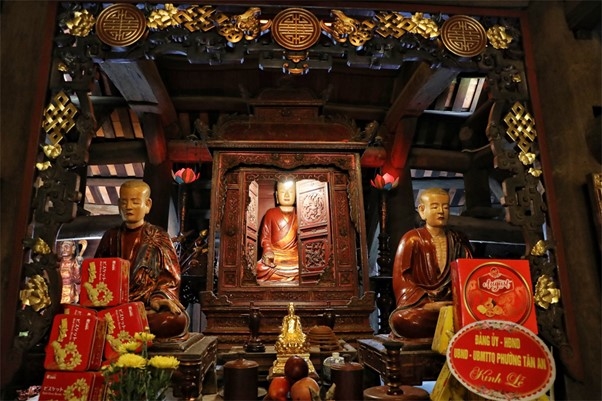
 The official recognition of the Truc Lam Zen Buddhist statue set as a national treasure is not only a source of local pride but also a significant milestone in preserving the Truc Lam Buddhist heritage, a Zen school founded by Vietnamese people
Heritage is a convergence of spirit and art
Vinh Nghiem Pagoda has long been known as Vietnam’s first ‘Buddhist University” and to be home to famous woodblock prints. But deep within the main hall, the statues of the Three Patriarchs of Truc Lam are the soul, the most sacred objects of veneration. The set of statues includes three founding masters: Emperor Tran Nhan Tong, Phap Loa and Huyen Quang. The three statues are a masterpiece of sculpture, reflecting the spirit of self-reliance and self-strength of the nation during the Tran Dynasty through the sculptural language of the Le Trung Hung period (17th - 18th centuries). The centerpiece of the collection is a statue of the founding ancestor Tran Nhan Tong, sculpted in a seated lotus position on a lotus throne, his face radiating serenity yet full of dignity. The most striking feature of this statue is the seamless combination of the appearance of an emperor and the demeanor of an ascetic monk. Ancient artisans skillfully crafted the soft, flowing folds of the robes that cascaded down to the base of the statue, creating the illusion that the figure was present in flesh and blood. His gaze was lowered, half-closed, half-open, as if he were in a state of profound meditation, yet still encompassing the suffering of humanity. This is the symbol of “Living in the world while still finding joy in the Dharma”, a core philosophy of the Truc Lam Zen school.
Standing or sitting on either side of the First Patriarch were the Second Patriarch Phap Loa and the Third Patriarch Huyen Quang. While the First Patriarch possessed the serene demeanor of a founder, the Second Patriarch, Phap Loa, appeared with the sharp intellect and wisdom of someone who made significant contributions to systematizing the scriptures and building the Buddhist Sangha. The statue of Phap Loa at Vinh Nghiem is sculpted with graceful lines, clearly reflecting the demeanor of a distinguished Buddhist intellectual. Meanwhile, the statue of the Third Patriarch Huyen Quang, the poet of the Zen school, exudes a benevolent and approachable aura. Details such as thick earlobes, a full face and a subtle smile on his lips evoke feelings of warmth and tolerance in the viewer. The presence of the three statues in a single structure not only carries religious significance but also affirms the continuous and enduring transmission of Vietnamese wisdom.
Unique value and noble symbolism
Unlike many sets of statues of the Three Patriarchs in other temples, which are usually made of fired clay or wood and painted with bright red and gold leaf, the set of statues at Vinh Nghiem pagoda retains the solemn and tranquil appearance of time. The sculpting techniques of that time had reached a masterful level in terms of realism. Every vein, muscle fiber, and wrinkle on the forehead of the statues is meticulously rendered, giving them a lifelike quality. Furthermore, the distinctive wood material and antique lacquer finish have helped the statues withstand the harsh hot and humid climate of the North (Vietnam) for hundreds of years. The Truc Lam Zen school, founded by King Tran Nhan Tong, has proven that the Vietnamese people are fully capable of building their own system of thought, suited to their identity and spirit, instead of passively accepting it from the outside. The statues are a declaration through sculptural art of that intellectual independence. The statues are a sculptural declaration of that intellectual independence. The statues of the Three Patriarchs of Truc Lam are cultural entities telling the story of a glorious era, of people who dared to renounce glory to find their true selves and, from that selves, in order to serve the people. In an effort to preserve and promote the value of this heritage, this precious set of statues will forever remain a spiritual anchor, a place where every Vietnamese person can find peace and national pride./.
