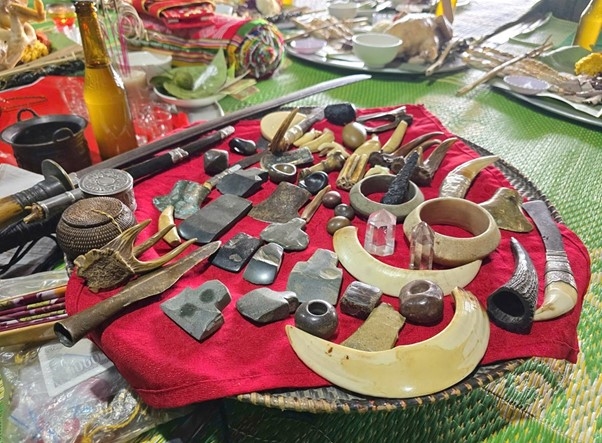
 The shaman's "Tui Khot" (Bag of Sacred Artifacts) is a collection of rich and unusual "magical objects" amassed over hundreds of years
Shamans are practitioners of folk culture and perform important spiritual rituals in the lives of the Muong people. They act as a “bridge” between the real world and the spiritual realm. In the shaman’s ceremonial tools, besides the bell, sword, and offerings, there is a special “treasure” that he always carries with him: the Khot bag. That bag opened up a mysterious spiritual world, containing invisible powers that helped the shaman subdue demons and preserving the memories of the village.
The shaman’s Khot bag is a rich and unusual collection of different “ritual objects”, sometimes collected over hundreds of years. The Muong people call it the “bag of precious items”, the “bag of magic” - an inseparable object that determines the authority and power of a shaman.
Before the ceremony, the shaman lights incense and recites a spell to “awaken the Khot”. When the shaman’s words are spoken, the bag is considered to have come back to life, ready to obey the shaman’s commands. Opening the bag, the world inside the Khot bag was utterly astonishing to outsiders. In the Khot bag contained all sorts of things: metal, stones, bones, horns. It is the convergence of three sources of energy: the power of earth and sky (meteorites, gemstones, metals); the power of ancestors (prehistoric artifacts); and the spiritual energy of all living things (tiger fangs and claws, bear hooves, elephant tusks... of wild animals that died of old age; absolutely no items from animals that have been slaughtered should be used). The Muong people believe that wild animals that have lived for many years have become “spirits”, so their souls are very powerful and can help the shaman protect himself when entering the underworld. The shaman arranges sacred objects on the altar to join with the spirits to assist him in performing the ritual.
The Khot bag also contained other objects, such as: axes, weapons, musical instruments made of stone, bracelets, earrings made of granite, transparent quartz, mysterious meteorite fragments believed to have fallen from the stars… All of these are objects found in nature, not modern artifacts, because man-made objects would have no spiritual value. The objects in Khot bag are not entirely found by the shamans themselves; sometimes, villagers working in the fields or plowing accidentally stumble upon a strangely shaped stone and then they bring it to the shaman as a gift. People believe that these objects have souls, and keeping them in the house without knowing how to “ward them off” will cause illness; only shamans have the magical power to “tame” them.
For shamans, the Khot is a sacred bag. The more rare objects a shaman possesses in the Khot bag, the more it demonstrates their superior status and power in the spiritual realm. These mysterious objects are the “invisible army” that helps the shaman to appease the spirits, ward off misfortune and protect the household. It may sound mystical, but in the spiritual life of the Muong people, it is a real and enduring belief that has lasted for many generations.
An interesting detail is that Khot bag cannot be bought with money. It is a family heirloom passed down from the shaman to his successor. With each generation, the contents of the bag accumulate, like layers of sediment from time, where the history of humankind through the Stone Age, Bronze Age and stories of sacred forests and wild animals… all gather. Khot bag is like a miniature “spiritual museum”, a place that stores memories and beliefs. Therefore, the Muong people have a saying: “as precious as a Khot bag”, implying that the bag serves as a measure of the most valuable things in life.
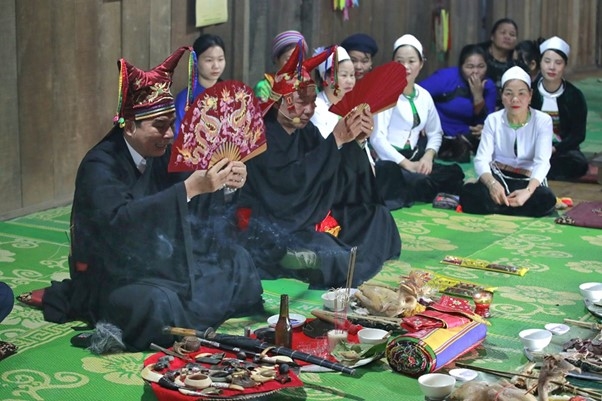 The “magical objects” in the Tui Khot (Bag of Sacred Artifacts), along with the fan are always inseparable items for the shaman when performing rituals
In today’s fast-paced life, where many rituals have been simplified and many items have changed, the Khot bag still accompanies the shaman up the steps of the stilt house and through every ceremony. It wasn’t a small, lightweight bag to carry around for convenience. It was a fortune. There are Khot bag weighing tens of kilograms, filled with strange objects accumulated over generations, each item representing a layer of memory, folk knowledge or a spiritual belief passed down through generations. Therefore, when a shaman carries a Khot bag during a ceremony, he is essentially carrying on his shoulders the history of his family, his Muong village and the entire spiritual world of the community.
Today, the secrets of the Khot bag have been deciphered. Many items inside have been inventoried and assigned codes by the State for management and preservation. However, as long as people seek out shamans to entrust their religious beliefs, the Khot bag will continue to accompany the shaman to every ceremony. And the Khot bag remains a distinctive and representative cultural and spiritual symbol of the Muong people throughout the years.
