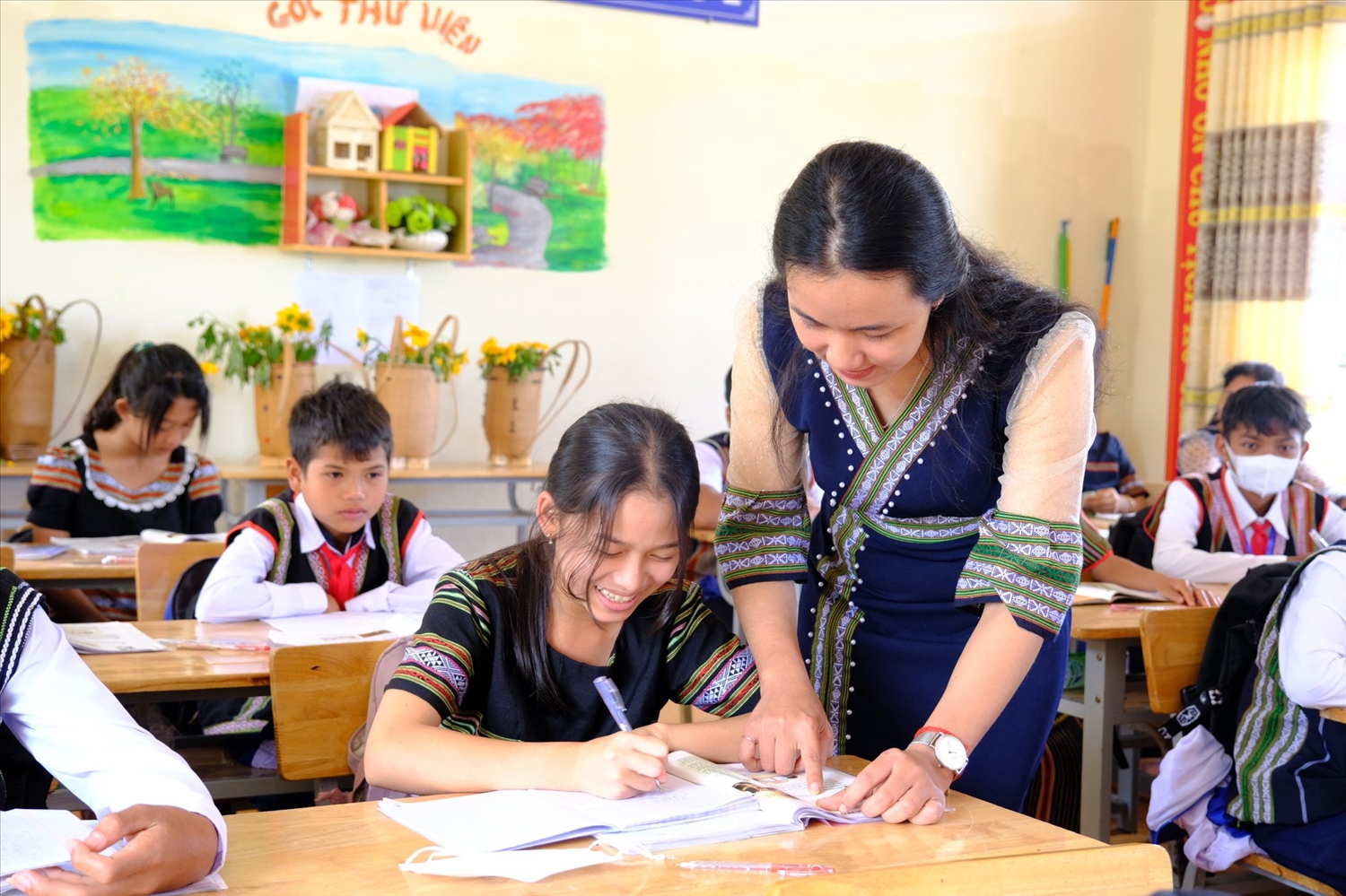
 Implementing the objectives in Resolution No. 71-NQTW presents a strong opportunity for the development of ethnic minority education
Keywords: Resolution No. 71-NQ/TW; Ethnic education; Ethnic minority and mountainous areas.
1. Research results
1.1. Overview of the current state of education and training in ethnic minority and mountainous areas
An analysis of the results of the survey on the socio-economic situation of 53 ethnic minority groups, conducted by the Committee for Ethnic Minorities Affairs (now the Ministry of Ethnic and Religious Affairs) in coordination with the General Statistics Office (Ministry of Planning and Investment), now the Statistics Department (Ministry of Finance) in 2024 (results published on November 28th, 2025), on the Ministry of Ethnic Minorities and Religious Affairs’s electronic portal, reveals the following issues:
Firstly, the level of access to general education for ethnic minorities has improved significantly, but there is a considerable disparity in access to lower secondary and upper secondary education between socio-economic regions.
According to the survey results, as of July 1st, 2024, the primary school enrollment rate for ethnic minorities was 103.2% (an increase of 2.7%) compared to 2019; lower secondary school enrollment was 91.5% (an increase of 5.7%); upper secondary school enrollment was 54% (an increase of 3.8%). Compared to the previous survey (2019), the level of access to general education of ethnic minorities has improved significantly, especially at the secondary school level.
The percentage of ethnic minority children attending primary school at the appropriate age reached 96.3%, a negligible decrease compared to 2019 (96.9%); at the lower secondary level, it reached 87% (an increase of 5.35%); at the upper secondary level, it reached 51.7% (an increase of 4.55%). There are not many differences between socio-economic regions in terms of primary education enrollment levels, but there are quite significant disparities at the lower and upper secondary levels. The highest rates of enrollment at lower and upper secondary levels are in the red river Delta region, at 92.4% and 66.4% respectively; the lowest are in the Central Highlands, at 77.1% and 31.8% respectively. Thus, the largest difference between socio-economic regions is 15.3% at the lower secondary level and 34.6% at the upper secondary level.
Secondly, there are gender and regional differences (rural and urban) in the literacy rate of the common script
Literacy in the common language refers to the ability to read and write a simple passage in everyday language. This rate is one of the general indicators reflecting the educational outcomes for ethnic minority communities.
According to the survey results, the literacy rate of ethnic minorities aged 15 and above is 84.9%, an increase of 4% compared to 2019. However, to achieve the goals in the Overall Plan for socio-economic development of ethnic minority and mountainous areas for the period of 2021-2030: “By 2025, over 90% of people aged 15 years and older will be able to read and write Mandarin fluently”. It is necessary to focus on policies to increase the school attendance rate of ethnic minority children at all levels and cultural enrichment programs for ethnic minorities beyond the age of high school attendance. In addition, there are gender differences and differences between urban and rural areas regarding the ability of ethnic minorities to read and write fluently in the common script. Male ethnic minorities have a higher literacy rate in the common script than female ethnic minorities by 8% (88.9% and 80.9%), although this gap has narrowed by 3.6% compared to 2019. The proportion of ethnic minorities living in urban areas is 7.3% higher than in rural areas (91.1% and 83.8%), although this gap has narrowed by 1.6% compared to 2019.
Thirdly, the educational level of ethnic minorities is still low compared to the national average
Education is one of the important indicators reflecting the quality of the population and education. Currently, the percentage of ethnic minorities aged 15 and over with a high school education by gender is 22.1%, much lower than the national average (36.5%) [1]. There are also disparities in the highest educational attainment levels of ethnic minorities between urban and rural areas. The percentage of ethnic minorities aged 15 and over who have not completed primary school in rural areas is 1.5 times higher than in urban areas; similarly, the percentage of ethnic minorities aged 15 and over with a high school education is 1.9 times higher in urban areas than in rural areas.
Fourthly, regarding technical expertise categorized by educational level and gender
Only 12.8% of ethnic minorities aged 15 and over have technical professional qualifications, much lower than the percentage of the population with technical professional qualifications of the whole country (19.2%) [2]. Among those with technical and professional qualifications, the proportion of ethnic minorities with college degrees or higher accounts for 46%. Notably, the proportion of ethnic minority people aged 15 and over without technical or vocational qualifications is higher among women than men (4.6%); however, the proportion of men with basic qualifications is 3.6 times higher than that of women. At higher levels such as college and university, ethnic minority women have a higher percentage than men (0.4% at the college level and 0.7% at the university level and above, respectively).
1.2. The core content of Resolution No. 71-NQ/TW of the Politburo, viewed from the perspective of ethnic education
In the process of national development, our Party and State always consider education and training along with science and technology as top national policies. However, the country's education and training in general, and ethnic education in particular, still face many difficulties and limitations, and have not yet truly become the key to breakthrough development for the country and for ethnic minority and mountainous areas.
Currently, Vietnam is facing a historical opportunity for breakthrough development, therefore the need to build human resources with patriotism and national pride, possessing the courage, intelligence, competence, qualifications and health to meet the requirements of national construction, development and defense in the new development phase is extremely important and urgent, demanding a breakthrough in education and training development. As a part of the national education system, education and training in ethnic minority and mountainous regions cannot be separated from the trends and requirements of national education and training development, especially in the context of the existing gap as broadly described in the picture above.
On August 22nd, 2025, the Politburo issued Resolution No. 71-NQ/TW on breakthroughs in education and training development (the Resolution). The Resolution emphasizes the following viewpoint: “Deeply and fully understanding and consistently implementing the view that education and training is a top national priority, determining the future of the nation”, and “Developing education and training is the undertaking of the Party, the State and the entire people”. These viewpoints are not new, but the approach has changed, with the tasks and solutions set forth being: “a strong shift from administrative management thinking to a development-oriented, modern governance and decisive action. Placing the development of education and training within the national and social governance mindset”. “Ensuring fair and equal educational opportunities for all”... In ethnic minority and mountainous regions, these principles have particular significance. Because, if we want to improve the quality of human resources, eradicate poverty sustainably and unleash the potential of the community… there is no more sustainable path than focusing on raising the intellectual level of the people and creating an equitable, modern education system accessible to all ethnic groups.
The Resolution emphasizes the State’s responsibility to “play a strategic guiding role, create development, ensure resources and equity in education”. Firstly, regarding strategic direction, the Resolution sets the goal to strive for by 2030: “In order to complete universal preschool education for children aged 3-5 and compulsory education up to lower secondary school; at least 85% of people of school age complete high school or equivalent”; “The percentage of people of school age pursuing post-high school education reaches 50%. The percentage of workers with college degrees or higher reaches 24%”.
Comparing the goals in the Resolution with the situation of ethnic minority and mountainous areas, it can be seen that the task of developing ethnic education in the period of 2026-2030 is very heavy. But achieving these goals is an opportunity to invest in strongly developing the current national education system. Furthermore, from the perspective of ensuring resources, the Resolution requires: “State budget expenditure on education and training must reach at least 20% of total state budget expenditure, of which investment expenditure must reach at least 5% of total state budget expenditure and expenditure on higher education must reach at least 3% of total state budget expenditure. Unanimously agreed on the principle of developing and implementing the National Target Program on modernization and improvement of the quality of education and training for the period of 2026-2035”.
From the perspective of ensuring equitable access to education, this is the foundation of social stability and a condition for the sustainable development of the nation and ethnic minority areas. Equity in education is achieved through tasks and solutions such as expanding the network of basic schools and classes to meet the learning needs of students from all backgrounds and regions; completing the construction of a network of ethnic boarding schools in ethnic minority areas, disadvantaged areas, and border regions before 2030; expanding the system of pre-university training for ethnic minority and mountainous students; ensuring that each province and city has at least one specialized educational institution up to the high school level… Successfully implementing these tasks and solutions is an opportunity to fundamentally address the “shortage of schools - shortage of classrooms - shortage of housing” that exists in many localities inhabited by ethnic minorities and mountainous areas.
Besides the general tasks and solutions for national education and training, studying the Resolution, can further summarize two major groups of policies related to ethnic minority education in the coming years as follows:
Firstly, regarding the quality-oriented group: The resolution requires: Taking care of children's education from the very beginning of their lives and preparing the necessary conditions for universal preschool education for children aged 3-5 years old; innovating methods and programs, strengthening the application of technology, developing digital education and open education; building and implementing high-quality vocational training programs for ethnic minorities in suitable professions… This is an opportunity for ethnic minority and mountainous regions to narrow the gap in the quality of education and training compared to other regions.
In reality, over the years, maintaining only the traditional classroom model under conditions lacking standard learning equipment, practical classrooms, and STEM/STEAM experiential learning spaces (which are practical activities, experiments and projects that help students apply knowledge from Science, Technology, Engineering, Mathematics, and Art - for STEAM) to solve real-world problems with the goal of developing critical thinking, creativity, problem-solving skills and the connection between theory and practice) makes it very difficult to improve the quality of education in ethnic minority and mountainous areas. However, if technology is leveraged, from online learning and blended learning to software supporting bilingual teaching, students in ethnic minority and mountainous areas can fully access learning content that was previously very difficult to access. On the other hand, for ethnic minority and mountainous regions, strengthening digital transformation also helps students have equal opportunities in accessing education. Where there is a shortage of teachers, online teaching can be provided; where transportation is difficult, students can learn using digital materials… Thus, it also contributes to narrowing the educational gap between ethnic minority and mountainous areas and more developed areas.
Secondly, the institutional orientation group: The resolution requires: There are specific and outstanding policies for teachers, especially good teachers and teachers who understand ethnic cultures; Increase the preferential allowance for teachers in preschool and general education institutions to at least 100% for teachers in particularly difficult areas, border regions, islands and areas inhabited by ethnic minorities; building official housing and creating favorable conditions for teachers from distant areas to work… This set of solutions is crucial because, without addressing the issue of teachers, the goals of educational reform will be difficult to achieve. In ethnic minority and mountainous areas, teachers are not only transmitters of knowledge but also cultural connectors, helping students both preserve their ethnic cultural identity and access new knowledge. Furthermore, as the Resolution calls for improving the quality of education, innovating methods, and applying technology, the need for high-quality teachers in ethnic minority and mountainous regions becomes even more urgent. In addition, the Resolution also calls for expanding financial support policies and preferential credit for learners, ensuring that no student has to drop out of school due to financial difficulties.
The resolution also outlines several important directions, namely: “The whole society has the responsibility to care for, participate in contributing resources to, and supervise the development of education”, and “education must ensure harmony between universal and elite education, comprehensive and specialized education, national and global education”. For ethnic minority and mountainous regions, concretizing these orientations presents an opportunity to develop many innovative education and training models such as: classes on preserving ethnic culture; vocational training programs in villages that combine the needs of businesses with local people in fields such as: forestry, agricultural production, traditional handicraft production, community tourism… If these classes are widely implemented, they will create a model of “practical education - real-world application - linked to livelihoods”, which is very much in line with the Resolution’s viewpoint that education and training must ensure "learning goes hand in hand with practice”, “theory is linked with reality”, and “schools are linked with society”, while simultaneously transforming heritage into assets from the incredibly rich and unique cultural and knowledge potential of ethnic minority communities. Combining vocational education with regional economic development needs can help ethnic minority youth establish careers in their hometowns, providing employment while promoting labor restructuring, reducing migration and minimizing social disruption in ethnic minority and mountainous areas. Furthermore, businesses, social organizations, and individuals, from successful individuals to Vietnamese expatriates abroad, can all become part of the ecosystem for developing national education through activities such as: awarding scholarships, opening volunteer classes, projects to donate libraries and computer labs, supporting teachers, providing internet sponsorship packages,… contributing to narrowing the educational gap between regions and ethnic groups.
2. Conclusion
Resolution No. 71-NQ/TW marks a turning point in the vision and policies for education and training nationwide in general and ethnic minority education in particular. The groundbreaking spirit in the Resolution stems from innovation in thinking, awareness, and institutions, with clear and specific tasks and solutions, hoping to become a driving force for sustainable development of education and training in ethnic minority and mountainous areas, contributing to the successful implementation of the new vision and strategy of the national education system in the context of digital technology and artificial intelligence reshaping education globally.
References
1, 2. Central Steering Committee for the Population and Housing Census, Results of the Population and Housing Census at 0:00 (April 1st, 2019), Statistical Publishing House, Hanoi, 2019.
3. Politburo (2025), Resolution No. 71-NQ/TW dated August 22nd, 2025 on breakthroughs in education and training development.
4. Ministry of Ethnic Minorities and Religions (2025), Updating and reviewing the results of the survey collecting information on the socio-economic situation of 53 ethnic minority groups in 2024, cema.gov.vn
5. National Assembly (2019), Resolution No. 88/2019/QH14 approving the Overall Plan for socio-economic development of ethnic minority and mountainous areas for the period of 2021-2030.
