Keywords: Ethnic minority cadres; Ethnic affairs; Ethnic policy; Human resource development.
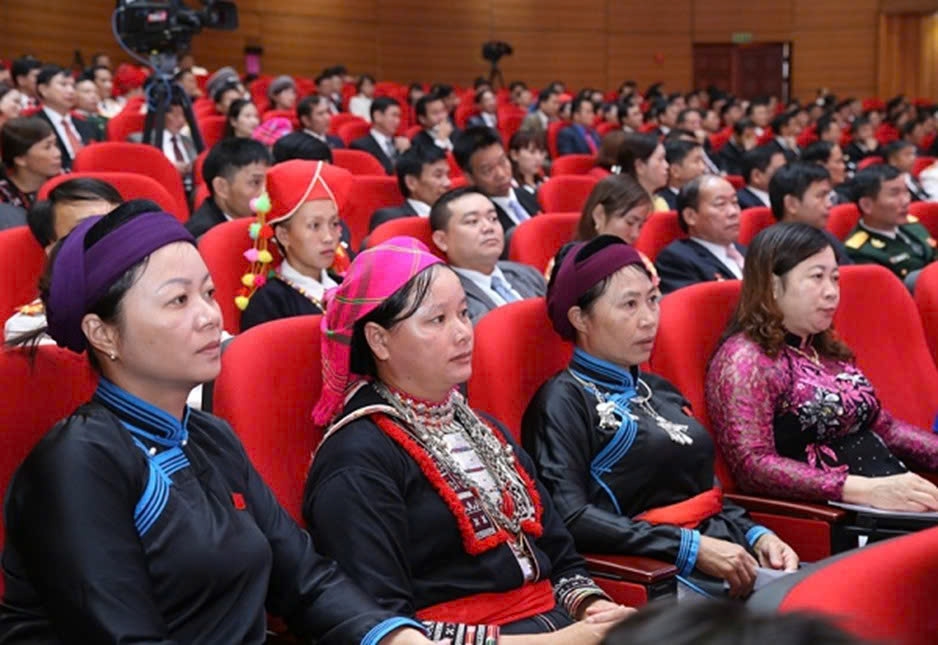 The Party and the State of Vietnam have always paid attention to and developed the contingent of ethnic minority cadres
 1. The Party’s viewpoint on building a contingent of ethnic minority cadres
Vietnam is a multi-ethnic nation in unity, with 54 ethnic groups, including 53 ethnic minorities. The majority of ethnic minorities live in mountainous, border, remote, particularly disadvantaged areas. Therefore, the Party and the State always highly appreciate the role of ethnic minority cadres in the revolutionary cause. Since 1947, the Resolution of the Central Cadre Conference (April 3rd to 6th) has requested: “Special attention should be paid to training ethnic minority cadres and supporting them, bringing them into local leadership agencies”[8].
That viewpoint has been further affirmed and concretized in numerous resolutions, directives and conclusions of the Central Committee throughout different stages of the revolution. Resolution No. 24-NQ/TW dated March 12th, 2003, of the Central Committee of the Communist Party of Vietnam (9th term) on ethnic affairs emphasizes: “Focus on developing and nurturing human resources; take care in building a team of ethnic minority cadres”, with the solution: “Effectively implement the planning, training, development and utilization of ethnic minority cadres for each region and each ethnic group”.
In Conclusion No. 65-KL/TW dated October 30th, 2019, of the Politburo on continuing to implement Resolution No. 24-NQ/TW of the 9th Central Committee of the Party on ethnic affairs in the new situation, it was stated: the grassroots political system in ethnic minority and mountainous regions has been strengthened, the cadre has been improved, better meeting the requirements and tasks; However, it was also noted that compared to the overall development of the country and each locality, the lives of ethnic minority people still face many difficulties, socio-economic development is slow; The rates of poverty, near-poverty, and the risk of falling back into poverty are high; The gap between rich and poor tends to widen. Outdated customs, practices and superstitions are slow to be eradicated; There are still underlying complexities related to political security, order and social safety…
Analyzing the causes of these shortcomings, the Politburo affirmed that some Party committees, Party organizations and government agencies “have not paid adequate attention to the work of creating a pool of candidates for planning and training cadres from ethnic minority groups” and requested: “Focusing on developing human resources and building a team of ethnic minority cadres”.
From the 11th National Congress (2011) to the 13th National Congress (2021), developing human resources to meet the requirements of socio-economic development has always been one of the three strategic breakthroughs of the Party. The congress documents all emphasized the importance of identifying, training, nurturing and utilizing cadres, especially female cadres and young cadres from ethnic minority groups.
In addition to general resolutions, directives and conclusions, the Politburo also issues specialized resolutions related to each region, especially regions with a large ethnic minority population. esolution No. 11-NQ/TW, dated February 10th, 2022, of the Politburo (13th term) on the direction of socio-economic development and ensuring national defense and security in the midland and mountainous regions of Northern Vietnam until 2030, with a vision to 2045, identifies the following tasks and solutions: “Improving the quality of human resources, especially those from ethnic minority communities is considered one of the breakthroughs for the rapid and sustainable development of the region”. Similarly, Resolution No. 23-NQ/TW, dated October 6th, 2022, of the Politburo of the 13th Party Congress on the direction of socio-economic development and ensuring national defense and security in the Central Highlands region until 2030, with a vision to 2045, also emphasizes: “Implementing comprehensive solutions to improve the quality and efficient use of human resources, especially those from local ethnic minority communities, should be considered one of the breakthroughs for the rapid and sustainable development of the region”.
The Party’s viewpoint is concretized by the State through a system of policies and laws. Article 11 of Government Decree No. 05/2011/ND-CP dated January 14th, 2011, on ethnic affairs stipulates: (1) Ethnic minority cadres who are capable and meet the standards prescribed by law are appointed to key cadre positions and management positions at all levels. In ethnic minority areas, it is essential to have key cadres who are members of ethnic minorities. (2) Ensuring a reasonable proportion of ethnic minority cadres, prioritizing female cadres and young cadres to participate in agencies and organizations in the political system at all levels. (3) Ministries, branches, localities are responsible for planning, training, fostering, appointing and utilizing the team of ethnic minority cadres.
In particular, Decision No. 402/QD-TTg dated March 14th, 2016, of the Prime Minister approving the Project on developing the contingent of ethnic minority cadres, civil servants and public employees in the new era, for the first time sets quantitative targets on the percentage of ethnic minority cadres in state agencies and identifies key groups of solutions, this includes the task of providing ethnic knowledge training to four target groups (Provincial-level leaders and equivalents; Department-level leaders and equivalents; Division-level leaders and equivalents; Cadres, civil servants and public employees who do not hold leadership positions). Decision No. 771/QD-TTg dated June 26th, 2018, of the Prime Minister approving the “Scheme for Training in ethnic knowledge for cadres, civil servants and public employees in the period of 2018-2025” assigned the Committee for Ethnic Minorities Affairs (now the Ministry of Ethnic and Religion) to preside over the development of training programs and materials, reflecting a shift from general training to equipping ethnic minority cadres with specific knowledge and skills.
The period of 2021-2025 marks a turning point in policy thinking regarding the training and development of ethnic minority cadres, with Project 5 being allocated to it within the National Target Program for socio-economic development of ethnic minority and mountainous areas (2021-2030): “Developing education and training to improve the quality of human resources" is essential to fulfilling this task. The project comprehensively covers all stages: from strengthening the system of ethnic minority boarding and semi-boarding schools (Sub-project 1); Ethnic knowledge enhancement and high-level training (Sub-project 2); Vocational education development (Sub-project 3); In order to enhance the capacity of the program implementation staff at all levels (Sub-project 4). This approach has closely linked the development of human resources for ethnic minorities with the overall socio-economic development goals of the entire region. Recently, on June 24th, 2025, the National Assembly passed the Law on Cadres and Civil Servants, in Article 3, Clause 7, which states the principle: “Prioritize recruitment, appointment and implementation of policies and regulations for ethnic minorities”.
2. Research Results
During the period of 2021-2024, the proportion of ethnic minority cadres, civil servants, and public employees in agencies and units has been gradually increased. The total number of ethnic minority cadres, civil servants and public employees is 267,229, of which 7,841 are at the central level and 259,388 are at the local level. Compared to the regulations in Decision No. 402/QD-TTg dated March 14th, 2016, of the Prime Minister, the number of ethnic minority cadres, civil servants and public employees at the provincial level in most localities has reached the prescribed ratio of the total allocated staff. In some provinces such as Cao Bang, Lang Son, Bac Kan (formerly) and Ha Giang (formerly), the percentage of ethnic minority cadres, civil servants and public employees ranges from 60-80%. Many localities have ethnic minority cadres holding key positions such as commune secretaries and chairmen, showing that the work of recruiting, assigning and utilizing ethnic minority cadres has made significant progress.
In 2025, the implementation of Resolution No. 18-NQ/TW dated October 25th, 2017, of the Central Committee of the Communist Party of Vietnam (12th term) on “Some issues concerning the continued reform and restructuring of the organizational apparatus of the political system to be streamlined, effective and efficient” will follow and the abolition of the district level and the shift to a two-tiered local government model have led to a positive shift and redistribution of civil servants, public employees and workers in the public sector. A significant workforce at the provincial and district levels has been supplemented and strengthened at the commune level, contributing to the standardization and enhancement of the capacity of ethnic minority civil servants at the commune level.
The work of recruiting, training, and developing cadres, along with policies on selective recruitment, targeted training and priority admission for ethnic minority students has significantly contributed to the formation of a pool of young cadres. Over the years, the scholarship program has trained tens of thousands of university and college-level officials for disadvantaged regions. The number and quality of ethnic minority cadres have undergone significant changes. Many ethnic minority cadres have received thorough training in professional skills, political theory and state management, gradually meeting the requirements for standardizing the workforce in the context of administrative reform and digital transformation. State-run political schools, academies and training institutions have allocated specific programs and quotas for ethnic minority individuals, creating conditions to improve the overall qualifications of this group.
During the period of 2021-2025, Sub-project 2: Ethnic knowledge training; Pre-university, university and postgraduate training to meet human resource needs for ethnic minority and mountainous areas under Project 5 of the National Target Program for socio-economic development of ethnic minority and mountainous areas organized ethnic knowledge training for 56,256 trainees; 7,160 trainees received training in ethnic minority languages; 843 students received support for university researchs; 315 students received support for master's degree training; eighteen doctoral students received support for their training. Project 10 organized 115 training courses to enhance the capacity of 9,360 cadres in monitoring and evaluating the program. These figures demonstrate the significant investment and efforts of the entire political system to enhance the capacity of ethnic minority cadres.
However, the quality of ethnic minority personnel in state agencies and public service units is still limited. The proportion of ethnic minority cadres and civil servants with university and postgraduate degrees, professional qualifications, management skills, foreign language proficiency and information technology skills remains low, especially at the commune level. Recruitment, training, and placement of ethnic minority human resources are uneven across different regions. Many provinces have a lower proportion of ethnic minority officials than stipulated in Decision No. 402/QD-TTg of the Prime Minister and this proportion is not commensurate with the proportion of the ethnic minority population. There is a significant disparity in the proportion of ethnic minority civil servants holding leadership and management positions in central and local government agencies. In many localities, the number of ethnic minority cadres and civil servants holding leadership positions does not meet the prescribed ratio, is unevenly distributed across levels, and does not ensure balance and harmony among ethnic minorities in areas with a high ethnic minority population of 70% or more. For example, in Lai Chau province, the Thai ethnic group accounts for over 30% and the Mong ethnic group for 24% of the population, but only 10% of provincial-level civil servants are from the Thai ethnic group, while 3.2% are from the Mong ethnic group. In areas with difficult socio-economic conditions, due to limited resources, policies for utilizing and attracting human resources, especially high-quality human resources have not met the requirements. Some localities, in their annual recruitment plans, do not specify the number of job positions to be filled by ethnic minorities, nor do they clearly define the recruitment targets and ethnic structure, leading to a failure to ensure the required proportion of cadres, civil servants and public employees in state agencies and public service units…
In addition, some ethnic minority officials have limitations in professional qualifications, management skills, foreign languages and computer literacy, while job requirements are increasingly demanding. In some localities, talent development efforts are still superficial and lack a long-term strategy; the link between training and employment is not strong, leading to situations where trained personnel are assigned to unsuitable jobs or even not utilized in their specialized fields. n many places, the remuneration mechanisms, working environment and opportunities for advancement for ethnic minority officials are still limited, affecting their motivation to contribute and their ability to retain young, capable cadres… These limitations reveal a certain gap between policy guidelines and practical implementation, requiring more comprehensive and fundamental solutions in the coming time.
3. Suggesting some solutions
In order to improve the effectiveness of recruiting and utilizing ethnic minority cadres, a comprehensive set of solutions needs to be implemented, focusing on the following key areas:
Firstly, continuing to thoroughly understand and concretize the Party’s viewpoint on the work of ethnic minority cadres in the new context. Party committees and government agencies need to clearly understand that building a team of ethnic minority cadres is an objective requirement in national governance. This perspective needs to be more clearly institutionalized in local human resource development programs and plans.
Secondly, significantly innovating the recruitment process, focusing on proactive, long-term strategies that are aligned with practical needs. Identifying and nurturing young cadres from ethnic minority groups should be done early, starting from the grassroots and linked to cadre planning. olicies on selective recruitment and targeted training need to be reviewed and adjusted to improve the quality of input while ensuring output, linking it to specific placement and utilization and avoiding waste of training resources.
Thirdly, improving the quality of comprehensive training and professional development for ethnic minority cadres. Besides professional knowledge and political theory, emphasis should be placed on equipping individuals with management skills, community engagement skills, digital skills and the ability to adapt to the demands of administrative reform. Training programs should be tailored to the specific characteristics of each region and the working conditions of ethnic minority cadres.
Fourthly, improving the mechanisms for employing, evaluating and rewarding ethnic minority cadres. The placement and utilization of cadres should be based on their abilities, strengths and job requirements, at the same time ensuring a reasonable proportion of ethnic minority cadres in necessary areas. The evaluation mechanism must be fair and transparent, avoiding both tendencies: formal favoritism or rigid “prioritization”. There should be appropriate incentive policies regarding working conditions, housing and income, especially in remote areas to motivate staff to work long-term with peace of mind.
Fifthly, strengthening inspection, supervision and practical experience review. The implementation of policies regarding ethnic minority cadres needs to be monitored and evaluated regularly, promptly identifying shortcomings so that adjustments can be made. Focusing on summarizing successful models and experiences at the local level, then replicating effective practices.
4. Conclusion
In the new context, as the demands for rapid and sustainable development in ethnic minority and mountainous regions become increasingly higher, building a team of ethnic minority cadres that is sufficient in quantity, strong in quality and rational in structure becomes even more urgent. This requires the synchronized involvement of the entire political system, a close combination of sound policies of the Party and State with effective implementation and a strategic vision with concrete, practical solutions. Only then will ethnic minority cadres truly become a core force, a solid bridge between the Party, the State and ethnic minority people, contributing to consolidating national unity and promoting national development in the new period.
* Academy of Construction Strategy and Cadre Training (Ministry of Construction)
References
1. Government (2011). Decree No. 05/2011/ND-CP on ethnic affairs.
2. Communist Party of Vietnam (2003). Resolution No. 24-NQ/TW dated March 12th, 2003 on ethnic affairs.
3. Communist Party of Vietnam (2019). Conclusion No. 65-KL/TW dated October 30th, 2019 of the Politburo on continuing to implement Resolution No. 24-NQ/TW of the Central Committee of the IX Party Congress on ethnic affairs in the new situation.
4. Communist Party of Vietnam (2021). Documents of the 13th National Congress. National Political Publishing House.
5. Communist Party of Vietnam (2022). Resolution No. 11-NQ/TW dated February 10th, 2022, of the Politburo of the 13th Party Congress on the direction of socio-economic development and ensuring national defense and security in the midland and mountainous regions of Northern Vietnam until 2030, with a vision to 2045.
6. Communist Party of Vietnam (2022). Resolution No. 23-NQ/TW dated October 6th, 2022, of the Politburo of the 13th Party Congress on the direction of socio-economic development and ensuring national defense and security in the Central Highlands region until 2030, with a vision to 2045.
7. Prime Minister (2016). Decision No. 402/QD-TTg approving the Project on developing the team of cadres, civil servants, and public employees from ethnic minorities.
8. Committee for Ethnic Minority Affairs (2013). The Communist Party of Vietnam and Ho Chi Minh Thought on the National Question. National Political Publishing House, p.34.
9. National Assembly’s Committee on Culture and Society (2025). Institutionalization of the Party’s policy in laws, ordinances and resolutions of the National Assembly and the Standing Committee of the National Assembly on human resource development, high-quality human resources in ethnic minority and mountainous areas.
