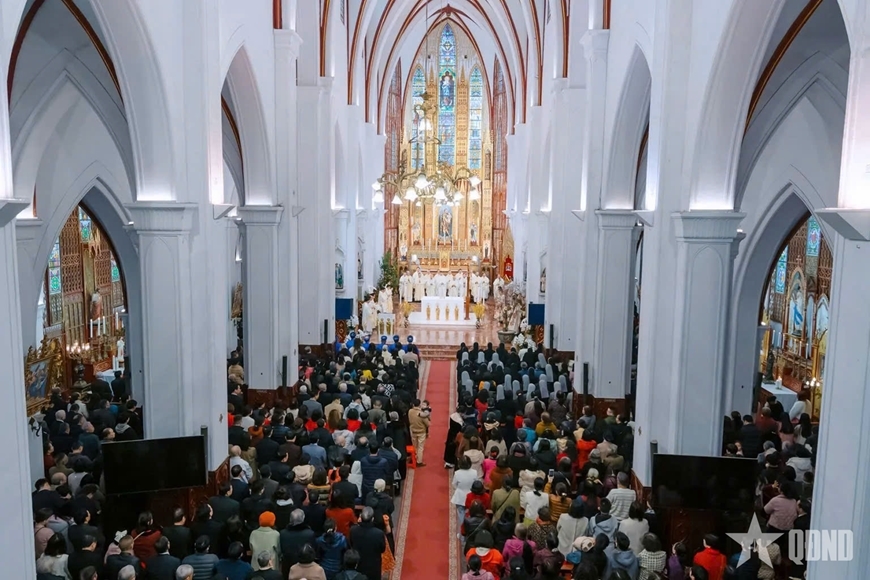
 New Year’s Holy Mass for Catholics
Keywords: Culture; Catholic culture; Cultural integration.
1. Introduction
Catholicism is a major religion with a long history, deeply intertwined with Western culture. Upon its introduction to Vietnam, Catholic culture presented a genuine challenge in the journey of walking alongside the nation. Perspectives on Catholic culture shaped from its very origins through the Bible and the Church's magisterial documents encapsulate moral principles that guide the contemporary Catholic worldview and secular conduct. This article examines the concept of Catholic culture to explore its moral foundations and the process of its inculturation into Vietnamese national culture.
2. Catholic culture - Moral issues
Ideas regarding society which laid the foundation for the Catholic Church's system of views on culture emerged 2,000 years ago in the Old Testament. They stem from the doctrine affirmed in the Book of Genesis concerning human existence: “God created man in His own image”. Human beings represent the consummate image and the central element of all the human cultural values that ought to be pursued. In the Bible, humanity is a primary theme; messages concerning equality, justice and righteousness are all directed toward upholding human dignity particularly for the poor and the oppressed who suffer injustice at the hands of social institutions that show little regard for human culture. The Bible also conveys a spirit of solidarity, teaching people to care for others whether near or far and to share in their joys and sorrows; it underscores the duty of each individual to focus on building a civilization of love. Cultivating a Catholic culture centered on the human person is synonymous with building the “Kingdom of God” here on earth, a society where all institutions from economic, political, educational, social and religious issue operate rightly, with the ultimate goal of enhancing human dignity.
The Catholic Church has continued to address cultural themes across various historical contexts. The period spanning the 17th to the 19th centuries marked the transition from medieval civilization to the new industrial civilization; during this time, the Church’s cultural positions were increasingly met with societal hostility, suspicion, accusations and condemnation. It was not until the pontificate of Leo XIII and his encyclical “Rerum Novarum” (1891) that the Church’s cultural concerns truly began to engage with the modern world. Notably, under Pius XI, the encyclical “Quadragesimo Anno” (1931) proposed building a world founded upon “Christian civilization” or a “civilization of love” which was, in essence, an aspiration to universalize Catholic cultural values on a global scale. Subsequently, the subject of culture was examined in depth by the Second Vatican Council in the Constitution “Gaudium et Spes” (1965), the Declaration on Human Dignity and the Declaration on Christian Education (1965). Research indicates that the Catholic Church addresses culture across key dimensions, such as the concept of culture, the role and constituent elements of culture and the means of cultural transmission.
About the concept of culture given its polysemous and complex nature there remain numerous approaches and definitions; the Catholic Church approaches culture in a narrow sense as spiritual culture. Accordingly: “Culture designates all those means by which human beings refine and develop their manifold mental and physical capabilities; strive to subdue the universe through knowledge and labor; and humanize social life as well as family and civic life through the advancement of customs and institutions”.
The role of culture: culture permeates every aspect of social life, playing a significant role in either fostering or hindering social progress. This role manifests in two dimensions: for the individual, culture serves to humanize the person or in other words, “thanks to culture, a human being becomes more truly human and in doing so, renders their existence more meaningful”. For a nation, culture “serves as the source that safeguards a people's identity, while simultaneously expressing and upholding that nation’s sacred sovereignty.” In reality, culture comprises many constituent elements; however, the Catholic Church focuses on two fundamental aspects: morality and truth. Morality is the factor that determines the character of a culture. Therefore, the Catholic Church proposes building an ethic based on core values that upholds the noble dignity of the human person, especially the poor and the working class, who must be given top priority in the endeavor to build a human culture.
The Catholic Church regards truth as the core element of an advanced culture. A culture that respects truth is one built upon respect for human dignity, placing the human person at both the starting point and the ultimate goal of all social development policy planning. Alongside the values of goodness and beauty, truth must be cultivated, practiced, and universalized so that it truly becomes a vital pillar of human character; at the same time, truth must serve as a moral standard in scientific, political and social relations, as well as within the family and in bonds of brotherhood.
Among the countless methods of transmitting culture, the Catholic Church is interested in two main aspects: education and communication, considering these to be urgent areas that need proper attention in the contemporary world. Affirming the urgency and important role of education, on October 28th, 1965, the Catholic Church issued the Declaration on Christian Education. Accordingly, it affirms that the right to education is inviolable and equal for all human beings and must be guaranteed and upheld worldwide: “All people, regardless of race, class or age, by virtue of their human dignity, possess an inalienable right to an education that fulfills their specific mission, suits their individual character and gender, and adapts to their culture and national traditions”.
Recognizing the role of mass media in fostering a genuine culture, the Catholic Church primarily views media as instruments for creating and strengthening solidarity. The Church advocates for mass media to serve the common good aiming to address and eliminate human injustice and suffering rather than catering to the “greed and cravings” of the wealthy. Media must filter out and reject toxic ideologies that run counter to universal cultural traditions and values; media structures, policies, and the distribution of technical infrastructure must ensure fairness and equality regarding everyone’s right to access information; Ensuring a media landscape imbued with an ethical spirit, grounded in “casting aside deceit” to move towards a culture of “truth”.
3. The process of integrating Catholic culture into Vietnamese national culture
Integration with the national culture is an inevitable requirement of the historical development of both Catholicism and the nation; it is a crucial task and a sign affirming the path of accompanying the Vietnamese people. Stemming from this inevitable imperative, the process of integrating Catholic culture with national culture unfolded along two distinct paths: on the non-official level, integration began to take shape as soon as Catholicism arrived in Vietnam; on the official level, the history of cultural integration began later and faced greater challenges.
From an official standpoint, the Second Vatican Council had already issued messages regarding inculturation as early as 1962; however, the spirit of the Council remained unfamiliar to the Vietnamese clergy at the time. It was not until the 1980 Pastoral Letter that the Church addressed the issue of culture, albeit very briefly: “Building within the Church a way of life and a manner of expressing the faith that are in harmony with national traditions”. Regrettably, however, the spirit of inculturation saw little implementation in the years that followed.
Chung letter in 1992, the issue of national cultural integration was discussed more specifically and fully. The Church advises all members of God's people to know how to refine the quintessence of national culture to apply, making national culture a means of existence in the relationship between humans and God, at the same time, culture will bring people closer together. The Pastoral Letter states: “From the very beginning, our forebears knew how to draw upon the riches of our national culture to express their faith and their relationship with God spanning music, art, architecture and rituals, as well as the organization of family, village and parish life. Finding the nuances of national culture does not mean simply reclaiming the ancients, but ensuring that the national character is expressed in prayers and songs, in liturgical celebrations, in daily life as well as in theological reflection and language”.
In subsequent years, Catholic scholars organized numerous large-scale academic conferences aimed at finding solutions to integrate Catholic culture with national culture, placing particular emphasis on the research of local traditions, cultures and ethnic cultures”.
he shift in awareness has led to practical achievements. These achievements were reported by the Catholic Bishops’ Conference of Vietnam at the 1998 Asian Synod of Bishops. During the conference, the Vietnamese bishops presented experiences gained in the field of catechesis, as well as pastoral practices oriented towards inculturation and addressing societal needs. In summary, several key themes were highlighted: 1. How can we speak to God the Father and the Church within the cultural context of Vietnamese society, which is grounded in the family? 2. How can we recognize the working of the Holy Spirit in all people of good will, especially within other religions? 3. How can the veneration of grandparents and ancestors help people come to know God and better understand the Catholic understanding of filial piety in Vietnam?
From a non-official perspective driven by the inherent and inevitable laws of the history of cultural interaction, Catholic cultural elements gradually emerged and integrated with Vietnamese national culture from the very beginning.
Before Vatican II, the Church did not accept Ancestor worship, however, in reality before that, Catholics practiced Ancestor worship in different forms and levels: worshiping those who opened land and villages; worshiping craft ancestors; worshiping King Hung; Worshiping relatives, grandparents, parents and deceased relatives. Filial piety or the spirit of devotion toward parents, grandparents and ancestors serves as a point of convergence between the Vietnamese practice of ancestor veneration and the Catholic worship of God. While the manner of observance may differ somewhat from that of non-Catholics, it remains deeply rooted in national and regional cultural identity. According to a survey, in 1993, the number of Catholics in Ho Chi Minh City worshiping Ancestors reached 88.9% (higher than non-Catholics), Hue was 87.4%, Hanoi was 64.2%. In some countries and religions, a form of worshiping queens has appeared in churches, which is completely similar to the Vietnamese practice of worshiping queens at pagodas.
Catholic rituals and religious lifestyles have also undergone significant changes, moving towards integration with the national culture. Various forms of expression such as readings, prayers, dance, song and ceremonial rites now resonate with the distinctive spirit and character of the Vietnamese people. In the realm of architecture, although the majority of Catholic churches feature Western designs, there are numerous churches spanning over twenty varieties that embody East Asian styles; most of these were constructed by drawing upon the distinctive characteristics of Vietnamese architectural forms, such as communal houses, pagodas, shrines, mansions and palaces… A spirit of cultural integration is also clearly evident in the fields of painting and sculpture.
As we entered the 21st century, global cultural integration became increasingly deep and extensive. In its 2001 Pastoral Letter, the Church affirmed: “The Church brings the Good News not to replace cultures, but to help them flourish and attain the heights of truth, goodness and beauty”. Building upon the established direction, the Church provided more specific and comprehensive guidelines regarding the content and methods of Catholic inculturation in its 2010 Pastoral Letter to the community of God’s people. In this spirit, the Catholic Church in Vietnam must thoroughly study the nation's cultural identity in order to discern what is good, thereby expressing the faith through these cultural elements while infusing the spirit of the Gospel into cultural practices, specifically festivals, the Lunar New Year and rites associated with funerals and weddings. Likewise, it is necessary to encourage and guide Catholic artists in their creative work. Furthermore, training programs at all levels must pay attention to the study of inculturation”.
4. Conclusion
Catholic culture is not a new topic, yet the exploration of its doctrinal foundations has not truly received adequate attention. The inculturation of Catholicism within the national culture remains a genuine challenge. A segment of society views Catholicism primarily through a political lens rather than as a moral or cultural entity or as a resource. This situation has contributed to making Catholic culture appear “alien” to the rest of society. While Catholics may “walk alongside” others, achieving true “harmony” will be difficult as long as historically burdened mindsets and a lack of a spirit of dialogue persist within society. In practice, these moral and cultural issues have been widely disseminated by the Catholic Church, becoming a spirituality that guides Vietnamese Catholics in their commitment to inculturation and “journeying alongside the nation”.
* Academy of Public Administration and Governance
References
1. Nguyen Hong Duong (2016), Paths of Catholic evangelization in Vietnam, Religious Publishing House, Hanoi.
2. Second Vatican Council Community (1962-1965), Pastoral Constitution “Gaudium et Spes” - Joy and hope.
3. Second Vatican Council Community, Declaration on Christian Education, October 28th, 1965.
4. Gioan Phaolo II, Letter to UNESCO, June 26th, 1980.
5. Catholic Bishops’ Conference of Vietnam (2004), Compendium of the Social Doctrine of the Church, Religious Publishing House, Hanoi.
6. Catholic Bishops’ Conference of Vietnam (2002), Complete Bible of the Old and New Testaments, Publishing House. Ho Chi Minh City.
7. Catholic Bishops’ Conference of Vietnam, Catechism of the Catholic Church, Religious Publishing House, Hanoi, 2012.
8. Catholic Bishops’ Conference of Vietnam, Pastoral Letter of 1980, Hanoi, 1980.
9. Catholic Bishops’ Conference of Vietnam, Pastoral Letter 1992, Hanoi, 1992.
10. Catholic Bishops’ Conference of Vietnam, Pastoral Letter 1998, Hanoi, 1998.
11. Catholic Bishops’ Conference of Vietnam, Pastoral Letter 2001, Hanoi, 2001.
12. Catholic Bishops’ Conference of Vietnam, Pastoral Letter of 2010, Ho Chi Minh City, 2011.
