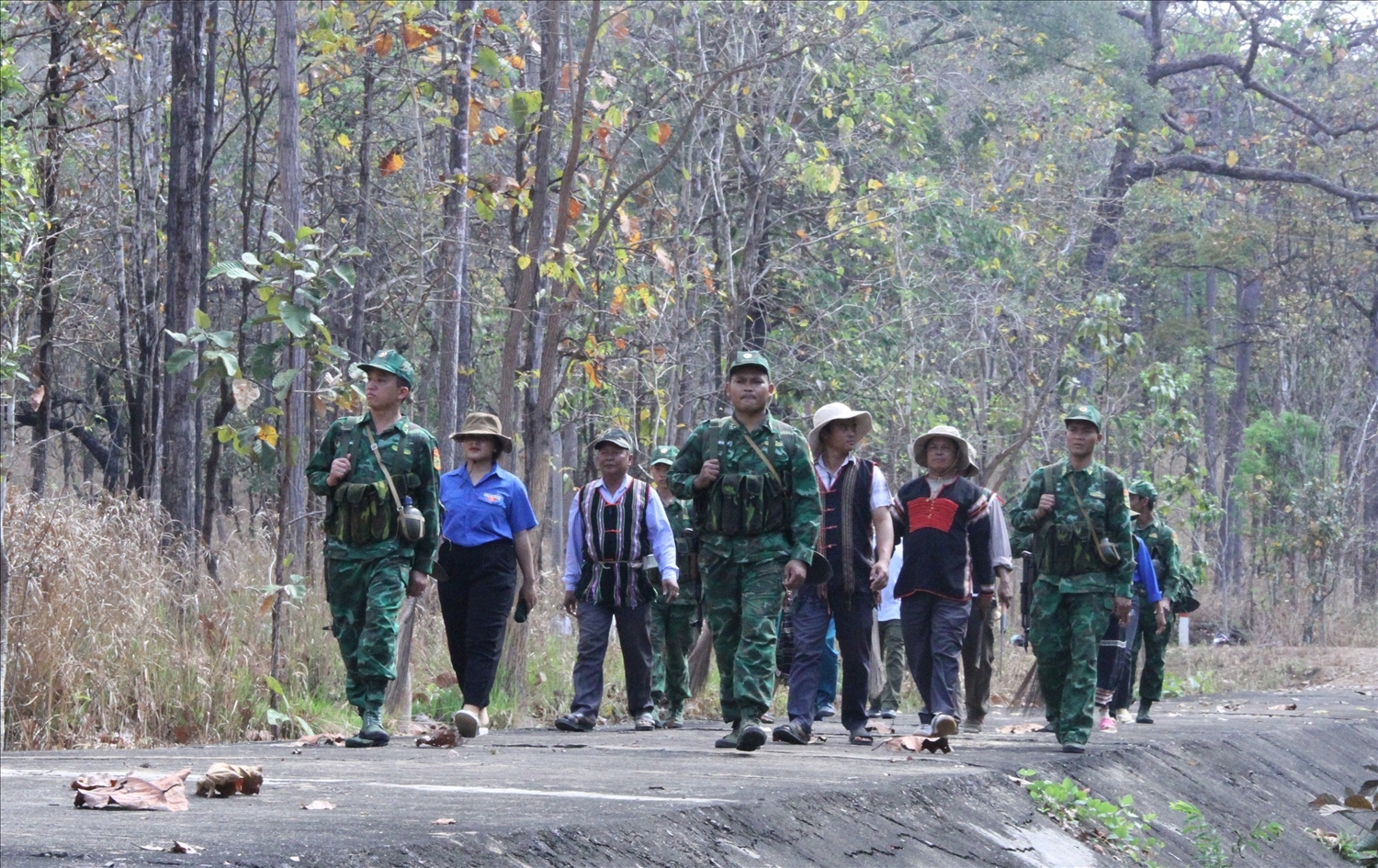
 Respected community figure Y Mosk Hra (third from the left) participates in a border patrol
 Keywords: Cultural security; Ethnic minority areas; Setting issue; Solution.
1. Introduction
Cultural security is a crucial component of national security, playing a direct role in ensuring social stability, strengthening the great national unity and guiding sustainable development. For ethnic minority and mountainous regions, cultural security is not only linked to the preservation of traditional cultural values but is also intimately connected to social trust, ethnic identity and community cohesion throughout the development process. In the current context of globalization, international integration and rapid digital transformation, the traditional cultural spaces of ethnic minority communities are facing significant impacts, posing new challenges for ensuring cultural security.
Reality shows that the disappearance of some traditional cultural values, the breakdown in cultural transmission between generations, along with the impact of the negative side of the market economy and digital media have increased the risk of intrusion and hybridization of local cultural values. Furthermore, the exploitation of cultural, spiritual and religious issues to influence ideologies and sow division within communities continues to harbor complexities that affect social stability in certain ethnic minority and mountainous areas.
In this context, research into cultural security in ethnic minority and mountainous regions holds both theoretical and practical significance. Fully identifying the issues at hand and proposing appropriate orientations and solutions will help strengthen cultural protection capabilities and uphold the role of communities as active agents; in doing so, it will ensure social stability and foster sustainable development in these regions during the current period.
2. Research results
2.1. The current situation of cultural security in ethnic minority and mountainous areas
In recent years, cultural security in ethnic minority and mountainous areas has received special attention from the Party and the State through the refinement of institutional frameworks and the implementation of programs to preserve and promote traditional cultural values. Many distinctive cultural values of ethnic groups such as festivals, beliefs, folk arts, languages, local knowledge and grassroots community institutions continue to be maintained and revitalized. The roles of village elders, village heads, and respected figures in upholding cultural standards, addressing social issues and strengthening community trust continue to be actively promoted, contributing significantly to ensuring social stability and cultural security at the grassroots level.
However, the current state of cultural security in ethnic minority and mountainous areas faces numerous complex challenges. Foremost among these is the risk of cultural identity erosion amidst globalization, the market economy and urbanization. The strong influx of foreign cultural products, alongside shifts in lifestyles and economic needs, has diminished the role of certain traditional cultural practices, particularly ethnic languages, folk rituals and local knowledge. A growing disconnect in intergenerational cultural transmission has become increasingly evident, as the younger generation feels less connected to traditional cultural spaces.
Furthermore, the rapid expansion of the digital media landscape presents new challenges for cultural security. While social media and digital platforms have broadened access to information, they also carry the risk of spreading misinformation and distorting the cultural, religious and historical values of ethnic minority communities. In some instances, cultural and religious factors are exploited to influence ideologies, sow internal division within communities, and complicate the local social security situation.
Another noteworthy issue is the lack of true harmony between economic development and the safeguarding of cultural security. Resource exploitation, tourism development, and economic projects in mountainous regions, if lacking appropriate planning and management can alter cultural landscapes, disrupt traditional institutions and place strain on the community’s cultural life. Meanwhile, the capacity of many communities to safeguard their own cultures remains limited due to a lack of resources, skills and access to information.
Furthermore, state management of culture in certain localities remains inadequate, failing to keep pace with the rapid changes in social life and the digital landscape. Coordination among various sectors and levels regarding the assurance of cultural security lacks synchronization, resulting in a reactive approach to addressing emerging risks and issues. It can be said that the current state of cultural security in ethnic minority and mountainous regions reflects both important foundations of stability and a range of new challenges. Addressing this issue requires comprehensive, community-centered solutions aimed at strengthening cultural preservation capabilities and ensuring cultural security in conjunction with sustainable development.
2.2. Issues concerning cultural security in ethnic minority and mountainous areas
Based on the current state of cultural security, several core issues facing ethnic minority and mountainous areas can be identified; these require a comprehensive approach and resolution, as follows:
Firstly, the issue of preserving cultural identity amidst rapid social change. Processes such as globalization, urbanization, and the shift to a market economy are altering traditional social structures, creating a risk that core cultural values, particularly languages, local knowledge and community cultural institutions may be lost. Unless preservation efforts are linked to the practical realities and livelihoods of the people, achieving sustainable results will be difficult.
Secondly, the capacity of communities to safeguard their own cultures remains limited. Many ethnic minority communities lack the necessary knowledge, skills, and resources to proactively identify, critically assess and respond to negative external influences, particularly within the digital media landscape. Disparities in education levels, access to information and digital literacy heighten the risk of cultural, spiritual, religious and ethnic issues being distorted or exploited.
Thirdly, the relationship between economic development and cultural security has not been harmoniously managed. Certain development activities such as resource extraction, tourism expansion and population resettlement can disrupt community cultural life, shattering traditional cultural spaces and eroding social trust if they lack proper consultation and cultural impact assessments.
Fourthly, limitations in governance and inter-agency coordination are also noteworthy issues. The policy framework regarding cultural security lacks coherence and coordination mechanisms among cultural management agencies, security and information bodies, and local authorities remain insufficiently tight. These issues highlight the urgent need to innovate the approach to cultural security by adopting a community-centered model that harmoniously balances preservation, development and the maintenance of social stability.
2.3. Cultural security contributes to the stability and development of ethnic minority and mountainous areas
Cultural security plays a foundational role in ensuring social stability and fostering sustainable development in ethnic minority and mountainous areas. As a component of non-traditional security, cultural security aims not only to safeguard traditional cultural values but also to strengthen social trust, enhance community cohesion and create a favorable environment for socio-economic development, such as:
Firstly, cultural security contributes to maintaining social stability and strengthening the great national unity. When core cultural values are respected and upheld, the community gains a solid spiritual foundation, thereby mitigating social conflict and limiting the risk of being influenced or divided by external factors. Traditional cultural institutions such as customary laws, village conventions, and the roles of village elders, village heads, and respected community figures continue to play an effective role in regulating social behavior, resolving conflicts, and maintaining order at the grassroots level in ethnic minority and mountainous areas.
Secondly, cultural security lays the foundation for sustainable economic development rooted in local identity. Preserving and promoting traditional cultural values facilitates the creation of suitable livelihood models such as eco-cultural tourism, traditional craft villages and creative economies that are based on local knowledge. When culture is safeguarded and develops healthily, economic activities not only generate income but also contribute to preserving the identity and enhancing the standing of ethnic minority communities throughout the development process.
Thirdly, cultural security plays a crucial role in enhancing the community's capacity for autonomy and adaptability in the face of social changes. In the context of integration and digital transformation, strengthening “cultural resilience” enables communities to proactively and selectively adopt new elements, avoiding assimilation or dependency. This is a prerequisite for ethnic minority groups to participate effectively in modern socio-economic life while preserving their cultural identity.
Fourthly, cultural security plays a significant role in enhancing the community’s capacity for autonomy and adaptability in the face of social changes. In the context of integration and digital transformation, strengthening “cultural resilience” enables communities to proactively and selectively adopt new elements, avoiding assimilation or dependency. This is a prerequisite for ethnic minority groups to effectively participate in modern socio-economic life while preserving their cultural identity.
Fifthly, ensuring cultural security contributes to enhancing the effectiveness of state management at the grassroots level. When culture is regarded as a resource and a prerequisite for development, ethnic policies garner greater community consensus, thereby strengthening the stability and sustainability of ethnic minority and mountainous areas.
2.4. Orientations and solutions about cultural security in ethnic minority and mountainous areas
Ensuring cultural security in ethnic minority and mountainous areas requires a comprehensive approach that regards culture as both the spiritual foundation of society and a resource for sustainable development. The overarching approach is to harmoniously combine the preservation and promotion of traditional cultural values with the requirements of social stability and integration, wherein ethnic minority communities play the central role, while the State acts as a facilitator and coordinator. Policy development and implementation should be based on the principle of respect for cultural diversity, ensuring the cultural rights of ethnic minorities and at the same time have a mechanism to monitor and evaluate cultural impacts on development, tourism and resource exploitation projects.
About the promotion of the community’s role, it is essential to strengthen the capacity for cultural self-protection through education, the transmission of traditional values, and raising awareness of cultural security among the public, particularly the younger generation. The roles of village elders, village heads, influential figures and grassroots cultural institutions need to be strengthened and leveraged as “pillars” for preserving cultural identity and maintaining local social stability. At the same time, the community should be encouraged to take an active part in managing cultural spaces and challenging manifestations of cultural encroachment.
In the rapid growth of digital media, it is essential to prioritize solutions for managing the information landscape by combining media guidance with efforts to enhance information literacy and digital skills among ethnic minority communities. Creating appropriate media content that accurately reflects local cultural values will help strengthen “cultural immunity” against misinformation and distorted information.
In particular, it is essential to strengthen inter-agency coordination among cultural, security and information authorities and local governments, at the same time enhancing cooperation with social organizations, researchers and the community. Such synchronized coordination is a crucial prerequisite for ensuring cultural security in conjunction with social stability and sustainable development in ethnic minority and mountainous areas.
3. Discussion
The aforementioned issues demonstrate that cultural security in ethnic minority and mountainous areas is not merely a matter of protecting heritage or preserving identity, but a core component of social stability and sustainable development. In the context of globalization, international integration, and digital transformation, cultural security needs to be approached as a dynamic process linked to the community’s flexible adaptation to socio-economic changes and the information environment.
Accordingly, shifting from an administrative management approach to a cultural governance model based on community participation is essential in the current new phase. Promoting the active role of ethnic minorities in protecting and promoting cultural values not only improves the effectiveness of cultural security, but also strengthens social trust and the legitimacy of policies. However, without appropriate support mechanisms in terms of resources, education and communication, it is difficult for the community to cope with external impacts on its own.
In addition, cultural security needs to be placed in an organic relationship with economic development and social security. Research shows that only when development policies respect cultural space, ensure people’s livelihoods and cultural rights, can cultural security truly become a foundation for stability and sustainable development in ethnic minority and mountainous areas.
4. Conclusion
Cultural security in ethnic minority and mountainous regions is a crucial pillar for ensuring social stability, strengthening the great national unity and promoting sustainable development. Research indicates that amidst globalization, international integration, and the rapid expansion of the digital media landscape, the traditional cultural values of ethnic minority communities are subject to multifaceted impacts, giving rise to new challenges for cultural security. Ensuring cultural security goes beyond mere heritage preservation; it requires an approach based on comprehensive governance, linked to socio-economic development, cultural rights and the community’s capacity for self-protection. Therefore, strengthening cultural security requires a harmonious combination of institutional refinement, the promotion of the community’s role as the primary actor and enhanced governance effectiveness, all aimed at building a solid cultural foundation for the stability and sustainable development of ethnic minority and mountainous areas in the current period.
* Journal of Ethnic and Religious Research
References
1. Party Central Committee (2014). Resolution No. 33-NQ/TW on building and developing Vietnamese culture and people to meet the requirements of the country’s sustainable development, Hanoi.
2. Government (2021). Strategy for Vietnam's Cultural Development to 2030. Hanoi.
3. Dr. Trinh Quang Canh & MA. Nguyen Duy Dung (2022), Conservation and development of certain ethnic groups with very small populations in Vietnam (Si La, Pu Peo, Ro Mam, Brau, O Du...), People’s Public Security Publishing House, Hanoi.
4. Dr. Nguyen Anh Tuan (2020), Non-traditional security: Issues and solutions for ethnic minority regions, https://lyluanchinhtri.vn/an-ninh-phi-truyen-thong-nhung-van-de-dat-ra-va-giai-phap-doi-voi-vung-dan-toc-thieu-so-1366.html
5. Senior Lieutenant Colonel, MA. Hoang Duc Thanh (2025), Linking sustainable socio-economic development in the Central Highlands with ensuring national defense and security in the context of integration, Journal of Ethnic and Religious Research, Issue 4 - December.
