Keywords: Thang Long Four Fortresses; Thang Long culture; Folk beliefs; Cultural heritage; Imperial city.
1. Introduction
In terms of feng shui, Thang Long is considered a land of coiled dragons and crouching tigers, a place where the spiritual energy of mountains and rivers converges. However, according to the beliefs of the time, any sacred land needed to be protected and guarded to prevent the loss of its dragon vein and to block negative energies from all directions. The Thang Long Four Fortresses system was the solution to that feng shui problem. The placement of the four temples at the four extreme points of East, West, South and North was not simply a matter of dividing administrative boundaries, but rather created a giant Bagua (eight trigrams) diagram, acting as four energy checkpoints. Each deity worshipped here was not merely a historical or legendary figure, but was embodied as a feng shui entity, tasked with guarding the vital gateways of the capital city.
The ancients believed that when the four directions were guarded by great gods, the center, the royal palace, could gather the essence and maintain absolute stability. This is a type of spiritually-driven defensive architecture, reflecting a national governance mindset based on belief in supernatural protection. From a cultural research perspective, this mindset demonstrates the confidence of our ancestors in mastering their living space. They did not passively wait for the whims of nature but actively established a cultural order based on geographical features. The Four Guardian Deities thus became symbols of balance: East (Wood), West (Metal), South (Fire) and North (Water) forming a circle of the five elements in mutual generation, encompassing the Earth element (the center of the capital city).
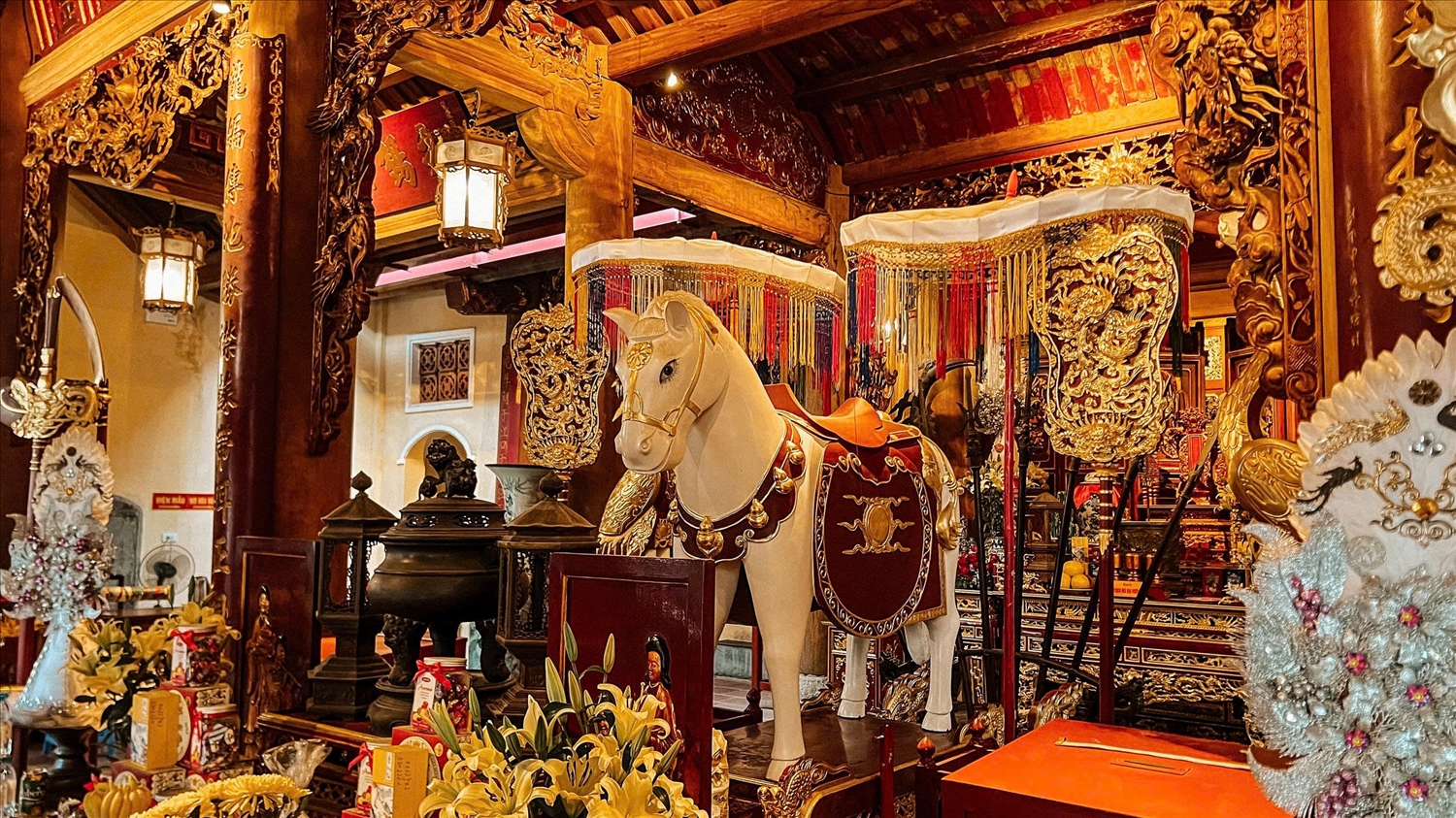 Bach Ma temple is one of the “Four Fortresses” of the ancient Thang Long capital
Therefore, when analyzing the value of the Four Fortresses, considering the architectural principles of feng shui and the mindset of guardianship is key to understanding why these temples have such enduring vitality. The Four Guardian Temples are not merely religious relics, but embodiments of a strategic urban planning philosophy, where every brick and every statue carries the mission of protecting the nation’s longevity and the peace of its people. This wisdom lies in connecting human geography with folk beliefs, creating a unique identity for Thang Long - Hanoi, a city with a thousand years of cultural heritage.
2. The appearance of the Thang Long Four Fortresses system
The appearance of the Thang Long Four Fortresses system emerges as a multifaceted cultural and spiritual diagram, reflecting the close interaction between people, deities and the urban landscape over centuries. Looking at the appearance of the Four Fortresses, one sees a meticulously calculated arrangement, creating a shield protecting the capital from four directions, with each point of contact bearing a distinct architectural nuance and divine character, creating absolute harmony between movement and stillness, between myth and reality.
In the east, the Bach Ma temple (No. 76 Hang Buom Street) stands out as a temple situated in the heart of the busiest part of ancient Thang Long. This is the leading temple of the Four Fortresses (Eastern Guardian temple), dedicated to the god Long Do - a local deity considered the tutelary god of the capital city. The appearance of Bach Ma temple is distinctly characteristic of urban architecture, with a narrow width that gradually deepens inward, following the “inner courtyard, outer walls” structure. The grandeur of the temple lies not in its land area but in its interior decoration system with wooden trusses, ornate gilded horizontal and vertical plaques and especially the statue of the white horse (Bạch Mã), a symbol of auspiciousness and protection for the construction of the citadel. The White Horse Temple represents enduring vitality, where spiritual beliefs are closely intertwined with the bustling commercial life of the capital city.
About the west, the Voi Phuc temple (located by Thu Le Lake) presents a completely different appearance, serene, tranquil and in harmony with nature. The Western Temple is dedicated to Linh Lang Dai Vuong, a prince of the Ly Dynasty who contributed to fighting foreign invaders. The temple is situated on a high mound, surrounded by centuries-old mango trees. The image of two kneeling stone elephant statues in front of the temple gate not only explains the name of the monument but also creates a majestic atmosphere, representing military strength and patriotic loyalty. The appearance of the Voi Phuc Temple evokes a majestic yet poetic western gateway, where historical values are embraced and preserved by nature.
About the south, Kim Lien temple (Phuong Lien ward) served as the southern guardian temple, dedicated to the deity Cao Son Dai Vuong. The temple’s appearance is closely associated with the embankments and agricultural land on the outskirts of the ancient capital. The most striking feature in the architectural appearance of Kim Lien temple is the Cao Son Dai Vuong Than Tu Bi Minh stone stele, erected in 1510, a masterpiece of Le Dynasty sculpture. Compared to the other three temples, Kim Lien temple has the appearance of a cultural institution closely associated with agricultural communities, with its spacious interior and meticulously carved dragon and phoenix motifs on the arched doorways, expressing the aspiration for peace and favorable weather for the low-lying southern region of the capital city.
About the north, Quan Thanh temple (guarding the intersection of Thanh Nien and Quan Thanh streets) emerges with the ethereal beauty of Taoism. The northern side is dedicated to the deity Huyen Thien Tran Vu, who possesses the power to ward off evil spirits and control floods. The appearance of Quan Thanh temple is striking, with its massive triple-arched gate reflected in West Lake and a colossal bronze statue cast in 1677. The statue of Saint Tran Vu, with his hands forming a mudra, his sword resting on the back of a turtle with a snake coiled around it, is not only a national treasure but also defines a cultural image of absolute power. The temple creates a sense of tranquility and solemnity, contrasting with the expansive waters of West Lake, completing the spiritual quadrilateral that protected Thang Long.
Overall, the Thang Long Four Fortresses system does not appear as separate entities, but rather as interconnected spiritual threads, forming a closed arc. The diversity in architecture, from the exquisite beauty of Bach Ma temple, the ancient charm of Voi Phuc temple, the historical significance of Kim Lien temple to the majestic grandeur of Quan Thanh temple, creates an overall appearance that is both solemn and approachable. It represents the presence of deities in secular life, an affirmation of sovereignty, and a symbol of the enduring nature of this land of outstanding people and rich history. Each temple is a perfect piece, painting a portrait of Thang Long that is not only politically strong but also deeply rooted in cultural and religious beliefs.
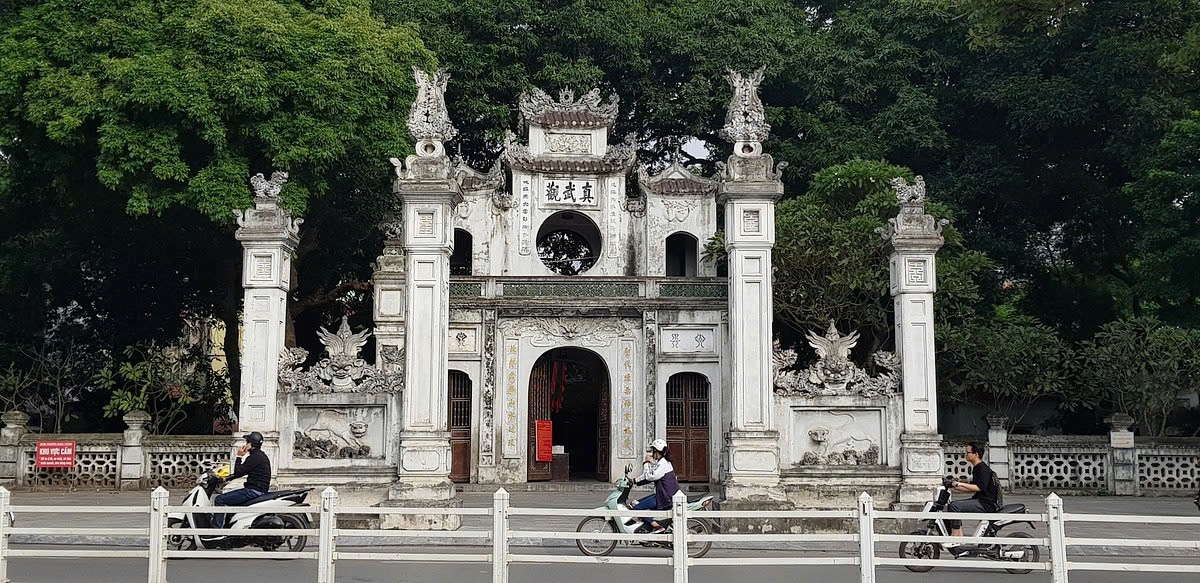 Quan Thanh temple
3. The depth of cultural value of the Thang Long Four Fortresses
In order to understand why the Thang Long Four Fortresses are not merely spiritual destinations but also the soul of the capital city, it is necessary to analyze the layers of culture accumulated over thousands of years. This is a complex system of values where history, philosophy, art and community life are intertwined.
Firstly, in terms of historical value and cultural transformation, the Four Temples are vivid witnesses to the process of building the Vietnamese national identity. Each temple carries within it a story of the transition from indigenous beliefs to imported ideologies that have been deeply internalized. At Bach Ma temple, one can see the image of the deity Long Do, a river and mountain god of ancient agricultural communities, who was later elevated to the status of tutelary deity guiding Cao Bien and then becoming a national guardian deity during the Ly Dynasty. This is evidence of the fusion between indigenous power and the legitimacy of the dynasty. At Quan Thanh temple, the deity Huyen Thien Tran Vu, originally from Chinese Taoism, has been completely Vietnamized to become a water-controlling saint, warding off evil spirits and protecting the peace of the inhabitants of the Red River region. This adaptation demonstrates the cultural resilience of the Vietnamese people, who do not reject the new but always strive to separate the good from the bad in order to serve the cause of protecting and developing the country.
Secondly, in terms of symbolic value and philosophical meaning, the Four Fortresses system is the realization of the ancient people’s five-element philosophy and centralism. In the consciousness of the people of Thang Long, the Four Fortresses were not only four geographical gateways but also four pillars of morality and national strength. The Eastern (White Horse) symbolizes the wisdom and stability of this sacred land; the Western (Facing Elephant) extols loyalty to the king, heroic spirit and sacrifice for the greater good; the Southern (Golden Lotus) honors stability, prosperity and connection to its agricultural roots; the Northern (Quan Thanh) represents the aspiration to conquer nature, dispel darkness and chaos. These four symbols represent the philosophy of sustainable balance: for a strong center (the Imperial Citadel), the surrounding areas must be stable. This is a philosophy of life that emphasizes harmony between humanity and the universe, between secular power and the protection of the supernatural.
Thirdly, the architectural and artistic heritage value of the Four Fortresses is an invaluable treasure of traditional aesthetics. Each temple has its own style and a distinct mark of its era. While Kim Lien temple impresses with its Cao Son Dai Vuong Than Tu Bi Minh stone stele, a masterpiece of Le Dynasty sculpture with its exquisitely curved lines, Quan Thanh temple inspires awe in posterity with its colossal bronze statue, showcasing the peak of bronze casting skill achieved by the artisans of the ancient Ngu Xa village. The architecture of the Four Fortresses strictly adheres to feng shui principles, with courtyards, arched doorways, and crescent-shaped ponds, creating an ethereal yet intimate space. The carvings of dragons, phoenixes and flowers on the wooden components are not merely decorative, but also convey lessons about historical anecdotes and aspirations for peace, passed down through generations of skilled craftsmen.
Ultimately, the value of community connection and religious practice is the lifeblood that keeps the Four Fortresses vibrant in the heart of the modern city. Festivals at the four temples are opportunities for the community to perform rituals of remembering their roots, strengthening neighborly bonds through processions, ceremonies and folk games. In their daily religious practices, Hanoians visit the Four Fortresses to seek inner peace and entrust their faith in virtuous values. This connection is not only between people and deities, but also a link between the past and the present, between generations of Hanoi residents. The Four Fortresses act as cultural anchors, preventing people from being swept away by the whirlwind of urbanization, at the same time maintaining the moral standards and family traditions of the people of Thang An (Hanoi).
4. The role of the Four Fortresses in contemporary society
Firstly, the Four Fortresses serve as anchors of identity amidst the whirlwind of urbanization. Hanoi today is constantly expanding with skyscrapers and modern new urban areas. In this context, the temples of Bach Ma, Voi Phuc, Kim Lien and Quan Thanh emerge as “memory landmarks”, helping the capital’s residents identify their cultural roots. Amidst the concrete and steel structures, the existence of the Four Fortresses reminds the people of a wise urban planning tradition passed down from their ancestors, where development always goes hand in hand with respect for feng shui and spiritual elements. This role is especially important for the younger generation, as the Four Fortresses become practical classrooms for learning about history and national pride, helping them avoid being assimilated into the trend of globalization while still preserving the roots of the people of Thang An.
Secondly, the Four Fortresses serve as a psychological filter and a space for balancing spiritual life. Contemporary society, with its fast pace, work pressure, and information overload, easily leads people into states of stress and disorientation. In this context, the Four Fortresses are not just places of worship but have become urban havens of tranquility. Upon entering through the triple-arched gate of Quan Thanh Temple or Voi Phuc temple, the tranquil atmosphere with its ancient trees and the scent of incense immediately creates a calming effect on the mind. People visit the Four Fortresses not only to pray for wealth and fortune, but more importantly, to seek peace and serenity in their hearts. The role of guardianship, which was once about preventing foreign invasions and evil spirits, has now transformed into one of calming the spirit, helping people find inner balance in a turbulent world.
Thirdly, the Four Towns serve as the nucleus of community cultural activities and social connections. In modern society, where neighborly relationships tend to weaken due to apartment living and increased privacy, festivals in the Four Towns act as a glue that binds people together. The annual festivals at Bach Ma temple and Kim Lien temple still attract tens of thousands of participants, from the elderly to teenagers. Here, traditional moral values are re-enacted through rituals, folk performances and group games. This is a place where the boundaries between social classes are blurred, everyone looks towards a common symbol, practices shared cultural values, thereby strengthening community solidarity and enriching the city’s social capital.
Finally, the role of the Four Fortresses in promoting the development of tourism and cultural industries is undeniable. As special national monuments, the Four Fortresses are important highlights on Hanoi’s tourism map, forming an attractive heritage exploration journey that draws domestic and international tourists seeking to understand the spiritual depth of Vietnam. Promoting the value of the Four Fortresses in conjunction with sustainable tourism development not only brings economic benefits to Hanoi but also directly contributes to the preservation and restoration of historical sites. The presence of the Four Fortresses in cultural tourism tours helps to elevate the image of the Capital city - a City for Peace, a destination that is both modern and dynamic while still retaining its ancient and mysterious charm.
5. Conclusion
In short, the Thang Long Four Fortresses constitute a unique cultural entity, a place where Eastern feng shui principles are combined with the Vietnamese people’s aspirations for peace and self-reliance. Through the ups and downs of history, the Four Fortresses remain steadfast as pillars of spirituality, reminding future generations of their origins and their responsibility to preserve their heritage. Preserving the Four Fortresses is not just about protecting bronze statues or stone steles, but about safeguarding the inherent vitality and lasting peace of this land of the flying dragon in the new millennium.
* Academy of Public Administration and Governance
References
1. Ha Van Tan (Editor) (2010), Vietnamese Temples and Pagodas, Social Sciences Publishing House, Hanoi.
2. Nguyen Thua Hy (2012), Thang Long - Hanoi: Exploring Heritage, Information and Communication Publishing House, Hanoi.
3. Tran Quoc Vuong (2005), Vietnamese Culture: Exploration and Reflection, National Culture Publishing House, Hanoi.
4. Bui Xuan Dinh (2014), Thang Long Four Fortresses in the Cultural Space of Hanoi, Journal of Historical Research, No. 4, p.15-28.
5. Institute for Religious Research (2018), Beliefs in the worship of deities in Vietnam: Tradition and transformation, Social Sciences Publishing House, Hanoi.
6. Hanoi City People’s Committee (2020), National Special Monument Dossier: Thang Long Four Fortresses, Archived at Hanoi Department of Culture and Sports.
