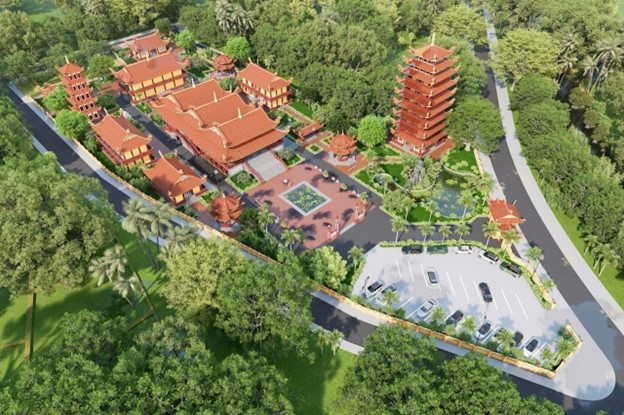
 Da Pagoda - a place of worship for over 500 Vietnamese revolutionary journalist martyrs
This land sheltered the footsteps of journalists during wartime
Going back in time to the arduous years of war, in the memories of veteran journalists, Da pagoda was not only a place of worship but also a shelter for press agencies, a place that witnessed the birth of news reports and articles right under its moss-covered roof or inside the nearby tunnels.
When bombs rained down, the protection of the temple and the local people ensured that the “lifeline of information” of the Party and the people was never interrupted for a single day. The hastily written war bulletins, penned in pencil on rough paper under the flickering oil lamp in the Buddhist temple are the most powerful testament to the harmonious blend of religion and life. Da pagoda is therefore imbued with the spirit of journalism: brave, resilient and always accompanying the nation's destiny.
A place where the spirituality and gratitude of the writers
Today, with the war long over, Da pagoda has become a symbol of gratitude. On major anniversaries, especially Vietnam Revolutionary Press Day on June 21st, the pagoda welcomes groups of reporters and editors from all over the country who come to gather.
The most impressive feature of Da pagoda, something found nowhere else, is its space dedicated to preserving journalistic artifacts from various periods. Between the lingering scent of incense, rusty typewriters, worn-out film cameras, and yellowed newspapers are displayed solemnly like stupas of relics representing the spirit of journalism. Here, every journalist finds a piece of history from their predecessors’ generation, allowing them to reflect on their own responsibilities and professional ethics.
Standing before the shrine, amidst the serene ringing of the pagoda bells, the pressures of journalism seem to vanish. Journalists come here seeking “a pure heart”, “a sharp pen” and above all, peace of mind to continue venturing into the dark and bright aspects of life.
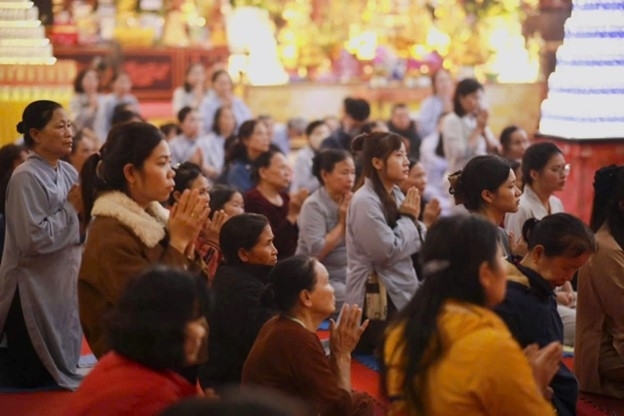 A religious activity at Da pagoda
A space for healing and inspiring creativity
Besides its profound historical value, Da pagoda is also a spiritual tourist destination thanks to its surrounding natural landscape. The pagoda is surrounded by ancient trees that remain lush and green all year round; the rustling of leaves blends with the sound of the wooden clappers and chanting, creating a strangely tranquil symphony.
Many journalists share that, after long reporting trips to disaster-stricken areas, epidemic zones or challenging investigative reporting projects, they choose Da pagoda as a place to recharge their energy. In this tranquil setting, creative thinking is sparked, and many excellent journalistic ideas, moving poems and heartfelt writings have been conceived within the grounds of this pagoda.
Da pagoda serves as a necessary moment of quiet reflection, reminding journalists that, before truthfully portraying the objective world, writers need a calm inner world, unmoved by waves of public opinion or petty self-interest.
The mission of extending the cultural heritage
The role of Da pagoda as a spiritual anchor is not limited to the papagoda regularly collaborates with journalists’ associations to organize seminars and generational gatherings, where veteran journalists pass on their passion and professional ethics to young newcomers to the profession.
For young journalists just starting out on the challenging path of writing, a pilgrimage to Da pagoda is like a spiritual coming-of-age ritual. They heard stories of journalist-soldiers who fell with their cameras still clutched in their hands, gaining a deeper understanding of the price of each news item and each photograph, thus becoming more resilient in the face of the challenges of their profession.
Da pagoda is a monument of memory, a unique cultural and spiritual space for journalism. In an age of information explosion and social media, Da pagoda stands like a lighthouse, keeping the ethical compass of journalists on the right track, upholding the resilient and humane spirit of writers that continues to flow intact through generations.
