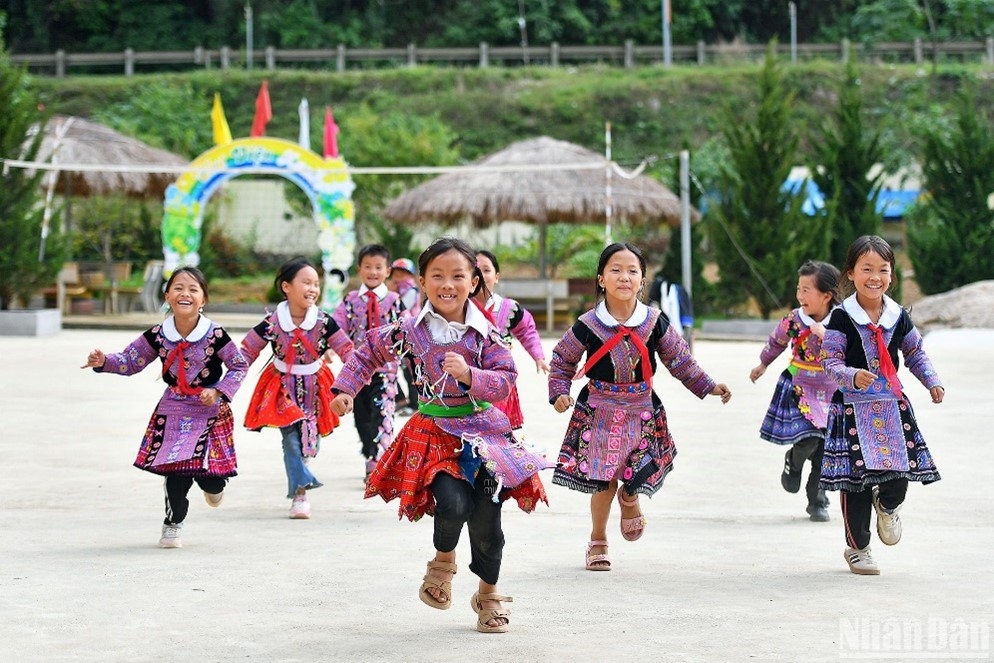
 The government, families and society always pay special attention to ensuring that children from ethnic minorities have the opportunity for comprehensive development
Keywords: Human rights; Rights of ethnic minorities; CERD.
1. Domestic policy
Vietnam is a multi-ethnic country, with 53 ethnic minority groups. Since the First Party Congress (March 1935), the Party has issued a Resolution on work among ethnic minorities. The resolution emphasized: “The Party Congress considers that the fighting force of ethnic minorities is a very large force”… and “the contempt for work in ethnic minorities is a very great political mistake” [3]…
At the Second National Party Congress (February 1951), the Party clearly stated: “All ethnic groups in Vietnam are equal in rights and obligations, unite and help each other in the resistance war and national construction. We must resolutely oppose narrow-minded nationalism and overthrow the imperialist plot to sow discord among the people, perpetrated by their henchmen. Improving the lives of ethnic minorities, helping them progress in all aspects, ensuring their participation in government and using their mother tongue in local education”.
Entering the Doi Moi (Renovation) period, the Politburo issued Resolution No. 22-NQ/TW, dated November 27th, 1989, “On some major guidelines and policies for socio-economic development in mountainous areas”. After 15 years of implementation, based on a profound assessment of the domestic and international situation, the importance of the ethnic issue and the resolution of ethnic relations in the cause of national construction and defense, on March 12th, 2003, the Seventh Conference of the Central Committee of the Party (9th term) issued Resolution No. 24-NQ/TW on ethnic affairs in the new situation. In this Resolution, the Central Executive Committee put forward the following viewpoints: (i) The issue of nation and national unity is a strategic, fundamental, long-term issue and also an urgent issue of the Vietnamese revolution today. (ii) The ethnic groups in the great Vietnamese family are equal, united, and mutually supportive, helping each other to develop together and strive together to successfully implement the cause of industrialization and modernization of the country, building and protecting the Socialist Republic of Vietnam. Determining to fight against all schemes to divide the nation. (iii) Comprehensive development of politics, economics, culture, society, security, and defense in ethnic minority and mountainous areas; Linking economic growth with addressing social issues; Effectively implement ethnic policies; pay attention to developing and nurturing human resources; and focus on building a team of ethnic minority cadres; Preserving and promoting the traditional cultural values and identities of ethnic minorities in the overall development of the Vietnamese nation. (iv) Prioritize investment in socio-economic development in ethnic minority and mountainous regions; firstly, focus on developing transportation and infrastructure and poverty reduction; Effectively exploiting the potential and strengths of each region, associated with protecting the ecological environment; Leveraging the internal strengths and self-reliance of the people of all ethnic groups, at the same time increasing the attention and support from the central government and assistance from localities throughout the country. (v) Ethnic affairs and the implementation of ethnic policies are the responsibility of the entire Party, the entire people, the entire army, all levels and sectors and the entire political system.
Regarding Resolution No. 24-NQ/TW on ethnic affairs in the new situation, our Party has conducted two reviews. In 2009, the Politburo first issued Conclusion No. 57-KL/TW on continuing to implement Resolution No. 24-NQ/TW. In the second review in 2019, the Politburo continued to issue Conclusion No. 65-KL/TW dated October 30th, 2019, on continuing to implement Resolution No. 24-NQ/TW.
At the 13th National Congress (January 2021), the Party affirmed the policy and guidelines for the period of 2021-2025 as follows: “Focus on perfecting and effectively implementing ethnic policies in all fields, especially specific policies to address the difficulties of ethnic minority communities. Creating livelihoods, jobs, and stable settlements for ethnic minority communities, especially in remote, mountainous and border areas. Focus on effectively implementing the National Target Program for socio-economic development in ethnic minority and mountainous areas for the period of 2021-2030. Protecting and developing the population of ethnic minorities with less than 10,000 people, especially those ethnic minorities at risk of declining in numbers” [4].
The Party’s system of viewpoints and guidelines on ethnic affairs serves as the political basis, objectives and foundation for the State to institutionalize in the 2013 Constitution and the legal system that regulates ethnic policies. Some notable legal documents, representing “firsts” have been issued by the Government and the Prime Minister, including: Decree No. 05/2011/ND-CP dated January 14th, 2011 of the Government on ethnic affairs (October 10th, 2024, the Government issued Decree No. 127/2024/ND-CP amending and supplementing a number of articles of Decree No. 05/2011/ND-CP dated January 14th, 2011 of the Government on ethnic affairs to overcome difficulties and obstacles and create favorable conditions in the implementation and enjoyment of ethnic policies); Decision No. 449/QD-TTg dated March 12th, 2013 of the Prime Minister approving the Strategy for Ethnic Affairs until 2020; Resolution No. 10/NQ-CP dated January 28th, 2022 of the Government promulgating the Strategy for Ethnic Affairs for the period of 2021-2030, with a vision to 2045. For the first time in history, the National Assembly implemented Clause 5, Article 70 of the 2013 Constitution to decide on ethnic policy by issuing Resolution No. 88/2019/QH14 approving the Overall Plan and Resolution No. 120/QH15 approving the policy, serving as the basis for the Prime Minister to issue Decision No. 1719/QD-TTg dated October 14th, 2021, approving the National Target Program for socio-economic development in ethnic minority and mountainous areas for the period of 2021-2030. For the first time in history, our country has a National Target Program specifically for ethnic minority and mountainous regions, creating new opportunities for these regions to leverage their internal strengths and achieve comprehensive and sustainable development.
Domestic policies, whose ultimate goal is to ensure the rights of ethnic minorities, are consistently aligned with the Party’s guidelines and policies, institutionalized in state legal documents, combined with the mobilization of socio-political organizations and ethnic minority communities to participate in their implementation, these are decisive factors in building a socialist society with Vietnamese characteristics. One of the defining characteristics of that society is: “the ethnic groups within the Vietnamese community are equal, united, respectful, and supportive of each other’s development” as analyzed by General Secretary Nguyen Phu Trong in his article “Some Theoretical and Practical Issues on Socialism and the Path to Socialism in Vietnam”, commemorating the 131st anniversary of President Ho Chi Minh’s birth and the election of deputies to the 15th National Assembly and People’s Councils at all levels for the term of 2021-2026.
2. Foreign pol
The rights of ethnic minorities are fundamental rights that ethnic minority groups in all countries are entitled to, and are officially recognized in two international conventions: the Universal Declaration of Human Rights of the United Nations of 1948 and the International Convention on Civil and Political Rights of 1966. Currently, Vietnam has ratified and participated in 7 out of 9 international conventions related to human rights, including the Convention on the elimination of all Forms of racial discrimination (CERD), which directly relates to relations between ethnic groups. Established in 1965, the CERD Convention condemns racial discrimination and sets forth the obligation for member states to take all necessary and immediate measures to eliminate all forms of discrimination based on race, color, ancestry, ethnicity or minority origin.
By joining the International Convention on the Elimination of all forms of racial discrimination in 1982, Vietnam has had the opportunity to help international friends gain a correct understanding and objectively assess the policies and guidelines on ethnic affairs and the achievements made in implementing these policies. At the same time, we should embrace international knowledge and consider applying it to the process of formulating ethnic policies that are appropriate to the country’s realities. Joining the Convention also means that Vietnam must fulfill obligations in accordance with the Convention’s mechanism, such as: Internalize regulations and principles regarding the rights of ethnic minorities in accordance with their political, economic, historical and cultural traditions; Ensuring genuine progress in human rights for all people, without distinction of race, ethnicity, color, gender, language, political views, origin,…; Regularly prepare national reports on the implementation of the Convention; implement recommendations and respond to appeals on human rights; Implementing educational and informational activities on human rights and other procedures as required by the CERD Committee (Le Van Loi, 2020).
In the current context of globalization and international integration, the issue of ensuring the rights of ethnic minorities in Vietnam is inseparable from international monitoring activities by United Nations agencies and international human rights treaties. By joining the Convention, Vietnam accepts international monitoring of the rights of ethnic minorities through the following forms: Reviewing national reports through a periodic assessment mechanism; Implementing special procedures to investigate and assessing specific human rights issues and situations; Providing comments and recommendations for Vietnam directly related to the rights of ethnic minorities… on ensuring human rights in general, and the rights of ethnic minorities in particular, manifested in the following aspects: raising awareness of rights protection; The “pressure” from these monitoring activities has had many impacts on ensuring human rights in general and the rights of ethnic minorities in particular, manifested in the following aspects: raising awareness of rights protection; Revising, supplementing and improving policies, laws, and mechanisms; enhancing transparency and accountability, promoting research activities; Promoting dialogue and advocacy on human rights at international forums (Le Van Loi, 2020). At the bilateral level, Vietnam currently has formal human rights dialogue mechanisms with five partners: The US, the EU, Switzerland, Norway and Australia. Building and promoting dialogue in the fields of democracy and human rights has a positive impact, contributing to enhancing mutual understanding and gradually narrowing disagreements with international partners on human rights issues. Through dialogue, we also refute false information, distorted narratives, and fabrications by extremist groups and individuals both domestically and internationally regarding the human rights situation in general and the rights of ethnic minorities in Vietnam in particular.
In the field of human rights, “a struggle is still ongoing between progressive forces aiming to promote core human values and forces exploiting human rights to carry out political intentions” [8]. The struggle in the field of human rights in general and the rights of ethnic minorities in particular is of great importance, especially when some international political and social forces use human rights as a tool to carry out “color revolutions” aimed at overthrowing social regimes that they consider “incompatible” with their views. And “ethnic and religious issues have always been fertile ground, a field that hostile forces seek to exploit, take advantage of and manipulate in order to undermine the Party and the State” (Dao Ngoc Dung, 2025). However, in theory and practice, the realization of democracy and human rights depends on many conditions. Countries with different political systems and levels of development cannot take the concepts and practices of one country or nation regarding democracy and human rights and impose them on another nation or country. With universal human rights values, the struggle in this area also aims to protect the principle of sovereign equality and non-interference in the internal affairs of United Nations members.
The struggle in the field of human rights in Vietnam has the important task of protecting the views of the Party and the State on human rights, protecting the achievements in human rights that the people in general and the ethnic minority communities of Vietnam in particular have achieved over the past nine decades; Resolutely combating the false, distorted and slanderous allegations of some hostile forces that aim to exploit ethnic issues to incite division, create political and social instability in ethnic minority and mountainous areas, undermining the people’s trust in the Party’s leadership and the State’s administration...
In implementing the CERD Convention, the Vietnamese Government assigned the former Committee for Ethnic Minorities, now the Ministry of Ethnic and Religious Affairs, to lead the coordination with relevant ministries and agencies in preparing the national report and organizing its defense at the CERD Convention Committee. Vietnam has successfully defended its National Report on the Implementation of the CERD Convention five times, in 1983, 1993, 2000, 2012 and 2023. The report focuses on showcasing Vietnam’s implementation of the CERD Convention, specifically the following aspects: Vietnam’s legal system and institutions that guarantee and promote the rights of ethnic minorities in Vietnam; Defining racism and assess the appropriateness of the definition of racism in Vietnamese law; The important role of ethnic affairs and the implementation of ethnic policies in eliminating all forms of racial discrimination; The results of implementing commitments to prohibit and eliminate racial discrimination in all its forms and to ensure equal rights before the law for ethnic minorities in Vietnam; Measures are being taken to ensure that ethnic minorities in Vietnam are not subjected to any acts of racial discrimination. In addition, Vietnam actively participates in dialogue sessions with Convention Committees and seriously considers recommendations, research and develops implementation plans to strengthen the enforcement of international conventions to which Vietnam is a member.
3. Conclusion
Recognizing and guaranteeing human rights is an indicator of the development of civilization and progress of each society, to be the basis for the State to recognize and guarantee the rights of its people (Nguyen Thi Thanh Hai, 2022). Ethnic minority communities are the subjects, driving force, goal, and center of all ethnic policies - these correct viewpoints of the Party are profoundly reflected in domestic and foreign policies on human rights. This is a clear manifestation of the development of thinking, vision, approach, and consistent viewpoint and actions of Vietnam in always respecting, guaranteeing and promoting the rights of ethnic minorities.
References
1. Dao Ngoc Dung (2025). Ensuring equality, solidarity, mutual assistance and joint development for all ethnic groups, https://baochinhphu.vn/bao-dam-cac-dan-toc-binh-dang-doan-ket-tuong-tro-cung-phat-trien-102251012181418286.htm
2. The Communist Party of Vietnam and Ho Chi Minh Thought on the issue of ethnicity (2013). National Political Publishing House, Hanoi.
3. The Communist Party of Vietnam and Ho Chi Minh Thought on the issue of ethnicity (2013). National Political Publishing House, Hanoi, p.15.
4. Communist Party of Vietnam (2021). Documents of the 13th National Congress. National Political Publishing House, Hanoi, p.140-141.
5. Le Van Loi (2020). Assessment and proposed additions and improvements to the Party’s guidelines and policies and the State’s laws on ensuring the rights of ethnic minorities in Vietnam in the context of globalization and international integration.
6. Nguyen Phu Trong (2021). Some theoretical and practical issues on socialism and the path to socialism in Vietnam, https://www.tapchicongsan.org.vn/media-story/-/asset_publisher/V8hhp4dK31Gf/content/mot-so-van-de-ly-luan-va-thuc-tien-ve-chu-nghia-xa-hoi-va-con-duong-di-len-chu-nghia-xa-hoi-o-viet-nam
7. Nguyen Phu Trong (2023). Promoting the tradition of national unity, building our country to be increasingly prosperous, civilized and happy. National Political Publishing House, Hanoi.
8. Vo Cong Khoi (2023). Identifying intervention tactics disguised as human rights, Journal of Law on Human Rights, No. 4 (32), p.3.
