Keywords: Ha Nhi people; Folk knowledge; Protect the forest; Sustainable development.
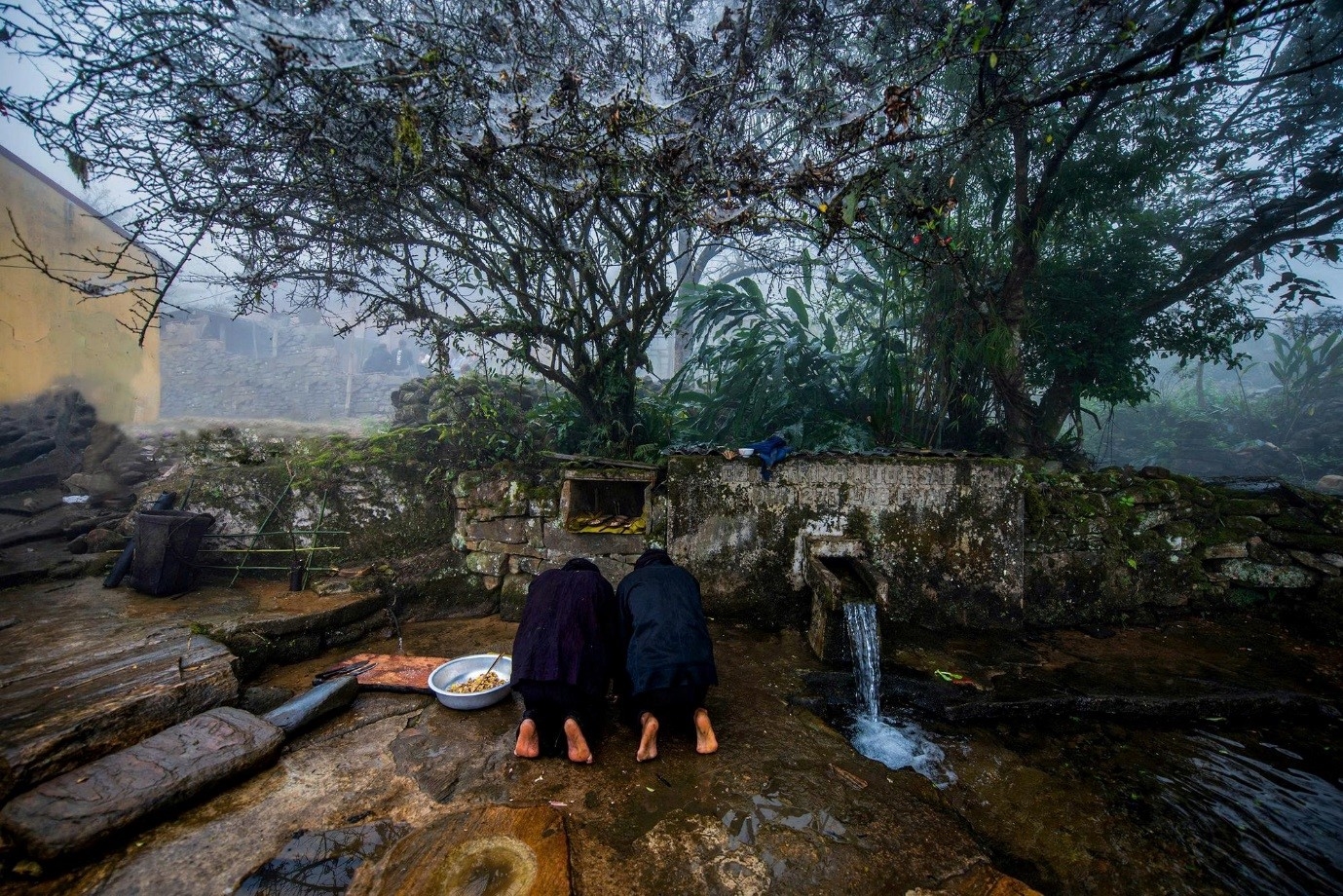 The forest worship ceremony of the Ha Nhi people in Lao Cai province
1. Introduction
The folk knowledge of forest protection among the Ha Nhi people in Lao Cai province is formed on the foundation of a long-standing close relationship between the community and the forest ecosystem. For the Ha Nhi people, the forest is not only a space that provides a source of livelihood but also a sacred entity, connected to the world of spirits and ancestors. This very concept has strongly influenced the way communities behave towards forests, creating a sustainable system of local knowledge that is appropriate to the ecological conditions of the high mountain area.
One of the notable findings is the relatively clear forest classification system of the Ha Nhi people, which is linked to forest use functions and sacredness levels. The community distinguishes between sacred forests, watershed forests, cemetery forests and production forests. Each type of forest has its own customs and taboos, which are strictly adhered to by the community. Sacred forests and watershed forests must absolutely not be encroached upon; no logging or exploitation in any form is permitted. This is an effective community self-governance mechanism for protecting forests and maintaining water resources, contributing to ecological balance.
The research also indicates that customary law and community conventions of the Ha Nhi people play a significant role in regulating the behavior of members towards forest resources. Acts of forest destruction such as illegal logging, indiscriminate hunting, burning forests for farming in violation of regulations are severely punished, not only through material penalties but also through religious measures. This creates a strong deterrent effect and reinforces each individual’s sense of responsibility towards the forest.
In addition, rituals and religious practices related to forests are also an important component of folk knowledge. Through rituals of worshipping the forest and its spirits, the community expresses gratitude to the deities for their protection and reaffirms the conventions for forest protection in the presence of the entire community. Therefore, rituals not only have spiritual significance but also a distinct social function in maintaining order and community cohesion.
The folk knowledge of the Ha Nhi people in forest protection is highly adaptable to natural conditions and shares many similarities with modern principles of sustainable forest management. However, in the context of current socio-economic changes, some traditional knowledge is at risk of disappearing due to the impact of administrative management mechanisms, changes in livelihoods and the perceptions of the younger generation. From the above results, it can be affirmed that the folk knowledge of the Ha Nhi people in forest protection not only has cultural value but also profound practical significance. Identifying, preserving and appropriately integrating this knowledge into current forest resource management practices will contribute to improving forest protection effectiveness and promoting sustainable development in the highland areas of Lao Cai province.
2. Research results
2.1. Folk knowledge
Folk knowledge is the sum total of human understanding of nature, society and themselves, formed and accumulated throughout the long history of a community. This type of knowledge arises from real-life experiences, through productive labor, social relations and the process of human adaptation to the natural environment to meet the needs of survival and development. Folk knowledge is not separate from daily life but is closely linked to the livelihood activities, beliefs and social organization of the community.
A key characteristic of folk knowledge is the coexistence of secular and sacred elements. In this knowledge system, experiential understanding is always intertwined with supernatural concepts, spiritual beliefs and socially accepted norms of behavior. Therefore, folk knowledge is not only the result of observation and experience but is also reinforced through rituals, customs and forms of cultural practice. The transmission of knowledge primarily occurs through oral tradition, direct instruction and the process of “learning by doing” between generations within the community.
Compared to folk knowledge, scientific knowledge has a different nature and method of formation. Scientific knowledge is built on abstract thinking, rigorous methodology, and empirical verification, focusing on secular elements and excluding the supernatural. This type of knowledge is highly generalized and predictive and is systematized and preserved primarily in written form. Meanwhile, folk knowledge is specific, closely tied to the local context and flexible in its application and adaptation to suit the practical conditions of community life.
The folk knowledge of the Ha Nhi people in Lao Cai province is a system of understanding and experience formed from their long-term residence and direct interaction with the mountainous forest environment. This knowledge is accumulated through productive labor, community life, and religious practices, and then passed down from generation to generation through memory, oral tradition, customary laws and traditional rituals. Throughout history, this system of knowledge has been continuously supplemented, adjusted and had outdated elements removed in order to adapt to changes in the natural environment and socio-economic context.
It can be affirmed that the folk knowledge of the Ha Nhi people not only reflects the community’s life experiences but also demonstrates ecological thinking and a concept of harmony between humans and nature. This is a valuable source of knowledge for studying ethnic cultures, at the same time it also opens up many possibilities for application in resource management, conservation and sustainable development in the current context.
2.2. Folk knowledge in forest protection
As a long-standing agricultural community living in the high mountains, the Ha Nhi people have a close relationship with the forest throughout the formation and development of their community. For the Ha Nhi people, the forest is not only a living space but also the material, spiritual and religious foundation of their village life. Forests provide almost all the essential resources for daily life, from food, firewood, timber for houses, medicinal herbs to water for domestic use and production. At the same time, forests also play a role in sheltering and protecting villages from natural disasters, regulating the ecological environment and maintaining the long-term stability of living spaces.
Beyond its economic and ecological value, the forest also holds a particularly important place in the spiritual life of the Ha Nhi people. With their animistic beliefs, the Ha Nhi people believe that forests, trees, mountains, water sources and animals all possess souls and are governed by forest spirits (mu gie do). These deities serve both as benevolent protectors of the community and as a force that monitors and punishes acts of forest destruction and damage to the sacred space of the village. It is this belief that has shaped the mechanism of forest sacralization - a method of forest protection that is voluntary, sustainable and there is a strong influence on community life.
From the very beginning of choosing land to establish their village (phu), the Ha Nhi people have performed rituals to establish sacred forests around their settlements. Each traditional village has four spiritual forests including: the forest dedicated to the village’s guardian deity (Ga ma do), the park forest (a go la do), the forest dedicated to the earth god (Thu ty) and the forest for the March festival (Mu thu do). Each forest serves a unique spiritual function, linked to a system of rituals and natural deities and forms four important spiritual pillars of the community.
Besides sacred forests, the Ha Nhi people also classify other natural forests to serve their livelihood needs while ensuring the principles of protection and rational exploitation. Forest types such as protected forests, watershed forests, old-growth forests, primary forests have clearly defined functions and strict regulations established by the community for their exploitation. The use of forest resources should only be carried out within permitted limits, under community supervision, thereby contributing to maintaining ecological balance and protecting forests sustainably.
2.3. Protecting forests through sacred rituals
In the folk knowledge system of the Ha Nhi people, sacred rituals associated with the forest play a particularly important role in regulating the community’s behavior towards forest resources. Through these rituals, the forest is sanctified, becoming an inviolable sacred space, thereby contributing to the sustainable and long-term protection of forests.
One of the typical rituals is the worship of the local earth god (Thu ty). The forest where the local earth god is worshipped is usually located at the western end of the village. The ceremony is held on the night of the 30th of the Lunar New Year, presided over by a representative of the clan that played a leading role in pioneering and establishing the village, after which other families in the village take turns participating in the ritual. The ritual aims to express gratitude to the local deity for protecting the villagers during the past year, and to pray for continued protection so that people may be healthy, crops may be bountiful, livestock may thrive and the village may be peaceful. After the ceremony, women from each family carry bamboo tubes to the village's sacred water source to collect the first water of the year for cooking, believing it will bring health and good fortune for the entire year.
The road closure ceremony (Ga tu tu) is the opening ritual in a series of sacred ceremonies related to forests, land and water sources throughout the year. The ceremony is held on the day of the Tiger (tha no) in the first or second week of the first lunar month, in the village’s park forest (a go la do). The ceremony is performed by two shamans (Ga ma guy), with the aim of inviting benevolent spirits (nẹ mừ) to protect the village, at the same time driving evil spirits (ne ma mu) out of the community’s living space. After the road closure ceremony, the villagers continued to hold the ritual of worshipping the sacred Ga ma do forest.
The Gạ ma do sacred forest worship ceremony is considered the most important annual ritual for the Ha Nhi people in Lao Cai province. The Ga ma do forest, usually located above the village, to the East, Southeast or Northeast, is where the village’s guardian deity (Ga ma do khu li) is worshipped. The ceremony is held on the day of the Dragon (lo no) in the first or second week of January, to pray for favorable weather, good crop growth, thriving livestock, good health for the people and peace in the village.
In addition, the Mu thu do forest worship ritual also plays an important role in the agricultural production cycle. Mu thu do is located at a lower elevation than the Ga ma do forest and near cultivated fields. According to the beliefs of the Ha Nhi people, the Ga ma do forest is where they worship the “husband god”, who protects the villagers, while the Mu thu do forest is where they worship the “wife god”, who protects the crops. The Mu thu do forest worship ceremony is held on the day of the Horse (Mo No) in the third lunar month, and only after the ceremony is completed do the villagers officially begin a new planting season.
Through the sacralization of the forest using a rich and rigorous system of rituals, the Ha Nhi people have built an effective forest protection mechanism based on religious beliefs and community consensus. Sacred forests are not only spaces for spiritual practice but also play a crucial role in preserving the ecological environment, protecting villages from natural disasters and maintaining the sustainable development of the community.
3. Discussion
Customary law is an important part of folk knowledge, formed and accumulated over a long historical process through human experience in interacting with the natural environment and social relationships. Not existing in written form, customary law is transmitted primarily through memory, oral tradition and social practice, yet it exerts a powerful influence on community life. For the Ha Nhi people in Lao Cai province, customary law is not only a system of rules regulating social behavior but also an important tool in protecting and managing forest resources effectively and sustainably.
The customary laws of the Ha Nhi people are built, agreed upon, and voluntarily implemented by the community, aiming to regulate behavior in relationships between people with people and people with the natural environment. In that customary law system, regulations related to forest protection held a particularly important position and were concretized through strict penalties. This demonstrates the community’s deep awareness of the vital role of forests in the survival and development of their village. In particular, the Ha Nhi people’s forest protection mechanism is a close combination of customary law and belief in the sacredness of the forest. Sacred forests are considered the dwelling places of benevolent spirits, possessing the power to protect or punish people. This belief has fostered a sense of self-discipline in adhering to customary laws within the community, making forest protection not only a social obligation but also a spiritual responsibility. Alongside religious beliefs, there is a system of clear and strict penalties for acts of encroachment on sacred and forbidden forests, thereby strengthening the effectiveness of customary law in practice.
In addition, customary law also specifies the organization of forest protection forces and community monitoring mechanisms. The annual rotation of forest rangers and the voluntary participation of members in detecting and reporting violations have created a widespread forest protection network based on the shared responsibility of the entire community. Forest exploitation, even for essential needs such as firewood, bamboo, timber for housing is strictly controlled by the community and to be only carried out at permitted times and within permitted areas.
4. Conclusion
It can be said that the folk knowledge of the Ha Nhi people in forest protection is a harmonious blend of customary law, beliefs and practical livelihood. This system has contributed to maintaining ecological stability, protecting villages from the negative impacts of natural disasters and ensuring the sustainable development of the community. In the current context, as modern forest resource management mechanisms are increasingly perfected, the values of the Ha Nhi people’s customary law retain their significance and vitality, becoming an important reference source for community forest management and sustainable development in the high mountain area.
References
1. Duong Tuan Nghia (2012), “The unique buffalo sacrifice ritual in the Khu Gia Gia festival of the Ha Nhi people in Lao Cai province”, Journal of World heritage.
2. Tran Huu Son (2008), “Indigenous knowledge of the Ha Nhi people in Vietnam on the issue of forest protection”. 3rd International Conference on Vietnamese research.
3. Ngo Duc Thinh (2010). Traditional Vietnamese Cultural Values, National Political Publishing House, p.183.
4. Ngo Duc Thinh (2004), “Indigenous worldview”, Journal of Folklore culture, No. 4. p.3-15.
