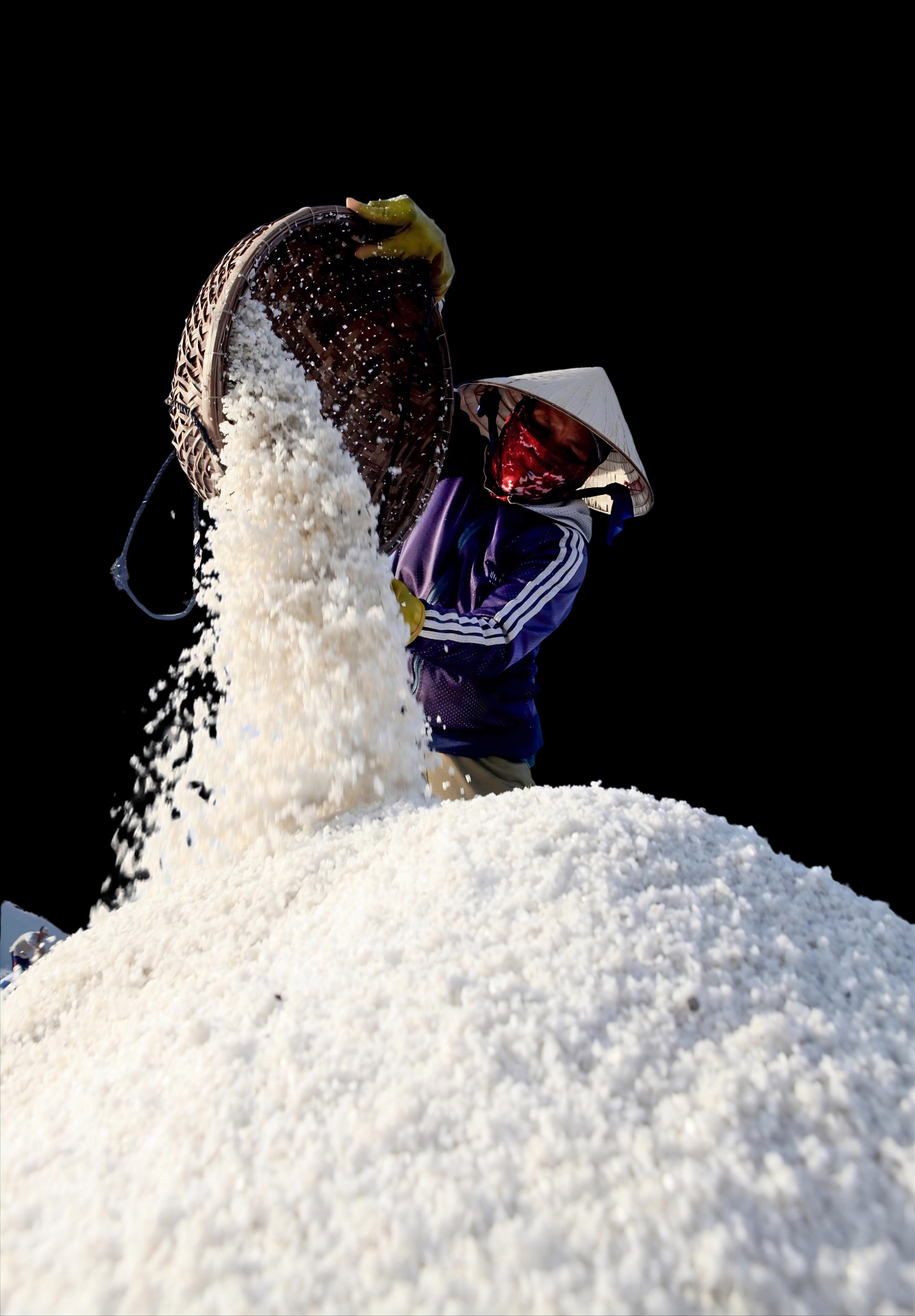
 Go Co’s salt flowers
Unlike traditional salt fields that stretch across flat coastal terrain, the salt pans in Go Co are formed upon natural rock surfaces. Large rock cavities serve as natural “basins”, into which seawater is carried by the tides. Under the direct influence of the sun and winds characteristic of Central Vietnam, the water gradually evaporates, causing its salinity to increase over time. This marks the beginning of a unique salt-crystallization process, intrinsically linked to the specific topography and climate of the region.
Following the initial natural accumulation phase, salt farmers channel the saline water into small, manually constructed plots, using a mixture of clay and sand to build the surrounding embankments. Here, the seawater is left to evaporate under the sun for about 3-4 days. This process demands patience, close monitoring of weather conditions, and expertise passed down through generations. Without the use of machinery or chemicals, every stage relies entirely on the natural rhythms of the sea, the sun and the wind.
 Sa Huynh salt fields
At Go Co, salt crystallizes entirely through the action of the sun, wind and natural rock surfaces. Unlike conventional salt, these salt crystals do not sink to the bottom; instead, they form thin, delicate flakes resembling flower petals which is why they are known as “salt flowers”. This product boasts high purity and a mild, subtle saltiness, making it a favored choice for food preparation and the creation of traditional products.
Having been an integral part of the lives of coastal residents for generations, the traditional practice of salt-making on rock surfaces in Go Co is now gradually dwindling, challenged by shifting economic conditions and the competition from modern production methods. Today, only three households in Go Co remain committed to this traditional craft. Among them is Bui Thi Van, who steadfastly continues the work that has been passed down through her family for generations.
According to Ms. Van, the process of producing salt on rocks is entirely manual and heavily dependent on weather conditions. Each production cycle lasts about three days, yet it yields only 7-8 kg of salt. Consequently, this craft demands a great deal of effort, time and patience from those who practice it.
Salt harvested from the rocks at Gò Cỏ is favored by consumers for its distinctive flavor and unique production method. Priced at approximately 100,000 VND per kilogram, significantly higher than that of mass-produced salt, it generates substantial economic value. More than just a commodity, this “rock salt” embodies cultural memories and local knowledge that deserve to be preserved and safeguarded.
According to local authorities, the value of the rock-based salt-making craft lies not in its production volume, but in its uniqueness, a traditional practice deeply intertwined with the history and development of the coastal community of Go Co. However, the craft is now at risk of fading away, as there are fewer and fewer younger workers to carry it on. Coupled with its small-scale production and heavy reliance on natural conditions, these factors present significant challenges for the preservation and promotion of this traditional craft moving forward.
At a time when the traditional craft of salt-making on rock surfaces faces the risk of fading away, the unique qualities of this practice offer new development opportunities for Go Co. By integrating the Sa Huynh cultural heritage, the coastal landscape, and this traditional salt-making craft, it is possible to create a distinctive community-based tourism product, one where visitors can go beyond mere sightseeing to gain firsthand insight into the process of producing “salt blossoms”, crystallized through the sun, the wind, and the diligent efforts of the local people.
With appropriate investment and planning, Go Co has the potential to become a destination that integrates cultural and historical values with community livelihoods. This initiative goes beyond merely preserving a long-standing traditional craft; it represents a strategic approach to effectively leveraging heritage resources for rural economic development. Given the growing preference for artisanal, eco-friendly products with transparent origins, the salt harvested from the rocks of Go Co is well-positioned to carve out a distinct niche in the market.
From its modest coastal rocky expanses, Go Co is revealing the potential of a “living heritage” space, a place where traditional cultural values are not only preserved but also transformed into a driving force for sustainable future development./.
