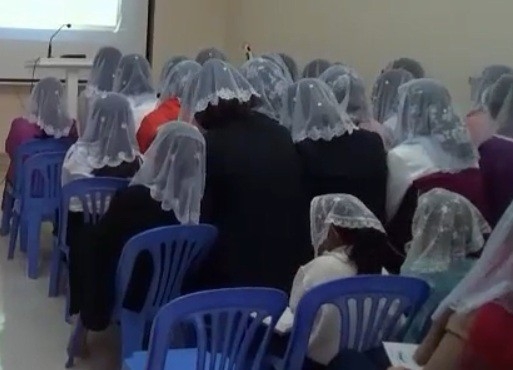
 The “Church of God the Mother” has been shut down nationwide by authorities
Keywords: New religious phenomenon; Strange religion; State administration.
1. Identifying the “new religious phenomenon” in Vietnam
Today, the diversification of religious life, primarily the choice of faith and beliefs that align with the trends of a civil society and the increasingly open democratic movement, has led to the emergence of “new religious phenomena”, or “unorthodox religions”, sects, subgroups and minor faiths. This is an inevitable consequence of the transformation of religious life in contemporary Vietnamese society due to opening up and integration. According to statistics up to the end of the 1990s, there were 50 religious groups with about 60 different names. Among them, there are many religious groups from foreign countries that have entered Vietnam, such as: Thanh Hai Vo Thuong Su; Omotoism; Soka Gakkai (Japan); Vovi Phap (France); Earth Mother Buddha or Dia Mau (China)... There are about 8 such religious groups out of a total of 50 “new religious phenomena”.
The activities of “new religious phenomena” and “unorthodox religions” in recent times have had a certain impact on the economic, cultural, and religious life of a segment of the population, especially anti-cultural forms such as the Luu Van Ty religion in Ha Tinh, the Pha Toc religion in Son La province and the Finger-Cutting religion in Ho Chi Minh City. Besides that, there are also types of “unusual religions” whose practices and rituals resemble a form of belief, such as the Truc Lam Yen Tu sect, the Zen sect of non-action,... Some of these “unusual religions” even apply for registration with the authorities to operate like other beliefs and religions.
2. The current state of “new religious phenomena” in Vietnam
Recent surveys on “new religious phenomena” in northern Vietnam reveal numerous religious phenomena stemming from traditional folk beliefs, particularly the Mother Goddess religion. This is also seen as a regular transformation of modern religious beliefs in Vietnam. The emergence of “new religious phenomena” in the 19th century became one of the most pressing issues in world religion in general and in Vietnam in particular. European and American countries were interested in the messianic theories of the millennium. In Asia, Japan is typically interested in salvation from other “supreme beings”. In Vietnam, in the last two decades, sect groups with “theological” origins and different psychologies have created “new religious phenomena” and “strange religions” that are very closely related to many familiar forms of belief. This also reflects the transformation of religious and spiritual life in modern society, the shift in values and faith practices and greater “equality” among different types of faith in each country.
Previously, “new religious phenomena” or “unusual religions” in Vietnam, if they existed at all, usually appeared only in the South under names such as secret societies, the Heaven and Earth Society, and especially the Ong Dao and Coconut Religion movements in Ben Tre province. Now, in the North, with its opening up and integration, more groups and sects of “new religions” are appearing than in the South. This clearly shows that in the northern provinces there is a more pronounced gap in religious consciousness, creating an opportunity for religions to expand their membership. They even frequently change the names of their faiths to better adapt to religious life. These “new religious” groups only have their own self-composed, orally transmitted teachings and worship instructions. They lack a structured leadership system; instead, they only appoint individuals as presidents, vice-presidents and treasurers to manage their followers in specific areas. They also lack clear doctrines and rituals. The lifestyle is focused on goodness and cultivating virtue. However, it is intertwined with elements of superstition (magic), with some groups exhibiting quite serious practices. There are even manifestations of reactionary political content (Thanh Hai Vo Thuong Su of Dang Thi Trinh) or depravity (Chan Khong of Luu Van Ty). The majority of those who initiated (or led, or were religious leaders) in the past were men. However, in the last 20 years or so, the majority of those who founded and led these organizations have been women, such as: Dang Thi Trinh in Taiwan (Supreme Master Ching Hai); Dinh Thi Ha in Phu Tho province (Hung Vuong Group 18); Nguyen Thi Luong in Hai Phong city (Ho Chi Minh Jade Buddha); Huynh Thi Bay in Pleiku (Immortal-Buddhist Unity Religion); Nguyen Thi Noi in Thai Binh province (Co Non Religion or Thien Co Religion); Nguyen Thi Trieu in Hai Duong province (Nature Religion).
Generally, Vietnamese people do not have a single religion designated as the national religion; they still maintain the tradition of “three religions sharing a common origin”, believing that all religions are good. This habit of harmonizing with religions, “initially unfamiliar, then becoming familiar”, has created a rich and diverse religious “system” in Vietnam, incorporating many religious influences from around the world and the region. The increasing number of “new religious phenomena” and “unusual religions” reflects the trend towards “religious pluralism”.
3. Identifying the plots and activities of hostile forces that exploit religion to undermine the Vietnamese revolution
The conspiracies and activities of hostile forces exploiting religion to undermine the Vietnamese revolution are schemes and actions by individuals and organizations inside and outside the country that exploit issues related to religion to sabotage the cause of building and defending the socialist Vietnamese Fatherland. This issue identifies the targets, purposes and content of the conspiracies and activities of hostile forces exploiting religion to undermine the Vietnamese revolution.
Hostile forces abroad: International human rights and religious organizations, mainly in the US and Europe and opposition groups within religions overseas... often play the leading, directing, funding and supporting roles for domestic targets.
Domestic hostile forces: These include individuals who oppose religions (those who do not recognize religions or religious organizations recognized by the State) or religious organizations within religions not recognized by the State (including all 16 religions and “new religious phenomena”, strange sects and cults), or reactionary, politically opportunistic, degenerate and law-violating individuals who directly implement the schemes and intentions of hostile forces abroad to exploit religion.
Although their conspiracies and activities exploiting religion to undermine the Vietnamese revolution may differ, they are always closely interconnected, sharing a common goal of opposing communism, disrupting the path to socialism in our country through the strategy of “peaceful evolution”, inciting riots and overthrowing the government, promoting self-evolution and self-transformation; eliminating the leadership role of the Party and overthrowing the socialist regime in Vietnam.
Specific manifestations:
Firstly, they undermine national unity, incite religious followers to oppose the Party and State’s religious policies, oppose the Party, and ultimately demand the abolition of the leadership of the Communist Party of Vietnam over the national revolutionary cause.
Secondly, it neutralizes the role of the State in managing society.
Thirdly, it would deviate from the socialist orientation of national development that our Party and people have chosen.
International hostile forces exploit religious issues to gather information from religious leaders and followers in the country, especially reactionary and dissident elements within illegal religions and religious organizations not recognized by the State, in order to engage in slanderous activities and interfere in Vietnam’s internal affairs. This is a common and widespread plot and activity carried out by hostile forces that exploit religion to undermine the Vietnamese revolution. These activities are always supported by international religious and human rights organizations.
Domestic hostile forces: frequently collude closely with each other, receiving and implementing directives and support from hostile forces abroad; drafting and disseminating documents with content inciting opposition against the Party and the State; exploiting religious holidays to incite and lure followers to gather in large numbers, engaging in disruptive actions, demonstrations and causing a loss of security and order; Exploiting “new religious phenomena” for personal gain, distorting moral and cultural norms, causing political and social instability, creating public confusion and undermining the Party, the State and the socialist regime in our country.
4. Orientation for addressing “new religious phenomena” in Vietnam and proposing some solutions for state management of religious activities
Identifying the models, organization, and activities of the aforementioned types of religious phenomena, the impact and influence of these new religious phenomena on various aspects of economic, political and social life, is a matter of great concern to our Party and State. Therefore, specific methods are needed for campaigning, propaganda and combating activities that exploit new religious phenomena to violate the law and affect national interests. Research and policy planning regarding new religious phenomena and “unorthodox religions” face certain difficulties.
Firstly, there is no recognized definition of the new religious phenomenon, “strange religion”. Religious studies have also only recently begun. If “strange religion” is considered a “new religious phenomenon”, then new religions have continuously emerged in the world, especially from the first half of the 20th century onwards.
Secondly, new religious phenomena, “unorthodox religions”, currently lack the organizational structure of traditional religions. They are semi-public, semi-secret, difficult to control and more harmful than beneficial; they are essentially “small group religions”.
Thirdly, from a legal standpoint, while countries tend to expand “religious freedom”, including the right to convert or change religions, our country has grounds and experience to argue that this type of religion easily leads to political and social insecurity, undermines moral standards and harms public health… The “new religious phenomenon” from the 60s of the 20th century onwards has conflicts with fairly high standards of moral values, causing more complexity in international relations on religion and human rights.
The issue of dealing with and policies towards new religious phenomena is very difficult. It is necessary to carefully consider each step of recognizing them legally, instead of the previous attitude of “ignoring” them. It is a whole process of awareness, a very positive new transformation. New religious phenomena, new religions, strange religions, when they appear, usually have few people who believe in or follow them and they exist for a short time [3]. The emergence and rise of new and unusual religions have significantly impacted the economic, social, cultural, and public order aspects of our country. However, some unusual religions have had a certain positive influence, demonstrating the principle of “remembering one's roots”, participating in social charity, criticizing corruption and eradicating superstition in religious life...
5. Some proposed solutions
In order to build a healthy religious life among the people and effectively manage religious affairs, the following solutions should be implemented simultaneously:
Firstly, strengthening the leadership and guidance of Party committees and government agencies at all levels regarding religious activities in general and the activities of this phenomenon in particular, overcoming the lack of centralized unity.
Secondly, need to change our perception and objectively evaluate new religious phenomena, ‘unorthodox religions” and their activities; clearly analyze the causes and effects of these forms on national culture, their relationship with traditional forms, beliefs and religions.
Thirdly, prioritizing investment in areas with difficult socio-economic conditions.
Fourthly, innovating information and propaganda work to ensure the freedom of belief and religion for the people and mobilize the masses and believers to live virtuous lives.
Fifthly, continue to supplement and improve policies and laws regarding “unorthodox religions” or “new religious phenomena” in our country.
Sixthly, resolutely fight against and eliminate illegal forms of activity by new religious phenomena and “strange religions” in society that are extremist, dangerous and contrary to national culture.
6. Conclusion
The emergence, development, with diverse and complex activities of new religious phenomena in Vietnam have had a significant impact on many aspects of social life. Therefore, it is essential to work together in managing and classifying different new religious phenomena in order to respond appropriately, ensuring the people’s freedom of belief and religion; stabilizing social security and order; strengthening national unity to successfully achieve the goals set by the Party and the State in the new era.
* Academy of Public Administration and Governance
References
1. Ngo Huu Thao, Strange Religions in Hanoi Today and the Issues Raised, Political Theory Publishing House, Hanoi, 2014, p.19.
2. https://thanhtravietnam.vn/dan-toc-ton-giao/su-can-thiet-cua-quan-ly-nha-nuoc-doi-voi-cac-hinh-thuc-dao-la-ta-dao-196095.html đăng ngày 25/06/2021 By author Kim Ngan.
3. Nguyen Thanh Xuan, (2020), Religion and religious policy in Vietnam, Religious Publishing House, p.219, 220.
