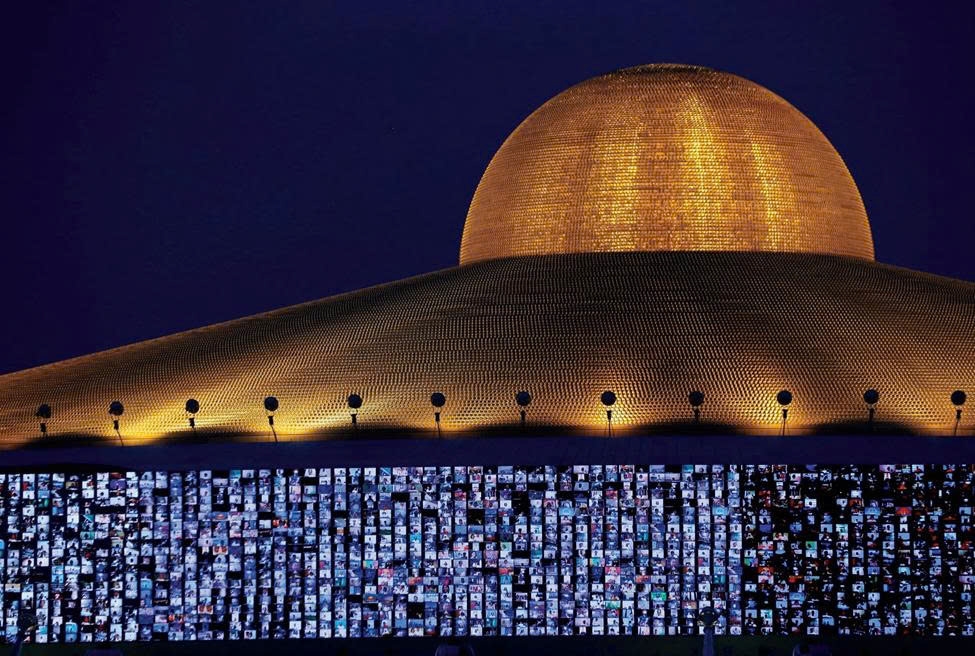
 Makha Bucha Day at Wat Phra Dhammakaya temple was held via Zoom
Keywords: Digital Religion; Online religion; Cyberspace; Digital transformation of religion; Globalization of religion.
1. In the United States
The United States, with the burgeoning silicon technology sector and one of the most religiously diverse nations in the West has become a vibrant testing ground for the virtual church model. This rise is not merely a stopgap solution during the pandemic, but the result of a long evolutionary process from 1980s television-based evangelical Christianity to a fully interactive digital ecosystem. In the United States, the concept of attending church is no longer tied to stepping into a cathedral or chapel made of brick and stone, but rather to logging into a sacred space created by algorithms and broadband internet.
The most distinctive feature of virtual churches in the United States is the complete erasure of geographical boundaries to establish a new digital authority. Megachurchs like Life Church (Oklahoma) and Saddleback Church (California) have pioneered the development of online platforms that allow tens of thousands of people to attend a service simultaneously from thousands of different time zones. Unlike passively watching a broadcast, these virtual churches establish prayer chat rooms where online volunteers are available to interact, answer questions and comfort believers while the pastor is preaching. This creates a sense of virtual presence yet real connection, helping to alleviate the thirst for community among a segment of Americans living in an era of increasing isolation.
More profoundly, this resurgence is restructuring the economics of religion in America. In the traditional model, the existence of a parish depended on its geographical location and the contributions of its local residents. However, virtual churches have shifted to a free market model in cyberspace. A believer in New York might choose to join a virtual community in Texas simply because they like the music style or the theological thinking of the pastor there. his creates fierce competition among religious organizations to attract spiritual consumers. Technologies such as virtual reality (VR) and augmented reality (AR) have been applied to transform religious services into breathtaking displays of art and faith, where worshippers can wear VR glasses to see themselves standing in the middle of a magnificent cathedral while in reality they are sitting in their living rooms.
However, the practice in the United States also reveals sociological dissonances. Researchers at the Pew Research Center have pointed out a phenomenon called front-row abandonment. As access to faith became too easy and highly individualized, the communal commitment that had been the strength of traditional American churches began to decline. No matter how modern screen interaction may be, it can hardly replace direct support activities such as visiting patients or sharing meals in the community. In addition, the rise of influential pastors on YouTube and TikTok has created challenges regarding the control of religious doctrine. These individuals may have millions of followers but do not belong to any mainstream church, leading to the risk of spreading extremist views or excessively commercializing the faith through the sale of spiritual products online.
In short, the virtual church model in the United States is a prime example of how religion has not disappeared in the modern world, but is merely changing its form to adapt to the digital environment. This model offers maximum freedom and convenience for individuals, but at the same time raises serious questions about the authenticity of the sacred experience and the future of traditional religious institutions within American society. This is an important lesson for other countries as they embark on the path of digitizing spiritual life, where technology can be a bridge connecting people but can also be a wall separating genuine empathy between individuals.
2. In Thailand and Japan
In Thailand, Buddhism’s adaptation to cyberspace is not a complete replacement like the virtual church model in the United States, but rather exists as a hybrid form of Buddhism, a seamless blend of millennia-old tradition and modern technology. Thailand, known as the Land of Golden Temples has taken a giant leap in the digitalization of Buddhism, moving from simple chanting apps to creating epic, grand ceremonies on digital platforms. A prime example is Wat Phra Dhammakaya. This temple has transformed traditionally introspective meditation ceremonies into global events through the Zoom platform and its own satellite television channels. The image of millions of online participants displayed on giant LED screens surrounding the stupa not only demonstrates the power of technology but also reflecting a new concept of digital merit. Thais believe that whether you're in a small apartment in Bangkok or working abroad, focusing your mind on the altar through a screen and performing the rituals of bowing creates a spiritual energy equivalent to being physically present. This has addressed the problem of disconnection among young workers in modern industrial society, helping them maintain their religious identity without the pressures of time and geographical distance.
This adaptation also faces cultural and religious gray areas. In Thailand, the phenomenon of monks using social media to livestream and share personal views sometimes deviates from the norms of the Sangha Council. Heated debates about whether monks should use beauty filters when giving sermons, or whether receiving donations via bank accounts violates precepts regarding money, remaining at the center of public attention. In Vietnam, the challenge lies in controlling information within a free-flowing spiritual market. The emergence of online fortune tellers and fake Fanpages impersonating major temples to exploit the faith of Buddhists through the sale of feng shui items or virtual fundraising has caused negative consequences for the reputation of the Buddhist Church. Therefore, technological adaptation requires a more intelligent governance mechanism from religious organizations to protect legitimacy in a digital environment rife with disruption.
Meanwhile, in Japan, the adaptation of religion to the digital world is demonstrated through addressing environmental issues, land scarcity and the busy lives of modern people with the Ruriden digital cemetery and online meditation. Meanwhile, in Japan, the adaptation of religion to the digital world is demonstrated through addressing environmental issues, land scarcity and the busy lives of modern people with the Ruriden digital cemetery and online meditation. Koukokuji pagoda has established a modern columbarium system with over 2,000 crystal Buddha statues illuminated by LED lights. Relatives use smart cards to access the site; when the card is swiped, the corresponding Buddha statue will light up in a different color for easy identification. This model helps save land resources, protect the environment, and reduce the cost of maintaining graves. Due to the impact of the pandemic and the busy pace of life, many pagodas such as Myoshinji Taizoin (Kyoto) and Tokozenji (Kanagawa) have organized meditation courses through online chat tools. In order to make online meditation practice more effective, some temples even send tea and pastries by mail to students before the session so they can use all five senses while practicing at home.
Overall, the adaptation of Buddhism in Thailand and Japan demonstrates a principle: Religion is not outside the 4.0 revolution; religion is actively engaging with the world using the most modern tools. Cyberspace is no longer a virtual world opposed to reality, but has become a digital realm where traditional values are redefined to coexist within modern society. This shift does not lose the sacredness, but expands the scope of the sacredness, bringing Buddhist philosophy into every rhythm of life of digital citizens, creating a dynamic, youthful form of Buddhism but also full of challenges in preserving the original essence.
3. In Muslim countries
In the Islamic world, the concept of a global community of believers (ummah) holds a sacred meaning of unity regardless of race or political boundaries. Before the digital age, maintaining this unity relied primarily on Hajj pilgrimages or traditional academic networks. However, the explosion of mobile applications and digital platforms has created a digital ummah, where the bonds between believers from the Middle East and North Africa to Southeast Asia have become stronger and more instantaneous than ever before. In countries like Saudi Arabia, Indonesia, and the United Arab Emirates (UAE), digital technology has been deeply integrated into the five pillars of Islam, transforming daily religious practices into an experience heavily supported by algorithms.
The most significant aspect of this practice is the rise of Islamic super apps like Muslim Pro, Athan and Umma. For a Muslim, observing the five daily prayer times and identifying the direction toward Mecca are mandatory and strict requirements. In the modern mobile world, applications utilizing GPS and digital compasses have become indispensable, helping them perform their religious duties accurately whether they are in the heart of a Western city or on a transcontinental flight. This demonstrates a perfect adaptation: Technology does not diminish the discipline of Islam; on the contrary, it becomes a diligent assistant, helping believers maintain their piety in a world full of distractions. The integration of the complete translated Quran, audio recitations by renowned scholars and a daily reminder system has transformed the smartphone into a pocket sanctuary, blurring the lines between the secular and the sacred space.
Furthermore, cyberspace has redefined how Zakat, one of the most important obligations of Muslims is performed. In Indonesia and Malaysia, Islamic Fintech platforms and online payment gateways have made the collection and distribution of Zakat funds more transparent. Believers can directly track how their donations are being sent to specific relief projects in Palestine, Syria or impoverished regions of Africa. This shift from cash to digital not only enhances governance efficiency, creating a sense of direct participation in the destiny of the global Ummah community, but also transforms individual acts of charity into a highly interactive collective effort, reinforcing the belief that each Muslim is a brick in the common Ummah.
However, the rise of online Islam also poses serious challenges to digital sovereignty and ideological security. Cyberspace is a double-edged sword, as it serves both as a platform for community connection and a fertile ground for the spread of extremist ideologies. Extremist organizations have exploited the anonymity and rapid spread of information on social media to lure young people through misrepresentations of Jihad (Holy War). This forces the governments of Muslim-majority countries to establish agencies to monitor digital content and promote moderate Islam online. The fight against misinformation and hate speech on the internet is just as important as building religious structures. In addition, the issue of personal data security on religious applications is also a dark area when information about the spiritual habits, locations and ideological tendencies of millions of believers can be exploited for political or commercial purposes.
In summary, the practices in Islamic countries demonstrate a model of digital transformation that is disciplined and interconnected. Digital technology has helped Islam overcome the barriers of physical space to maintain a unified and strong community identity. Despite lingering concerns about radicalization and privacy issues, it is undeniable that the digital Ummah is a prime example of how religion can leverage the power of the 4.0 revolution to preserve its core values while continuously modernizing its practices.
4. Conclusion
Online belief and religious activities are no longer a temporary phenomenon but have become an inevitable trend in the global digital transformation process. Through practical analysis ranging from virtual churches in the Uinted States, the flexible adaptation of Buddhism in Thailand and Japan, to the digital ummah network of the Islamic world, it is evident that online religion is no longer a separate entity or a backup option for the physical world. Technology does not diminish sacredness, but rather creates a multi-layered sacred ecosystem where the boundary between a phone screen and the church gate becomes blurred. This shows that religion, by its very nature as a system of human meaning, always possesses a strong capacity for self-adjustment and regeneration in the face of any technological revolution. The future of religion will lie in the harmonious interplay between advanced technology and spiritual connection. Countries need to adopt an objective approach to facilitate the healthy development of religious activities in cyberspace, at the same time building a robust legal framework to prevent abuses. Ultimately, digital religion must still guide people towards the values of truth, goodness and beauty, whether it is practiced in a church or on a phone screen.
References
1. Government Religious Affairs Committee (2021), State management of religious activities in the context of the COVID-19 pandemic and the shift to cyberspace, Journal of Religious Affairs, December 2021 issue.
2. Chu Van Tuan (2020), Religion in the context of the fourth industrial revolution, Publishing House. Social Sciences, Hanoi.
3. Hoang Van Nghia (2022), The influence of social networks on the spiritual life of young people today, Journal of Religious Research, No. 04 (214), p.15-32.
4. Le Tam Dac (2021), Vietnamese Buddhism adapts to the context of digital transformation and the pandemic, Journal of Political Theory, No. 524.
5. Nguyen Hong Duong (2018), Religion and social change in Vietnam today, Encyclopedia Publishing House, Hanoi.
6. Institute for Religious Research (2023), Proceedings of the scientific conference: Digital Religion - Global Trends and Practices in Vietnam, Vietnam Academy of Social Sciences.
7. Duong Hoang Loc (2019), The Rise of Virtual Religious Communities on Facebook: A Case Study of Buddhist Lay Groups, Journal of Science and Technology Development, Vietnam National University Ho Chi Minh City.
