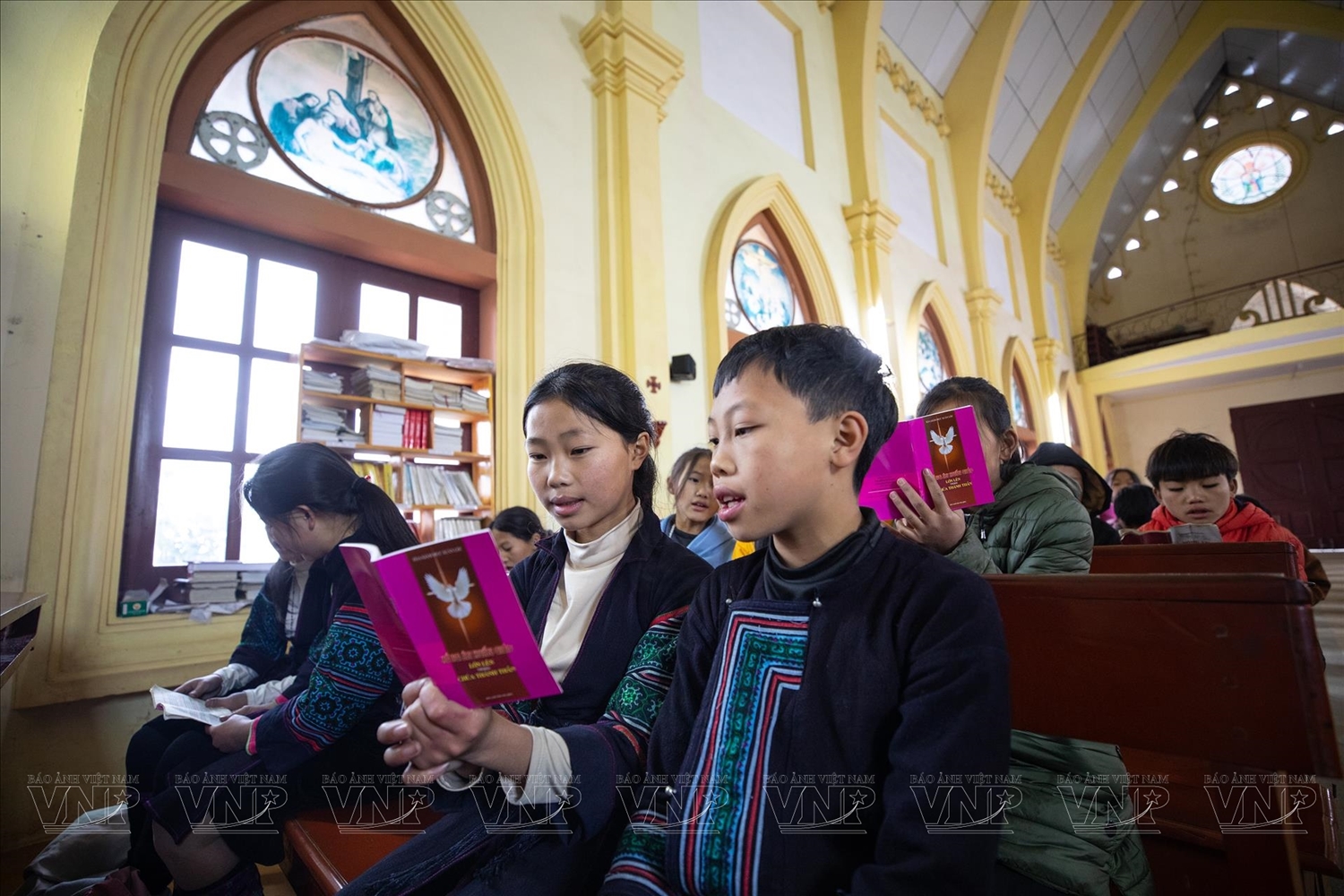
 Parishioners perform religious services at Hau Thao parish church in Lao Cai province
1. Introduction
Drawing lessons from the turbulent times in the history of missionary work, the clashes, conflicts and disagreements between Eastern and Western cultures, about liturgical rituals in various countries, including Vietnam during the early missionary period. Over time, many generations of Catholics have strived to integrate and bring Catholic culture closer to national culture, not only in religious activities but also in liturgical celebrations. The Church is acutely aware that only cultural integration is the path to expanding its missionary reach, connecting with people in remote areas and ethnic minority communities, avoiding authoritarian tendencies, reducing religious conservatism, minimizing cultural clashes and fostering a more diverse religious life. Cultural integration is also a way for Catholicism to leverage its resources and responsibilities in preserving the cultural values of the Vietnamese nation. In order to take more confident steps in accompanying the nation, Catholicism has been implementing major projects to promote cultural integration, from customs, rituals and lifestyles to architecture and art.
2. The process of cultural integration of the Catholic Church with national culture before the period of religious policy reform
Catholicism is a monotheistic religion and its systematic nature and norms are considered fundamental measures in the foundation of its faith. According to the regulations of the Council of Trent (1554-1563) and the Vatican Council (1869-1870), Catholic activities in any country must be unified in liturgical celebrations, clerical attire and the exclusive use of the Latin language. Researchers argue that this was a period of homogeneous Church, a Church in which the cultural identities and values of nations and peoples were assimilated into a culture considered to be that of the Church, but which was in reality European culture. Therefore, cultural clashes and conflicts between Catholicism and the countries to which it originated were inevitable during the missionary process.
Catholicism, when introduced to Vietnam, came to a country with a long-standing culture and polytheistic beliefs, therefore encountered cultural clashes and conflicts from the outset. With its monotheistic Catholic faith, it does not recognize polytheism, including ancestor worship, which is a deeply ingrained cultural tradition of the Vietnamese people. Other religions that practiced polytheism or whose objects of worship were not God were also considered heretical by Catholicism. This was one of the main reasons why Catholicism, when first introduced to Vietnam, was not supported by the feudal dynasties (which considered Confucianism the dominant ideology in society) and was not accepted by the people as readily as some other religions. There was a time when Catholicism was banned by the feudal court and considered a “heretical” religion of the West. Cultural differences led to many negative consequences in perception and ideology, resulting in a lack of mutual respect between the parties involved. Furthermore, it was exploited by colonial and imperial powers during their invasion of Vietnam. This history has had a significant impact on the development and image of Catholics in Vietnam.
In order to overcome cultural barriers and avoid conflict within the Catholic Church, great efforts have been made to find ways to reconcile and harmonize with national cultures. However, due to subjective and objective factors, the spirit of the Second Vatican Council and the 1980 Pastoral Letter - a most important document of the Vietnamese Bishops' Conference entitled “Building in the Church a way of life and an expression of faith in accordance with national traditions” - which contains fundamental content on dialogue with national culture, dialogue with other religions and with the poor has been poorly implemented and has not permeated religious life. Furthermore, due to the country’s constant warfare, the recognition and opportunities for Catholicism to integrate into the national culture were not adequately addressed. Therefore, prior to the country's reform process in 1986 and the religious policy reforms in 1990, Catholic efforts to integrate into the national culture were limited to recognizing cultural values and practicing ancestor worship. It allows believers to set up ancestral altars, organize commemorative activities, and use the Vietnamese language in the celebration of Mass. For ethnic minorities, it involves understanding their customs and traditions to minimize conflicts and achieve missionary goals.
3. The integration of Catholic Church culture with national culture during the period of reform
Vietnam has 54 ethnic groups, each with its own unique culture, customs, language, and religious traditions, making it, and will continue to be, fertile ground for Catholicism to pursue its integration path. The policy of integrating national culture during this period was established and implemented by the Church very early on; however, it was not until the 5th General Assembly of the Vietnamese Bishops’ Conference that this integration was concretized and emphasized in the Pastoral Letter: “Searching for national cultural identity does not simply mean reviving ancient traditions, but rather ensuring that the national character is expressed in prayers, songs, liturgical celebrations, daily life, and theological reflections and language”. In the context of national development and integration, the issue of cultural reform to absorb and integrate Catholic culture, making it closer to national culture, continues to be a concern of the Church. In recent years, the Church has promoted cultural integration in regions with large ethnic minority populations, especially in the Central Highlands, Northwest and Southwest Vietnam. Dioceses continue to promote the translation of scriptures into the languages of several ethnic minorities to make Catholic doctrine more accessible to them and, at the same time, in order to preserve the languages and scripts of these ethnic groups in the context of increasing loss and decline. Some parishes and sub-parishes with a large number of ethnic minority parishioners have organized separate Masses and catechism classes in their respective ethnic languages.
The Church continues to guide and train clergy and religious from ethnic minority groups to serve their own people. Currently, seminarians from ethnic minority groups or mountainous regions studying at seminaries during the three summer months must dedicate one month to learning their ethnic language at the Bishop’s residence. The integration of national cultures continues to be implemented by the Church through long-term, specific plans. At the 14th General Assembly in 2019, the Vietnamese Bishops' Conference approved a three-year trial of the document “Guidelines for the Veneration of Ancestors” by the Cultural Committee; and approved the K'ho language translation for Sunday Mass readings, even though since 1966 the dioceses in the Central Highlands provinces have used the K’ho language in Mass instead of Latin. At the end of 2020, the Vietnam Catholic Academy collaborated with Dong Nai Publishing House to publish the Kơ Ho - Vietnamese dictionary compiled by Father Dominic Nguyen Huy Trong. This dictionary continues the tradition of previous missionaries and is an important tool for evangelization in ethnic minority areas. With this trend, in the future, many parishes and congregations in ethnic minority regions will use their native languages to conduct Masses for the people.
The process of Catholic cultural integration continues to emphasize the inheritance and selective development of traditional cultures from various regions, integrating them into Catholic culture in the celebration of Mass and religious activities. In this process, believers both practice Catholic rituals and observe the customs and traditions of their birthplaces. This includes the use of gongs and the singing and dancing of Quan Ho folk songs, folk songs from other regions and songs of ethnic minorities. Catholic traditions are depicted through local cultures, such as the Bắc Ninh diocese using Quan Họ folk songs to portray biblical stories. Catholic processions are not unlike village festivals, featuring drums, trumpets, traditional music ensembles, colorful gongs, stilt walkers and drum dances. The elderly men also wear turbans and silk robes, and the women wear traditional four-panel dresses and conical hats; the only difference is the addition of a brass band. The brass band, originally imported from the West, has been Vietnamese-ized in terms of both attire and performance style and has been accepted by society to serve at festivals, funerals and weddings. During funerals, in addition to performing Catholic rituals, believers set up altars, display portraits, light incense, and place flowers and fruits to remember and honor the deceased. At engagement and wedding ceremonies, it’s not just about the church service; it also includes traditional engagement and wedding customs with rituals specific to each locality.
In terms of music, the trend towards integration is very clear. Previously, the language of hymns used in liturgy was Latin, but now musicians have translated hymns into Vietnamese, using folk melodies such as “Luu Thuy Hanh Van”, “Nam Ai”, and “Hat Do” to re-arrange them, making them easier for parishioners to remember and learn. A music group specializing in composing Vietnamese sacred music has been established, called the Bao Tinh Music Group, with many renowned musicians such as: Hung Lan, Tam Bao, Nguyen Khac Xuyen... have composed many songs imbued with religious and national spirit, with the following guiding principles: About the content of serving God and the Fatherland, and the art of using traditional folk songs as a sound structure, hymns will continue to be adapted by Vietnamese artists not only in their lyrical expression but also by incorporating folk melodies from each region of the country, making the prayers and hymns more appealing to the people and enabling them to easily express their faith in God.
In the arts, many Catholic churches that are being and will be built feature Vietnamese styles, such as the Cam Ly Church in Da Lat, which resembles the stilt houses of ethnic minorities; The Cua Nam Church in Lang Son province resembles the eight-roofed longhouse of the highlanders in Lang Son province; the Ban Lim Church in Gia Cat commune, Cao Loc district, Lang Son province, is built with honey and earth in the style of a traditional house, with the majority of its followers being Nung and Tay ethnic groups. Many churches in the Central Highlands are built in the style of the traditional longhouses of ethnic minorities. Within the church grounds, there are also auxiliary structures such as artificial rock formations, ponds and greenery, creating a miniature universe according to the Eastern concept of “heaven, earth and humanity as one”. The carvings in the church have enough peaches, chrysanthemums, bamboo, apricot, dragon, lychee, turtle, phoenix... The church - Rong house - Long house will become a place for common activities and also a place to create a connection between Catholic culture and the culture of Vietnamese ethnic minorities, a place to preserve and develop good cultural values.
One issue of concern for Catholicism in the process of cultural integration is the preservation of the cultural heritage of ethnic groups, especially minority groups in the Northwest and Central Highlands regions. Several dioceses have been building traditional houses to serve as centers for storing and preserving ancient artifacts of these communities. This idea originated from the passion of several priests and missionary monks in the ethnic minority areas. They painstakingly collected, gathered, and preserved artifacts from the villages, including very rare and valuable items such as elephant teeth, ancient stone musical instruments, petrified trees, precious stones, ancient gongs, ancient food bowls, wine vessels, amulet containers and many ancient musical instruments such as the four-hole mouth organ of the K’ho people... At the traditional house of the Da Lat diocese, many artifacts related to religion and beliefs are on display, such as statues of the gods Brahma, Shiva, Po Naga, Thien Y Ava, Ganesha, bronze mendicant statues, statues of demons and gods of various sizes, a collection of ancient coins... Preserving culture means preserving fragments of memory to tell future generations the historical and cultural stories of ethnic minorities, which are worthy of respect and preservation.
The Church will place greater emphasis on translating liturgical books for ethnic minorities; not only in the K’ho language but also in the languages of several other ethnic groups. Cardinal Nguyen Van Nhon, when he was Bishop of the Diocese of Da Lat stated: Ethnic groups all have different origins, and we strive to adapt to each ethnic group. Therefore, in compiling prayer books, songs, dictionaries, folk songs, proverbs and especially documents serving the church, they were translated into K'ho language after completing the translation into Churu and Lach languages. Researching history, customs, traditions and literature requires a lot of effort and time, but the church is doing it. Currently, dioceses in the Central Highlands region are translating Pastoral Letters and Pastoral Letters to disseminate the content guiding their activities to ethnic minority believers.
Along with the process of national cultural integration, the utilization and application of information technology in missionary activities is also a trend promoted by the Church. Catholicism is one of the religions that has extensively and effectively exploited the Internet for evangelization. Most dioceses, parishes, and religious orders have websites. The Church utilizes these websites as a new forum for updating information, disseminating information and evangelizing. People around the world can use computers to read the Pope’s speeches, learn about the situation of the Catholic Church worldwide, accessing information about individual dioceses and religious orders in Vietnam, and vice versa. The application of this technology has been and will continue to be widespread, including in ethnic minority areas and remote regions, thus bridging the gap between believers and the general public in understanding this religion.
It can be said that the integration of Catholic culture with Vietnamese national culture has brought about a strong transformation in awareness and actions, not only among clergy and religious leaders but also among believers. Previously, integration aimed to avoid cultural conflicts and ostracism, reduce the perceived “foreign religion” aspect and achieve missionary and religious development goals. Today, integration aims to promote Catholic cultural values within the community, increase the role and responsibility of the Church in preserving and promoting national culture and enhancing the influence of Catholicism in society. Therefore, in recent years, cultural integration has not only been about evangelization and bringing Catholicism closer to all segments of society, but also a responsibility of Catholics in preserving and promoting the cultures of other nations.
4. Conclusion
Integrating and developing national culture is a positive trend for Vietnamese Catholicism, directly impacting the thoughts, feelings, and actions of clergy, religious, and lay people. It makes them proud of the positive values of Catholicism within the flow of national culture, of their homeland, and recognizes their responsibility in building and protecting the nation and preserving national cultural identity. This is a common ground, a “denominator” for fostering national unity between Catholics and non-Catholics. At the same time, it helps to mitigate differences, conflicts and cultural clashes that could affect national unity.
* Ho Chi Minh National Academy of Politics
References
1. 9th Central Committee of the Party (2003), Resolution No. 25 - NQ/TW dated March 12th, 2003 on religious affairs.
2. Pastoral Letter of the Vietnamese Bishops’ Conference, 1980
3. Proceedings of the scientific symposium “From the Second Vatican Council to the 1980 Pastoral Letter”, Religious Publishing House, 2006, p.288.
4. Pastoral Letter of the Vietnamese Bishops’ Conference, 1992.
5. Pastoral Letter of the Vietnamese Bishops’ Conference, 1995.
6. Pastoral Letter of the Vietnamese Bishops’ Conference, 1998.
7. Pastoral Letter of the Vietnamese Bishops’ Conference, 2001.
8. Pastoral Letter of the Vietnamese Bishops’ Conference, 2004.
9. Pastoral Letter of the Vietnamese Bishops’ Conference, 2007.
10. Pastoral Letter of the Vietnamese Bishops’ Conference, 2016.
