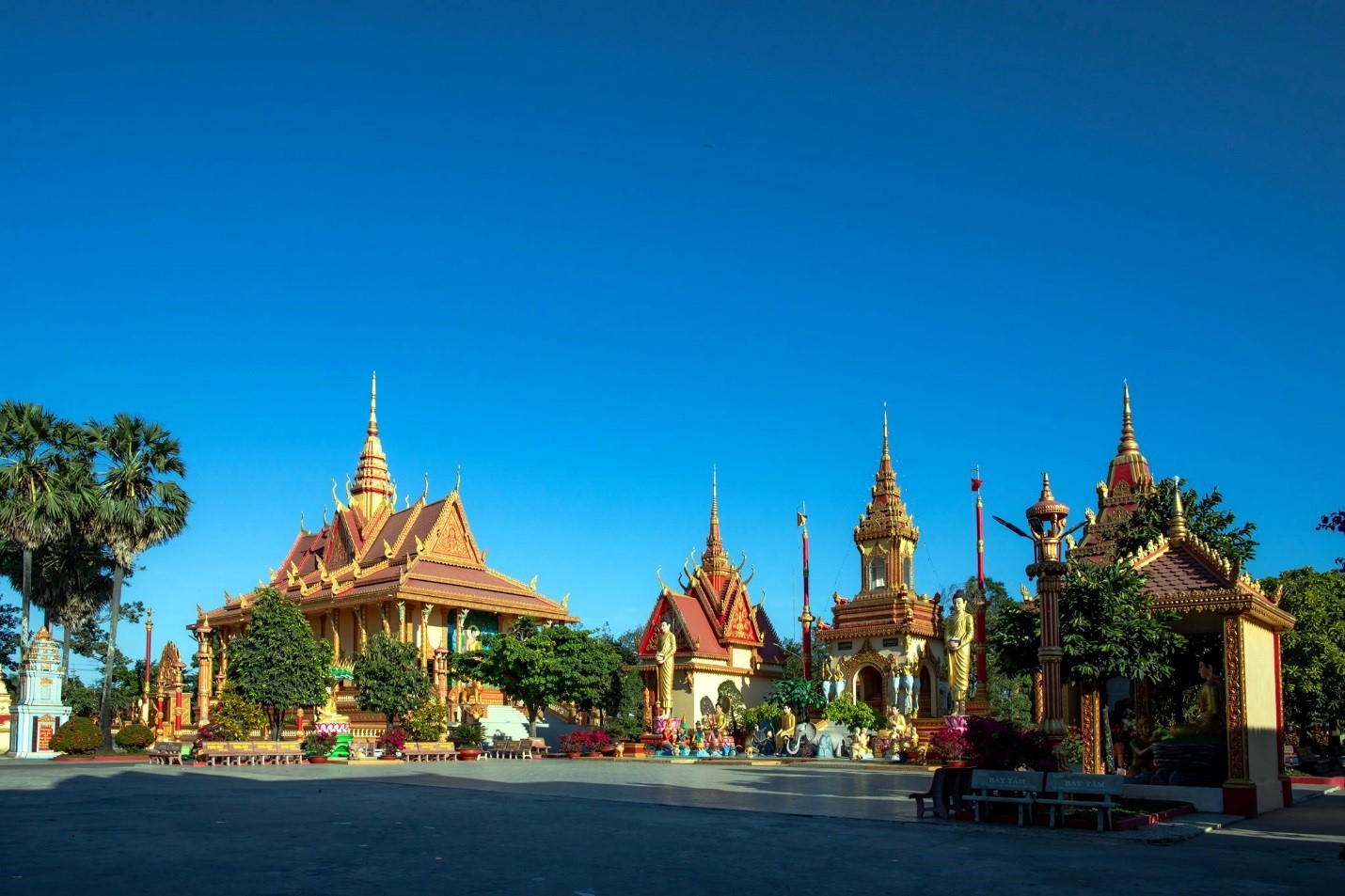
 Xiem Can pagoda is a unified architectural and artistic whole, representing a harmonious blend of three elements: Heaven, Earth and Humanity
Keywords: Khmer pagoda architecture; Southern Vietnam; Cultural symbol; Community engagement.
1. Introduction
Within the cultural landscape of the Southern region, the Khmer pagoda (Wat) is far more than a mere religious architectural structure; it is a vibrant entity that holds a central place in the collective consciousness and social life of the community. Spiritually, the pagoda serves as a sanctuary for the community’s unwavering faith in the teachings of Theravada Buddhism. Socially, the pagoda is the heart of the phum and squirrel. This is the only community space capable of connecting all members, from the elderly to children, from the rich to the poor, without discrimination. The pagoda serves as a multi-purpose cultural center; It is also a school that teaches literacy, ethics and career for young people through the form of cultivating karma; It is also a library that stores ancient scriptures written on leaves; It is also an art museum displaying the quintessence of national sculpture and painting.
Moreover, the pagoda stands as a symbol of strong community cohesion. All collective activities from discussing village affairs to organizing traditional festivals such as Chol Chnam Thmay or Sene Dolta take place within the pagoda grounds.
The pagoda serves not only as a place of worship but also as a strong spiritual bond that fosters unity, acting as a steadfast spiritual anchor that enables the community to preserve its distinct cultural identity amidst the diverse integration unfolding across the Mekong Delta.
In short, for the Khmer people, the loss of the pagoda signifies the loss of their roots and ethnic identity. The pagoda embodies the ideals of truth, goodness and beauty values that every Khmer person aspires to and upholds with deep reverence.
1. Architectural characteristics, the convergence between Heaven, Earth and Humanity
The architecture of Khmer pagoda in Southern Vietnam is not only a brilliant achievement of visual art but also a message conveyed through form and structure, reflecting the local people’s profound philosophies regarding human existence and the cosmos. It is a unified artistic whole, where every line, pattern, and spatial structure results from the harmonious interplay of three elements: Heaven (the realm of the divine and Buddhist philosophy), Earth (the natural environment and the soil of the Southern region) and Humanity (human creativity, aspirations and communal life).
Firstly, the element of “Heaven” is manifested through the tiered structure and the dense system of religious symbolism. In the worldview of Theravada Buddhism, the main sanctuary represents Mount Meru - the center of the universe and the abode of the gods - a concept reflected in the pagoda’s roof design. The roofing system typically consists of three superimposed layers, each subdivided into three smaller tiers, creating a soaring, majestic rhythm. The steep slope of the pagoda’s roof not only serves to drain water during the rainy season typical of the tropics, but is also a symbol of the heavens in Buddhism. On the roof tops, the Neak dragon image curves, its head raised high, its tail curved, playing the role of preventing evil spirits, representing the bridge between earth and sky, between humans and the supernatural. The vibrant murals adorning the main hall depicting the life of the Buddha and stories of his past incarnations - represent a way for people to manifest the noble moral values of “Heaven” within the physical realm, transforming the pagoda into a sanctuary for spiritual cultivation.
The “Earth” element in Khmer pagoda architecture demonstrates remarkable adaptation to the natural conditions of the Mekong Delta. These pagodas are typically built on elevated, dry ground to avoid flooding and to harness the land’s vital energy to the fullest. The choice of yellow as the dominant color for the entire structure carries profound significance; it is the color of monks’ robes - symbolizing Buddhist liberation and wisdom as well as the hue of ripened grain and brilliant sunlight across the vast fields of Southern Vietnam, creating a contrast that is both stunning and remarkably harmonious with the greenery of surrounding sugar palm groves and fruit orchards. In particular, the pagoda’s architecture maximizes open space through large windows and corridors encircling the main hall; this design invites natural light and breezes, fostering an airy atmosphere and a sense of closeness to the elements, thereby dissolving the boundary between the solemn spiritual sanctuary and the picturesque natural surroundings.
Ultimately, the “human” element is the soul that breathes life into inanimate brick and stone. Pagoda architecture embodies the quintessence of Khmer craftsmanship; from the Krud (Garuda) figures supporting the roofs and the graceful Keynor (Kinnari) goddesses adorning column capitals to the ferocious Reahu (Rahu) monsters at the entrance, every detail is the product of human artistic talent and deep devotion. Each carved detail represents more than mere craftsmanship; it embodies an aspiration for a peaceful life, the triumph of good over evil, and a devotion to virtue. The element of “Humanity” is also reflected in the spatial layout: while the main hall is dedicated to the “Divine”, the Sala hall, monks’ quarters and spacious pagoda courtyard are dedicated to the “Human” realm. This is a venue for community gatherings and festive celebrations - a place where locals come together to perform acts of merit, research and share in life’s joys and sorrows. The presence of towers housing the ashes of the deceased around the pagoda creates an enduring bond between the living and the departed, transforming the site into a meeting place for generations and demonstrating the principle of “drinking water, remembering its source” -gratitude towards one’s origins.
The convergence of Heaven, Earth and Humanity in the architecture of Khmer pagoda in Southern Vietnam creates a unique, unmistakable beauty. It is an artistic structure that simultaneously aspires to the sublime and mystical realm of the divine, remaining deeply rooted in the bountiful mother earth and radiating a warmth and intimacy closely attuned to the pulse of human life. The pagoda does not stand apart like an alien monument but exists as an integral part of both nature and society. It is precisely this harmony that has endowed Khmer pagoda architecture with enduring vitality, allowing it to become a steadfast spiritual symbol that has bound the Khmer community to the Southern region (Vietnam) for centuries.
2. Khmer pagodas, centers for community cohesion
In the lives of the Khmer people in Southern Vietnam, the pagoda is far more than a mere religious structure; it has become the heart of the village and a unique bond uniting all members of the community. This central role is clearly demonstrated through two primary aspects: the pagoda serves as a lecture hall preserving the nation's wisdom and as a vast stage for cultural activities and festivals.
Firstly, the Khmer pagoda serves as a center for preserving and disseminating knowledge - a unique type of school where the boundary between the religious and the secular blurs in the pursuit of raising the community’s educational level. Historically, before formal education systems had expanded into remote areas, the pagoda was the sole place where children from local villages could learn the Khmer script. The Khmer youth tradition of temporary monastic practice (filial piety practice) often undertaken as an act of filial piety - stands as the clearest testament to this educational function. Upon entering the pagoda for research and practice, young people are not only taught to chant sutras and studying Buddhist doctrine to cultivate their character, but also learn to read and write their own ethnic language. The pagoda serves as a cradle for preserving the soul of the culture through its spoken and written language, ensuring that the younger generation does not lose sight of its roots.
Moreover, the pagoda serves as a living library, preserving ancient scriptures inscribed on palm leaves - an invaluable intangible cultural heritage. It is also a place where knowledge regarding traditional medicine, astronomy, calendrical science and agricultural practices is passed down. Consequently, the pagoda became a center of wisdom - a place where people sought solutions to spiritual concerns and the challenges of daily life. A deep-seated love of learning and respect for the intellectual class (comprising monks and village elders) fostered a robust moral foundation and strengthened the bonds between generations within the Khmer community.
At the same time, the pagoda serves as a venue for festivals and community cultural activities - a place where the spirit of national unity shines most brilliantly. Throughout the year, all major Khmer events revolve around the pagoda; from the traditional Chol Chnam Thmay New Year and the Sen Dolta ancestral worship festival to the Ok Om Bok Moon-worshipping ceremony, the pagoda grounds serve as the central venue for all these rituals.
At this moment, the pagoda sheds the absolute serenity typical of a place of worship, transforming instead into the site of a grand festival for the entire community. A sense of communal solidarity is forged through shared experiences - residents joining hands to offer meals to the monks, preparing ceremonial trays and decorating the main sanctuary and the Sala hall. The spacious pagoda courtyard becomes a venue for distinctive folk art forms such as Lam Thon dance and Du Ke singing as well as traditional games like tug-of-war and stick pushing. The vibrant sounds of the traditional five-tone orchestra resonating from the pagoda roofs serve not only as an invocation to the deities but also as a rallying call that draws people closer together. This bond extends across communities, as Ngo boat teams from various pagodas gather to exchange visits and compete, forging a vast network of solidarity among the Khmer villages throughout the Southern region.
It is through these cultural activities that the pagoda fulfills the function of regulating social relationships. Conflicts and disputes between families are often resolved in the presence of the Buddha and through the mediation of highly respected monks. With its open space and inclusive nature, the pagoda creates a safe environment for the Khmer people to express their identity and share their joys and sorrows.
It can be said that the Khmer pagoda in Southern Vietnam is a unique social entity - a place where knowledge is transmitted and culture nurtured, a repository of faith regarding the afterlife and a steadfast pillar of earthly life. The sense of community cohesion centered around the pagoda has generated immense inner strength, enabling the Khmer people to preserve their unique cultural identity amidst the changing times, at the same time adding a vibrant hue to the multicultural tapestry of the Vietnamese nation. The pagoda stands as a symbol of the enduring vitality, benevolence and aspiration for harmony that define the spirit of the Khmer people in this riverine region.
3. A symbol of the Khmer soul
In the socio-cultural life of the Southern region, the Khmer pagoda is not merely a tangible architectural structure; it is also a reflection of the spiritual values, character and profound aspirations of the Khmer people. If architecture represents the physical form, then the philosophy underlying the pagoda roofs and towers is the soul - a soul that is radiant yet humble, intricate yet deeply compassionate, perfectly reflecting the identity of a people living in harmony with both nature and the Dharma.
Firstly, the Khmer temple is a symbol of goodness and absolute piety. For Khmer people, Theravada Buddhism is not just a religion but a way of life, a moral standard that governs all behavior. The Khmer soul is refined through listening to sermons and participating in short-term monastic retreats at the pagoda. Upon stepping through the temple gate - under the gaze of the monster Reahu or the mythical bird Krud - one naturally feels small and compelled to shed the greed, hatred and delusion of worldly life. The serenity and solemnity of the main hall, combined with murals depicting the life of the Buddha, offer visual lessons on the law of cause and effect and the virtue of altruism. These elements shape the distinctive character of the Khmer people - gentle, sincere and steadfast in their belief in the fairness of the universe. They live not only for the present but also to accumulate merit for the afterlife, regarding the contribution to temple construction as a supreme honor. Their spirits shine as brilliantly as the golden hues of the temple roofs, forever turned toward the light of the Buddha’s wisdom.
Secondly, Khmer pagodas symbolize the resilience and indomitable vitality of the people. Despite centuries of historical upheaval, natural disasters and the harsh conditions of newly reclaimed lands, Khmer pagodas have continued to rise and stand firm. The Khmer people may live in humble dwellings, but their pagodas must always be the most beautiful and majestic structures. The meticulous investment in every carving and statue not only demonstrates artistic talent but also reveals an unwavering determination to preserve national identity. The pagoda serves as a cultural stronghold, preserving the language, script and customs of the people. A steadfast spirit resistant to assimilation by foreign cultural currents is the source of strength that enables the Khmer people in Southern Vietnam to maintain their unique identity. The Khmer pagoda, therefore, stands as a testament to the enduring essence of the national spirit amidst the passage of time.
Thirdly, Khmer temple architecture reflects a free-spirited nature and a love for the natural world. Despite adhering to strict standards regarding religious symbolism, the temple grounds remain open and expansive, harmoniously blending with greenery, the breeze and sunlight. The Khmer people do not separate themselves from nature but rather view themselves as an integral part of it. The blend of brilliant yellow hues with the lush green of sugar palm groves and fruit orchards creates a remarkably harmonious aesthetic whole. Their souls are just the same open and hospitable, much like the space at Sala House ready to welcome and shelter anyone who comes seeking refuge. This spirit of tolerance extends beyond one’s own ethnic group to neighboring communities, fostering a distinctive cultural blend in the Mekong Delta.
Ultimately, the Khmer pagoda stands as a symbol of optimism and an aspiration for beauty. The intricate decorative patterns and the lively Lam Thon dances performed beneath the pagoda’s eaves during festivals reveal a spirit that embraces life with joy, even amidst the hardships and toil of daily labor. For the Khmer people, beauty lies not in extravagance or wastefulness, but in reverence for the divine and for life itself. The pagoda is the place where they bring to life their dreams of a paradise right here on earth; every architectural detail is a prayer and every festival an occasion for spiritual elevation.
4. Conclusion
In summary, the Khmer pagoda architecture of the Southern Khmer people is not merely a collection of physical structures made of brick, stone and mortar; rather, it is a multi-layered system of cultural symbols that embodies the wisdom, beliefs and the aspiration of an entire nation. Through the harmonious convergence of Heaven, Earth and Humanity, the pagoda transcends the boundaries of a mere religious site to become the soul of the local villages; it serves as a repository of precious knowledge, a vibrant setting for traditional festivals and above all, an enduring bond that strengthens community solidarity. In the hearts of the Khmer people, the golden pagoda roof - gleaming brilliantly under the southern sun - stands as a steadfast spiritual anchor and a source of pride in a unique cultural identity that shines forever as an eternal value.
References
1. Chu Quang Trứ (2003), Traditional Vietnamese folk architecture, Fine Arts Publishing House, Hanoi.
2. Luong Ninh (2004), History of Khmer culture in Southern Vietnam, Education Publishing House, Ho Chi Minh City.
3. Phan An (2009), The Khmer People in Southern Vietnam, Social Sciences Publishing House, Hanoi.
4. Son Phuoc Hoan (2014), Southern Khmer Culture: Distinctive Values, Ethnic Culture Publishing House, Hanoi.
5. Tran Hong Lien (2004), A Contribution to Understanding the Culture of the Southern Khmer, Social Sciences Publishing House, Ho Chi Minh City.
6. Institute of Social Sciences in Southern Vietnam (2012), Khmer pagodas in Southern Vietnam: Art and Symbolism, Proceedings of the Scientific Conference, Can Tho City.
