 The cultural heritage of ethnic minorities - a resource for tourism development in Lao Cai province
Keywords: Lao Cai province; Preservation and promotion; Cultural heritage; Ethnic minorities.
1. Introduction
In the context of integration and globalization, preserving national cultural identity is becoming a major challenge for many countries and localities. In Vietnam, the Party has always emphasized the view that culture is the spiritual foundation of society, serving as both a goal and a driving force for development. In line with the Party's viewpoint, Lao Cai province has always considered the preservation and promotion of the fine traditional cultural values of its ethnic groups as a central and continuous task. Culture is not limited to core spiritual values but is also recognized as an important resource for promoting sustainable tourism development, thereby directly improving the material and spiritual lives of local people. This research aims to clarify how Lao Cai province has been and is currently addressing the harmonious balance between heritage preservation and economic development from cultural heritage resources within ethnic minority communities.
2. Overview of cultural potential and resources in Lao Cai province
Lao Cai is a border province in the Northwest region, holding a particularly important strategic position as it serves as a gateway connecting the entire Kunming - Lao Cai - Hanoi - Hai Phong - Quang Ninh economic corridor. The entire province spans an area of over 13,256 km² and is home to nearly 1.8 million people. The most significant demographic feature contributing to the province's cultural richness is the presence of ethnic minorities, who make up 57.6% of the population, comprising 34 ethnic groups living across 99 communes and wards. It is this diversity that has transformed Lao Cai province into a treasure trove of exceptionally unique tangible and intangible cultural heritage.
Statistics show that Lao Cai province currently possesses and manages 207 classified historical sites, including 1 special national-level site, 34 national-level sites, and 172 provincial-level sites. In addition, the province has 60 inscribed intangible cultural heritage sites, most notably 4 sites recognized by UNESCO as representative intangible cultural heritage of humanity, such as: “The Tay and Giay tug-of-war rituals and games”; “The Tay, Nung, and Thai Then practices; Thai Xoe dance art” and 56 other heritage items are listed at the national level and recognized by the Ministry of Culture, Sports and Tourism.
Along with numerous traditional folk rituals and festivals, the various forms of tangible and intangible cultural heritage of the ethnic groups have contributed to making Lao Cai province a truly attractive destination. Recognizing that the cultural heritage of ethnic groups is an important resource in the tourism development orientation of Lao Cai province, in recent years, all levels and sectors of the province have always worked alongside ethnic communities to preserve and promote the value of existing cultural heritage forms, and to restore and revive lost cultural heritage to jointly protect it.
Recognizing that the cultural heritage of ethnic groups is an important resource in the tourism development orientation of Lao Cai province, in recent years, all levels and sectors of the province have always worked alongside ethnic communities to preserve and promote the value of existing cultural heritage forms and in order to restore and revive lost cultural heritage to jointly protect it. Simultaneously, conservation is being linked with the development of unique tourism products of the province. Currently, every year, the people of various ethnic groups in Lao Cai province organize dozens of traditional rituals and festivals of varying scales, creating unique tourism products that attract thousands of visitors each time they are held, such as: The Roong Pooc festival of the Giay people in Ta Van, the Gau Tao festival of the Mong people in Pha Long, the Bao Ha Temple festival, the Thuong Temple festival, the Long Tong festival of the Tay people, the new rice harvest festival of the Giay people, the Coming-of-Age ceremony of the Dao people, the traditional wedding ceremony of the Giay and Ha Nhi people,... This is an invaluable resource for the locality to exploit and promote, turning national culture into a driving force for economic development.
3. Models for preserving and promoting ethnic cultural identity in Lao Cai province
Based on research, five core models for preserving and promoting ethnic cultural identity in Lao Cai province can be identified as follows:
Firstly, the traditional festival preservation model is associated with community tourism development
Instead of letting festivals fade away or being held only on a small scale internally, Lao Cai province has transformed them into powerful tourism products. Every year, the province hosts over 100 traditional festivals. Many of them have become iconic tourism events, such as: The Rice Planting Festival (of the Tay, Nung, and Giay people); the Gau Tao Festival of the Mong people (in Pha Long, Sin Cheng, and Tram Tau communes); the Fire Dance Festival of the Red Dao people (Bac Ha commnune); the Kho Gia Gia Festival of the Ha Nhi people (Bat Xat commune); and the Com Festival of the Tay people (Nghia Do commune). In addition, there is a system of folk religious festivals held at the beginning of spring at Thuong Temple, Trung Do Temple, Bao Ha Temple, Dong Cuong Temple,…
The festivals are organized in a way that preserves traditional rituals, but resolutely reduces formality and enhances cultural experiences for participants. The biggest breakthrough lies in the management method. Lao Cai province empowers the community to take ownership of the festivals, relying primarily on artisans and heritage custodians. State management agencies only play a role in providing guidance, professional support, ensuring security and order, environmental hygiene and promoting tourism. Thanks to this clear division of roles, the appeal of the festivals has skyrocketed, with each spring festival attracting an average of 3,000-4,000 visitors. In early 2026 alone, events such as the Thuong Temple Festival and the Dong Cuong Temple Festival recorded a record number of nearly 10,000 attendees.
Secondly, the model of preserving traditional cultural villages is linked to sustainable livelihoods
Cultural heritage truly comes alive only when it exists within the daily lives of the people. Recognizing this, Lao Cai province has oriented its conservation efforts in conjunction with the goal of creating livelihoods, through investing in the development of traditional cultural villages linked to community tourism. With resources from the National Target Program for socio-economic development in ethnic minority and mountainous areas, especially Project 6: In order to preserve and promote the valuable traditional cultural values of ethnic minorities in conjunction with tourism development, Lao Cai province has prioritized investment and support for the construction of many exemplary traditional cultural villages, such as: the Mong ethnic village in Ban Pho hamlet (Ban Pho commune), the Ha Nhi ethnic village in Choan Then hamlet (Y Ty commune) and the Tay ethnic village in Nam Cam hamlet (Nghia Do commune). This represents a crucial shift in thinking: instead of investing in a scattered manner, Lao Cai focuses its resources on building exemplary traditional cultural village models that are highly representative of each ethnic group. Establishing these model villages helps create “living museums”, where all values, from architecture and lifestyle to art are fully represented.
Regarding community intervention and support methods, in these key areas, the government does not do the work for the people but plays a supporting role, providing funding and capacity building. Specifically, in terms of hardware, people receive direct support to renovate their traditional houses, focusing on preserving the integrity of ethnic architecture and protecting shared cultural spaces of the community. In terms of services and human resources (software), specialized agencies guide the people on how to organize and develop standardized homestay accommodation models. In particular, the local people participate in training courses to become tour guides, independently explaining and telling the cultural stories of their ethnic group to tourists. Regarding cultural experiences, the province encourages and supports the people in organizing folk art performances, introducing traditional culinary arts and characteristic handicrafts to tourists.
Through a harmonious combination of architectural preservation, human capacity building, and service development, cultural heritage sites in Lao Cai province have truly come alive and are vividly present in contemporary life. The traditional cultural village model has initially proven its validity in gradually transforming cultural resources into a core resource for community-based tourism development. The greatest achievement is that this model directly creates jobs and increases stable income for local people, thereby forming a sustainable development cycle: culture creates livelihoods, and good livelihoods, in turn, provide material resources and spiritual motivation for people to love and consciously protect their ethnic heritage.
Thirdly, the model for restoring rituals, performing arts and folk knowledge
Protecting intangible cultural heritage means protecting the “soul” of an ethnic group's culture. Preserving intangible cultural heritage requires meticulous attention to detail in its restoration work. Many beautiful customs, unique rituals, and core traditions at risk of disappearing have been systematically restored and invested in by Lao Cai province, such as the Then Khoan ritual of the Tay ethnic group (Nhuan 3 village, Tang Loong commune), the Spring Festival of singing in the village of the Tuyen Dao people (Khe Dung village, Bao Thang commune), and the Sacred Forest Worship Festival of the Red Dao people (Den Sang commune).
In order to ensure the continuity of the folk culture of ethnic minorities, Lao Cai province has created a solid support network by encouraging the development of effective grassroots cultural clubs, such as: The Xa Pho ethnic cultural club in An Thanh village, Gia Phu commune; the Mong ethnic folk culture club in Den Sang commune; and the khene and senh tien dance clubs in Ai Nam village, Phong Hai commune. These activities contribute to preserving, promoting and spreading the traditional cultural identity of these ethnic groups.
The most profound and strategic step forward is proactively integrating these traditional cultural values into school environments and incorporating them into experiential tourism programs. This approach creates a favorable ecosystem for preservation linked to natural transmission, helping the younger generation absorb heritage in a more accessible way and transforming heritage into a vibrant, organic part of contemporary life.
Fourthly, the model for preserving traditional crafts
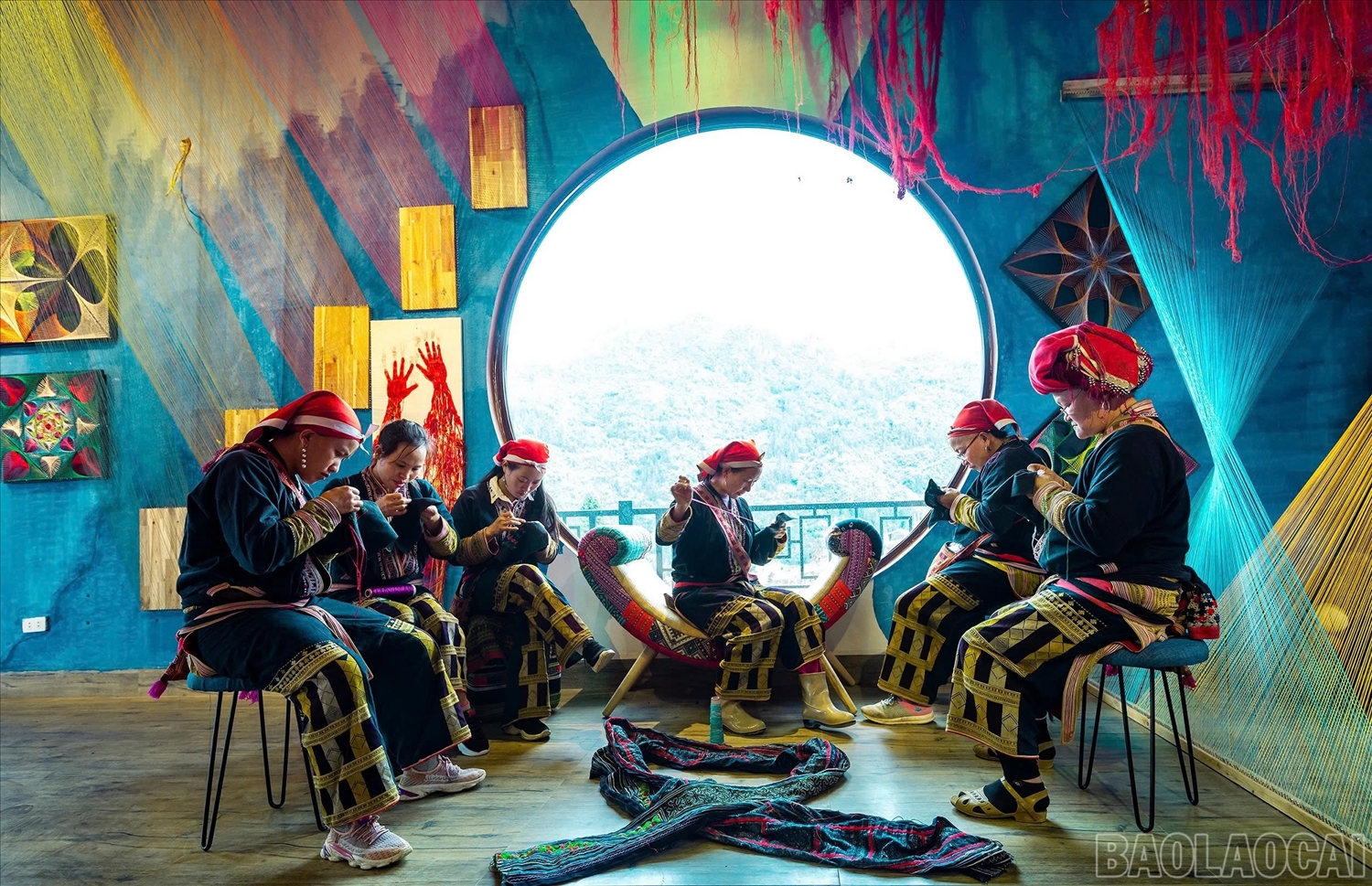
Traditional crafts, imbued with unique skills, knowledge, and aesthetic concepts, are the most exquisite material proofs of each ethnic group’s identity. Preserving and developing traditional crafts is a way to preserve and promote the cultural identity of each ethnic group. With that perspective, Lao Cai province has made efforts to restore and develop many distinctive handicrafts, such as: silver carving in Muong Hum, Bac Ha, and Ngu Chi Son communes; basket weaving by the Ha Nhi people in Y Ty commune and by the Tay people in Nghia Do commune; brocade weaving by the Thai people in Nghia Lo commune and Van Chan commune; and blacksmithing by the Mong people in Tram Tau commune and Mu Cang Chai commune... This contributes to preserving the unique handicraft techniques and traditional cultural identity of the ethnic minorities.
The local government's innovative thinking lies in recognizing that the preservation of traditional crafts must be closely linked to the practical needs of the market in order to ensure their sustainable existence. Therefore, local authorities not only support technical preservation but also deeply intervene in the value chain by assisting people in building brands, promoting trade and connecting consumption through fairs, cultural and tourism festivals, as well as directly integrating products into tours and travel routes. This approach helps to enhance the value of handcrafted goods, create jobs, and provide a stable source of income instead of just work during the off-season, thereby encouraging people to stay committed to their ancestral craft for the long term.
Fifthly, to highlight and maximize the role of artisans, village elders, community leaders and influential figures among ethnic minority communities
People are always at the center of all processes of creating, practicing, and transmitting heritage. Deeply aware of this, Lao Cai province has been building a proud network of “living treasures” with 45 artisans awarded titles by the State (including 2 People’s Artisans and 43 Outstanding Artisans), along with 45 provincial-level artisans in the field of intangible cultural heritage and 20 folk artisans.
Lao Cai province places special emphasis on and recognizes the role of village elders, community leaders, artisans and influential figures among ethnic minorities as the core force and pillars in preserving the precious cultural heritage of the ethnic groups. Therefore, the province specifically empowers and fully utilizes the position and voice of village elders, community leaders and influential people in the community. They are not only “teachers” who directly teach the spoken language, written language, folk songs, and folk dances to their descendants, but also “spiritual leaders” who mobilize the people to preserve good customs and traditions, build a cultured way of life at the grassroots level, resolutely eliminate outdated customs and pioneer in leading the community to participate in community tourism development models and build a civilized way of life.
espite positive results, cultural preservation models linked to tourism in Lao Cai province still face many challenges. Some areas remain dependent on government support, and their self-reliance and ability to connect with the market are still limited. The risks of commercializing festivals, eroding original values, and lacking a new generation of artisans still exist. Digital transformation in cultural preservation, while emphasized, is not yet uniform across localities…
4. Some lessons learned
From a series of synchronous intervention models, positive results have been achieved along with some identifiable challenges in Lao Cai province, a number of lessons can be drawn, providing principles for heritage management and conservation as follows:
Firstly, we must firmly adhere to the principle of community-centeredness: Cultural preservation cannot succeed if it is separated from the people. Therefore, cultural preservation cannot be imposed from the top down. Local people must be positioned as both creators of heritage and direct beneficiaries of those cultural values. The state should only play a role in guiding, providing professional support, ensuring security and promoting awareness.
Secondly, the principle of “culture goes hand in hand with livelihood”: For heritage to be preserved and have long-lasting, sustainable vitality, all conservation efforts must be linked to economic development, with the biggest focus being the development of community tourism strategies and the development of distinctive products bearing local brands.
Thirdly, the principle of "inheritance": It is necessary to continuously nurture and pass on the love of national culture to the younger generation through traditional education activities, combined with the flexible application of digital technology in the preservation, management and promotion of heritage.
Fourthly, the principle of “mobilizing combined strength”: The task of protecting heritage is a tremendous challenge, requiring the joint and coordinated efforts of resources, from the coordination of the State and the partnership of the business sector to the contribution of the entire society.
5. Conclusion
The cultural identity of ethnic minorities is not only an invaluable asset but also the source of strength for national unity. Based on the practical implementation in Lao Cai province, it can be affirmed that effectively addressing the organic relationship between heritage preservation and tourism-based livelihood development is the golden key to sustaining traditional culture. With its flexibility, creativity and people-centered approach, Lao Cai province will continue its efforts to preserve this precious heritage, gradually transforming culture into an endogenous resource, creating a solid foundation for the rapid and sustainable development of the locality.
References
1. Communist Party of Vietnam (2026), Resolution No. 80-NQ/TW dated January 7th, 2026 of the Politburo on the development of Vietnamese culture, Hanoi.
2. Communist Party of Vietnam (2026), Documents of the 14th Congress, National Political Publishing House, Hanoi.
3. Presentation by Lao Cai province at the National Conference on Ethnic Culture (April 2026).
