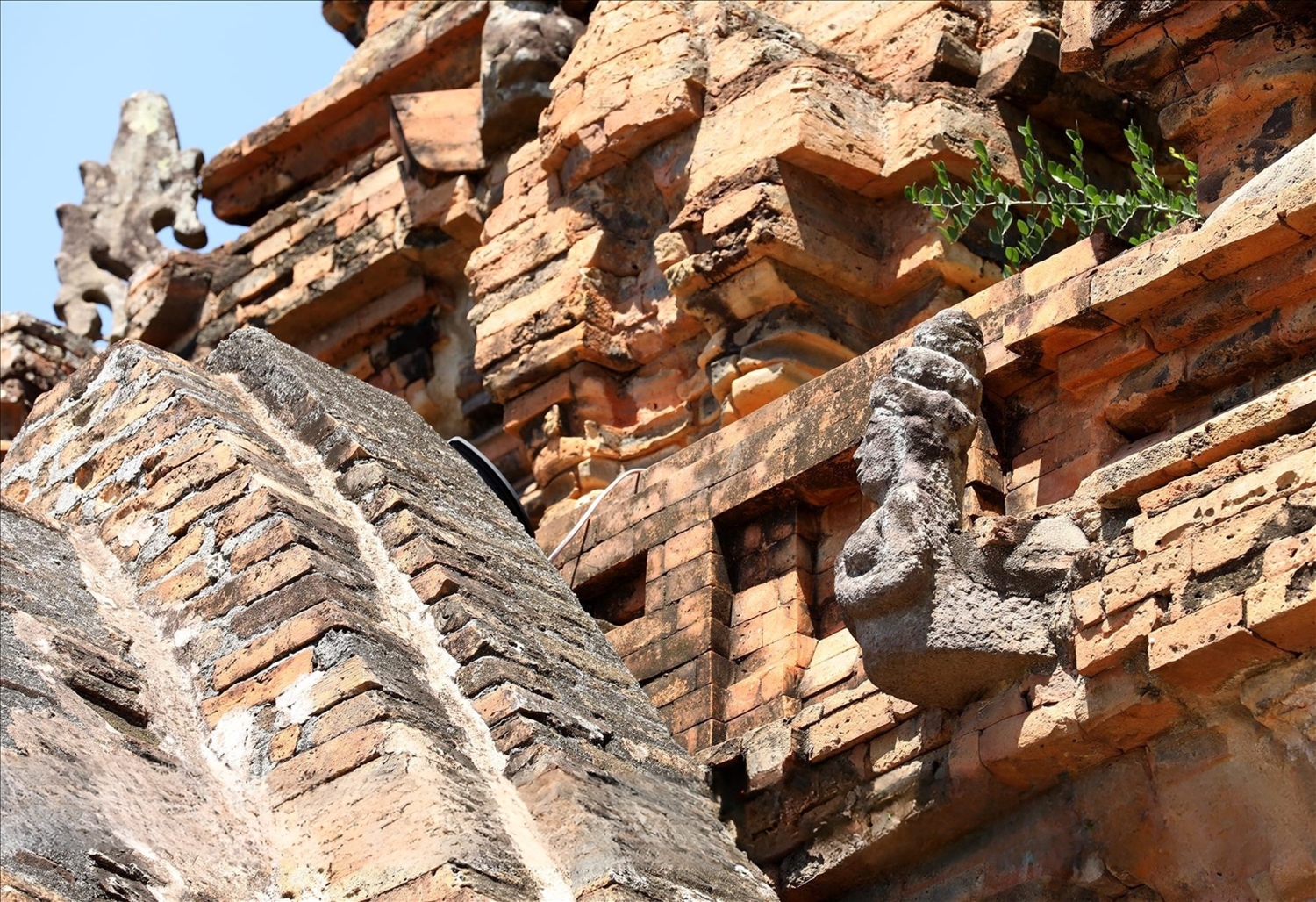
 The distinctive sculptural style of Cham culture
Location and Architecture: A convergence of earth, sky and water
The Ponagar South Tower also known as the Po Sanh Tower, to be one of the four remaining towers in the relic complex. This structure stands out not only for its height and dimensions but also for its unique architecture, which differs from that of many other traditional Cham towers.
According to researchers, the South Tower rebuilt on the site of an earlier structure in the mid-12th century (1143) exhibits an architectural style characteristic of the later period of Champa art.
Right from the beginning of the 20th century, French architect H. Parmentier realized the specialness of this tower. While traditional Champa towers often have square bodies and multi-tiered roofs, the South Ponagar tower has an unique roof shape made up of four curved sides, combined into a tall block, shaped like a giant onion. The combination of a sturdy, square tower body and a gracefully rounded roof creates a unified and perfect aesthetic, embodying the harmony between architectural and spiritual elements.
The temple dedicated to the god Shiva
The most distinctive feature of the South Ponagar Tower is its historical significance. It once served as a temple dedicated to Shiva, the god of destruction and regeneration and one of the three supreme deities of Hinduism. Shiva, known by various forms and names, is worshipped by the Cham followers of Brahmanism as a powerful and eternal deity. At the South Tower, rituals honoring Siva are conducted with solemnity. The worship of Shiva here holds not only religious significance but also reflects the relationship between Cham kings and Hindu deities.
However, starting around the early 12th century, the temple underwent a change regarding its principal deity. At this time, the goddess Bhagavati (also known as Ponagar) was worshipped as the principal deity of the temple complex, although traces of Shiva worship remained very distinct. This transformation reflects a process of profound cultural intersection and acculturation within the religious life of the Cham people.
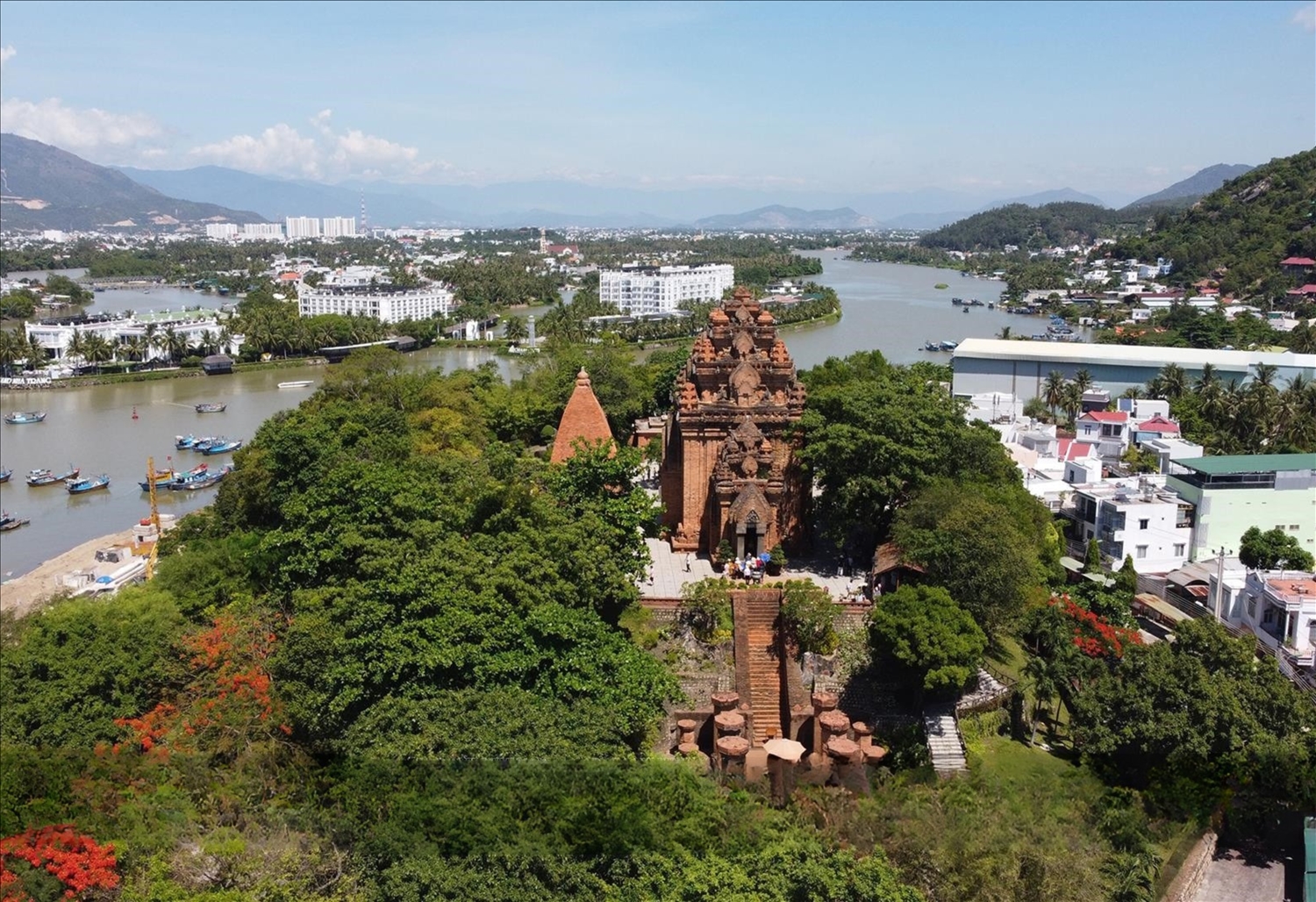 The Ponagar Cham Towers sit nestled atop a beautiful hill beside the gentle Cai River
The blending of Vietnamese and Cham cultures
In the land of Khanh Hoa province, the Ponagar Tower is worshipped by the Vietnamese people. The Cham Mother Goddess Ponagar is revered by the Vietnamese under the name Thien Y A Na. This process of cultural acculturation has created a unique characteristic for Lady Tower (Ponagar Tower), a site where the Vietnamese Mother Goddess worship blends with Cham Hindu traditions.
Legend has it that Thien Y A Na was a fairy who descended to earth and taught the local people how to cultivate rice, weave cloth and organize their social life. When she ascended to the heavens, the people built a temple in her memory. The story is a legend, reflecting the Vietnamese people’s gratitude and reverence for a figure of great merit.
This cultural blend is also clearly evident in the Via Ba Festival, held annually in the third lunar month. This festival attracts not only the Cham people but also tens of thousands of Vietnamese devotees from all over the country. The rituals, ranging from the ceremonial bathing of the statue and the offering of gifts to traditional dance performances, represent a blend of both cultures, creating a vibrant spiritual atmosphere and affirming the enduring bond between the two peoples.
It can be said that the South Tower of Ponagar and the Lady Tower complex as a whole, constitute a precious cultural heritage, a tangible testament to the cultural interchange between the two great civilizations of India and Southeast Asia. Every brick and every statue here is a page of history, recounting the story of a glorious civilization that once existed. Standing before the South Tower of Ponagar, one can hear the wind rustling atop the structure, the distant murmur of lapping waves and the echoes of time itself, telling the story of the mighty god Shiva and the Mother Goddess of the Realm and of a culture that has woven an enduring bond between the past and the present./.
