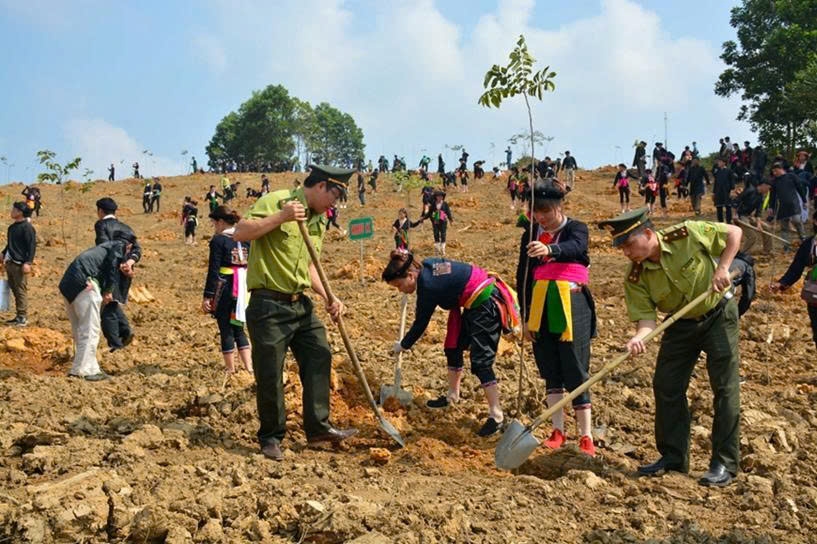
 Forest rangers and ethnic minority people participate in the tree planting festival
Keywords: Preservation and promotion; Traditional cultural values; Ethnic minority people; Environmental protection.
1. Introduction
In the context of increasing globalization and climate change, preserving and promoting the traditional cultural values of ethnic minorities associated with protecting the environment has become an urgent requirement, possessing both humanitarian significance and strategic value. The local cultural space of ethnic minority communities is closely linked to ecological knowledge, sustainable farming practices and a belief system that respects nature. However, urbanization, overexploitation of resources and the encroachment of modern lifestyles are putting these values at risk of disappearing. Therefore, studying the close relationship between traditional culture and the environment not only helps identify existing challenges but also opens up policy directions for sustainable development, ensuring harmony between cultural preservation and ecosystem conservation.
2. Research results
2.1. Theoretical basis of cultural preservation and environmental protection
From a sustainable development perspective, culture is considered the fourth pillar, alongside socio-economic and environmental factors. Preserving traditional culture is inseparable from protecting the environment, because the natural environment is the space in which culture exists and is nurtured.
The community-based conservation approach emphasizes the active role of people in resource management. For ethnic minorities, traditional institutions such as village elders, customs, and customary laws are an important foundation of environmental governance. Therefore, cultural preservation must go hand in hand with empowering communities, respecting local knowledge and creating mechanisms for people to directly participate in environmental protection programs.
2.2. The current state of traditional cultural values and the environment in ethnic minority and mountainous areas
Ethnic minority and mountainous areas are unique areas, occupying a large proportion of land (3/4 of the country’s area), yet having a low population density. These regions possess many valuable and unique cultural characteristics, reflecting the deep relationship between people and nature among ethnic minority communities.
The current state of traditional culture and the environment in ethnic minority and mountainous areas reveals a complex interplay between values that are still sustainably maintained and elements that are at risk of significant decline due to social and ecological changes. Firstly, traditional cultural values continue to play a pivotal role in community life. Many agricultural rituals, taboos, customary laws, and folk cultural practices of the Tay, Thai, Mong, Dao, Ede, Bana, Co Tu and other ethnic groups are still preserved and practiced in daily life. These elements not only reflect cultural identity but also contain important local knowledge related to resource use and environmental protection. For example, customs such as worshipping sacred forests, regulations prohibiting hunting during the breeding season of wild birds and animals and rules for protecting springs in the Central Highlands create sustainable self-governance mechanisms, contributing to maintaining ecological balance.
However, many cultural values linked to the environment are facing a disruption in their transmission. Part of the reason stems from the deep penetration of the market economy, leading to changes in livelihoods, changes in residential patterns and transformations in the role of traditional community institutions. The decline in the role of customary law, a previously important tool in resource management. Meanwhile, the migration of young people for labor creates a generational gap in the practice of local knowledge, putting much of the knowledge about forest classification, seed selection, cropping patterns or festival organization at risk of rapid disappearance.
From a natural environmental perspective, ethnic minority and mountainous regions are facing significant pressure from overexploitation of resources and climate change. Many localities have recorded a substantial reduction in natural forest area due to logging, conversion of forest land for agriculture, hydropower or infrastructure projects. The decline in upstream forest area leads to water depletion, directly impacting traditional livelihoods such as rice cultivation, slash-and-burn agriculture and semi-natural livestock farming. Soil erosion, flash floods, and prolonged droughts are becoming more common, weakening the ecological foundation that sustains local culture.
Simultaneously, the commercialization of culture, especially in the tourism sector has also raised prominent issues. Many festivals are organized in a performance-oriented manner, detached from their original sacred spaces; traditional costumes are being modified to suit market tastes; handicraft products tend to simplify traditional techniques to increase commercial value. These changes diminish the value of traditional culture and weaken the connection between culture and the natural environment, which is a constituent element of a community’s identity.
On the other hand, household waste and waste from modern agricultural practices are polluting the soil and water in many ethnic minority and mountainous areas. The use of chemical fertilizers, pesticides and single-use plastics is increasingly widespread, while waste collection and treatment systems remain limited. This leads to a decline in the quality of the living environment, directly affecting public health and disrupting the foundation of traditional ecological knowledge based on the natural cycle model.
However, despite the difficulties, many localities have made significant efforts in preserving culture and the environment. Some communities effectively maintain community forest models based on customary law; many community tourism villages implement activities linked to environmental protection education; artisans continue to pass on weaving, basketry and traditional festivals to the younger generation. Community-based resource management programs are beginning to demonstrate effectiveness when combining local knowledge with modern management policies.
2.3. The relationship between traditional culture and environmental protection
The relationship between traditional culture and environmental protection in ethnic minority communities is a reciprocal, intertwined and sustainable one, formed over hundreds of years of adaptation to specific ecological and social conditions. Firstly, the traditional culture of ethnic minority communities is the result of a long process of interaction with nature, in which the environment is not only a living space but also the foundation that shapes local knowledge, value systems and social structures. Concepts such as “the forest is our mother” “the stream is the source of life”, or “the land is our ancestor” foster a deep sense of community and responsibility towards the environment. Accordingly, many ethnic groups have established systems of customary laws and village regulations to protect forests and conventions on land and water use in order to regulate behavior and ensure ecological balance. This demonstrates a culturally-driven environmental protection mechanism that operates on trust, credibility and community spirit rather than administrative coercion.
On the other hand, the natural environment also sustains and nurtures traditional culture. The existence of agricultural festivals, polytheistic beliefs and ritual practices related to forests and water depends on an intact ecosystem. Many traditional crafts, such as brocade weaving, stilt house construction, basket weaving, and musical instrument making, rely on local materials and sustainable harvesting techniques. When the environment degrades, forests shrink, water sources become polluted and the climate changes, the cultural elements associated with them also break down or change in a negative direction. This highlights the vital role of the environment in cultural continuity.
Furthermore, traditional culture is an important resource contributing to contemporary environmental protection strategies. Local knowledge about circular, rotational, and intercropping farming practices; community-based water resource management; and weather forecasting skills based on natural observation are increasingly recognized as components of sustainable development. Combining local knowledge with modern science not only improves resource management efficiency but also strengthens the community’s cultural identity and pride. Therefore, preserving traditional culture and protecting the environment are not just two parallel tasks, but two dimensions of a mutually reinforcing process. Culture protects the environment and the environment preserves culture. A deep understanding of this relationship is fundamental to developing sustainable policies and development models that are appropriate to the specific characteristics of ethnic minority communities in the current period.
2.4. The environment is the space that nurtures culture
The environment is a space that nurtures culture. For ethnic minority communities, the natural environment is not only a physical dwelling place but also a cultural and social space that plays a role in nurturing, shaping and recreating cultural identity across generations. In the context of traditional social structure mainly based on communal living, directly dependent on natural resources, the environment is considered the cradle of local knowledge, customs, practices, beliefs and spiritual value systems of the community. Firstly, the mountainous ecological landscape, including forests, mountains, streams, terraced fields, valleys, etc., forms the foundation of the philosophy of life for many ethnic minority communities, where each natural element is viewed as a sacred entity. The animistic belief system prevalent in the faiths of the Thai, Mong, E-de, Katu and Bana peoples, among others, demonstrates the close relationship between humans and nature. Forests are not only a source of livelihood but also a sacred space, the dwelling place of the Forest spirit; streams are the dwelling place of the water spirit; rice fields are the fruit of the harmony between humans and mother earth. These beliefs shape environmental behavior, helping communities maintain unwritten rules about protecting sacred forests, preserving water resources and limiting overexploitation.
Furthermore, the natural environment is also a condition for the existence of festivals, ritual practices and folk cultural activities. Many agricultural festivals, such as the new rice harvest festival of the Gia-rai and Bana people, the new rice harvest festival of the Tay and Nung people, or the water source worship ceremony of the E-de people, are directly linked to the natural cycle. If the ecosystem degrades, these practices not only lose their context but also become altered or disappear, leading to a disruption in the community’s spiritual life. Similarly, many traditional crafts, from brocade weaving, indigo dyeing, basket weaving, to stilt house construction and musical instrument making, depending on local raw materials such as rattan, bamboo, wood and herbal dyes. Environmental richness is therefore a prerequisite for maintaining traditional craft techniques.
In particular, the environment is also a space for natural cultural education, where local knowledge is taught through labor, rituals and daily living experiences. Children learn to identify medicinal plants, read animal tracks, keep track of seasons, find water sources,… not through books, but through direct interaction with the ecosystem. This shows that the environment acts as an "open school," where cultural values are naturally and sustainably reproduced.
Thus, the environment not only nurtures material life but also supports and preserves the spiritual values of ethnic minorities. Any environmental degradation inevitably leads to the distortion or loss of traditional culture, demonstrating the inseparable unity between environmental protection and cultural preservation.
3. Solutions for preserving and promoting cultural values associated with protecting the environment
Preserving and promoting the traditional cultural values of ethnic minority communities associated with protecting the environment requires a comprehensive, integrated set of solutions that are appropriate to the cultural and ecological characteristics of each region.
Firstly, local knowledge, including land use practices, community conventions on forest protection, sustainable shifting cultivation cycles and traditional craft techniques, should be considered an important resource in resource management. Collecting, digitizing and incorporating local knowledge into environmental planning and socio-economic development systems helps increase efficiency, community acceptance and ensure cultural inheritance.
Secondly, it is necessary to establish a community-based environmental governance mechanism. This model empowers people to monitor and patrol forests, manage water resources and allocate land according to customary law and state law. When communities become active participants in the decision-making process, the sustainability of both culture and the environment is strengthened. At the same time, it is necessary to expand sacred forests and community forests; providing financial and legal support so that these spiritual and ecological spaces become shields protecting biodiversity.
Thirdly, developing a green economy and ecotourism and cultural tourism is a crucial solution to create momentum for conservation. The exploitation of traditional cultural values in tourism must adhere to the principles of respecting identity, limiting excessive commercialization and ensuring the economic interests of local communities. Sustainable models of traditional brocade weaving villages, agricultural experiential tourism, or OCOP products made from local herbs need to be promoted in a way that reduces resource use, reducing emissions and increasing green livelihoods.
Fourthly, environmental education, integrated with cultural education, needs to be implemented comprehensively in schools, cultural institutions and community life. Incorporating content on customary laws, local knowledge and environmental protection skills into local education programs not only helps the younger generation understand cultural values but also strengthens their responsibility in preserving the environment.
Fifthly, the State needs to improve its ethnic and environmental policies in an interdisciplinary direction, especially by integrating cultural preservation into sustainable development programs in ethnic minority and mountainous areas. Financial and technical support mechanisms, along with the mobilization of social organizations' participation, will create conditions for communities to maintain their cultural and ecological spaces in a stable and long-term manner.
In general, cultural preservation and environmental protection are only effective when implemented in a symbiotic manner, in which the community is at the center and local knowledge is respected as a strategic value of sustainable development.
4. Conclusion
Preserving and promoting the traditional cultural values of ethnic minority communities in conjunction associated with protecting the environment is a strategic direction for sustainable development. Traditional culture not only reflects the community’s long-term adaptation to nature but also contains local knowledge systems that are valuable in modern resource management. Conversely, the environment is the fundamental space that ensures the existence and reproduction of cultural values. Therefore, the development of policies, models, and governance mechanisms needs to place the community at the center; harmoniously combining local knowledge and science. At the same time, it creates socio-economic incentives for culture and the environment to be maintained and developed sustainably.
* Central Committee for Propaganda and Mass Mobilization
* Journal of Ethnic and Religious Research
References
1. Nguyen The Anh, Nguyen Dinh Thao (2020), Local knowledge and the issue of forest resource protection among ethnic minorities in the western part of Thanh Hoa province, Journal of Culture and Arts, No. 433 - July.
2. Ngo Duc Thinh (2003), Understanding the customary laws of ethnic groups in Vietnam, Hanoi: Publishing House. Social science.
3. Tran Huu Son (2008), Local knowledge of the Ha Nhi people in Vietnam on the issue of forest protection, 3rd Vietnam Studies Conference.
4. UNESCO (2021), Safeguarding Intangible Cultural Heritage and Sustainable Environmental Practices, Paris.
