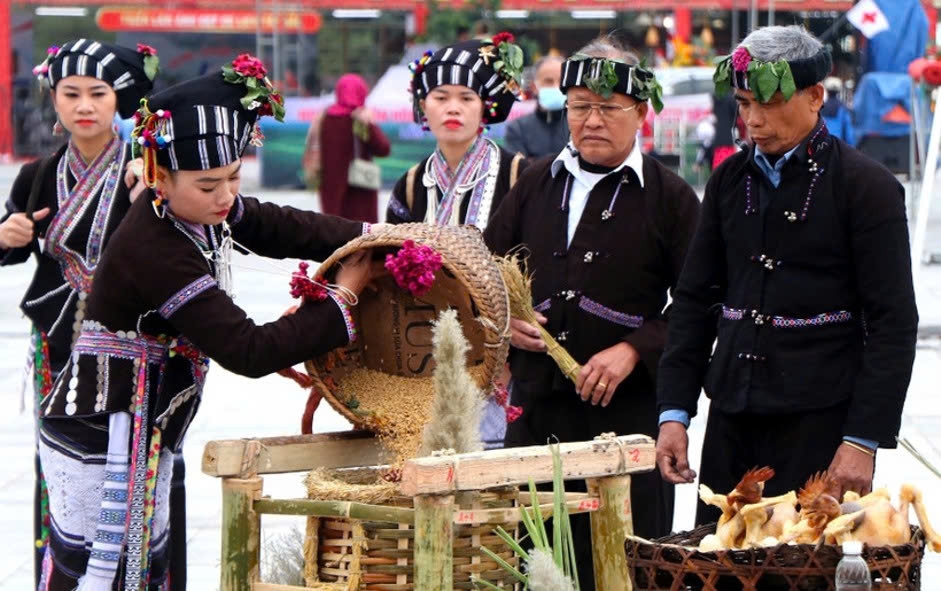
 Traditional costumes at the “New Rice Festival” of the Lu ethnic group, Lai Chau province
Keywords: Traditional costumes; Ethnic minorities; Festivals; National cultural identity.
1. The close connection between traditional clothing and festivals
Vietnam is a unified, multi-ethnic country, with 53 ethnic minority groups, and traditional clothing is one of the important ways to distinguish one ethnic group from another. With the diversity of traditional costumes of 53 ethnic minorities, “the costumes of ethnic minorities contribute to creating the national cultural value of Vietnam, rich in identity, diverse in unity” [5].
Depending on natural conditions, landscape, environment, and society, each ethnic group selects and develops materials, processes, methods of weaving, dyeing, sewing, embroidery, decoration, structure, shape and color for their traditional costumes according to their own values and identity. Through traditional clothing, ethnic minorities not only express their aesthetic taste but also reflect their religious beliefs, worldview and even the origins and development of their people.
Throughout their existence, ethnic minorities have produced costumes suitable for various purposes: clothing for labor and production, clothing for festivals, weddings and funerals; costumes for shamans and priests when performing rituals, clothing for the elderly, children,... The clothing of different ethnic groups varies, even among groups within the same ethnic group. Because of its richness, diversity, and expressive nuances, traditional clothing is one of the typical values that contribute to the cultural identity of ethnic minorities in Vietnam.
According to statistics from the Ministry of Culture, Sports and Tourism, “the whole country currently has 8,868 festivals, of which 8,103 are traditional festivals, showing that the vast majority of festivals in our country are traditional festivals” [1]. Although costumes and festivals are two distinct cultural elements, they are closely related. Festivals provide an environment for costumes to be expressed, while costumes contribute to the unique character of the festival. Therefore, “festivals are a good environment to preserve traditional cultural values, including the costumes of ethnic minorities” [9].
Festival spaces are considered unique environments where core elements of the traditional cultural life of ethnic minorities are preserved, such as: Clothing, rituals, beliefs, music, cuisine, customary laws, community relations… are fully revealed, highly symbolic, easily observable and capable of clearly reflecting the ethnic identity. In many ethnic minority communities, traditional clothing plays a special role in festivals, reflected in the richness of its craftsmanship and the system of symbols associated with rituals, beliefs and social structures.
Some examples of symbolic elements in traditional clothing include the Long Tong festival of the Tay and Nung people in the northern midland and mountainous regions, where Tay women stand out in their five-panel blouses, rich in indigo blue, as if blending into the deep green landscape of the mountains and forests. For the Mong people, the Gau Tao festival is an occasion when all the women in the village wear traditional linen dresses embroidered with floral patterns. The patterns on their clothing mainly mimic nature (flowers, plants) and folk beliefs (diamonds, spirals, swastikas, the sun) with vibrant colors (red, yellow, green, white) reflecting the distinct identities of each Mong ethnic group: the Flower Mong, the Black Mong and the White Mong. “The bodice and skirt worn by Mong Hoa women in Bac Ha (Lao Cai province) has two vertical bands embroidered with many patterns”. According to the artisans, it symbolizes the two rivers that the Mong people had to cross when entering Vietnam. Or the clothing of the Black Ha Nhi people (in Bat Xat - Lao Cai province, Phong Tho - Lai Chau province), indigo black is the main color and there are legends explaining that the color protects the Ha Nhi people in the forest to escape from hunting [4].
In the Thai community, the Xen Ban - Xen Muong festival is not only an occasion to pray for a bountiful harvest but also a time for women to showcase their beauty through traditional dresses. The pieu scarf, the com blouse, the belt, and silver jewelry create the distinctive cultural identity of Thai women. The dominant colors on the piêu scarf include the green of the mountains and forests, the yellow of ripe rice, the red and white of flowers and grass, expressing love and attachment to the homeland and village. These knots - rolled-up cloth knots resembling fern shoots, often red in color are believed to ward off evil spirits. The symmetrically embroidered patterns at both ends of the scarf repeat motifs of flowers, leaves and birds, symbolizing the natural world and fertility. The piêu scarf is also a token of love, containing philosophies of life associated with sincere and faithful love between couples... The Bana, Xo-Dang, Co-tu and Brau ethnic groups in the Central Highlands all wear short, simple clothing, suitable for their gathering and production methods in the dense forests and hot, humid climate of their habitats.
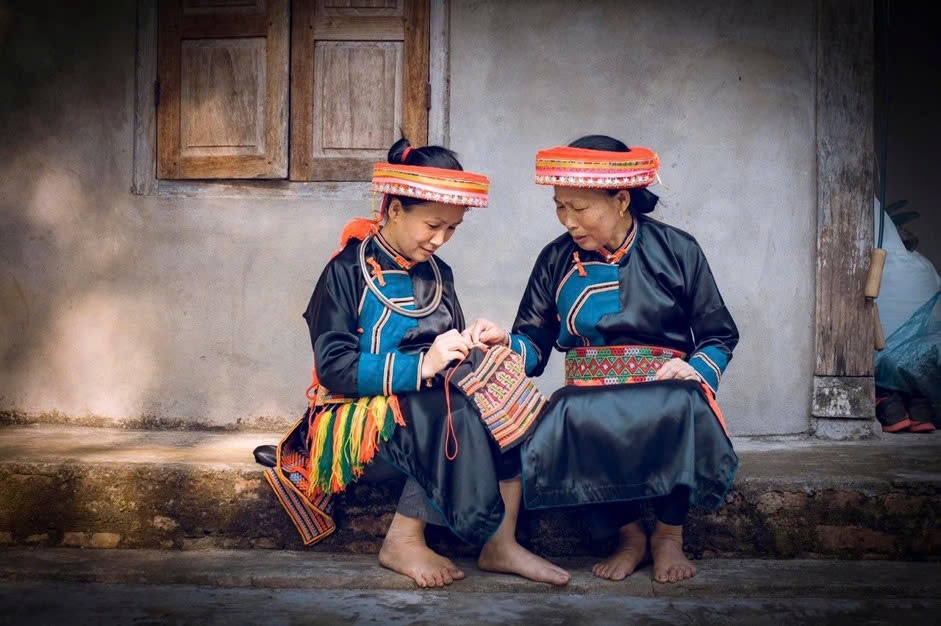 The Dao people in Thai Nguyen province preserve and maintain their traditional clothing
2. The role of traditional costumes of ethnic minorities in festival spaces
Traditional costumes worn during festivals are always the most beautiful and elaborately prepared, because festivals are important events for the entire community. In particular, traditional attire is mandatory in sacred spaces and during ritual practices at festivals. In the festival space, the traditional costumes of ethnic minorities clearly demonstrate many roles from different perspectives.
Firstly, traditional clothing is a means of identifying and affirming ethnic identity.
During festivals, traditional clothing is the most visual, clear and immediate way to distinguish one ethnic group from another. Simply by looking at the style of clothing, the color combinations, patterns and accessories, people both within and outside the community can identify the ethnic group, or even identify a local group, clan or region of residence. With the diversity of ethnic costumes, when participating in festivals, especially those involving many ethnic groups, the traditional attire can reveal the identity of the festival’s organizer.
Unlike everyday life, where clothing can be simplified or replaced by modern attire, festivals are a time when the community actively chooses the most complete and authentic traditional costumes. Dressing appropriately during festivals is not simply a matter of aesthetics, but a conscious cultural act that demonstrates respect for ancestors, community and the unique cultural identity of one’s nation.
Secondly, traditional clothing is a system of cultural and religious symbols that are encoded
Traditional costumes in festivals are not just for “looking” but also for “reading”. Each pattern, color and material carries layers of meaning related to the worldview, philosophy of life and beliefs of the community. For many ethnic minority groups that lack a written language or whose writing is not widely used, traditional clothing becomes a form of preserving knowledge through images and symbols.
In the festive atmosphere, a time of harmony between humans, nature, and deities, the symbols on traditional costumes become even more meaningful. Indigo is associated with earth and resilience; red symbolizes fertility and good fortune; Motifs of trees, flowing water and the sun reflect the cycle of nature and the hope for a bountiful harvest. Wearing traditional clothing during the festival therefore signifies communication with the supernatural world, allowing people to express gratitude and pray for good things in the new year.
Thirdly, traditional costumes are an integral part of the sacred space of the festival
Traditional costumes directly contribute to creating a sacred atmosphere, distinguishing festivals from everyday life. During the ceremony, both the practitioner and the recipient must wear traditional attire in accordance with the community’s regulations. Wearing traditional clothing shows solemnity and respect for the deities, and also helps the deities recognize the role of the person performing the ritual.
The attire of those performing the rituals varies depending on the ethnic group. The traditional attire of the Dao Tien shaman in Khuoi Xoan village, Minh Quang commune, Tuyen Quang province includes: a hat, belt, sash, gong… and other musical instruments appropriate for each specific ritual. The dress, reaching to the wearer’s heels, is predominantly indigo black, buttonless and fastened with a cord or belt. The collar and sleeves are adorned with geometric patterns, plants, flowers and other motifs… Notably, the shaman's attire differs from everyday clothing in that it features three fabric straps, approximately 150 cm long and 20 cm wide, draped over the shoulders. These straps come in three different colors including: white, black and red. The colorful tassels on the strap have colorful patterns, and the embroidery is quite elaborate with many kinds of colored threads such as red, white, yellow… which have sacred meaning, suppress evil spirits, eliminate evil people, create solemnity and bring prosperity and wealth [2].
San Chay shamans wear matching robes; the inner robe is white, shorter than the outer robe, and is traditionally made with buttons and pockets on both sides. The outer garment is quite elaborate, with intricate tailoring and decorative patterns featuring exquisite embroidery; it is usually black or indigo, extending below the knees, with a collar that runs from top to bottom, often embroidered with red thread also running from top to bottom, and the body of the garment is often decorated with embroidered dragon motifs. The sleeves are wide, shorter at the top, and gradually drape downwards to the bottom of the garment. The cuffs feature an embroidered or red trim, while the hem is embroidered with a mix of red and yellow threads. Pants the same color as the shirt, wide legs, the crotch usually reaches the knee, the hem of the pants covers the whole foot [1].
For the Mnong people in the Central Highlands, during festivals, the village elders, the chief officiants, the shamans wear floral loincloths, the gong-playing group wears floral loincloths and goes shirtless, and women participating in performances wear floral skirts and short-sleeved shirts to make it easier to play gongs, dance and sing [6].
Fourthly, traditional clothing is a means of recreating and transmitting cultural knowledge
Festivals are the community’s biggest “cultural classroom” and costumes are the most visual “textbook”. Children and teenagers, through observing, trying on, and learning how to coordinate costumes at festivals, acquire traditional knowledge and aesthetic standards, thereby developing a deeper awareness of their social roles. During the festival preparations, weaving, embroidering, and adjusting costumes become opportunities for the older generation to pass on skills and recount cultural stories associated with patterns and colors to the younger generation. Thus, clothing also serves as a bridge between generations, contributing to maintaining cultural continuity within the community.
Fifthly, traditional clothing is an expression of social order and community relations
During festivals, traditional clothing often clearly reflects the social status, age, gender and marital status of the wearer. Differences in how headscarves are worn, jewelry is adorned, colors are coordinated or accessories are used demonstrate that traditional social structures are still maintained and respected within the festival space.
Through traditional clothing, the community reaffirms behavioral norms, from family and kinship relationships to the roles of men and women, the elderly and the young. This helps the festival become not only an occasion for fun but also a mechanism for reinforcing traditional social order, limiting conflict and maintaining community cohesion.
Sixthly, traditional clothing is a tool for community bonding and fostering cultural pride
When the entire community wears traditional clothing during a festival, the sense of belonging and national identity in each individual is strongly reinforced. Clothing helps individuals better understand their place within a group, thereby strengthening social cohesion. For communities heavily impacted by migration, cultural exchange and economic change, this role becomes even more crucial. The festival, with its prominent display of traditional costumes, becomes an opportunity for the community to reflect on itself and affirm that even as life changes, national cultural identity remains cherished and preserved.
Seventhly, traditional clothing is a cultural resource that serves sustainable development.
In the current context, traditional costumes in festivals not only hold cultural value but also become a resource for socio-economic development, especially through tourism. When properly utilized, traditional costumes can both contribute to heritage preservation and create livelihoods for ethnic minority communities.
The roles mentioned above demonstrate that traditional costumes in ethnic minority festivals are not merely a supporting element but a central component of their culture. Traditional clothing is a treasure trove of knowledge passed down through generations, serving symbolic, ceremonial, educational and social functions, while also contributing to the strengthening of identity and community development.
3. Conclusion
Traditional clothing holds a particularly important place in the cultural life and festivals of ethnic minorities in Vietnam. The project “Preserving and Promoting Traditional Costumes of Ethnic Minorities in Vietnam”, implemented from 2019 to 2030, aiming to preserve and promote the traditional costumes of ethnic minorities, meeting the requirement that “cultural heritage is both a driving force and a goal”, contributing to the sustainable development of the cultures of ethnic minorities in Vietnam.
Making traditional costumes more prevalent in the lives of ethnic minority communities contributes to enhancing pride, awareness of preservation and promotion of traditional ethnic costumes. Events such as the “Colorful Cultures of Ethnic Groups” festival, the Vietnamese brocade culture festival associated with the National Unity Day of Vietnamese ethnic groups, Vietnam Heritage Day, and thousands of other festivals held annually are important solutions for preserving and promoting the value of traditional costumes of ethnic minorities in the festival space.
From a cultural science perspective, traditional clothing can only endure if it is placed within the festival space, where it is associated with rituals, sacred spaces and the communities that practice it. Festivals are the most vibrant environment for traditional costumes to showcase their role, as every detail, from patterns to color combinations, carrying meaning and conveys cultural messages. If festivals become commercialized or lose their authenticity, traditional costumes will also lose their platform for expression and gradually diminish in value.
Conversely, if the festival is restored to its traditional standards, encouraging full community participation and strengthening the role of village elders, chiefs, and artisans, then traditional costumes will naturally be used, recognized and passed down. Therefore, preserving traditional costumes cannot be separated from preserving festivals, so that traditional costumes become a cultural and economic resource contributing to the sustainable development of ethnic minority areas.
* Academy of Construction Strategy and Cadre Training, Ministry of Construction
References
1. News Newspaper (Ethnic Groups and Mountain Regions), Shaman’s attire of the San Chay people, https://dantocmiennui.baotintuc.vn/trang-phuc-thay-cung-cua-nguoi-san-chay-post178613.html
2. Tuyen Quang Newspaper, The shamanic attire of the Dao Tien people: https://baotuyenquang.com.vn/trang-phuc-thay-cung-cua-nguoi-dao-tien-144521.html
3. Ministry of Culture, Sports and Tourism (2019), Decision No. 209/QD-BVHTTDL dated January 18th, 2019 on approving the Project “Preservation and promotion of traditional costumes of ethnic minorities in Vietnam in the current period”.
4. Ministry of Culture, Sports and Tourism, Digitizing data on the number of traditional festivals, https://bvhttdl.gov.vn/so-hoa-du-lieu-le-hoi-truyen-thong-20231221110113818.htm
5. Le Ngoc Thang (2023), Some issues on preserving and promoting the value of ethnic minority costumes in the context of industrialization and modernization, Proceedings of the Forum on Culture of Ethnic Minorities.
6. Vietnam Plus/VNA, , https://vietnam.vnanet.vn/vietnamese/long-form/trang-phuc-dan-toc-mnong-306948.html
7. National Assembly of the Socialist Republic of Vietnam (2024), Law No. 45/2024/QH15: Law on Cultural Heritage, promulgated on November 23th, 2024.
8. Tran Huu Son (2023), Theories and approaches to ethnic costumes in Vietnam, Proceedings of the Forum on Culture of Ethnic Minorities.
9. Vu Thi Uyen (2023), The role of ethnic minority costumes in festival spaces, Proceedings of the Forum on Culture of Ethnic Minorities.
