Keywords: State management of religious affairs; The great national unity bloc; Ca Mau Province.
1. Introduction
During the period of 2018-2024, Party committees, authorities, and mass organizations in Ca Mau province created favorable conditions for religious dignitaries, clergy and followers to conduct their activities in accordance with the law and the spirit of Directive 18-CT/TW. Consequently, followers have been able to practice their religion with peace of mind, in line with the charters and guiding principles of their respective faiths.
However, state management of religious affairs still faces certain challenges and limitations that affect the building of great national unity within the province, in accordance with the spirit of Resolution No. 23-NQ/TW (dated March 12th, 2003) of the 9th Party Central Committee and Directive No. 18-CT/TW (dated January 10th, 2018) of the 12th Politburo. Therefore, in order to “ceaselessly promote equality and solidarity among ethnic groups and religions” (Nguyen Phu Trong, 2022), it is essential to effectively implement state management of religious affairs in conjunction with “fostering religious solidarity and great national unity” (Nguyen Phu Trong, 2022) and “implementing policies regarding social affairs, ethnic groups, beliefs and religions” (Nguyen Phu Trong, 2022) to meet the requirements of the new situation in Ca Mau province.
2. The current state of state management of religion
People of various ethnic groups, particularly ethnic minorities in Ca Mau province live intermingled across most communes, wards and towns in the province, fostering harmonious relationships within the community (Ca Mau Provincial Party Committee, 2020). The province is home to seven legally recognized religions, with hundreds of places of worship and hundreds of thousands of adherents who actively embody the spirit of “living a good secular and religious life”, participating in patriotic movements and contributing to maintaining security, fostering socio-economic development, and strengthening the great national unity bloc (Ethnic and Development Newspaper, 2025). Political security and social order in religious communities remain stable. The great national unity bloc has been consolidated, harnessing the power of consensus to build public trust in the Party and the State and to enhance social consensus (Ca Mau Provincial Party Committee, 2022).
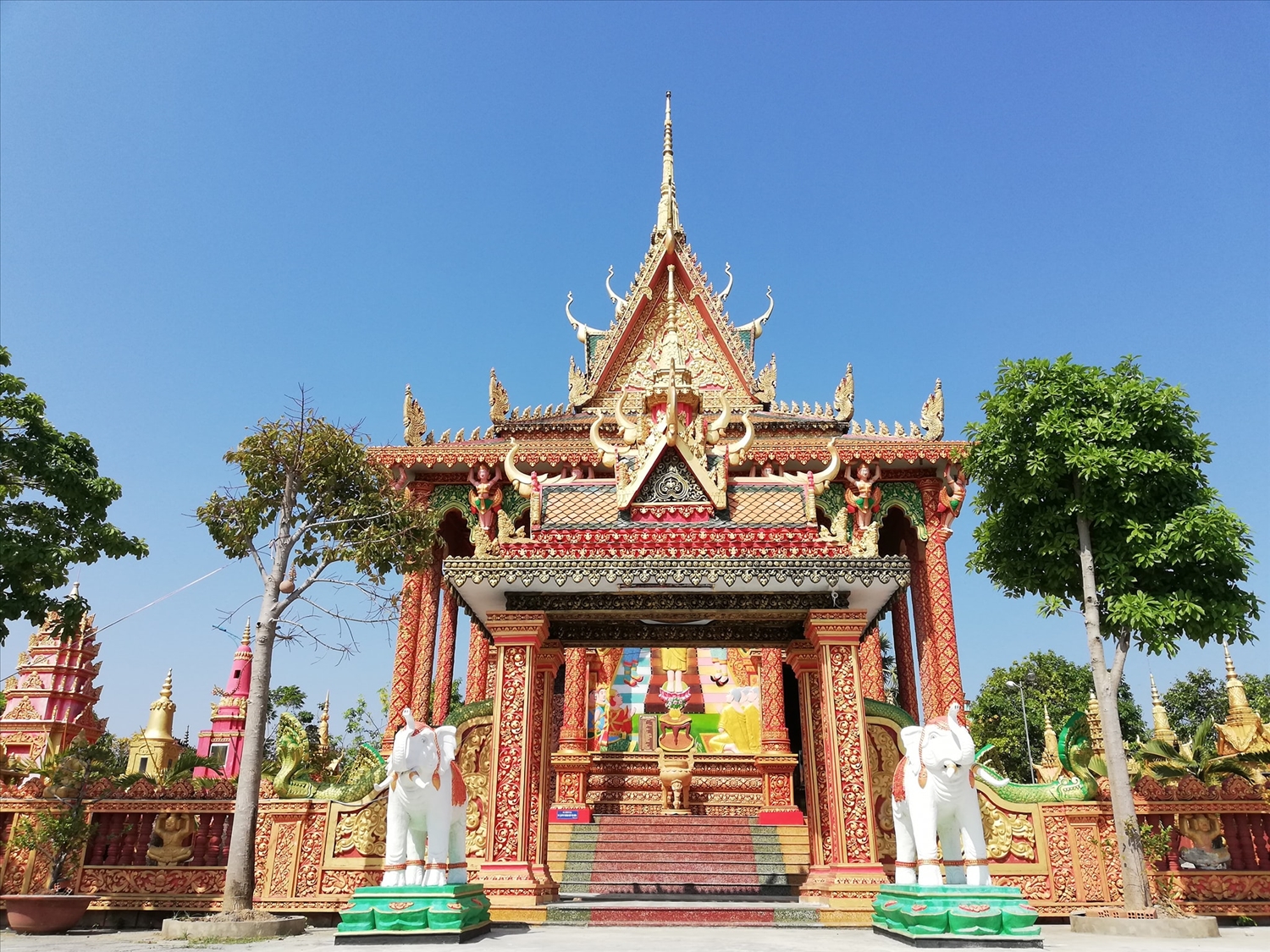 Monivongsa Bopharam pagoda in Ca Mau province
After more than five years of implementation, state management of religious affairs in Ca Mau province has achieved many positive results:
Firstly, priority is consistently given to providing advisory support for the formulation of policies, plans, and regulatory documents concerning beliefs and religions. Specialized agencies proactively develop plans and effectively implement state management in the fields of belief and religion on an annual basis.
Secondly, the dissemination of the Party’s guidelines and the State’s policies and laws regarding belief and religion aimed at officials and civil servants working in this sector, as well as religious dignitaries, functionaries and followers has proven highly effective. Since 2018, Ca Mau province has organized seven professional training courses on belief and religious affairs, attended by over 800 officials and civil servants (including two courses held online due to the COVID-19 pandemic).
The Department of Home Affairs assigned civil servants to carry out the dissemination, implementation, and promotion of a thorough understanding of the Law on Belief and Religion; Government Decree No. 95/2023/ND-CP dated December 29th, 2023 (detailing specific articles and implementation measures for the Law on Belief and Religion); and Ca Mau Provincial People's Committee Plan No. 34/KH-UBND dated February 3rd, 2021, regarding Protestantism-related activities in the province for the period of 2021-2030. Additionally, information was disseminated to six training classes on doctrine and religious practice for the Cao Dai Minh Chon Dao, Cao Dai Tay Ninh and Hoa Hao Buddhist groups, attracting nearly 1,000 participants (Ca Mau Department of Home Affairs, 2024).
Thirdly, the provision of guidance on administrative procedures regarding beliefs and religions has been effectively carried out, meeting the religious practice needs of organizations and individuals, particularly at the commune and district levels. The Religious Affairs Division of the Department of Home Affairs advises the Department Director on coordinating with district and city People’s Committees to provide procedural guidance regarding annual conferences, the appointment and ordination of religious dignitaries and notifications concerning the transfer of clergy and religious functionaries.
Fourthly, the work of inspection, examination, resolution of complaints and denunciations, and handling of violations regarding belief and religion has been carried out rigorously. Specialized agencies annually coordinate with relevant departments, sectors, and district- and city-level People’s Committees to conduct reviews, inspections, and reporting in accordance with regulations. Consequently, numerous instances of illegal proselytization and activities associated with “heretical sects” or “strange cults” have been promptly prevented.
Fifthly, attention is paid to addressing matters regarding religious land use in accordance with relevant legal regulations. As of the end of 2024, Ca Mau province had allocated land and issued land use rights certificates to 122 religious establishments (Ca Mau Department of Home Affairs, 2024), covering a total area of nearly 1.4 million square meters; meanwhile, 30 religious establishments currently using land have not yet been formally allocated land or issued certificates in accordance with regulations, involving a total area of over 185,000 square meters.
Sixthly, religious organizations receive guidance and support to adhere to their established religious tenets and participate in patriotic emulation movements. Authorities focus on aligning administrative units with religious activity structures, thereby facilitating both management and religious observance. The Provincial People’s Committee has issued numerous directives to assist religious groups in operating in accordance with their charters, statutes and the law.
Seventhly, attention is paid to consolidating the organizational structure and apparatus, as well as training and professional development for officials responsible for state management of belief and religious affairs. On December 27th, 2019, the Chairman of the Ca Mau Provincial People's Committee issued Decision No. 2034/QĐ-UBND regarding the reorganization of specialized divisions and administrative units under the Ca Mau Department of Home Affairs. This was followed by Decision No. 015/2025/QĐ-UBND, dated July 9th, 2025, defining the functions, tasks, powers, and organizational structure of the Ca Mau Department of Ethnic and Religious Affairs.
However, alongside the achievements made, state management of religious affairs in Ca Mau province has recently faced certain difficulties and limitations:
Firstly, the application of legal regulations, particularly the Law on Belief and Religion and Decree No. 162/2017/NĐ-CP (now Decree No. 95/2023/NĐ-CP) remains subject to certain limitations due to a lack of alignment between legal provisions and local realities.
Secondly, legal regulations concerning belief and religion lack coherence and contain overlaps. Certain provisions are inconsistent with the Law on Construction, the Land Law and regulations on fine arts. This lack of consistency complicates legal implementation, oversight and application, thereby affecting state management and creating obstacles for religious organizations regarding the construction and repair of places of worship.
Thirdly, state management of belief and religious affairs in Ca Mau province has at times failed to meet the requirements of the new situation. This is due to a lack of personnel, limited professional expertise and inadequate coordination among agencies, which affects the safeguarding of citizens' rights to belief and religion while hindering efforts to monitor and prevent religious activities that violate the law.
Fourthly, the situation regarding the establishment of religious sites and unauthorized missionary and preaching activities remains complex. In the near future, religious groups are likely to expand their reach and attract followers through social charity work, particularly in remote and isolated areas. This could lead to competition and rivalry among religious groups over the recruitment of followers.
Fifthly, some religious dignitaries and officials have a limited understanding of the law, leading them to put forward inappropriate proposals. Furthermore, a segment of the population characterized by naivety and economic hardship is easily influenced and susceptible to adopting new religious phenomena, “heretical sects” or “strange cults” that operate in violation of the law (Ca Mau Department of Home Affairs, 2024).
3. Some solutions to enhance state management capacity regarding religion in the coming period
In the coming period, to further enhance state management of religious affairs in Ca Mau province and contribute to fostering the strength of the great national unity bloc guided by the principle of “effectively realizing the goals of religious unity and great national unity, while ensuring the right to freedom of belief and religion for all in accordance with the law” (Communist Party of Vietnam, 2021) and particularly following the reorganization of administrative units at various levels and the establishment of a two-tier local government model, Ca Mau province needs to focus on synchronously implementing the following solutions:
Firstly, Party committees, authorities, the Fatherland Front, socio-political organizations, as well as cadres and Party members must continue to thoroughly grasp, disseminate, and widely communicate the Party’s guidelines and the State’s policies and laws regarding religious affairs and the promotion of the great national unity bloc within Ca Mau province, particularly Directive No. 18-CT/TW (dated January 10th, 2018) of the 12th-tenure Politburo and Plan No. 26-KH/ĐĐMT (dated October 10th, 2018) of the Party Caucus of the Vietnam Fatherland Front. Furthermore, attention must be paid to implementing Government Decree No. 124/2025/NĐ-CP (dated June 11th, 2025), which regulates the decentralization and delegation of powers, as well as the delineation of authority between the two levels of local government regarding ethnic, belief and religious affairs.
Secondly, continue to refine policies and laws regarding belief and religion to align with the new situation. Regulations concerning land use and the construction of religious facilities need to be adjusted to suit the realities of administrative unit reorganization and the two-tier local government model. Procedures for licensing and managing land and the construction of facilities for beliefs and religions should be simplified and digitized to minimize time and costs for religious organizations, in the spirit of implementing Resolution No. 57-NQ/TW (dated December 22nd, 2024) of the 13th Politburo regarding breakthroughs in science, technology, innovation, and national digital transformation. At the same time, it is essential to listen to the views of religious communities and the general public, particularly at the grassroots level, in order to fully understand the specific needs and challenges regarding the actual religious and spiritual lives of local residents.
Thirdly, step up the organization of conferences and in-depth training sessions for officials working in religious affairs. Training plans must be specific, flexible and tailored to the needs of different target groups, while also keeping pace with new trends and challenges. Particular emphasis should be placed on training grassroots-level officials, as they frequently rotate positions and often face difficulties in fully grasping policies. Additionally, promoting online training methods to reduce costs and expand outreach.
Fourthly, strengthening the review, research, and monitoring of the situation regarding beliefs and religions to support state management. Paying close attention to the legal status, organizational structure, and internal regulations of religious groups in order to propose appropriate, lawful solutions. Regularly visit religious communities during festivals and holidays to listen to their thoughts and aspirations and in order to make recommendations tailored to each specific religion.
4. Conclusion
State management of religious affairs in Ca Mau provinve has yielded positive results, yet challenges remain, necessitating specific solutions to enhance effectiveness. Moving forward, the synchronized implementation of solutions combined with the replication of successful models will foster the sustainable development of religious activities while laying a foundation for state management that simultaneously promotes the great national unity bloc.
References
1. Party Central Committee (2003), Resolution No. 23-NQ/TW dated March 12th, 2003, of the 9th Party Central Committee on promoting the strength of great national unity for the goal of “a wealthy people, a strong country and a just, democratic and civilized society”.
2. Party Central Committee (2003), Resolution No. 25-NQ/TW, dated March 12th, 2003, of the 9th Party Central Committee on religious affairs in the new situation.
3. Politburo (2018), Directive No. 18-CT/TW, dated January 10th, 2018, of the 12th-tenure Politburo on the continued implementation of Resolution No. 25-NQ/TW, dated March 12th, 2003, of the 9th-tenure Party Central Committee regarding religious affairs in the new situation.
4. Government (2023), Decree No. 95/2023/ND-CP dated December 29th, 2023, of the Government detailing a number of articles and measures for the implementation of the Law on Belief and Religion.
5. Government (2025), Decree No. 124/2025/ND-CP dated June 11th, 2025, of the Government, stipulating the decentralization and delegation of powers, and the delineation of authority between two levels of local government regarding ethnic affairs, beliefs and religions.
6. Ca Mau Provincial Party Committee (2018), Official Dispatch No. 849-CV/TU dated March 21st, 2018, regarding the implementation of Directive No. 18-CT/TW of the Politburo.
7. Ca Mau Provincial People’s Committee (2025), Decision No. 015/2025/QĐ-UBND dated July 9th, 2025, of the Chairperson of the Ca Mau Provincial People’s Committee, prescribing the functions, tasks, powers and organizational structure of the Department of Ethnic and Religious Affairs.
8. Standing Committee of the National Assembly (2025), Resolution No. 1655/NQ-UBTVQH15 dated June 16th, 2025, on the reorganization of commune-level administrative units in Ca Mau Province.
