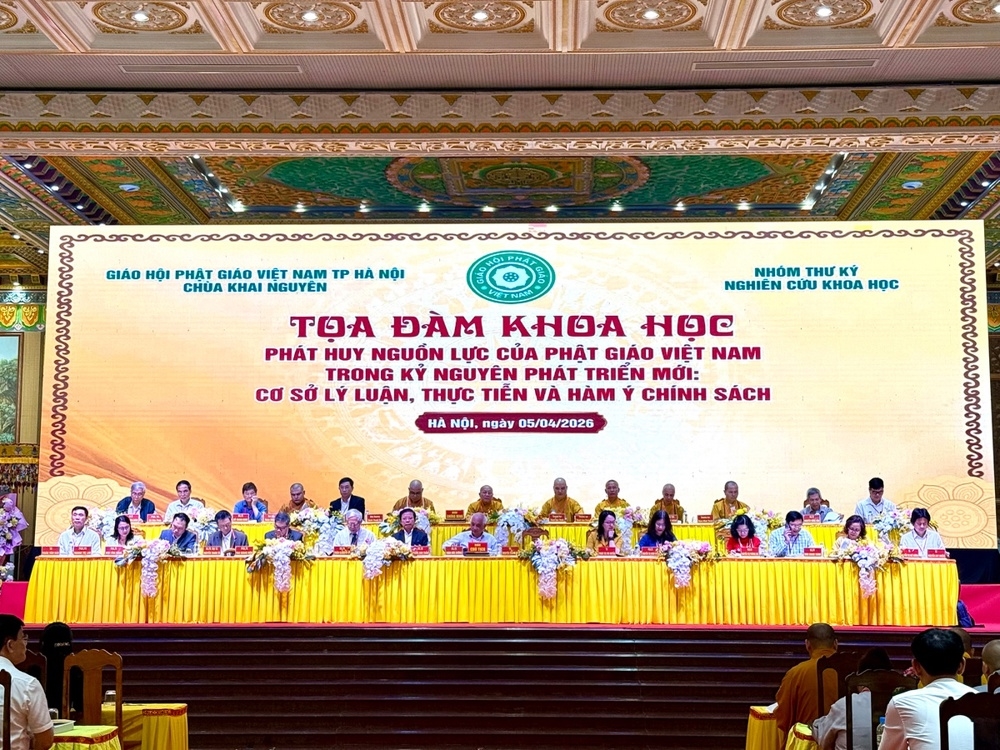
 Buddhism will become a unique endogenous resource of national culture, contributing to building a Vietnam that is prosperous in material terms and peaceful in spirit
Keywords: Buddhist economic resources; A new era; Cultural economy; Buddhist ethics; Sustainable development; Religious institutions.
1. Introduction
Throughout its millennia-long history alongside the Vietnamese nation, Buddhism has not only served as a solid spiritual foundation and a profound humanistic philosophical ideology, but also as a tightly structured social entity possessing immense material and human resources. Entering a new era - a period in which Vietnam is witnessing a strong shift towards a knowledge-based economy, a circular economy, and especially a phase of accelerated national development linked to sustainable development standards - the approach to resources of religion in general and Buddhism in particular needs a strategic breakthrough. The new era demands that Buddhist economics not be viewed as a closed system confined to monastic settings, or as spontaneous, small-scale charitable activities, but rather as an organic component of national cultural resources, an endogenous driving force capable of participating extensively in the supply chain of cultural services, ecotourism, specialized education, public health and environmental protection. The utilization of these resources is entirely consistent with the strategic policy of the Vietnamese Party and State in mobilizing all legitimate resources, including religious resources, to serve the goal of a prosperous people, a strong nation, democracy, fairness and civilization.
2. The nature of Buddhist economic resources
2.1. Tangible material resources
The tangible material resources of Buddhism are the concrete, external manifestations that can be quantified, measured, and directly valued using common economic indicators. The first significant component of these resources is the infrastructure of monasteries, architecture and cultural landscapes. With over 18,000 monasteries, temples, hermitages, and prayer halls spread throughout the country, Vietnamese Buddhism possesses a vast real estate and ecological space. From an economic perspective, this is a unique architectural heritage site and a cultural landscape with significant tourism value. Many temples have become centers attracting millions of pilgrims and visitors from all over the world each year, creating a solid foundation for the development of the spiritual and cultural tourism industry, stimulating the demand for supporting services and bringing significant revenue to the local economy.
Alongside the architectural infrastructure are self-funded financial resources and the circulating flow of charitable donations within Buddhism. Buddhist capital comes from voluntary contributions and offerings from followers, Buddhists and philanthropists both domestically and internationally. This funding source is characterized by its high degree of voluntariness, deep social roots, and lack of pressure from short-term profits or dividends. This provides Buddhism with a stable and independent financial space to reinvest in long-term cultural projects and effectively carry out relief and social welfare activities.
In addition, the land and ecological space associated with many monasteries open up great potential for developing green economic models, ecological agriculture or centers for elderly care and meditation. Finally, specialized production systems such as vegetarian food production facilities and Buddhist cultural products are gradually becoming professionalized, contributing a significant amount of added value to the national economy.
2.2. Intangible resources
The social capital of Buddhism is built primarily on a vast and tightly-knit network of community connections. The Vietnam Buddhist Sangha possesses a complete and consistent organizational structure from the central to local levels, connecting millions of followers and Buddhists. The core of this form of social capital is faith. Social capital also includes the elite human resources, comprising monks, nuns, lay Buddhists, and followers with high levels of knowledge, virtue, and selfless service. This force directly manages and operates the socio-economic resources of Buddhism, creating a competitive advantage in terms of social operating costs.
In particular, the core of the distinctive identity of Buddhist economics includes a system of ethical values and economic philosophy that is deeply internalized into people’s consciousness, consumption behavior and production. ore principles such as “Minimum Desires and Contentment”, “Karma”, “Dependent Origination” and “Compassion” create a sound business ethics framework, guiding people towards responsible production and sustainable consumption that does not harm the ecological environment. This transforms monastic institutions into highly reputable spiritual brands. When a product or service is associated with a serene space and Buddhist philosophy, such as spiritual retreats or eco-friendly vegetarian food, it not only satisfies ordinary material needs but also addresses the psychological stress faced by people in the digital age. It is this intangible capital that has inspired, guided, and driven the flow of tangible material resources, transforming the Buddhist economy into a humane economic model.
3. The current state of promoting the economic resources of Vietnamese Buddhism
3.1. Outstanding achievements
In the recent period, Vietnamese Buddhism has successfully unlocked and transformed its economic resources into immense practical value based on three core pillars, specifically: In the field of spiritual and cultural tourism, this is a bright spot, demonstrated by the formation of large-scale spiritual centers and complexes such as: The Trang An - Bai Dinh Scenic Landscape Complex (Ninh Binh province), Tam Chuc Tourist Area (Ha Nam old, now Ninh Binh province), Yen Tu (Quang Ninh province), Ba Den Mountain (Tay Ninh province),... have transformed barren lands into powerful economic growth engines for these localities, creating jobs for local workers, promoting the development of supporting service industries such as accommodation, transportation and food, contributing significantly to the local economic structure.
In the field of charity and social welfare, the financial resources mobilized from voluntary donations and contributions from Buddhists have been effectively channeled by the Vietnam Buddhist Association into social welfare work. On average, Buddhism contributes trillions of VND annually to activities such as building charitable houses, disaster relief, humanitarian eye surgeries, rural infrastructure development, and caring for orphans and elderly people living alone. The system of monasteries and temples has shared a significant portion of the budget burden with the Government in implementing national goals for sustainable poverty reduction.
In the fields of healthcare and education, many traditional medicine clinics and meditation centers in temples operate free of charge or at low cost, providing medical treatment and dispensing medicine to millions of poor and vulnerable people in society. From an educational perspective, the system of preschools, free charity classes, and large-scale Buddhist scholarship funds have supported many students from particularly disadvantaged backgrounds, helping to alleviate pressure on the public social service system.
3.2. Limitations and shortcomings
The distribution of resources is uneven, with a significant gap in economic resources currently existing among monasteries. While a few large, famous pilgrimage temples attract substantial donations, many village temples and pagodas in remote, border and island areas suffer from dilapidated facilities and a lack of operating funds, diminishing the overall strength and cohesion of the Buddhist system.
Lacking sustainability and supply chain integration, the current economic activities of Buddhism remain largely spontaneous and localized, such as the highly potential market for vegetarian and health-conscious foods, however, Vietnamese Buddhism has not yet been able to build strong brands with sustainable supply chain linkages or professional management and distribution processes standardized according to modern food safety standards.
The lack of transparency in the management of funds is a bottleneck that has affected credibility in recent times. The financial management mechanisms of monasteries in many places are still lax, lacking a clear separation between the personal assets of the abbot and the common assets of the Church and the community.
4. Solutions for leveraging Buddhist economic resources in the new era
Firstly, about institutions and legal frameworks. The legal framework needs to be reviewed and amended to include regulations recognizing the specific commercial legal status of legitimate religious organizations when participating in non-profit economic activities serving society. The state should allow pilot programs for social enterprise models established by religious organizations to create a practical basis before widespread legalization. However, strict regulations are needed to separate accounting mechanisms and ensure that core religious assets such as main halls and religious artifacts are inviolable and not subject to seizure in the event of financial risks for the affiliated enterprise.
It is necessary to clearly define the sources of revenue for monasteries based on the guiding principles of current regulations. Income from donations and offerings purely for religious and charitable purposes is tax-exempt; conversely, income from commercial services with fixed prices, such as commercial vegetarian restaurants, accommodation services and souvenir sales, must be accounted for separately and subject to appropriate tax obligations to ensure a level playing field for competition.
In accordance with the principles of the 2024 Land Law, it is necessary to expedite the issuance of land use right certificates to religious establishments, clearly affirming that the land and assets on the land of monasteries are the common property of the Church and the Buddhist community, not the private property of any monk or nun, in order to thoroughly prevent complex civil disputes.
Secondly, regarding governance and technology, the Church needs to concretize the implementation of the spirit of Circular No. 04/2023/TT-BTC of the Ministry of Finance on the management and expenditure of donations. We encourage the adoption of financial technology solutions such as identified accounts for monasteries and QR code scanning for donations to ensure transparency in the flow of funds. Donations should be managed centrally, with a portion going to the Church's common fund to regulate and support infrastructure development for monasteries in remote areas, eliminating the current disproportionate allocation.
For large projects such as Buddhist hospitals, nursing homes, or major historical sites, the Buddhist Sangha needs to adopt a modern management model: hiring experts and highly specialized personnel to manage operations under the spiritual guidance and supervision of monks and nuns. Strictly adhere to the principle of separating specialized professional management from spiritual leadership.
In Buddhist academies, in addition to the core Tripitaka scriptures, supplementary multidisciplinary courses in religious economics, general management and current civil law should be added to equip young monks and nuns with sufficient knowledge to appropriately address complex socio-economic issues.
Thirdly, regarding the unique economic model of Buddhism, the trend of vegetarianism for health and environmental protection is booming. The Church needs to collaborate with farmers to develop clean, organic agricultural raw material areas, apply high-quality vegetarian food processing technology, affix reputable Buddhist certification labels and create a sustainable, clean source of funding to support educational and charitable activities.
Instead of just organizing short pilgrimage tours, monasteries with suitable landscapes should invest in longer-term experiential tourism products, meditation retreats combined with stress relief therapies using Buddhist psychology and traditional medicine. This is a high value-added service segment that aligns with modern trends. By mobilizing capital from Buddhist entrepreneurs to specifically fund green startup projects, businesses commit to allocating a portion of their profits to environmental protection or creating jobs for people with disabilities, thereby generating a positive ripple effect in the economy.
5. Conclusion
Through various layers of analysis, from theory to practice, it can be affirmed that Vietnamese Buddhism possesses an incredibly vast and diverse resource: the harmonious blend of tangible material assets and an invaluable system of moral values and intangible spiritual capital. This resource, if properly channeled, is not only a strong economic and cultural driving force contributing to the overall growth index, but also a tool to help balance the shortcomings and consequences of the rapid development of the digital age. Entering a new era - the era of artificial intelligence, comprehensive digital transformation, and green economic thinking - Vietnamese Buddhism is facing an opportunity to renew itself, shifting from a spontaneous operating model to a proactive, transparent and integrated system. The solution to the economic challenges facing Buddhism in the new era lies not in pursuing profit or accumulating capital, but in transforming material resources into means of serving society. When donations and monastic infrastructure are managed with modern thinking and guided by a spirit of compassion and wisdom, the Buddhist economy will become a unique endogenous resource of national culture, contributing to building a Vietnam that is prosperous in material terms and peaceful in spirit.
References
1. Ministry of Finance (2023), Circular No. 04/2023/TT-BTC guiding the management and collection of donations and sponsorships for historical sites and festival activities, Hanoi.
2. National Assembly of the Socialist Republic of Vietnam (2024), Land Law of 2024, National Political Publishing House, Hanoi.
3. Do Quang Hung (2015), Religion and Social Change in Vietnam today, National Political Publishing House, Hanoi.
4. Vietnam Buddhist Association (2022), Summary Report on Buddhist Activities during the 8th term (2017-2022) and Directions for Activities during the 9th term (2022-2027), Central Office of the Vietnam Buddhist Association, Hanoi.
5. Nguyen Hong Duong (2018), Religious resources for sustainable development in Vietnam today, Social Sciences Publishing House, Hanoi.
6. Nguyen Minh Ngoc (2020), Buddhist economy and suggestive values for a sustainable development model in Vietnam, Journal of Religious Studies, No. 04.
7. Payutto, P. A. (1998), Buddhist Economics: A middle way for the market place (Buddhist economy: The middle ưay for the market), Buddhadhamma Foundation, Bangkok.
8. Thich Thanh Quyet (2021), Promoting the cultural and economic resources of Buddhism in the Northeast region in sustainable tourism development, Proceedings of the National Scientific Conference, Hanoi National University Publishing House, Hanoi.
