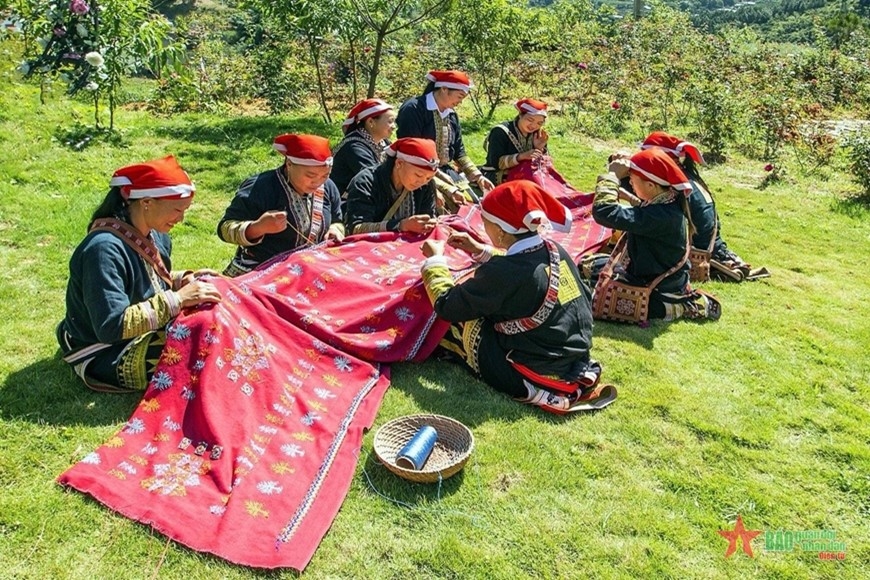
 The embroidery and brocade weaving craft in Sa Pa (Lao Cai province) is developing increasingly.
Keywords: Traditional crafts; Ethnic minorityies; Cultural industry; Conservation and promotion; Sustainable development.
1. Introduction
eveloping the cultural industry is a strategic direction in Vietnam’s socio-economic development. In Party documents, culture is identified as an important endogenous resource for the sustainable development of the country. From that perspective, exploiting and promoting traditional cultural values, especially the culture of ethnic minorities is seen as a long-term approach that both preserves identity and creates new drivers of growth.
Traditional crafts of ethnic minority communities are formed and developed in close connection with the natural conditions, history of residence and cultural, social life of each ethnic group. Traditional crafts such as brocade weaving, basket weaving, blacksmithing, pottery making, carpentry, musical instrument making, food processing, medicinal herbs and crafts serving daily life and religious beliefs... not only create material products but also embody local knowledge, ethnic knowledge, folk aesthetics and profound spiritual values, possessing great potential when linked to cultural tourism and the local economy.
However, approaches to traditional crafts of ethnic minorities are currently mainly focused on heritage preservation or livelihood support, while approaches to traditional crafts as a component of cultural industries remain limited. This is a research gap that needs further clarification, especially in the context of Vietnam's efforts to promote the development of cultural industries linked to national cultural identity.
2. The concept of traditional crafts
Clause 1, Article 3 of Government Decree No. 52/2018/ND-CP on the development of rural industries explains: “Traditional crafts are those that have been established for a long time, creating unique and distinctive products, which have been passed down and developed to this day or are at risk of disappearing or being lost”.
Clause 2 of Article 5 of the above Decree stipulates 3 criteria for recognizing traditional crafts: “a) The craft has existed in the locality for over 50 years and is currently continuing to develop up to the time of the application for recognition; b) Occupations that create products reflecting the national cultural identity; c) A craft associated with the name of one or more artisans or the name of a craft village”.
The definition and criteria for recognizing traditional crafts mentioned above have three notable points:
Firstly, the requirement of “long-standing tradition” emphasizes the element of time and historical continuity, affirming that traditional crafts are the result of the accumulation of knowledge and production experience over many generations.
Secondly, the requirement for “unique and distinctive products” shows that traditional crafts not only create utilitarian value but also contain cultural, aesthetic and symbolic value. This approach aligns with the modern concept of viewing culture as a resource for development, especially in the context of promoting the cultural industry, where distinctiveness and identity play a decisive role.
Thirdly, acknowledging that traditional crafts “are either preserved and developed to this day or are at risk of disappearing or being lost” reflects a mindset that views traditional crafts not as immutable entities but as constantly evolving in relation to the socio-economic context.
This opens up policy space for both preserving and promoting traditional crafts in the new context.
From the general definition, it can be seen that the traditional crafts of ethnic minority communities are a unique category, possessing all the core characteristics of traditional crafts, at the same time having their own distinct nuances. Traditional crafts in ethnic minority communities are often closely linked to the living space, ecological environment and social structure of the ethnic group; they directly reflect local knowledge, worldview and distinctly ethnic aesthetic concepts. The process of passing on skills is not only about transferring technology but also about transmitting cultural values, social norms and community identity. In many cases, the traditional crafts of ethnic minority communities coexist with religious beliefs, festivals and community activities, with the boundary between production activities and cultural practices intertwined and difficult to separate. This characteristic makes the traditional crafts of ethnic minorities not only objects of occupational preservation, but also a form of “living” cultural heritage, which is important in maintaining the cultural identity of the ethnic group and the diversity of national culture.
3. The value of traditional crafts in ethnic minority communities
Firstly, traditional crafts possess profound cultural and historical value. Each traditional craft is linked to the history of the ethnic group, representing the long-term accumulation of local knowledge, experience in interacting with the natural environment and social and aesthetic values refined over many generations. Therefore, traditional crafts can be seen as a “living museum”, where community history is not only recorded in memory or written documents but is also concretely present in the crafting techniques, labor processes and cultural products.
Historically, traditional crafts reflect the level of socio-economic development and the organization of community life in each period. The choice of materials, production tools, methods of passing on skills and division of labor all bear the imprint of the specific historical context. For many ethnic minority communities, traditional crafts are also linked to the process of migration, settlement and adaptation to specific ecological spaces, thus becoming a “historical marker” of the ethnic group in the process of nation-state formation and development.
In terms of cultural value, traditional crafts embody folk knowledge, aesthetic concepts and the spiritual value system of the community. The patterns, motifs, colors, and shapes on handcrafted products are not only for decoration but also contain symbolic meanings, reflecting the worldview, philosophy of life and conceptions of social order and the universe of each ethnic group. Through traditional crafts, cultural values, moral standards and lifestyles are transmitted naturally and enduringly, contributing to the preservation of ethnic identity amidst strong cultural exchange and transformation.
Secondly, traditional crafts possess distinct social value, manifested in organizing community life, strengthening social relationships and maintaining the stability of traditional social structures. Traditional crafts are often associated with families, clans, villages and ethnic communities. The processes of production, skill transfer and product consumption take place within familiar social spaces, thereby forming and maintaining strong bonds among community members.
From a sociological perspective, traditional crafts contribute to shaping roles, status and the division of labor within the community. In many ethnic minority communities, traditional crafts are associated with specific age groups, genders or clans, reflecting the unique social organization of each ethnic group. Through traditional crafts, knowledge, skills and social norms are passed down between generations, creating continuity and social stability in a changing context. Traditional crafts also contribute to affirming the role and social status of artisans. They possess high skills, knowledge, prestige and a voice within the community. In many cases, they participate in activities that strengthen community cohesion, educate the younger generation and preserve cultural values. Honoring artisans reflects the State’s recognition of the social value of traditional crafts.
From a development perspective, traditional crafts create local livelihoods, helping to limit spontaneous labor migration and reduce social pressure in urban areas, especially for female workers and the elderly, enabling them to maintain their roles in the family and community. For ethnic minorities, traditional crafts serve as a “social anchor”, helping communities maintain their connection to their living spaces and protect traditional social structures. This is consistent with the Party and State's policies on socio-economic development linked to stability and ensuring social security in ethnic minority and mountainous areas.
Party documents on ethnic affairs and cultural development all emphasize the need to promote the role of communities and strengthen national unity. Traditional crafts, as socio-cultural practices closely linked to the community, contribute to realizing this requirement in practice. Through maintaining and developing traditional crafts, ethnic minority communities not only preserve their identity but also strengthen social cohesion, enhance their self-organizational capacity and actively participate in the development process.
Thirdly, economically, traditional crafts are an important source of livelihood for ethnic minority communities living in areas with limited production resources. In the context of shrinking agricultural land, challenging farming conditions and limited non-agricultural employment opportunities, traditional crafts generate local income, contributing to improved living standards and ensuring social security for the people. The economic value of traditional crafts is therefore measured not only by direct income, but also by their ability to maintain stable and sustainable livelihoods for the community.
A prominent characteristic of traditional crafts is their ability to utilize readily available local resources, from natural materials to family labor, which helps reduce production costs and is suitable for small-scale households and communities. For ethnic minority communities, traditional crafts are often flexibly combined with agricultural production, creating diverse livelihood models that help to mitigate risks and increase adaptability to socio-economic changes.
In the Party and State’s policies on sustainable poverty reduction and socio-economic development in ethnic minority and mountainous areas, the development of traditional crafts is identified as one of the important solutions to create livelihoods, increase income and enhance the economic self-reliance of the people. With support in production organization, vocational training, market access, and brand building, traditional crafts can transcend the framework of supplementary livelihoods, becoming a primary source of income and making a positive contribution to household and local economies. From that perspective, traditional crafts are not only a traditional means of livelihood, but also an important economic resource if organized, invested in and developed in the right direction.
4. The role of traditional crafts in the development of cultural industries
A full understanding of the values of traditional crafts is essential for developing policies to promote cultural industries linked to poverty reduction and sustainable development in ethnic minority and mountainous areas.
In the cultural industry, the economic value of traditional crafts is not limited to individual handcrafted products but is also expanded through participation in the cultural value chain as an important resource for the development of cultural tourism and community tourism. Combining traditional crafts with cultural tourism, creative design, and related service industries will generate higher added value, contributing to increased income for craftspeople and enhancing the competitiveness of products in the market.
In the development of the cultural industry, the traditional crafts of ethnic minority communities serve as a unique source of “cultural raw materials”. Aesthetic values, local knowledge, and cultural stories associated with traditional crafts form the foundation for creating cultural products that are profound, distinctive and bear the imprint of Vietnamese identity. Traditional crafts contribute to the formation of competitive cultural industrial products in a market that increasingly values culture, craftsmanship and uniqueness. From handicrafts, fashion and souvenirs to cultural experiences and traditional crafts, all can participate in the cultural industry value chain. Traditional crafts also play a bridging role between cultural preservation and economic development. Through the cultural industry, traditional values are not only “preserved” but also “activated” and “reborn” in contemporary life, creating added value and resources for reinvestment in conservation.
From a social perspective, developing traditional crafts within the cultural industry contributes to enhancing the status of ethnic minority communities as key players in the development process. By participating in the cultural value chain, communities are not only beneficiaries of policies but also become creators and owners of their own cultural products.
Vietnam is home to 53 ethnic minority groups, resulting in a rich diversity of traditional crafts among them. This is a great advantage for developing diverse and distinctive cultural industrial products. Many traditional crafts are still preserved relatively intact within the community, creating favorable conditions for their restoration, preservation and promotion. Human resources, especially the team of artisans are a crucial potential asset. With support, recognition, and connections to contemporary creative forces, artisans can become key players in developing traditional crafts in conjunction with the cultural industry.
Furthermore, traditional crafts are closely linked to cultural spaces, festivals and tourism. The combination of handicraft production, craft demonstrations, cultural experiences and community tourism opens up many new development models, in line with current trends in cultural enjoyment. In terms of markets, demand for handicrafts and local cultural products is increasing, both domestically and internationally. This presents a significant opportunity for traditional crafts of ethnic minorities to participate more deeply in the cultural industry market, if properly organized and guided.
5. Promoting traditional crafts in the development of cultural industries
In order to effectively promote the traditional crafts of ethnic minority communities in the development of cultural industries, such as:
Firstly, it is necessary to improve institutions and policies in a comprehensive and long-term manner. Policies should consider traditional crafts not only as objects of preservation but also as resources for development, linked to the national cultural industry strategy.
Secondly, ethnic minority communities need to be placed in the position of creative subjects. ll models for developing traditional crafts must ensure the participation, decision-making and benefit-sharing rights of the community; respecting local knowledge and the role of artisans.
Thirdly, a harmonious balance is needed between preserving traditional values and fostering innovation. The application of new designs and technologies must be based on core cultural values, avoiding distortion or simplification of identity.
Fourthly, human resource development is a key factor. Policies are needed to train, pass on skills, honor artisans and build a professional intermediary workforce in the cultural industry.
Finally, the development of traditional crafts should be linked with cultural tourism and sustainable development. Development models must ensure a balance between economic benefits, cultural preservation and environmental protection.
6. Conclusion
Traditional crafts of ethnic minority communities are unique cultural resources with multifaceted value for the development of the cultural industry in Vietnam. Promoting traditional crafts contributes to preserving the national cultural identity and opens up a direction for socio-economic development that is suitable to the conditions and advantages of ethnic minority communities.
In the current context, traditional crafts need to be approached as an important component of the cultural industry, linked to the market but not separated from core cultural values. This requires the coordinated efforts of the government, the community, businesses and creative entities. Continuing research, refining policies, and replicating effective development models will contribute to promoting the traditional crafts of ethnic minority communities as an important endogenous resource, making a practical contribution to the country’s sustainable development goals.
References
1. 11th Central Committee of the Communist Party of Vietnam (2014), Resolution No. 33-NQ/TW dated June 9th, 2014 on building and developing Vietnamese culture and people to meet the requirements of sustainable national development.
2. Conclusion No. 65-KL/TW dated October 30th, 2019 on continuing to implement Resolution No. 24 NQ/TW of the 9th Central Committee on ethnic affairs in the new situation.
3. Ministry of Culture, Sports and Tourism (2025), Decision No. 3399/QD-BVHTTDL dated September 23rd, 2025 approving the National Target Program on Cultural Development for the period of 2025-2035, Phase I from 2025 to 2030.
4. Government (2018), Decree No. 52/2018/ND-CP dated April 12th, 2018 on the development of rural industries.
5. Prime Minister (2016), Decision No. 1755/QD-TTg dated September 8th, 2016 approving the Strategy for the Development of Vietnam's Cultural Industries until 2020, with a vision to 2030.
6. Prime Minister (2021). Decision No. 1719/QD-TTg dated October 14th, 2021, approving the National Target Program for socio-economic development of ethnic minority and mountainous areas for the period of 2021-2030, Phase I: 2021-2025.
