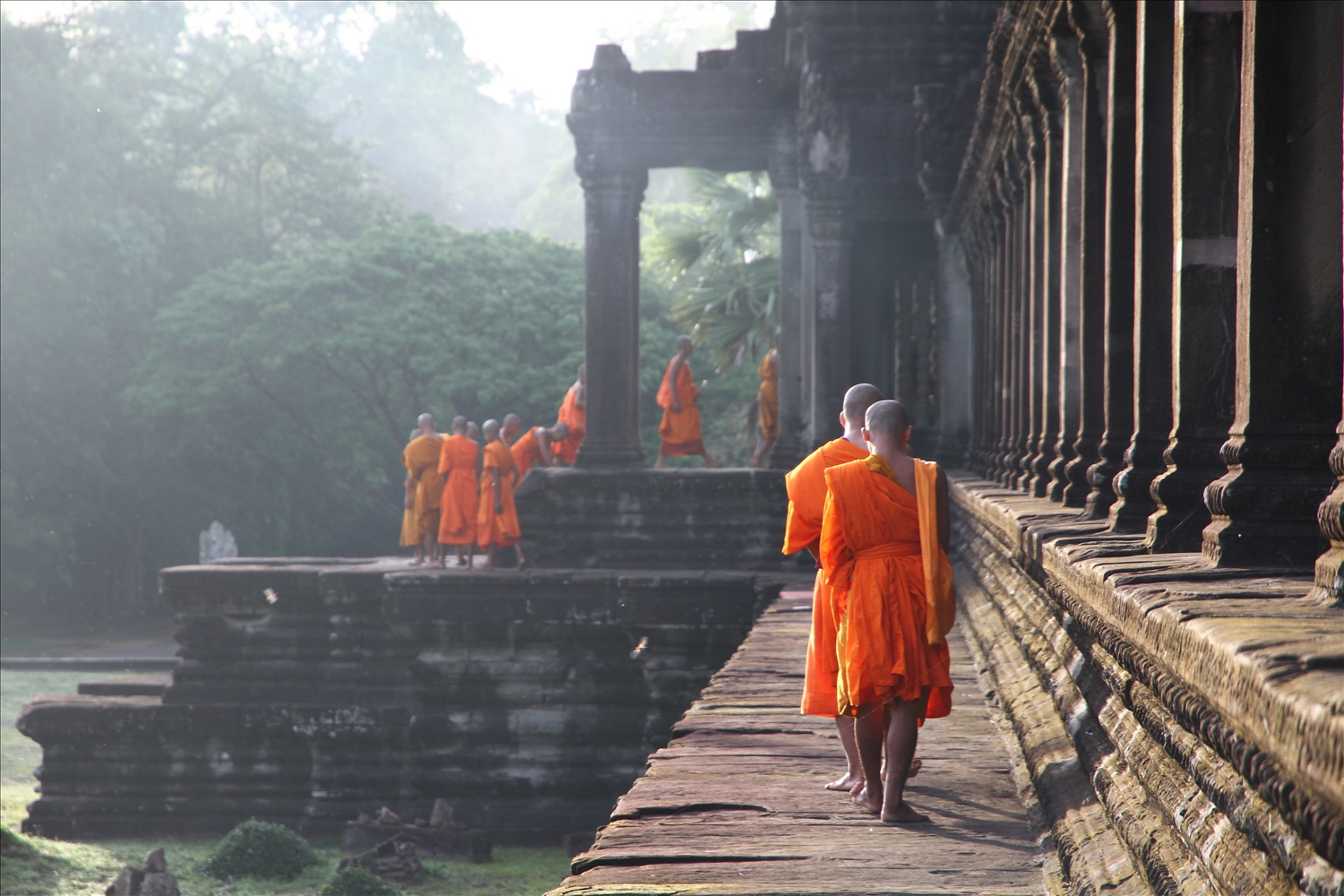
 Cambodia has identified Buddhism as its state religion
Keywords: Religion; Religious policy; Campuchia.
1. An overview of religion in Cambodia
Cambodia, with an area of 181,035 km2, shares land borders with Thailand, Laos, and Vietnam (1,137 km). In 2025, Cambodia’s population was projected to be 18.5 million, with Khmer people accounting for nearly 90%, Vietnamese 0.5%, Chinese 0.1% and the remainder being other ethnic groups. About administration, Cambodia comprises 21 provinces and 3 centrally administered cities.
Before the introduction of Buddhism, the inhabitants of Cambodia followed Hinduism. During the Angkor period - a powerful empire from the 9th to the 15th centuries - the Cambodian kings also followed Hinduism. Angkor Wat temple was built in the early 12th century under the reign of King Suryavarma II (at the throne 1113-1150). Angkor Thom, the capital of Chenla, was also built in the late 12th century under the reign of King Jayavarman VII (at the throne 1181-1201).
Hinduism is a tolerant religion, so although Hinduism is the main religion, Buddhism still thrives in Cambodia. In the early period, Buddhism was introduced to Cambodia from both the Mahayana and Theravada traditions. From the 6th to the 12th centuries, Mahayana Buddhism flourished, with many temples built during this period, such as Prasat Banteay Kdei, Ta Prohm, Preah Khan,... However, for various reasons, Mahayana Buddhism eventually gave way to Theravada Buddhism.
Theravada Buddhism arrived in Cambodia primarily from Sri Lanka. From the 15th century onwards, Theravada Buddhism played a leading role, spreading throughout Cambodia. Regarding this process, Dr. Nguyen Manh Cuong clarifies: “Furthermore, the Khmer’s defeat at the hands of the Siamese and the decline of the Angkor empire led the Khmer to accept Theravada Buddhism as their salvation”. Author Ajahn Chah argues that in the 14th century, Siam (Thailand) conquered Angkor and caused widespread unrest, while Cambodia (Chan Lap) had to confront popular resistance due to social injustice, heavy taxes, and the burden of contributing to the repair and maintenance of massive temple structures dedicated to “a sacred king”. These factors led people to flock to Theravada Buddhism. Furthermore, Theravada Buddhism is more egalitarian, worshipping only the Buddha Shakyamuni. King Indravarman III (reigned 1295-1308) converted to Theravada Buddhism. From this point onwards, Sanskrit - the language of Hinduism was replaced by Pali, the language of Theravada Buddhism. Later, particularly from 1867, after the establishment of the Norodom dynasty, Theravada Buddhism officially became the state religion in Cambodia. Cambodian Buddhism is divided into two branches: Mahanikay (common people) and Thommayud (noble people). In terms of organizational structure, Buddhism in Cambodia is divided into two main sects: Firstly, Mahanikay accounted for 94% of the temples, with 90% of the monks; secondly, Thommayud had fewer monks and temples, but the majority were ordained nobles and enjoyed the support of the royal family. Both factions have a Royal Monarch alongside the Cambodian Royal Family who participates in the Council of the Throne, also known as the Council of Royal Succession, which is responsible for finding and deciding the successor to the throne.
The Muslim community is the second largest religion in Cambodia, closely associated with the Cham people. In Cambodia, the Cham were introduced to Islam by the Malays (whose language group is Malay Polynesian), forming a Muslim Cham community in Cambodia, mainly in Kampong Cham province, known as Khmer Islam. Later, Catholicism, Protestantism and other religions also spread to Cambodia, but the results were not as desired.
In 2020, the specific religious figures in Cambodia were as follows: Buddhism had over 13 million followers, 4,872 temples (Popular sect: 4,656, Noble sect: 216); 69,199 monks (Popular sect: 64,407, Noble sect: 4,792); approximately 25,000 followers of Mahayana Buddhism, mainly Vietnamese. Islam: 371,132 followers, 487 mosques, 576 Surao (small mosques); Catholicism: 22,000 followers, 65 churches, 2 bishops, 96 priests; Protestantism: 90,903 followers, 732 prayer facilities belonging to 93 organizations. Other religions, such as Cao Dai, Khong Minh, Avalokiteshvara Bodhisattva,… have 30,734 followers. Thus, the vast majority of the Cambodian people are followers of various religions, primarily Buddhism.
2. Religious policy in Cambodia
As a predominantly Buddhist country with a significant influence on all aspects of political, social and cultural life, Cambodian political institutions from the modern era have paid close attention to Buddhism. In the 1950s and 1960s, the Shihanouk dynasty advocated for the promotion of Buddhism and the construction of “Buddhist Socialism” with three pillars: The throne, Buddhism, and the people were in power, while simultaneously pursuing a policy of neutrality based on the Buddhist “Middle Way” theory. However, the “Buddhist Socialism” of the Sihanouk dynasty failed to overcome the contemporary political crisis and for various reasons, led to a coup in early 1970, with Lol Non seizing power under a military regime. Lol Non advocated fighting the Khmer Rouge under the slogan “fighting the infidels”, believing that “with the arrival of Communism, Buddhism will be completely eliminated”. Under the Khmer Rouge genocide regime (1975-1979), with the extremist ideology of an “iron fist” Pol Pot destroyed 2,300 temples, murdered 90,000 monks and sent 65,000 monks to labor camps... In just five years under the Khmer Rouge genocide regime, Buddhism virtually disappeared in Cambodia.
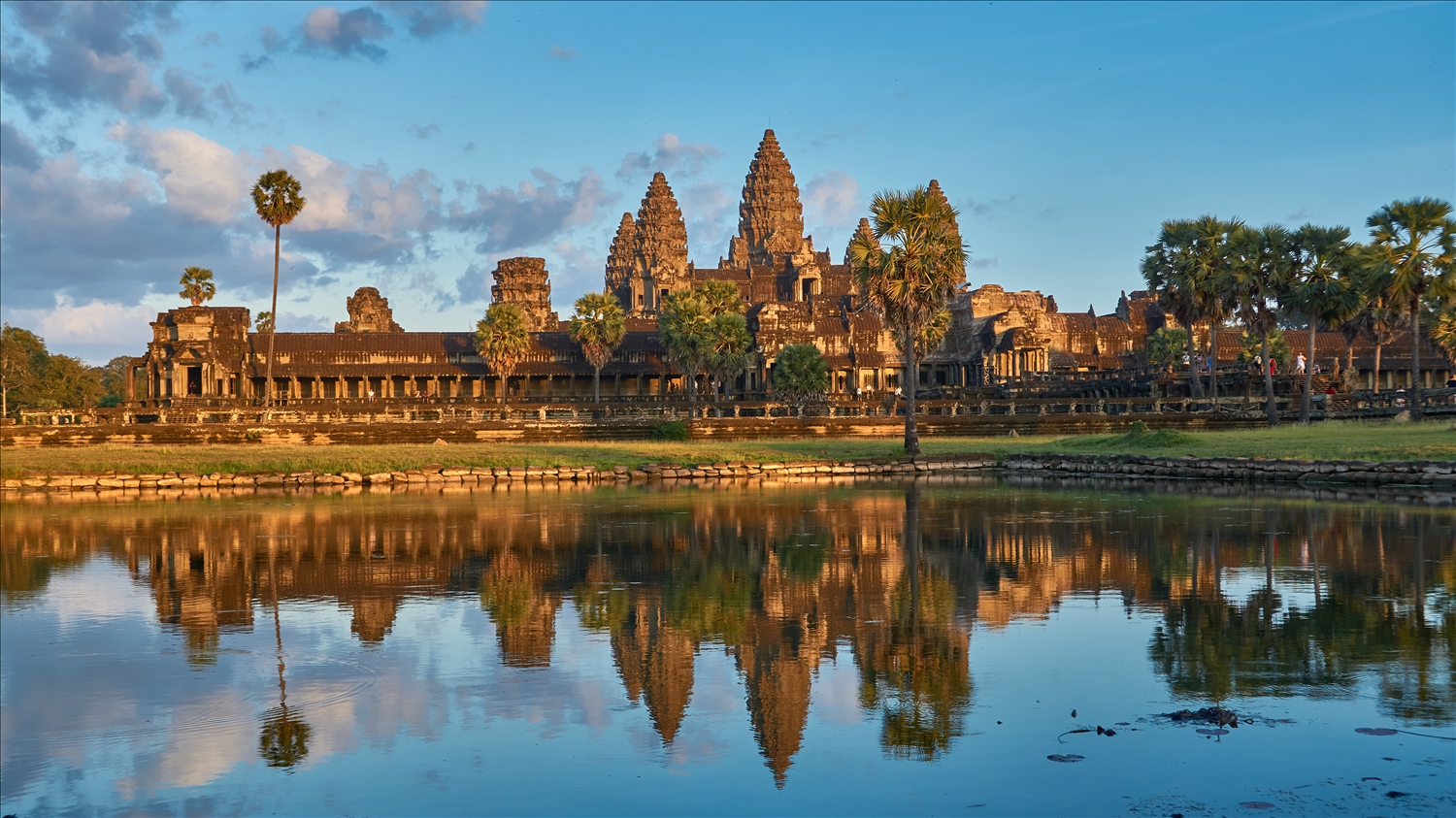 Angkor Wat temple in Cambodia
Reviewing the course of policies and approaches to religion in Cambodia reveals the current Cambodian government’s efforts on this issue. After the overthrow of the Pol Pot genocidal regime, in addition to efforts to mitigate the social consequences of the Pol Pot genocide, the Cambodian People’s Revolutionary Party and the Government of the People’s Republic of Cambodia paid close attention to religious affairs, with a focus on Buddhism. Firstly, it is necessary to overcome the consequences of the Khmer Rouge genocide. Heng Samrin, General Secretary of the People’s Revolutionary Party and Chairman of the State Council, who made significant contributions to the restoration of Buddhism, highly valued the role of Buddhism in Cambodia’s history and present day. He said, “Buddhism was established in Cambodia in the 3rd century and has continued to flourish ever since. Buddhism will endure forever… Buddhism is a religion that teaches us to live in a spirit of democracy, solidarity and harmony, thinking of the interests of the majority rather than personal gain”.
Thanks to the efforts of the Party and Government, Buddhism in Cambodia was soon restored and developed. In 1988, 2,292 temples with 6,515 monks were restored in Cambodia. By 2020, the number had increased to nearly 5,000 temples and almost 70,000 monks, bringing Cambodia back to its former meaning as the “Land of temples”.
The understanding and approach to religion, especially Buddhism, is reflected in the 1999 Cambodian Constitution. Firstly, the Cambodian Constitution states: “Buddhism is the state religion”. Although it designates Buddhism as the state religion, the Constitution of the Kingdom of Cambodia still upholds the right to religious freedom for all citizens: “All Cambodian citizens have full religious rights. The State guarantees religious freedom, the exercise of religious rights, and the right not to affect other beliefs or religions or public order and security” (Chapter III, Paragraph 43). Like Buddhism, other religions in Cambodia operate normally, from the religious activities of their followers, the activities of their clergy, organizational activities such as congresses and conferences, ordinations, training of clergy, construction and repair of places of worship, publication of scriptures, international relations,… Regarding religions practiced by foreigners, Cambodia also has specific requirements for control, including the requirement to register religious activities and the establishment of schools for training religious leaders.
While Cambodia adheres to the constitutional principle of religious freedom and recognizes Buddhism as the state religion, it lacks specific legal regulations governing religious activities. Although it doesn’t impose administrative control over religious affairs, Cambodia has had a state agency dedicated to religion since its early days, known as the Ministry of Ceremonies and Religion. The Ministry of Ceremonies and Religion is responsible for assisting the King and the Government in all matters related to religion. Specifically: guiding and assisting all religious organizations, especially Buddhism, in their religious activities; Monitoring and guiding religious establishments and organizations in implementing religious doctrines and state laws; organizing training programs for human resources in Buddhism; maintaining relationships and providing support to the two Supreme Patriarchs (Samdech) and the heads of other religious organizations; coordinating with the Ministry of Culture and Arts to research and develop regulations and programs on Buddhist culture and national traditions; coordinating with relevant agencies to disseminate information about Buddhist scriptures and other religions; supervise Buddhist education; promoting the establishment of libraries in places of worship; implementing international cooperation agreements in the field of religion.
The organizational structure of the Cambodian Ministry of Ceremonies and Religion includes: the General Directorate of Ceremonies (comprising the Department of Ceremonies, the Department of Religion, the Department of Research, Education and Propaganda); the Buddhist Education Inspection Board. Sihanouk Buddhist University; Buddhist Academy; Inspection Board; Administrative and Financial Board; Office. The leadership of the Ministry of Ceremonies and Religion consists of the Minister and 7 Secretaries of State (Deputy Ministers) and 10 Deputy Secretaries of State. At the provincial level, there is the Department of Ceremonies and Religion and at the district level, there is the Office of Ceremonies and Religion, operating under the vertical direction and management of the Ministry of Ceremonies and Religion.
The work content, functions and responsibilities of the Ministry of Ceremonies and Religion reflect the Cambodian government’s policy towards religion, especially Buddhism. With its defined functions, the Ministry of Ceremonies and Religion focuses on guiding and assisting the activities of religions, especially Buddhism, promoting religious unity with Buddhism as the cornerstone; at the same time, the Ministry of Ceremonies and Religion assists the King and the Government in resolving social issues related to religion.
3. Conclusion
The Kingdom of Cambodia is a Southeast Asian country with a long history intertwined with Hinduism and Theravada Buddhism and deeply influenced by Indian culture. Cambodia went through a painful and decadent period, even religiously, due to the Khmer Rouge’s genocidal regime. The current Cambodian government’s policy towards Buddhism continues the tradition of the feudal dynasties, recognizing Buddhism as the state religion, supporting and assisting it. Although Buddhism is recognized as the state religion, the Cambodian government maintains a balanced approach to the activities of other religious organizations. This is why Cambodia is considered one of the exemplary countries in Southeast Asia in terms of its religious policy.
* Central Committee of the Vietnam Fatherland Front
References
1. Government Religious Affairs Committee, Studying the religious affairs apparatus in some countries around the world, Hanoi, 2012.
2. Ajahn Chah, Understanding Theravada Buddhism, Hong Duc Publishing House, Hanoi, 2014.
3. Nguyen Manh Cuong, Khmer Buddhism in Southern Vietnam (Issues to Revisit), Encyclopedia Publishing House, Hanoi, 2008.
4. Tran Quang Thuan, Theravada Buddhism in Southeast Asia, Religious Publishing House, Hanoi, 2008.
5. Ngo Thi Xuan Lan (Editor), Religious Diplomacy in Vietnam, Religious Publishing House, Hanoi, 2022.
6. Nguyen Van Luan, The Cham Muslims in the Southwestern Region of Vietnam, Research Book Series, Saigon, 1974.
7. Do Quang Hung (Editor), Initial Study on the Relationship Between the State and the Church, Religious Publishing House, Hanoi, 2003.
8. Pham Viet Trung, History of Cambodia, Hanoi Publishing House, Hanoi, 1982.
9. Nguyen Sy Tuan (Editor), Dictionary of Cambodian History and Culture, Encyclopedia Publishing House, Hanoi, 2013.
10. Mai Ly Quang (Editor), 252 countries and territories in the world, The World Publishing House, Hanoi, 2010.
11. Nguyen Thanh Xuan - Nguyen Quynh Tram, Religion and religious policies in some countries around the world, Religious Publishing House, Hanoi, 2023.
