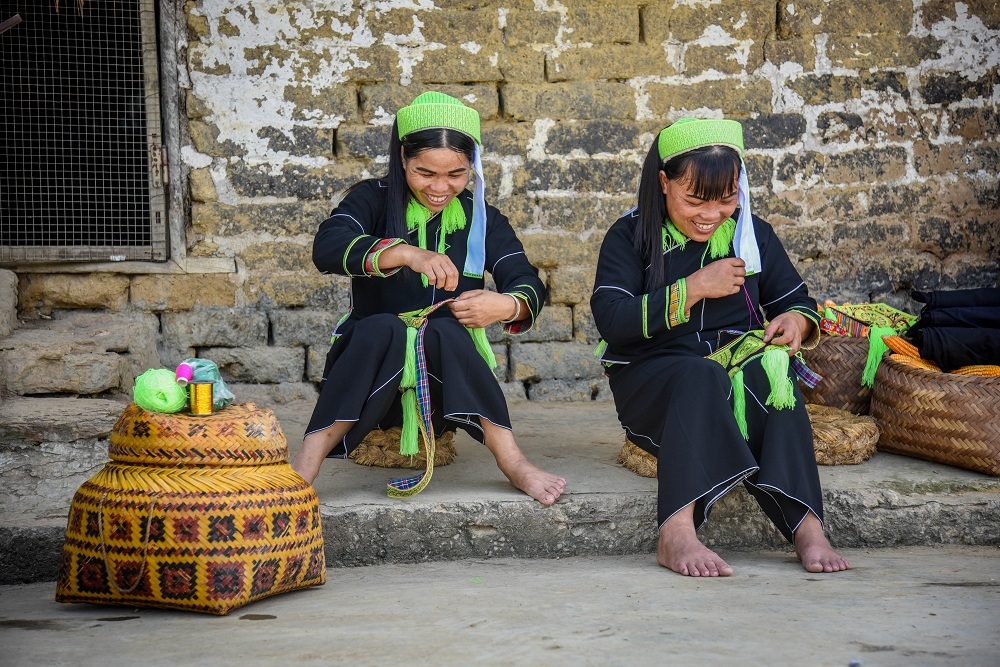
 The traditional clothing of the Nung Phan Slinh Cum Cot people is made from indigo-dyed fabric with minimal patterns
Traditional clothing of the Nung Phan Slinh Cum Cot people
The traditional clothing of the Nung Phan Slinh Cum Cot people is made from indigo-dyed fabric with minimal patterns. In order to make their attire stand out, the women embroider colored threads and small silver beads onto their headscarves. They typically wear a five-panel indigo outer garment, with a blue or red striped inner shirt; the collar is adorned with blue tassels, which are visible when worn to add a touch of flair to the indigo shirt. The trousers are usually wide, with unembroidered hems, a crotch, wide legs and a leaf-shaped waistband. When worn, the belt is wrapped around the waist, with the two ends tied at the sides of the hips.
Traditional clothing of the Nung Phan Slinh Hua Lai people
The name Nung Phan Slinh Hua Lai means “Phan Slinh Head with Dots”. In the Nung language, “Hua” means “Head” and “Lài” means “Dot”. This name originates from the headscarf worn by Nung women. They embroidered small, white dots in prominent rows against an indigo background. Each time a woman wore it on her head, it was likened to wearing a starry sky. Women’s blouses usually consisted of four or five indigo panels. The short, loose-fitting shirt, both in the body and sleeves, allows the wearer greater comfort in daily life or during work. A contrasting piece of fabric is added to the cuffs and the front of the chest, creating a distinctive look for the garment. Women’s trousers were made with a diagonal crotch, wide legs and a leaf-shaped waistband. When worn, a drawstring was threaded through the waistband and tied. Nowadays, diagonal-crotch trousers are gradually being replaced by silk or satin trousers with pleated legs, creating a softer silhouette.
Traditional clothing of the Nung Chao people
The indigo-dyed outfit is a long-standing traditional garment, closely associated with the culture and identity of the Nung people. Perhaps due to living conditions, indigo has become the dominant color in the clothing of the entire Nung ethnic group.
Indigo dyeing makes clothes more colorfast, less prone to staining, and more durable. Therefore, indigo is suitable for the agricultural lifestyle of the Nung people in the mountainous region. Nung women wear four-panel or five-panel blouses that extend past their hips. The collar is round, with a stand-up collar height of about 1cm, and is made of 3-4 layers of fabric to create a structured look. An extra layer of fabric is added to the collar, chest placket and sleeve placket for added detail. The sleeves are wide for comfort during work and production. The shirt typically has seven buttons. The bodice is A-line, flaring slightly towards the sides. The entire hem and skirt are sewn with folded seams to conceal the fabric edges. Men’s everyday shirts are short-sleeved, four-panel shirts with a row of seven fabric buttons on each placket, a round collar in the style of a mandarin collar, a collar stand about 2cm high, two pockets at the bottom hem and moderately wide sleeves. These trousers have a crisscross crotch design, a wide waistband resembling a leaf-shaped waistband, and when worn, the seams are pulled forward and tightened with a fabric drawstring.
Traditional clothing of the Nung Inh people
Essentially, the clothing of the Nung Inh people only differs slightly depending on age and gender. They do not have separate clothes for special occasions like festivals and celebrations; instead, they share a single type of clothing. Men’s clothing is simple in color and style, without decorative patterns, consisting of a four-panel jacket and trousers. The jacket is cut and sewn with a split chest, a round neckline, no shoulder pads, but with a wide lotus-leaf-shaped piece of fabric padding around the neck. The jacket has a high slit and a double row of fabric buttons; below, near the hem, are two small, rectangular pockets without flaps. The shirt is tailored to fit snugly, its length just slightly past the waistband of the trousers. The trousers are usually ankle-length, cut in a diagonal crotch style, also known as crotchless trousers. These trousers have a moderately wide crotch, a waistband that is 12-14cm wide, and no drawstring; instead, when worn, the trousers are gathered forward and tied with a fabric cord on the outside. Women’s blouses have a round neckline, a V-neck, a wide placket and hem, two small pockets on the front, and a row of small buttons on the placket. The pattern on the collar is square, diamond-shaped and arranged in adjacent triangles. The collar is decorated with brightly colored fabric patches, but the main color remains indigo, fastened with a row of fabric buttons under the right armpit. Women's blouses are slit at both sides like men’s. The most common trousers are long, ankle-length leaf-shaped pants./.
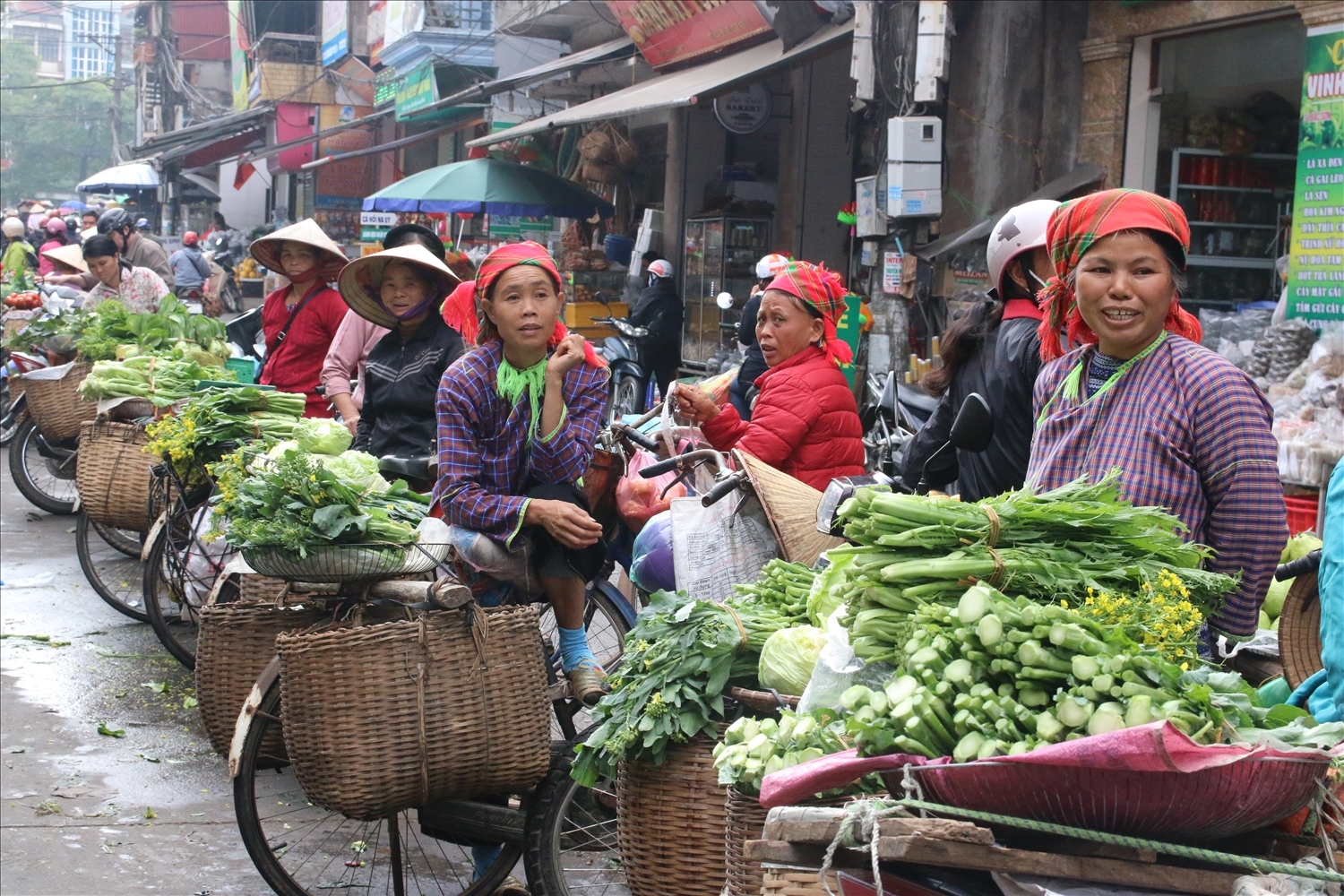 The Nung ethnic people wear traditional clothing in their daily lives
