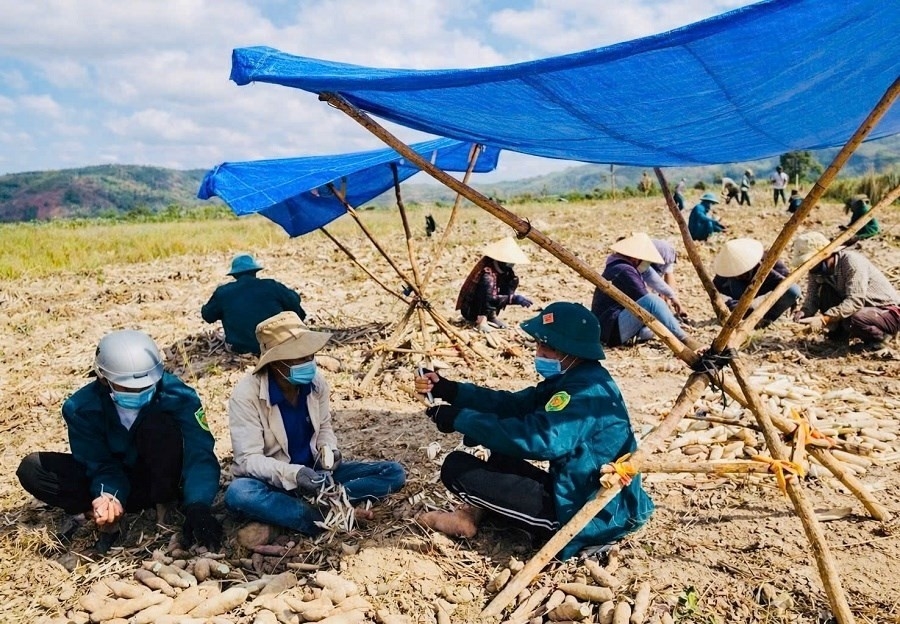
 Ethnic minority people in western Gia Lai province harvest cassava on sun-drenched hillsides
On the gentle slopes of the hills, each cassava plant is pulled up, revealing creamy white tubers still covered in moist red basalt soil after months of rooting in the fields. The clinking of knives peeling the cassava, the lively conversations, and the laughter echoing amidst the highland sunshine and wind create a simple yet heartwarming scene of labor. For the Gia-rai and Bana people, cassava has long been a familiar crop, closely linked to their production activities and playing a significant role in improving the income of many families.
Mr. Siu Quyen said: His family cultivates about 4 acres of cassava. During harvest season, all family members rush to the fields early in the morning to work on schedule. The work isn't too difficult, but it requires many people working together. Some pull up the cassava, others peel it and some slice it before drying it. If the weather is sunny, the cassava dries in a few days. The villagers then simply gather it, packing it into bags and transporting it home or selling it to traders.
Not far from Mr.Quyen’s field, on the hillside in Tul hamlet, Ia Tul commune, Mr. Siu Luk’sfamily is also busy harvesting cassava. Mr. Siu Luk said: This year, his familyplanted about 5 acres of cassava. During the harvest season, his parents andolder brother also come to the field to help, so the work is easier. Thesedays, his family takes advantage of the harvest because dried cassava sells fora good price, providing extra money to pay for their children’s education andcover living expenses.
At this time of year, many highland communes in Gia Lai province are entering the cassava harvesting season. On the hillsides, rows of cassava drying areas stretch endlessly, creating a characteristic scene of highland agriculture. The cassava season is also an opportunity for people in the villages and hamlets to bond with each other more closely. Most of the work, such as pulling up cassava, peeling, slicing, and drying, is done manually and requires many people to participate. Therefore, villagers often help each other “exchange labor”. Today, the whole village comes to help one family harvest and the next day they move to another family’s field to continue working until the harvest is finished. Thanks to this, the work becomes faster and the sense of community is strengthened.
The entire Po To commune currently has over 1,000 hectares of cassava, of which about one-third is grown on mountain slopes. These days, cassava farmers in the area are also urgently harvesting to dry in the favorable sunny days. While nimbly peeling cassava at the drying area, Ms. Dinh Su (village 5) said: “My family cultivates about 5 acres of cassava. This year, we expect to harvest over 11 tons of fresh cassava, which will yield about 8 tons after drying. After deducting expenses for seeds, fertilizer and labor, my family will earn a profit of about 25 million VND. This amount isn’t large, but it helps my family cover our living expenses”.
Mr. Tran Dinh Duc, Deputy Head of the Economic Department of Po To Commune, said: The area of cassava cultivated on the mountain slopes and foothills of the locality mainly depends on rainwater, while investment in fertilizers and care is limited, so the yield is not high compared to flat areas. However, due to the steep terrain and arid soil, switching to other crops is difficult. Therefore, cassava has remained the crop that farmers have chosen to cultivate for many years. Most of the harvested cassava is peeled, sliced and dried before being sold, essentially providing an additional source of income to support their lives.
On the sun-drenched, windswept hillsides of western Gia Lai, cassava plants remain quietly intertwined with the lives of the Gia-rai and Bana ethnic groups. Each harvest season not only brings income but also provides motivation for the people to continue cultivating their land and developing their family’s economy./.
