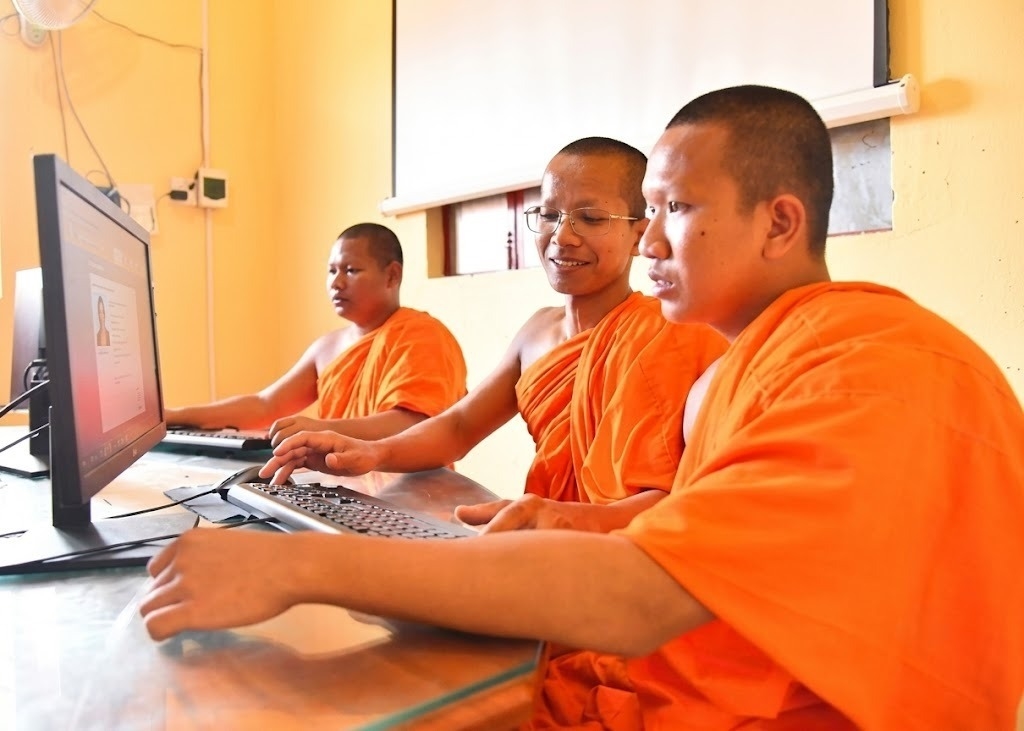
 Most religions utilize advancements in science and technology to support their religious activities
Keywords: Spreading religion; Social network; Network environment; Freedom of belief and religion.
1. Introduction
In recent years, the rapid development of media and social networks such as Facebook, YouTube and TikTok has had a profound impact on many aspects of social life, including religious activities. In Vietnam, religious organizations and individuals are increasingly using these platforms to spread their doctrines, attract followers and expand their sphere of influence. Besides the advantages, spreading religious teachings through the internet also raises many issues such as difficulty in controlling content, the risk of misinformation and changes in religious practices. Therefore, studying the impact of media and social networks on missionary activities in Vietnam is necessary to clearly identify the current situation and propose appropriate solutions.
2. The religious situation in Vietnam
Vietnam is a multi-religious country. As of May 2024, the State had recognized and registered 43 organizations belonging to 16 religions, with approximately 27.7 million followers (accounting for about 27.7% of the country’s population), over 54,000 religious dignitaries, more than 144,700 religious officials and 29,801 religious places of worship. Religious life in Vietnam today has undergone fundamental changes towards international integration. This is a result of the Party and State’s renewed policies from the late 1990s to the present. This change is influenced not only by socio-economic conditions but also by the scientific and technological revolution, or more precisely, the Fourth Industrial Revolution.
Nowadays, most religions utilize advancements in science and technology to support their religious activities. Major religions have all developed online communication systems to serve their missionary purposes, both domestically and internationally. For example, in our country, Catholicism and Protestantism have flourished in the northern mountainous provinces as well as among the ethnic minorities in the Central Highlands thanks to radio broadcasting, now they have access to other more useful means, especially smartphones.
In the context of the Fourth Industrial Revolution, the conditions that give rise to religion have not been overcome, the world still faces many injustices, the gap between rich and poor in some developed countries is becoming increasingly pronounced, ethnic and religious conflicts, international terrorism, local wars, economic wars, cyber wars, interventionist and subversive activities, civil disobedience, disputes over sovereignty, territory and resources... are occurring in new and more intense forms. Global and non-traditional security issues such as food security, energy security, water security, financial security, cybersecurity, climate change, natural disasters, epidemics,… remain complex, science and technology have not yet adequately addressed and explained the increasingly urgent and high demands of humanity, therefore, these issues continue to impact and reinforce beliefs in religion and the spiritual needs of people. Religion in the context of the Fourth Industrial Revolution still retains its full religious qualities and beliefs, influenced by globalization, diversification, secularization and the cultural elements of various nations and peoples. Therefore, a religious approach within the context of globalization is needed to shape new norms and rules in the process of development and integration.
However, in the time of the Fourth Industrial Revolution, religious transactions and services no longer take place solely at places of worship, but can occur anytime, anywhere, posing difficulties for religious management, especially for religions that are not yet permitted to operate. Online communities of religious followers have also been formed, especially those religions that are closely linked to modern society, making it difficult to monitor compliance with state regulations on the establishment of associations, operational regulations and operational guidelines, ... raising cybersecurity issues in the religious field.
The impacts of the Fourth Industrial Revolution have presented both opportunities and challenges, requiring scientific research to maximize the positive aspects and mitigate the negative ones of religion, integrating religion with the nation is a strategic and necessary requirement that every country and nation in the world is utilizing, exploiting and choosing to serve its national interests.
3. The current situtation of Internet and social media usage and its social impact
The Fourth Industrial Revolution (IR4) ushers in a new era in the history of human development, impacting production methods, fundamentally changing social relationships and becoming a crucial driving force and foundation for societal progress.
The new productive forces built upon breakthroughs in the development of the Internet of Things (IoT), cloud computing, 3D printing, sensor technology, virtual reality, artificial intelligence,… give rise to new production relations, suited to the developmental needs of the productive forces, encompassing all attributes from production, division of labor and product distribution… The formation and development of cyberspace in the Fourth Industrial Revolution has profoundly impacted all aspects of life, from politics, economics, culture, society worldwide and religion is no exception. The cyberspace has become a “unique social space”, where new social relationships take place. According to the “Digital in 2025: Vietnam” report, Vietnam will have 79.8 million internet users by the beginning of 2025; and 76.2 million social media “user identities”.
The impacts of the Fourth Industrial Revolution have presented both opportunities and challenges, requiring scientific research to maximize the positive aspects and mitigate the negative ones of religion, integrating religion with the nation is a strategic and necessary requirement that every country and nation in the world is utilizing, exploiting and choosing to serve its national interests.
4. Policy and legal framework regarding “religious practice and proselytization” and conduct in cyberspace
Resolution No. 25-NQ/TW dated March 12th, 2003, of the 7th Conference of the Central Committee of the Communist Party of Vietnam (9th term) on religious affairs affirms that: the practice of religion, the propagation of religion and all other religious activities must comply with the Constitution and laws; it is strictly prohibited to exploit religion to propagate heresy and superstition; it is strictly prohibited to coerce, bribe, obstruct others from following or not following a religion.
The core point here is: The State respects and guarantees freedom of belief and religion, but manages it through law to protect the common good (national security, social order and safety, social morality, human rights).
The Law on Beliefs and Religions defines religious activities as including: the propagation of religion, religious practices and the management of religious organizations (Article 2).
The law also recognizes the right of religious dignitaries, officials, and clergy to preach and spread the faith at religious establishments or other legally permitted locations; At the same time, it is strictly prohibited to exploit religious activities to infringe upon national defense, security, social order, morality and the legitimate rights and interests of organizations and individuals (Article 5).
The “bottleneck”: The law is designed primarily based on physical space (religious establishments/legal locations/areas of responsibility). This makes the current activity of “spreading religion online” an area that is not directly defined, easily leading to: It is difficult to reach a consensus on identifying behaviors and grounds for handling them; there is a risk of “applying procedures to the wrong subjects” (for example, treating online activities as “preaching outside the designated area”); or conversely, “overlooking” acts of exploiting religion online.
The Cybersecurity Law prohibits the use of cyberspace to infringe upon national security, social order and safety and the legitimate rights and interests of organizations and individuals (including acts related to harmful, inciting and divisive information...).
Information Technology Law: stipulates a group of prohibited acts when providing, transmitting, storing, and using digital information, including acts against the State, undermining national unity,…
The Telecommunications Law (effective July 1st, 2024) establishes responsibilities for ensuring infrastructure safety and information security; and a coordination mechanism as required by the Cybersecurity Law.
The Children’s Law (2016) stipulates the responsibility to protect children when participating in the online environment.
The amended Advertising Law of 2025 (Law No. 75/2025/QH15, effective January 1st, 2026) clearly stipulates that online advertising includes advertising on social networks, online applications and digital platforms with internet connectivity.
However, these regulations govern “information behavior” in general; whereas religious dissemination activities are specific in nature (subject, content, goals, community influence). Without a “bridge” in the Law on Beliefs and Religions, there would be a lack of a mechanism that both ensures the right to practice religion legally in the digital environment; preventing and properly addressing acts of exploiting religion online.
5. The impact of media and social networks on the dissemination of religion
The impact of media and social networks on religious dissemination today is far-reaching, presenting both great opportunities and significant challenges. This can be viewed from two main perspectives:
Positive impact
Firstly, utilizing the conveniences of the Internet, social media, electronic information websites, online platforms such as YouTube and Livestream,… to guide and share experiences on religious practices and beliefs simultaneously with a large number of followers worldwide, without being limited by space, time, natural disasters, or epidemics and without fear of misinterpreting the content, at the same time promoting missionary activities and developing followers in nations and globally.
Secondly, religions will quickly catch up and adapt to the trends of the globalization era, such as artificial intelligence, 3D printing technology, biotechnology, virtual reality, the use of robotic preachers. This brings convenience and closeness to believers, strengthening their faith, psychology and religious consciousness, the propagation of religious faith, combined with vivid and memorable visual images, makes believers feel as if they are directly interacting with their faith, while also providing opportunities to reflect, contemplate, compare, and contrast what has been taught and preached with the vibrant reality of daily life.
Thirdly, religion will gradually shift from “traditional” communication methods to utilizing the conveniences of “technological” and “digital” media, centered around its followers, to disseminate its views and ideas in order to attract the attention of society and other religions and gradually strengthen the faith of its followers. According to data from the Government's Religious Affairs Committee: “The number of religious followers is also increasing rapidly. Currently, more than 80% of the world's population are religious followers, including over 2 billion Christians (1.17 billion of whom are Catholic), 1.2 billion Muslims, 786 million Hindus, 362 million Buddhists and 102 million followers of other new religions”.
Using “soft evangelization” to spread faith and religious beliefs in the form of ideas, culture, and art, as one scholar once wrote: “Every pulpit is a propaganda loudspeaker…”. Welcome, support and encourage parishioners, believers, Buddhists to use the internet and information technology in evangelism, religious development, daily life and the practice of religious rituals.
Negative impacts and legal and social risks.
Information on social media is difficult to control, making it easy for distorted content, misinterpretations of doctrines, or the exploitation of religion for personal gain to appear.
The commercialization and “entertainment” of religion. Some religious content is being turned into a tool for attracting views and likes, diminishing its solemnity and spiritual depth.
The spread of extremist information is rapid. Extremist views and superstitions can spread quickly, negatively impacting public perception.
6. Conclusion
Today, in the era of global development, we are living in an era of industrialization and modernization of the country based on IR4, with the rapid development of science and technology and information technology impacting every aspect of society. Advances in the Internet of Things, smart devices and applications, artificial intelligence, robotics,... promise to bring new potential in accessing knowledge, this innovation will help improve both material and spiritual life and bring countless benefits from IR4 to us. However, alongside the opportunities we have gained, we also face various challenges, under the impact of the 4.0 revolution which creates many changes and instabilities in socio-cultural life, in there religious life is no exception.
With a consistent policy of respecting and guaranteeing freedom of belief and religion, our Party and State always create favorable conditions for religions to operate and develop in a rich and diverse manner; All citizens are free to engage in activities and participate in their beliefs and religions within the framework of the law; All religions in Vietnam are treated equally, without discrimination. Each religion plays an important role, to be a significant part of the country’s cultural and social life.
The coming years are predicted to be a period of increasing religious organizations and activities. Religious organizations that have been recognized over the years have basically followed the correct direction and principles of religious practice, closely accompanying the nation. However, religious activities still harbor many complex elements, superstitious practices in religious establishments and places of worship tend to increase. Issues such as proselytization, illegal construction of places of worship and disputes over religious land continue to occur. The management of aid received by non-governmental organizations for religious purposes remains inadequate...
Especially in the current era of the 4.0 revolution, if all these factors are not handled properly, they can easily have a negative impact on the political security and social order of the country.
The changes in religious life during the Fourth Industrial Revolution necessitate new perspectives, viewpoints, as policies and laws aimed at promoting the positive aspects and mitigating the negative impacts of religion in the sustainable development of the country. The most important issue is the need to continue improving policies and laws on religion in order to promote and effectively utilize religious resources, especially in the areas of charity and humanitarian work, social welfare, social protection, as well as in education to raise public awareness, train human resources, and healthcare for the people, contributing to the sustainable development of the country in the era of globalization and the Fourth Industrial Revolution.
In order to achieve this, it is necessary to amend and supplement policies and laws related to religion, such as those concerning land, culture, education and healthcare, ensuring consistency with the law on religion and international conventions to which Vietnam is a party.
* Academy of Public Administration and Management
References
1. Government Committee for Religious Affairs, Report No. 192/BC-TGCP dated December 29th, 2020, on the results of the implementation of state management tasks on beliefs and religions in 2020.
2. Government Committee for Religious Affairs, Report summarizing the first three years of the Law on Beliefs and Religions.
3. National Assembly Standing Committee, Ordinance on Beliefs and Religions No. 21/2004/PL-UBTVQH11, dated June 18th, 2004.
4. Government Religious Affairs Committee (2010), “Survey of the current state of press activities and religious publications - recommendations on policy guidelines”, Committee-level project.
5. Government Religious Affairs Committee (2015), Religion and religious policy in Vietnam, Religious Publishing House, Hanoi.
