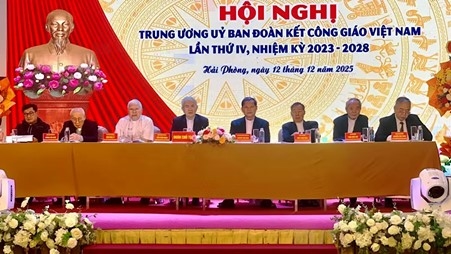
 The Presidium chaired the Central Conference of the Vietnam Catholic Solidarity Committee
Keywords: Vietnam Catholic Solidarity Committee; National Catholic Liaison Committee; Vietnamese Catholics.
1. From patriotic Catholic movements to the National Catholic Liaison Committee in 1955
Catholicism entered Vietnam in the mid-16th century. From 1533 onwards, it was introduced by missionary orders from the West, such as the Franciscans, the Jesuits from Portugal and the Dominicans from Spain, later the Paris Foreign Missions Society (Missions Étrangères de Paris - MEP) from France. Due to cultural differences, the early attempts to introduce Catholicism to Vietnam did not achieve the results that the missionaries had hoped for. Over time, especially since the 20th century, for various reasons, the number of Catholic believers in Vietnam has increased. Specifically: In 1890 there were 708,000 believers, in 1975 there were 3.5 million believers, in 2024 there were 7.5 million believers.
Along with the increase in the number of believers and the scope of its activities, Catholicism in Vietnam has built its Church organization according to tradition in its relationship with the Vatican Curia. Up to now, the country has a total of 27 dioceses across three archdioceses: the Archdiocese of Hanoi with 11 dioceses, the Archdiocese of Hue with 6 dioceses, the Archdiocese of Ho Chi Minh City with 10 dioceses.
As a medium of interaction and exchange between Western civilization and culture and Vietnamese culture, Catholicism has a long history of close ties with the Vietnamese people. Looking back at history, from the late 19th and early 20th centuries, many Catholics in Vietnam, including priests, monks and lay people, participated in the patriotic movement against foreign invaders. Under the leadership of the Communist Party of Vietnam, since the August Revolution (1945), the patriotic movement of Catholics has emerged and developed strongly with many diverse forms of activity to welcome and support the revolutionary government. This is the basis for the formation of patriotic organizations among Catholics. These organizations of the Catholic patriotic movement emerged under specific conditions. During the resistance war against French colonialism, many religious organizations for national salvation emerged under different names, including Catholic resistance organizations such as: the Southern Catholic Resistance Association, the Catholic Resistance Liaison Committee of Zone Three, the Left Bank Zone,... Patriotic Catholic organizations published newspapers such as “For God, For the Fatherland” in the South and “Glorify God” in the North to propagate and promote patriotism among Catholic compatriots.
In the early 1950s, Catholic patriotic organizations conceived the idea of unifying local Catholic resistance organizations into a single nationwide organization to carry out patriotic activities more effectively and practically. In August 1953, the National Religious Conference was held in the Viet Bac war zone, bringing together many delegates and religious leaders from localities across the country. The Catholic delegates attending the Conference met, exchanged views and agreed on the unification of the Catholic resistance organizations. However, due to wartime conditions, the delegation of Catholic priests and lay people participating in the resistance in the South (Vietnam) could not attend the conference, so the intention to unify the patriotic Catholic organization could not be realized.
Following the Geneva Accords, a massive exodus of over half a million Catholics had severe social consequences. In light of this situation, the need to establish a nationwide Catholic organization became extremely urgent. The Steering Committee, comprised of Catholic priests and intellectuals representing Catholic patriotic movements and organizations was formed with Father Peter Vu Xuan Ky as its head.
After three months of preparation and active campaigning, from March 8th to 11th, 1955, the Congress of Vietnamese Catholics who love their country and peace was held in Hanoi with the participation of 191 delegates, including 46 priests, 8 religious sisters and 137 exemplary parishioners. The Congress affirmed the need for a Catholic organization to unite all Catholics who revere God, love their country, love peace throughout the nation. The congress established an organization named: the Liaison Committee of Catholics Who Love Their Homeland and Peace (abbreviated as the National Catholic Liaison Committee). The National Catholic Liaison Committee has 27 members (including 11 priests), with Father Peter Vu Xuan Ky as Chairman, Father John Baptist Ho Thanh Bien and lawyer Duong Van Dam as Vice-Chairmen. The founding congress of the newspaper Chinh Nghia established it as the official mouthpiece replacing the previous newspapers in the three regions of Vietnam.
The Congress adopted the Charter with the following principles and objectives: To be an organization that unites all Catholics who revere God and love their country to work together with the people of the whole nation to accomplish the following tasks: 1. In order to enhance the spirit of reverence for God and love for the country among Catholics; 2. In order to join the entire nation in the struggle to consolidate peace and achieve national reunification through free general elections, creating conditions for progress towards achieving independence and democracy throughout the country; 3. Uniting with the entire nation to crush all the exploitative schemes of imperialism.
Throughout its activities before 1975, the National Catholic Liaison Committee adhered to its principles and objectives, mobilizing Catholic compatriots to contribute alongside the people of the whole country to the successful August Revolution, the victorious resistance against French colonialism, the victorious resistance against American imperialism and the reunification of the country.
2. The reunification of the country (1975) and the establishment of the Vietnam Catholic Solidarity Committee
The great victory of Spring 1975 ushered the Vietnamese nation and people into a new era of national construction and defense. The Catholic patriotic movement also underwent positive changes. After 1975, along with the activities of the National Catholic Liaison Committee, several localities also formed Catholic patriotic movements linked to the implementation of local socio-economic tasks. In Ho Chi Minh City, the movement developed strongly, so in 1980 the Ho Chi Minh City Catholic Mobilization Committee was established.
In order to unify the movement’s activities nationwide and fulfill the aspirations of the vast majority of Vietnamese Catholics, in December 1981, the National Catholic Liaison Committee held an expanded conference proposing the organization of a National Catholic Congress to establish a new organization for the nationwide Catholic movement. The delegates unanimously agreed and began preparing for the Congress. On July 6th, 1983, the Standing Committee of the National Catholic Liaison Committee met in Hanoi, affirming that the National Catholic Liaison Committee had completed its historical mission and decided to consult with several Catholic organizations and movements in various localities to hold a conference to establish the Preparatory Committee for the National Catholic Congress. On August 24th, 25th and 26th, 1983, in Ho Chi Minh City, a conference was held with the participation of representatives from patriotic Catholic organizations and movements nationwide. The conference established a Preparatory Committee chaired by Father Anton Nguyen The Vinh.
Preparations were carried out urgently in a short period of time, so that from November 8th to 10th, 1983, 299 delegates, including 142 priests, 11 religious sisters and 146 parishioners representing Catholics nationwide, gathered in Hanoi to attend the Congress of Vietnamese Catholics for National Construction and Defense. The Congress established the Committee for Patriotic Catholic Solidarity of Vietnam (later renamed the Committee for Catholic Solidarity of Vietnam). The Congress adopted the Charter affirming that the Committee for Catholic Solidarity of Vietnam continues the legacy of the predecessor organizations of the patriotic Catholic movement. Specifically: The Vietnam Catholic Solidarity Committee is a member organization of the Vietnam Fatherland Front, operating in accordance with the Constitution and laws of the Socialist Republic of Vietnam. The Vietnam Catholic Solidarity Committee’s mission and purpose is to unite the broad masses of Vietnamese Catholics in order to accomplish its tasks. Specifically: In order to encourage Catholics, together with the entire nation, in order to build and protect the socialist Vietnamese Fatherland; in order to contribute to implementing the Church’s orientation of close ties with the nation, strengthening and consolidating the great national unity on the foundation of the nation’s moral and cultural traditions; Concerned with the material and spiritual well-being of all Catholics, and reflecting the thoughts and aspirations of Catholics to the state for consideration and resolution; Together with all people and Christians around the world, let us build and protect peace, democracy and social progress.
When the National Catholic Liaison Committee (1955) and the Vietnam Catholic Solidarity Committee (1983) were established, they were not directly affiliated with the Catholic Church in Vietnam, therefore had views that overshadowed or dominated the Church and were heavily political... In response to conflicting opinions, the Vietnam Catholic Solidarity Committee, upon its establishment at the Congress in 1983, made it clear: “Contrary to the distortions, the National Liaison Committee of Vietnamese Catholics who love their country and peace has never had any intention of separating from its mother Church and has never operated as a purely religious organization subordinate to the clergy. This is a Catholic organization fulfilling its civic duty, wishing and striving to ensure that everyone in its community can stand shoulder to shoulder with their fellow countrymen, that the Mother Church can be worthy of its beloved homeland. From now on, patriotic Vietnamese Catholics will certainly think and act in the same way”.
Therefore, the National Catholic Liaison Committee and the Vietnam Catholic Solidarity Committee are not ecclesiastical organizations but rather socio-political organizations of the Catholic community in Vietnam. The 1983 Congress also decided to establish the official publication of the Vietnam Catholic Solidarity Committee, the weekly newspaper “Vietnamese Catholic” and continue maintaining the Catholic and Nation newspaper of the Ho Chi Minh City Catholic Solidarity Committee.
When the Vietnam Catholic Solidarity Committee was first established, some clergy, especially bishops were skeptical, but over time, through the activities and contributions of this organization, perceptions and behaviors have changed. Bishop John Baptist Bui Tuan highly appreciated the role of the Vietnam Catholic Solidarity Committee and its long-standing role as a key collaborator of the Vietnamese Catholic Newspaper and the Catholic and National Newspaper. In 2004, Father Paul Nguyen Thai Hop (later Bishop), in his article “Facing the Challenges of the Future” at the Seminar on Half a Century of Vietnamese Catholics Accompanying the Nation, expressed: “No one can doubt the role of the Catholic Solidarity Committee in mobilizing Catholic patriotism and affirming the position of the Catholic community within the nation”.
Although not a church, in order to affirm the position and role of a unique religious organization, the Chairman of the Council of Ministers issued Decision No. 13/CT, dated January 11th, 1984, approving the establishment of the Vietnam Catholic Solidarity Committee.
3. Congresses of the Vietnam Catholic Solidarity Committee
From its establishment in 1983 to 2023, the Vietnam Catholic Solidarity Committee has held 7 congresses, each lasting 5 years. Specifically:
The first Congress (1983-1990) held from November 8th-11th, 1983, unanimously established the Vietnam Catholic Solidarity Committee, comprising 74 members, including 49 priests, 1 religious and 24 parishioners. The chairman was Father Anton Nguyen The Vinh.
The Second Congress (1990-1997) held from October 10th-12th, 1990, elected 81 members to the Committee for Catholic Solidarity of Vietnam, including 55 priests, 1 nun and 25 parishioners. Father Peter Vo Thanh Trinh was the chairman.
The Third Congress (1997-2003) held in Hanoi from December 30th-31st, 1997, elected 97 members to the Committee for Catholic Solidarity of Vietnam, including 67 priests, 4 nuns and 26 parishioners. Father Paul Nguyen Thai Ba was the chairman.
The 4th Congress (2003-2008), held from January 2-3, 2003, defined its theme as: “Unity - Communion - Partnership”. The Congress elected 104 members to the Committee for Catholic Solidarity of Vietnam, including 64 priests, 6 religious, and 34 parishioners. The chairman is Father Benedicto Nguyen Tan Khoa.
The 5th Congress (2008-2013) held in Hanoi from November 19th-20th, 2008, defined its theme as: “Returning to the Roots - Integration - Advancement”. The congress elected 128 members to the Committee for Catholic Solidarity of Vietnam, including 74 priests, 4 religious and 50 parishioners. The chairman is Father Peter Nguyen Cong Danh.
The 6th Congress (2013-2018) held in Hanoi from November 19th-20th, 2013, identified the theme as: “Cooperation - Partnership - Sharing”. The Congress elected 138 members to the Committee for Catholic Solidarity of Vietnam, including 74 priests, 4 religious and 61 parishioners. The Chairman is Father Peter Nguyen Cong Danh.
The 7th Congress (2018-2023) held in Hanoi from October 12th-13th, 2018, identified the theme as: “Communion - Partnership - Service”. The Congress elected 147 members to the Committee for Catholic Solidarity of Vietnam, including 76 priests, 5 religious and 66 parishioners. The chairman is Father Joseph Tran Xuan Manh.
The 8th Congress (2023-2028) held in Hanoi from October 11th-12th, 2023, identified the theme as: “Cooperation - Sharing - Service”. The Congress elected 148 members to the Committee for Catholic Solidarity of Vietnam, including 64 priests, 6 religious and 78 parishioners. The chairman is Father Joseph Tran Xuan Manh.
The Catholic Solidarity Committee is stipulated to be established only at the central level and in provinces and cities with a large Catholic population. By 2004, 37 Committees for Catholic Solidarity of Provinces and Cities had been established nationwide. By 2025, after reorganizing the political system into two levels (provincial and commune), 25 provinces and cities will have Catholic Solidarity Committees.
4. Conclusion
For very specific political, cultural and social reasons, the Catholic community in Vietnam has formed an organization with socio-religious characteristics. Over its 70 years of existence and development (1055-2025), the Catholic Solidarity Committee has successfully fostered patriotism among Catholics, implementing the direction of the Vietnamese Bishops’ Council through its 1980 Pastoral Letter: “Living the Gospel in the heart of the nation to serve the happiness of our compatriots”, thereby affirming the position of Catholicism in the heart of the Vietnamese nation.
* Ho Chi Minh National Academy of Politics
References
1. Government Religious Affairs Committee, Vietnam Catholic Solidarity Committee (1983-2003), Hanoi, 2003.
2. Father Nguyen Thanh Danh (Editor), Proceedings of the Seminar of the Vietnam Catholic Solidarity Committee: 30 Years of a Journey, Religious Publishing House, Hanoi, 2013.
3. Nguyen Dinh Dau, The Mark of 50 Years of the Vietnamese Clergy. Religious Publishing House, Hanoi, 2010.
4. Vietnam Catholic Solidarity Committee, Proceedings of the Scientific Seminar, Hanoi, December 21st-22nd, 2004.
5. Vietnam Catholic Solidarity Committee, Half a Century of Vietnamese Catholics Accompanying the Nation, Religious Publishing House, Hanoi, 2005.
6. Vietnam Catholic Solidarity Committee, Report summarizing work in 2025 and directions and tasks for 2026, Hanoi, 2025.
7. Nguyen Thanh Xuan, Some Religions in Vietnam, Religious Publishing House, Hanoi, 2005.
