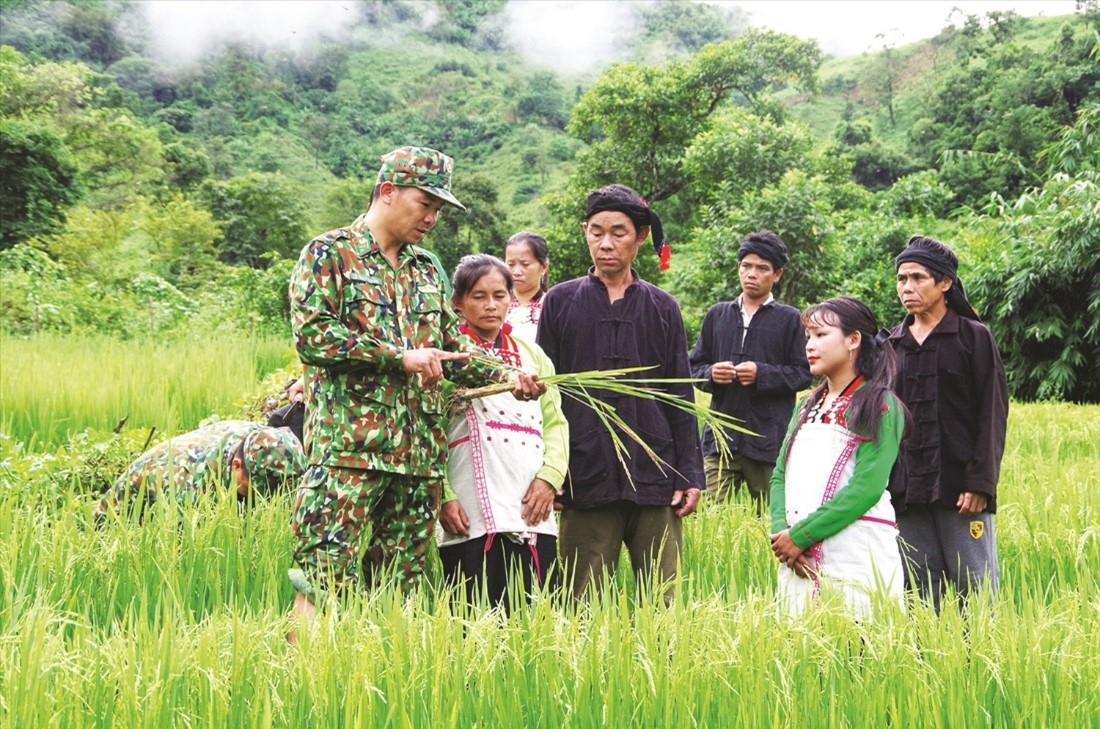
 Lai Chau provincial Border Guard soldiers guide the Mang ethnic group in cultivating wet rice
Keywords: Poverty reduction; Ethnic minorities; Ethnic minority and mountainous areas; Socio-economic; International Convention on the Elimination of all forms of Racial Discrimination.
1. Theoretical and legal basis of human rights for ethnic minorities
The international Convention on the elimination of all forms of racial discrimination (CERD) established in 1965, directly related to human rights, with the main objective of prohibiting and eliminating all forms of discrimination based on race, color, ethnic origin, in order to ensure equality and dignity for all individuals in all areas of social life. Vietnam became a signatory to the CERD Convention in 1982. As a signatory to the CERD Convention and several other international human rights conventions, Vietnam has the responsibility to incorporate the provisions of these international conventions into its national legal system. In the 2013 Constitution, the highest-ranking legal document in Vietnam’s system of legal regulations, Chapter II, with 36 articles, directly and clearly stipulates “Human rights, fundamental rights and obligations of citizens”.
One of the very important human rights stipulated in the CERD Convention is the right to social security (point d, paragraph 5, Article 5). In order to internalize this provision, Article 34 of the 2013 Constitution stipulates that citizens have the right to social security; Clause 2 of Article 59 stipulates that the State shall create equal opportunities for citizens to enjoy social welfare, develop the social security system, have policies to assist the elderly, people with disabilities, the poor and other disadvantaged people.
Social security is a cornerstone of social policy, serving as both a goal and a driving force for sustainable development and socio-political stability, it reflects the positive nature of our system, ensuring progressive and equitable social development, leaving no one behind.
Vietnam is a unified country with 54 ethnic groups living together, including 53 ethnic minorities. Ethnic minorities are an inseparable part of the Vietnamese nation and enjoy full human rights as stipulated in the Constitution and other legal documents. The Vietnamese State has always considered respecting, protecting, and promoting human rights and civil rights, including those of the 53 ethnic minority groups, as a fundamental principle of all socio-economic development strategies of the country. The 2013 Constitution stipulates: “In the Socialist Republic of Vietnam, human rights and civil rights in political, civil, economic, cultural and social spheres are recognized, respected, protected and guaranteed according to the Constitution and laws” (Clause 1, Article 14), “Everyone is equal before the law” and “No one shall be discriminated against in political, civil, economic, cultural and social life” (Article 16).
The social security structure in Vietnam consists of four pillars, two of which are directly related to poverty reduction for ethnic minorities: (i) Employment, income creation and poverty reduction policies aim to support people in proactively preventing risks in the labor market through policies on vocational skills training, credit, job creation, minimum income and sustainable one-dimensional and multi-dimensional poverty reduction. (ii) Policies to ensure minimum levels of certain basic social services for the people, especially the poor, the disadvantaged and ethnic minorities, in order to support people’s access to basic social services at a minimum level, including health, education, housing, clean water, information and communication and legal assistance.
In addition to enjoying all human and civil rights stipulated in the Constitution and other legal documents, the Party and State have issued many documents and legal regulations with specific policies for ethnic minorities in various fields, target groups, localities, including policies related to poverty reduction, aiming to improve their access to and enjoyment of human rights in the field of ensuring social security for ethnic minority communities.
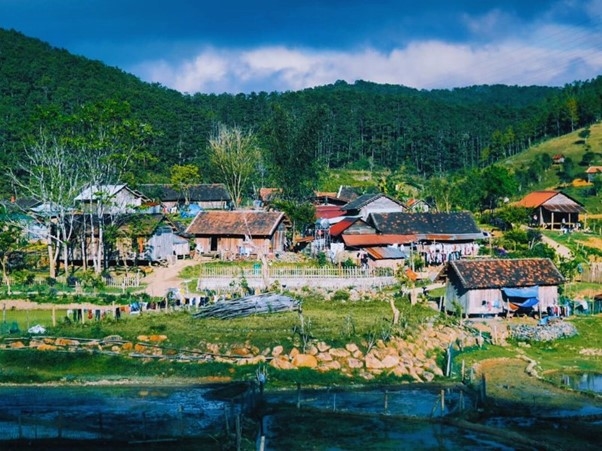 A positive development in ethnic minority and mountainous areas
2. Ensuring the human rights of ethnic minorities through poverty reduction policies for the period of 2021-2025
During the period of 2021-2025, Vietnam’s poverty reduction sector in general, and in ethnic minority and mountainous areas in particular will be governed by two National Target Programs: Sustainable poverty reduction and socio-economic development in ethnic minority and mountainous areas (Program 1719). Among these, Program 1719 is a new program, implemented for the first time and is considered an important, comprehensive solution, with the perspective that investing in socio-economic development in ethnic minority and mountainous areas is an investment in sustainable development, linked to poverty eradication, improving the material and spiritual lives of the people, especially ethnic minorities; Gradually narrowing the gap in living standards compared to developed regions; preserving and promoting the fine cultural identity of ethnic groups to help combat social evils; In order to achieve social progress and equity, with the goal of “leaving no one behind”. By the end of the period of 2021-2025, both Programs had achieved outstanding results, contributing to ensuring human rights for ethnic minorities.
Firstly, with the National Target Program for sustainable poverty reduction, poverty reduction results have met and exceeded the targets and indicators set by the National Assembly and the Government. By the end of 2025, the multidimensional poverty rate nationwide is expected to decrease to approximately 0.9%-1.1%; the poverty rate among ethnic minorities will be 12.55% (from 25.91% at the beginning of the period, a decrease of 4.45% per year). For Program 1719, the target for poverty reduction in ethnic minority areas is an average of 3.4%, with an expected total of 3.2% for the entire period (meeting the target of over 3% as planned). The average income of ethnic minorities reached 43.4 million VND, a 3.1-fold increase compared to 2020; it is projected to reach 45.9 million VND by the end of the period, a 3.3-fold increase compared to 2020 (the target is to increase by more than 2 times).
Secondly, awareness of poverty reduction efforts has been raised. The entire political system, from the central to local levels has strongly engaged, coordinating closely and uniformly in leadership, direction and implementation; mobilizing the active participation of the whole society. The perceptions of the poor are gradually changing, with many examples of people escaping poverty and voluntarily requesting to be removed from the list of poor households, including many households belonging to ethnic minorities.
Thirdly, regarding the application of the multidimensional poverty standard, Vietnam is one of the first 30 countries in the world and one of the first countries in Asia to apply the multidimensional poverty standard, ensuring a minimum standard of living linked to sustainable development goals. Applying a multidimensional poverty standard means that Vietnam is not only addressing poverty based on income but also on other aspects of life such as access to education, healthcare, housing, information and sanitation… These criteria are consistent with the economic, social and cultural rights stipulated in Article 5, paragraph 5 of the CERD Convention, namely the right to work, the right to freedom of choice of employment, the right to housing, the right to access public health, healthcare, social welfare and social services; The right to education and training; the right to equal participation in cultural activities. Therefore, applying the multidimensional poverty standard demonstrates respect for, guarantees, promoting human rights in Vietnam in general, among ethnic minorities in particular.
Fourthly, the government has issued a comprehensive program, mechanism, policy, and law on poverty reduction to provide all-round support for the poor. There are specific poverty reduction policies that prioritize vulnerable groups, ethnic minorities, areas of facing extreme difficulties. During the period of 2021-2025, the sustainable economic development policy group includes 52 ethnic policies, of which 8 are specifically for ethnic minority communities, ethnic minority and mountainous areas; The health, population, and public health policy group includes 9 ethnic policies, of which 1 policy is specifically for ethnic minorities and ethnic minority and mountainous areas; The group of cultural, sports and tourism policies includes 9 ethnic policies, one of which is specifically for ethnic minorities, ethnic minority and mountainous areas; The group of policies on information, communication, dissemination of laws, legal aid includes 10 ethnic policies, of which 4 are specifically for ethnic minorities, ethnic minority and mountainous regions…
Fifthly, Program 1719 addressed the most pressing needs, which are the main causes of poverty among ethnic minorities, resulting in the provision of housing land to 10,549 households; Housing support was provided to 42,567 households, direct support for production land was given to 13,387 households, support for vocational retraining was provided to 54,899 households; Providing decentralized water supply support to 479,358 households; Arranging and stabilizing the settlement of 25,056 households; Demolishing 42,567 temporary and dilapidated houses; Providing subsidies of 48,991 tons of rice to 120,055 poor households and ethnic minority households participating in forest protection and development; Implementing 403 projects supporting production development along the value chain; 2,562 community production development projects; Providing vocational training and job placement assistance for 115,575 workers; organized 4,752 literacy classes with 95,033 participants. Nearly 3.9 million mothers and children have access to primary healthcare services at the grassroots level... contributing to stabilizing the lives of poor and near-poor ethnic minority households and providing stable employment for a large workforce in the area. This provides ethnic minority communities with additional motivation to develop their economy and rise out of poverty in particularly disadvantaged areas.
Sixthly, priority investment in essential socio-economic infrastructure and regional connectivity has transformed the face of poor and particularly disadvantaged areas, contributing to narrowing the regional gap, promoting growth and shifting the economic structure.
Specifically, Program 1719 has implemented investment support for 6,018 rural transportation projects serving production, business and people’s lives; 8,673 km of roads have been asphalted, concreted or hardened; 442 projects provide electricity for daily life, production, and business activities in villages and hamlets; 90 commune-level radio relay stations; 1,787 community centers; Renovating and repairing 183 commune health stations; Providing equipment support to 118 commune health stations; 225 commune health stations and 629 school buildings and classrooms meet the standards; Renovating and constructing 986 small-scale irrigation works; Investing in 666 other small-scale infrastructure projects proposed by the community; There are 2,006 infrastructure investment projects implemented under the special mechanism for investment and construction; Maintenance and repair work was carried out using program funds for 5,484 infrastructure projects in particularly disadvantaged communes and villages.
Infrastructure investments have played a crucial role in supporting local people to engage in market-oriented production. Many essential infrastructure projects serving the people have made a significant contribution to achieving the goal of improving the quality of social services in healthcare, education, information,… in particularly disadvantaged communes and villages. The general level of education, the quality of education, and the human resources in ethnic minority and mountainous araes are increasingly improving, contributing to poverty reduction efforts in the area.
The achievements of the two National Target Programs are the result of focusing on addressing poverty issues in a targeted and clearly defined manner, with clear goals and deadlines, in order to ensure the social security rights of the poor in general, ethnic minorities in particular. In particular, poverty reduction targets and per capita income for ethnic minorities have increased significantly and exceeded the plan; access to education, healthcare services, development resources has been better and more equitable; and the material and spiritual lives of people in ethnic minority and mountainous areas have improved considerably compared to before. Program 1719 has made a significant and fundamental contribution to achieving the goal of rapid and sustainable poverty reduction in particularly difficult communes and villages, considered the “core of poverty” and home to the highest concentration of poor people in the country.
These achievements have been recognized by the entire nation and are considered by the international community as some of Vietnam’s most outstanding and humane successes in the process of national construction during the period of reform and international integration.
3. Conclusion
The Platform for Building the Country during the transition period to socialism (supplemented and developed in 2011) has developed and perfected several characteristics, at the same time adding two new characteristics compared to the 1991 Platform, including the characteristic: “A prosperous people, a strong nation, democracy, fairness and civilization”. This characteristic reflects the overall objectives of the reform process in our country. These are also the universal progressive values of humanity and the aspirations for development of nations and peoples, to be the goals that our nation strives for.
Based on the Party’s Platform, social policies in our country in general, and poverty reduction policies in particular are increasingly linked to ensuring human rights; Focus on addressing pressing issues in each stage of development so that all citizens, including ethnic minorities, can enjoy the fruits of development and achieve social justice. The practical implementation of the National Target Program on sustainable poverty reduction and Program 1719 for the period of 2021-2025 shows that poverty reduction in Vietnam, especially in ethnic minority and mountainous areas has moved beyond a purely social security support approach, gradually shifting towards ensuring and promoting human rights in a comprehensive and sustainable manner. The outstanding results in reducing poverty rates, increasing income, improving living conditions and expanding access to basic social services have affirmed the correct policy of the Party and the State in considering investment in ethnic minority and mountainous areas as an investment in the long-term development of the country. This is not only a requirement for socio-economic development but also a commitment of Vietnam to ensuring human rights, leaving no community outside the country’s overall development process.
References
1. Central Steering Committee for National Target Programs in the period of 2021-2025 (2025). Summary Report on the Implementation of the National Target Program for Socio-Economic Development in Ethnic Minority and Mountainous Areas in the period of 2021-2030, Phase I 2021-2025.
2. Central Steering Committee for National Target Programs in the period of 2021-2025 (2025). Summary Report on the Implementation of the National Target Program for sustainable poverty reduction.
3. International Convention on the elimination of all forms of racial discrimination, https://thuvienphapluat.vn/van-ban/Linh-vuc-khac/Cong-uoc-quoc-te-ve-xoa-bo-moi-hinh-thuc-phan-biet-chung-toc-270273.aspx
4. Communist Party of Vietnam (2011). Platform for building the country during the transitional period to socialism (Supplemented and developed in 2011), https://tulieuvankien.dangcongsan.vn/ban-chap-hanh-trung-uong-dang/dai-hoi-dang/lan-thu-xi/cuong-linh-xay-dung-dat-nuoc-trong-thoi-ky-qua-do-len-chu-nghia-xa-hoi-bo-sung-phat-trien-nam-2011-1528
5. Ngo Trung Thanh (2025). Basic views and policies of the Party and State of Vietnam on civil, political and judicial rights for ethnic minorities.
6. Phuong Lien (2024). No one is left behind in ethnic minority and mountainous areas, https://www.bienphong.com.vn/khong-ai-bi-bo-lai-phia-sau-o-vung-dan-toc-thieu-so-va-mien-nui-post483832.html
7. National Assembly (2013). Constitution of the Socialist Republic of Vietnam, Hanoi.
