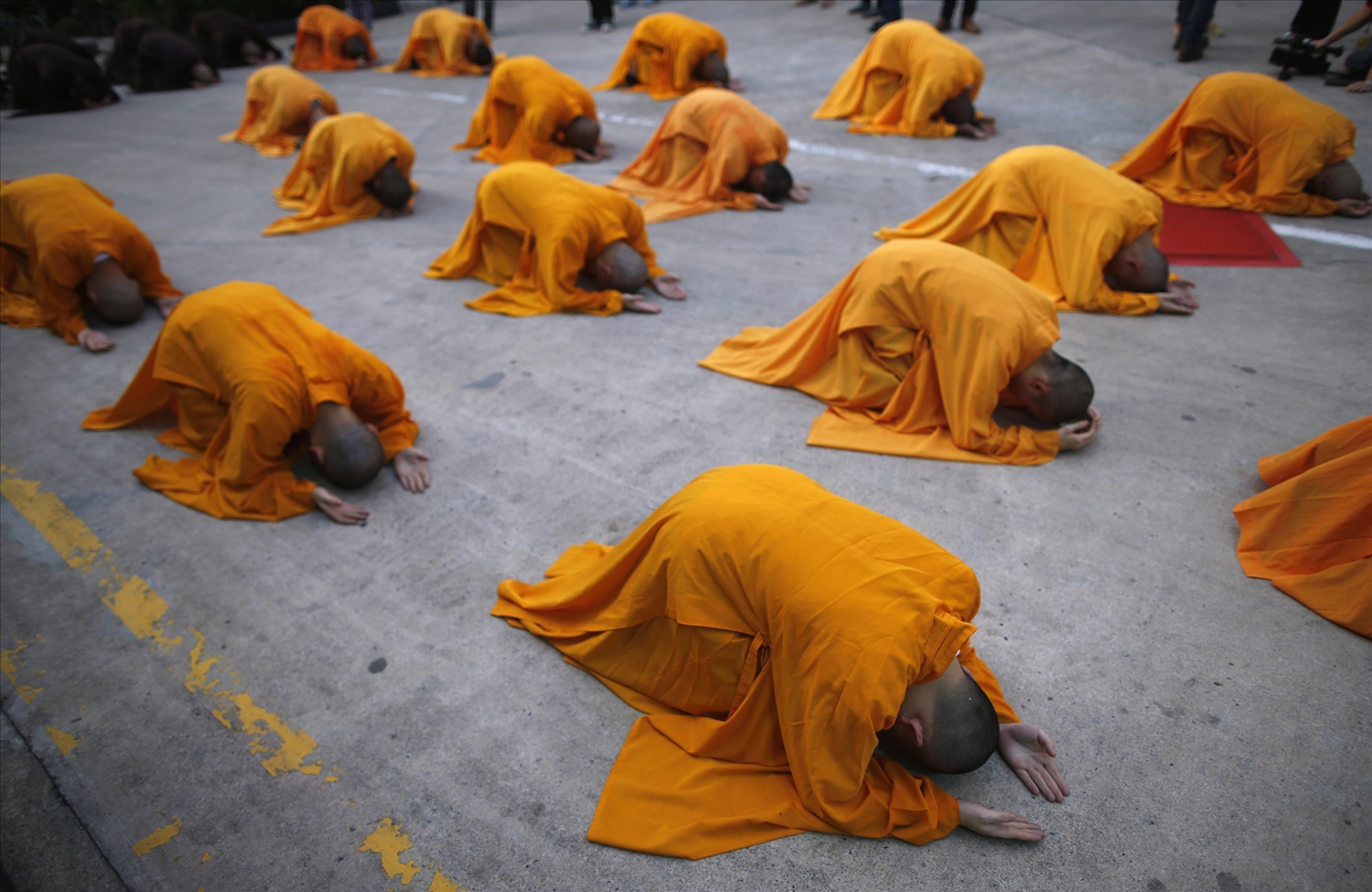
 The three bows are an act of reverence to the Three Precious Jewels: the Buddha, the Dharma and the Sangha
Most religions include acts of bowing or prostration, though the rituals and meanings vary. In Buddhism, the significance and manner of bowing differ from those in other religions. Buddhism originated in India. In that land long ago, people often expressed sincere reverence for someone they admired and respected by kneeling low and placing their foreheads upon that person's feet. The Buddha was a spiritual teacher and an enlightened being held in special reverence in the Indian society of that time.
During the Buddha’s lifetime, whenever the monks gathered to hear the Dharma or consult Him on a matter, they would typically join their palms and bow three times before speaking or listening. The Buddha tacitly accepted this practice, as it was a long-standing custom in Indian society; however, He did not mandate it as a formal ritual, leaving the matter to the discretion of His disciples.
After the Buddha entered Nirvana, these forms of ritual and reverence were maintained among His disciples. This practice was upheld with the aim of always regarding the Buddha as if He were still present in the world. Whenever the monks chant the sutras to reflect upon the Buddha’s teachings, they must wear the kasaya - the solemn, discolored robe and prostrate three times before the Buddha. The lay disciples also prostrated to the Buddha just as the venerable monks did.
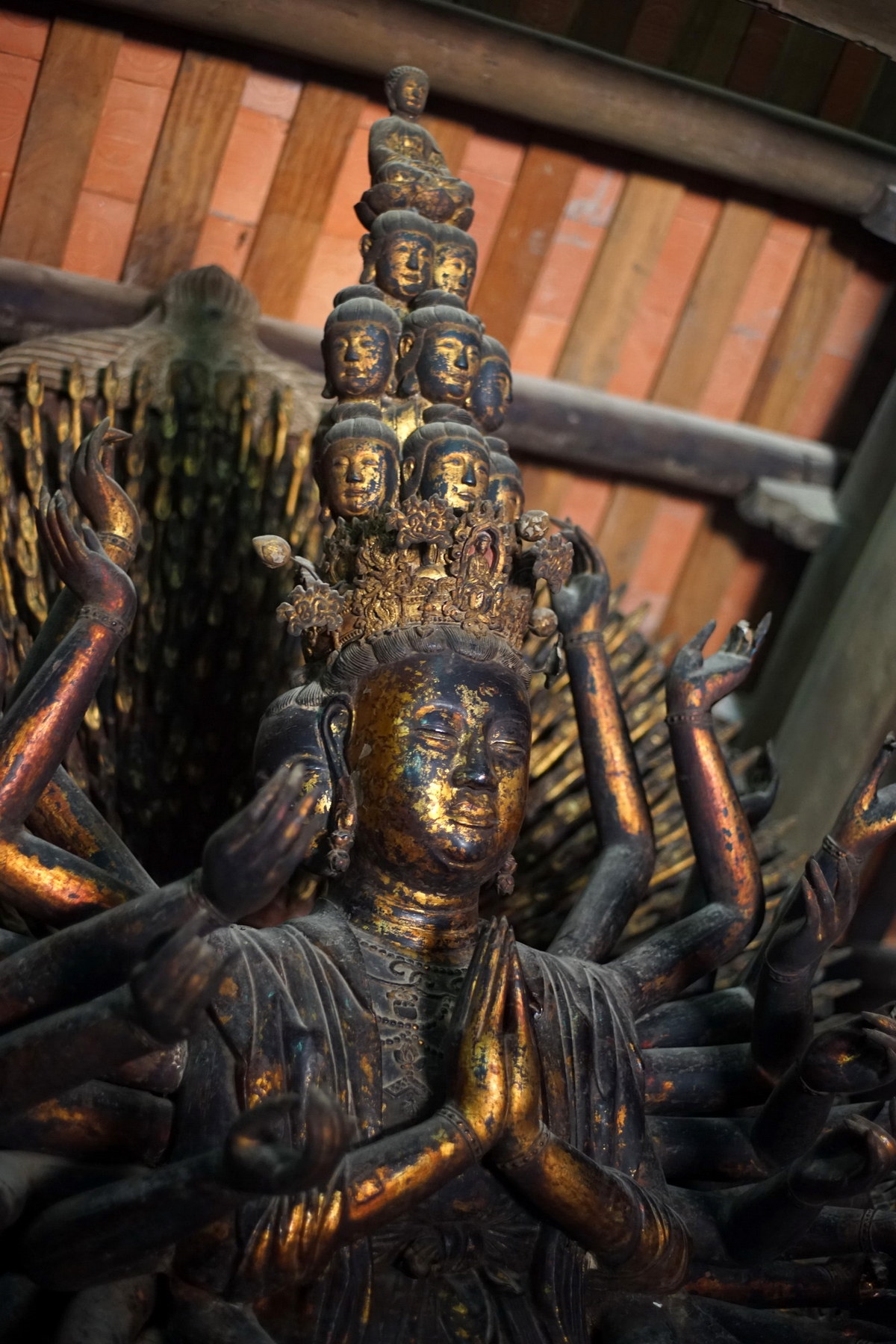 : Statue of Avalokiteshvara (Bodhisattva of compassion) with a thousand hands and a thousand eyes at But Thap pagoda
Why do we bow three times instead of once, twice, four times, or five times? The three bows are an act of reverence toward the Three Precious Jewels - the Triple Gem: the Buddha, the Dharma and the Sangha. People often regard gold, silver, diamonds, US dollars and worldly fame and fortune as precious. Yet, in reality, these things do not bring true happiness, nor can they save us from the cycle of birth, aging, sickness and death. However, the Three Jewels - the Buddha, the Dharma and the Sangha possess the power to guide people to liberation from all afflictions and the cycle of birth and death.
Beyond the aforementioned significance of paying homage to the Buddha, the Dharma, and the Sangha, the three prostrations also symbolize reverence for the Three Precious Jewels within ourselves and within every sentient being; for all sentient beings and the Buddhas share the same luminous essence (Buddha-nature), the same compassionate and egalitarian nature (Dharma-nature) and the same nature of purity and harmony (Purity-nature).
There are many different ways of bowing, Indians as well as Chinese have many different ways of bowing. Particularly, Vietnamese Buddhism often bows in the “Five Bodies and Grounds” way, which means touching the ground with both hands, feet and head. This is the most reverent form of prostration among all the various ways of bowing and prostrating. When performing prostrations, the Buddhist stands upright with feet together and palms pressed firmly against each other, adopting the anjali posture (rather than the lotus-bud shape) to symbolize single-mindedness.
When bowing to the Buddha, some people simply place their hands in front of their chests as they bow. Others raise their hands to their foreheads before performing the full prostration known as the five-point prostration which involves kneeling, turning the palms upward as if supporting the Buddha’s feet and bowing low to place one’s forehead upon the upturned palms. For women, they usually kneel straight and bow, not stand. Because of the special body shape of women, different from men, the upright position looks a bit obvious.
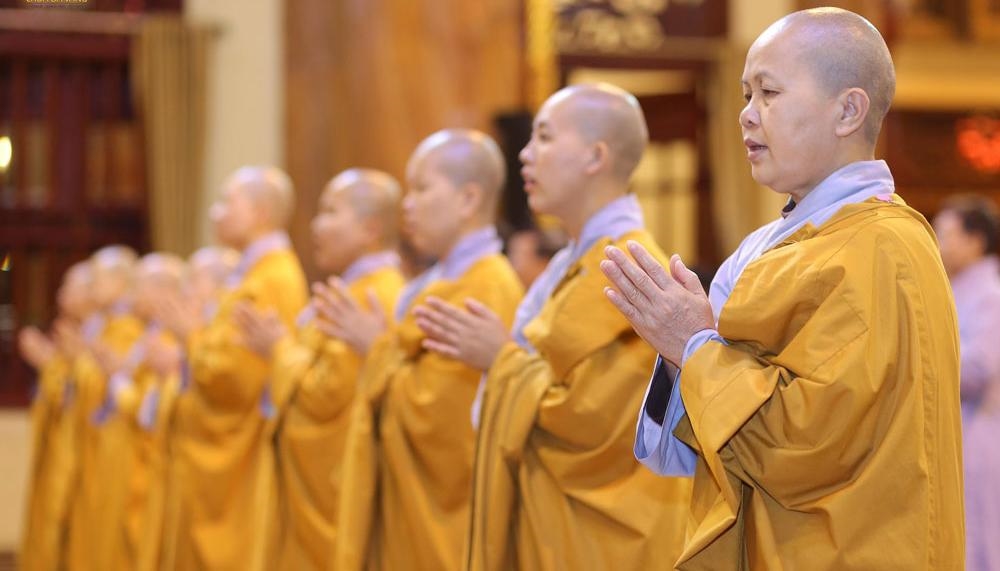 When performing prostrations, a Buddhist presses their palms together, symbolizing single-mindedness
In short, the phrase “the nature of the one who bows and the one being bowed to is empty and still” means that the essential nature of both the person bowing and the object of reverence is equally tranquil and void. The true nature of all phenomena manifests equally and without distinction; there is no perception of a self who is bowing or of another being to whom one is bowing. If, while performing prostrations, the mind remains entangled in the slightest expectation or dwells even fleetingly on thoughts of one's ancestral lineage, however fine as a single strand of silk, it is not in accordance with the proper practice. The mind must remain in a state of purity and stillness.
Vietnamese Buddhism has practiced this form of prostration since ancient times, indeed, it is hard to imagine a practice more profound in meaning or more perfectly aligned with the principles of Prajna (Ly Bat Nha)./.
