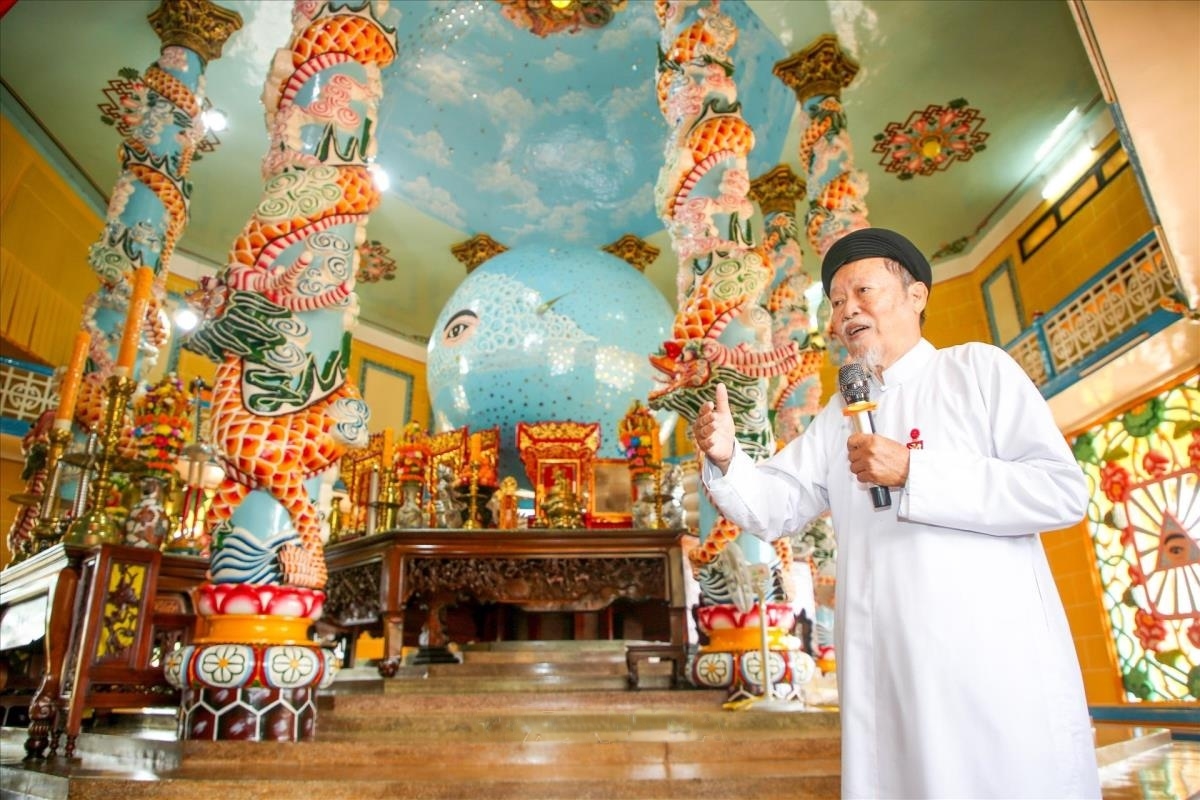
 The veneration of figures from various religions within Cao Dai religion reflects an open, harmonious nature and the philosophy that "all religions return to a single source
Keywords: Cao Dai religion; The Three Teachings share a common origin; One-fifth; World-renowned figures; Southern Vietnamese Culture.
1. Introduction
During the early decades of the 20th century, in the Southern region of Vietnam, then under French colonial rule, Western culture swept in like a whirlwind, clashing violently with the foundations of traditional Eastern culture that had been deeply rooted for thousands of years. The people of Southern Vietnam found themselves in a state of bewilderment, seeking a spiritual anchor that could both preserve their national identity and remain inclusive enough to embrace new, globally-oriented values. It was within this specific historical and psychological landscape that, in 1926, the Cao Dai faith, officially known as The Great Faith for the Third Universal Redemption was formally inaugurated. From its very inception, the Cao Dai faith has harbored a grand aspiration: to unite all the world’s religions and human ideologies back to a single, common source.
The philosophy of Cao Dai represents an unprecedented, large-scale synthesis, unfolding along two dimensions: vertical and horizontal. Vertically, it entails a profound integration of the “Three Teachings” of the East - Buddhism, Taoism and Confucianism, all of which have long been intertwined with the history of Vietnam. In a horizontal dimension, this represents an expansion of scope to embrace and honor great figures, philosophers, scientists, and cultural luminaries from both the West and the East, incorporating them into its own system of thought and pantheon. It constitutes a coherent philosophical framework that reflects the profound cosmological and anthropological perspectives of the Vietnamese people in an era of global cultural exchange.
2. The Synthesis of Buddhism, Taoism and Confucianism
According to Cao Dai philosophy, the founders of other religions such as Gautama Buddha, Laozi, Confucius, and Jesus Christ are all Saints, Immortals, or Buddhas who were appointed by the Supreme Being to descend into various regions of the world to establish religious traditions. The core of Cao Dai doctrine is founded upon the principle: “The Three Religions share a common origin; the five branches of spiritual evolution converge into one”.
Firstly, the Buddhist element
In the Cao Dai philosophical system, Buddhism occupies a supreme position at the upper level of spiritual structure. The image of Shakyamuni Buddha is worshiped in a solemn position on the Heavenly Table, representing the Buddhist path, the highest step in the Five Branches of the Great Path (Humanity, Shinto, Holy Path, Immortal Path, Buddha Path).
About the view of life and the universe, Cao Dai religion deeply absorbed the thought of the law of Cause and Effect and Karma. People born in the physical world are under the influence of previous shields (karma from previous lives). The purpose of practicing in Cao Dai religion is to liberate the soul from the cycle of reincarnation and return to the eternal spiritual realm.
About its spiritual practice, Cao Dai religion divides the path of cultivation into two stages: the “Lower Vehicle” and the “Higher Vehicle” . In the Higher Vehicle - a stage focused on meditative refinement, the Zen Buddhist concept of “perceiving one’s true nature to attain Buddhahood” and the philosophy of the “oneness of all things” (as found in the Avatamsaka Sutra) are thoroughly applied. Through meditation referred to as “refining the Way” or “stilling the mind”, Cao Dai practitioners seek to rediscover their true, pristine nature, coming to the realization that the human spirit is, in essence, a fragment- a small portion of the very essence of the Supreme Being.
About its scriptures and language, the canonical corpus of Cao Dai most notably the Prayers for the Heavenly Way and the Worldly Way, incorporates a wide array of Buddhist terms, such as “Western Paradise”, prajna , samsara (reincarnation/cycle of rebirth), sharira (relics), wu-wei (non-action or effortless action) and “great loving-kindness and great compassion”. This integration is so seamless that Cao Dai religion followers, in their daily recitation of these prayers, are naturally imbued with a spirit of compassion and an orientation toward goodness.
Secondly, the Taoist element
While Buddhism defines the ultimate goal of liberation, Taoism provides the structural foundation for the entire system of cosmology, rituals and esoteric practices within Cao Dai. Laozi (Tai Shang Dao Zu) is revered as the founder of the “Way of the Immortals” (Taoism) within the Cao Dai system.
About its cosmology and the symbol of the Divine Eye, the most distinctive feature of Caodaism is the worship of God through the emblem of a single left eye, the Divine Eye. This serves as a concrete manifestation of the Taoist concept concerning the nature of the universe. Before the existence of heaven and earth, the universe was a chaotic mass known as the Primordial Void. From this realm of the Infinite, a stream of primordial light emerges, this is the Supreme Divine Principle (Taiji). The Supreme Divine Principle gives rise to the Duality (Yin and Yang). The interplay of Yin and Yang generates the Four Phenomena, the Eight Trigrams, and all things in existence. The Divine Eye represents this Supreme Divine Principle, symbolizing a vision that penetrates the entire cosmos; furthermore, since the human spirit resides within the eyes, the veneration of the Eye is an act of honoring the sacred spirit of the universe as well as the spirit within the human being. About its organizational structure which encompasses both the manifest (tangible) and the unmanifest (intangible) realms, the Cao Dai church integrates the rigorous, structured approach characteristic of the West with the mystical traditions of Taoism. Its supreme legislative and spiritual body, the(Heavenly Alliance Palace, operates through a mechanism of communion with the invisible realm, facilitated by the practice of cau co, a form of spirit-writing or automatic writing. The mechanism of communication via planchette writing is a method for conveying religious teachings that is characteristic of the Cao Dai faith. While it may seem mystical to some readers, Cao Dai followers believe this method serves as a means to receive messages from the invisible realm.
About the practice of internal alchemy (neidan), advanced Cao Dai practitioners engage in the “unification of Essence, Energy, and Spirit” (jing-qi-shen) - a meditative method characteristic of the Taoist tradition. Adhering to a lifelong vegetarian diet and observing the five precepts serves not only to avoid negative karma (as in Buddhism) but also to purify the body and maintain the pristine quality of one’s vital energy (qi). This facilitates the cultivation of qigong and the gestation of a “sacred embryo”, enabling the soul to depart from the physical body upon returning to the divine realm.
Thirdly, the Confucian element
While Buddhism looks upward toward the transcendental realm and Taoism turns inward toward the essence of nature, Confucianism serves as the ethical foundation guiding the daily conduct of Cao Dai followers in their relationships with family and society. Confucius (Kongzi) is the revered master who represents this Path of the Sages.
About its philosophy of worldly engagement and humanism, the Cao Dai faith stipulates quite clearly that before one can attain the status of an Immortal or a Buddha (fulfilling the Heavenly Way), one must first complete one’s duties as a human being in this world (fulfilling the Human Way). The Human Way in Cao Dai religion is a direct continuation of the Confucian ethical system, adapted to suit the modern era. It encompasses an individual’s obligations within social relationships, specifically the Three Bonds (ruler and subject, father and child, husband and wife reinterpreted as responsibilities toward the nation, parents, and one’s spouse) and the Five Constant Virtues (benevolence, righteousness, propriety, wisdom and trustworthiness).
 The veneration of figures from various religions within Cao Dai religion reflects an open, harmonious nature and the philosophy that "all religions return to a single source - Sự thờ phượng các nhân vật từ nhiều tôn giáo khác nhau của đạo Cao Đài thể hiện tính mở, hòa hợp, và triết lý “vạn giáo quy nguyên” (mọi tôn giáo đều trở về nguồn gốc)
About the structure of the Church, the administrative system of Cao Dai religion is known as the Nine-Ranked Palace. It consists of nine hierarchical levels ranging from believer and lay official to junior initiate (in Caodaism), church members, professor, associate master, head monk and palm techniques, culminating in the Pope. This nine-tiered structure is modeled after the nine-rank bureaucratic system of traditional feudal Confucian society, reflecting the order, hierarchy and transparency inherent in Confucian political philosophy.
About practical ethics, Cao Dai followers live within the secular world rather than withdrawing from it. They pursue careers, engage in business, participate in social activities, and raise their children guided by the Confucian principle of “revering Heaven and loving humanity”. The motto “A glorious nation, a radiant Faith” encapsulates the traditional Confucian ideals of loyalty to the sovereign and love for one's country values that, in the modern context, manifest as patriotism and the fulfillment of civic duties.
Fourthly, a systematic, organic integration
The synthesis of the Three Teachings within Cao Dai is not a disjointed patchwork of ideas. The Cao Dai scripture the Three Teachings Returning to the One Source) encapsulates this as follows: “The Compassionate Mother Buddha delivers all sentient beings; Laozi brings purity to all living things; Confucius establishes the moral order to bring peace to the world, thus, the Three Teachings return to a single source, illuminating the one underlying Truth”.
Cao Dai religion views these three religions as three facets of a multifaceted whole, three stages or dimensions of a complete process of spiritual evolution. Confucianism addresses the foundation (the way of being human), Taoism concerns the body (harmony with nature and the universe) and Buddhism focuses on the culmination or fruit (ultimate liberation). Without Confucianism, one cannot establish oneself in life; without Taoism, one cannot comprehend the mysteries of Heaven or the laws of the universe; without Buddhism, one cannot attain the profound loving-kindness and compassion necessary for liberation. This constitutes a consistent, systematic framework that integrates the Three Teachings into a single, organic whole, serving the salvation of humanity during the Third Era.
3. The integration of world-renowned figures
The integration of world-renowned figures such as Victor Hugo, Sun Yat-sen and Nguyen Binh Khiem into the Cao Dai pantheon and doctrine is not merely a pragmatic approach to syncretism, but rather a coherent philosophical system.
Firstly, Western great figures
At the Tay Ninh Holy See, right at the main entrance, one can admire the renowned painting titled the Three Saints Signing a Peace Treaty. The artwork depicts three great figures drafting a peace treaty between humanity and God. The three figures are: Trạng Trình Nguyễn Bỉnh Khiêm (representing Vietnam, Eastern medicine, and Eastern philosophy), Sun Yat-sen (representing China and progressive revolutionary thought in Asia) and Victor Hugo (the renowned French writer, representing the West).
In Cao Dai religion thought, Victor Hugo recognized as a high-ranking dignitary is regarded not merely as a great writer, but as the true spirit of a Saint (Nguyet Tam Chan Nhon) who incarnated in France to disseminate ideals of universal love freedom, and equality, values that resonate with the compassion found in Buddhism and the humaneness and righteousness central to Confucianism. Through spirit-writing (séances), the spirit of Victor Hugo communicated numerous poems in both French and Vietnamese to elucidate the philosophy of universal harmony and to provide guidance to the early Cao Dai dignitaries on establishing the religion’s organizational structure. This honoring of Hugo reflects a remarkably progressive cultural outlook on the part of the founders of Cao Dai religion. They drew a clear distinction between the French colonial invaders and the great, humanistic French culture. They embraced the pinnacles of French culture to enrich their own religious philosophy.
Joan of Arc - a French national heroine who is also honored within the Cao Dai pantheon is regarded as a symbol of fervent patriotism, indomitable will and guidance by divine faith.
Through the practice of spirit writing, Western scientists and philosophers such as Isaac Newton, Louis Pasteur, René Descartes, Socrates, and Plato have also made appearances. The Cao Dai philosophy posits that the scientific discoveries of figures like Newton or Pasteur were not mere coincidences; rather, they were revelations of divine providence, bestowed by God upon these great souls to advance the material and intellectual evolution of humanity. Science and religion are not in conflict; science explores the visible world (the body of the universe), while religion explores the invisible world (the soul of the universe). Both converge upon the ultimate truth.
Secondly, the great figures of the East
Alongside prominent Western figures, the Cao Dai faith also incorporates individuals who have exerted a significant influence on the course of history and thought in the modern East.
Sun Yat-sen (Sun Yat-sen), the great Chinese revolutionary, proponent of the Three Peoples doctrine (Independent people, Freedom of the people, Happiness of the people). Cao Dai religion has absorbed this doctrine of the Three Peoples and spiritualized it as part of the church's mission, bringing freedom, equality and prosperity to sentient beings.
Within the Cao Dai pantheon, Sun Yat-sen represents a movement toward reform aimed at dismantling corrupt feudal structures to build a fair, progressive society, while still preserving the foundations of Eastern morality.
Nguyen Binh Khiem (Trang Trinh) was a great 16th century Vietnamese philosopher and prophet. He is revered as the Thanh Son Dao Si (a spiritual mentor within the Cao Dai movement). His philosophy of leisure and alignment with the natural order steeped in the traditions of Laozi and Zhuangzi combined with a profound concern for the nation and its people (rooted in Confucianism), has become an ideal model for the conduct of Cao Dai religion dignitaries: living a life of noble detachment and deep insight into the workings of the universe, yet remaining steadfastly committed to serving humanity.
Thirdly, the philosophical significance of incorporating world-renowned figures
Incorporating world-renowned historical figures into the pantheon is not merely a superficial ploy to attract followers; rather, it embodies profound philosophical messages.
About the realization of the ideal of universal harmony (Dai dong), Cao Dai religion demonstrates that God does not belong exclusively to any single nation, religion, or culture. The finest achievements of humanity whether manifested through literature (Hugo), science (Newton), politics (Sun Yat-sen), or philosophy (Socrates) are all rays emanating from the great divine light of God. They are all brothers and sisters within one grand spiritual family.
As a form of spiritual decolonization that emerged during the colonial era, the Cao Dai tradition’s act of “sanctifying” Western figures placed Vietnamese culture on an equal footing with Western culture, enabling a balanced dialogue between the two. The Vietnamese people no longer passively absorb Western culture from a position of subjugation; instead, they actively select and embrace the most humanistic Western values, integrating them into their own spiritual framework. This represents an ideological revolution with a profound national character.
4. The humanistic value of the syncretic philosophy of Cao Dai religion
Firstly, the aspiration for peace and interreligious dialogue
The philosophy of Cao Dai religion serves as an earnest call for harmony and mutual understanding among cultures. By asserting that “all religions share a single truth”, Cao Dai religion strikes at the very root of religious exclusivism, the underlying cause of countless bloody conflicts throughout human history. The religious intuition of the founders of Cao Dai a century ago aligns with the trend of “interreligious dialogue” that international organizations, such as the United Nations, are currently striving to promote.
Secondly, the harmony between science, the humanities, and spirituality
The fact that Cao Dai religion honors Western scientists alongside Eastern spiritual sages and philosophers offers an important insight for the development of modern humanity. Today, people lean too heavily toward the advancement of science and technology while neglecting the spiritual realm, a state that leads to emptiness, depression and a loss of direction. The philosophy of Cao Dai religion establishes a worldview in which science explores natural laws to serve daily life; the humanities encompassing literature and the arts enrich the human soul; and spirituality provides moral guidance, anchoring humanity to eternal values. This represents a comprehensive and sustainable development for humankind.
Thirdly, Vietnamese cultural identity
Cao Dai religion stands as a powerful testament to the cultural creativity and intellectual fortitude of the Vietnamese people. Faced with a wave of Western cultural encroachment, the Vietnamese did not retreat into self-deprecating isolation, nor did they succumb to assimilation that would have stripped them of their roots. They carried out a remarkable process of internalization, blending foreign cultural elements such as French literature, the Chinese Revolution, Christianity and Western Spiritualism with the core of indigenous culture including the Three Teaching (Buddhism, Taoism, and Confucianism), the worship of the Mother Goddesses, and the traditional ethic of “remembering the source when drinking water” (gratitude toward one’s origins). Through this synthesis, they created a new religion that possesses an international structure while remaining deeply imbued with the Vietnamese spirit.
5. Conclusion
The philosophy of Cao Dai is a grand mosaic, in which every element whether it be the compassion of the Buddha, the wu-wei (non-action) of Laozi, the doctrine of the "Golden Mean" of Confucius, the humanistic writings of Victor Hugo, or the progressive ideas of Sun Yat-sen is placed precisely where it belongs, collectively enhancing a shared vision of universal harmony and benevolence. This synthesis of Buddhism, Taoism and Confucianism, alongside the contributions of great global figures has been vividly embodied in the daily lives of millions of Cao Dai religion followers for the past century. Having weathered the ups and downs of history, this unique system of doctrine retains its enduring contemporary value. It contributes to the treasury of human thought a model of religious synthesis imbued with deep humanism, a spiritual bridge connecting East and West, past and present, all while pointing toward a future for humanity that is peaceful, prosperous and characterized by universal harmony.
References
1. Nguyen Trung Hau (Bao Phap), An Introductory Explanation of the Third Universal Redemption, Tay Ninh: Tay Ninh Holy See, 1956.
2. Dong Tan, History of the Cao Dai Faith: The Founding and Revelation of the Great Way, Saigon: Cao Hiên Publishing, 1974.
3. Cao Dai Church of Tay Ninh, Scriptures of the Heavenly Way and the Worldly Way, Tay Ninh: Church Publishing Department (reprint), 1972.
4. Nguyen Hong Duong, Religion in the Context of Culture and Development in Vietnam, Social Sciences Publishing House, Hanoi, 2005.
5. Nguyen Van Hong, Cao Dai Dictionary, for internal circulation among overseas Cao Đài followers, 2001.
6. Tran Van Giàu, The Development of Thought in Vietnam from the 19th century to the August Revolution, Vol. II, Social Sciences Publishing House, Hanoi, 1973.
