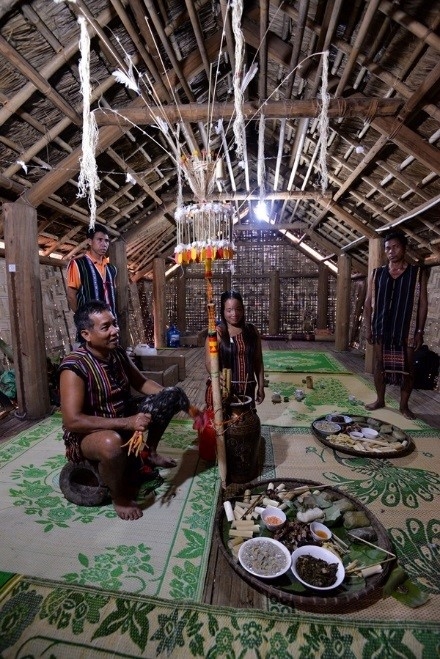
 The shaman performs the ritual during the Thanksgiving Ceremony to the Forest God
Keywords: Ma people; Thanksgiving ceremony to the Forest God; Traditional beliefs; Promoting cultural heritage.
1. Introduction
In the overall culture of ethnic minorities in Vietnam, folk beliefs play a particularly important role in shaping, maintaining and expressing the cultural identity of each ethnic group. Beyond reflecting worldviews and philosophies of life, forms of belief also profoundly influence social norms, customary laws and the way people interact with the natural environment. In many local communities, beliefs do not exist as a separate system, but are organically intertwined with daily life, from agricultural production and community organization to the relationship between humans and the forest and natural elements.
For the Ma people in Cat Tien commune, Lam Dong province, the forest holds a central position in their socio-economic and spiritual life. Forests are not only spaces for survival, providing essential resources, but also sacred spaces, the dwelling places of gods (Yang), especially the Forest God. In the traditional belief system of the Ma people, rituals related to the forest, most notably the thanksgiving ceremony to the Forest God, hold significant meaning in praying for peace and a good harvest, at the same time also expressing people’s respect and gratitude towards nature.
Through the ritual of giving thanks to the Forest God, the Ma community reaffirms the harmonious relationship between humans and the forest, while also strengthening the conventions and customs related to the exploitation, protection and preservation of the forest. Rituals not only serve a spiritual function but also play a role in regulating society, contributing to maintaining community order and transmitting local cultural knowledge through generations.
However, in the current context, under the impact of socio-economic development, environmental changes and changes in livelihoods, the traditional cultural and religious space of the Ma people, including rituals associated with the forest is facing many challenges. Some religious practices are at risk of shrinking, simplifying, or changing, leading to the erosion of local knowledge and traditional cultural values.
Based on this reality, studying the Ma people’s ritual of giving thanks to the Forest God is of significant importance not only in identifying and preserving the ethnic group’s cultural heritage, but also in contributing to clarifying the indigenous knowledge system and patterns of harmonious interaction with the forest. Thus, the research provides useful scientific arguments for cultural preservation, environmental protection, and sustainable development in the Southern Central Highlands region in general and Lam Dong province in particular.
2. Research result
2.1. Thanksgiving to the Forest God (Yang Bri)
For the Ma people, the forest is not only their living space and primary source of livelihood, but also a sacred entity, intimately connected to their spiritual life and traditional belief system. Throughout their history of settlement, exploration and adaptation to the natural environment, the Ma people have accumulated a rich treasure of folk knowledge, forming a sustainable “forest consciousness” that governs their interaction with nature. It is from this foundation that the system of rituals related to the forest, typified by the ritual of worshipping the Forest God (Yang Bri), was born and has been maintained as an important pillar in the cultural and spiritual life of the Ma people.
According to traditional beliefs, the Ma people classify forests into different types, each associated with its own ecological function, spiritual significance and behavioral rules, which are clearly reflected in customary law. The types of forests include: Yang forest (sacred forest), Krong forest (old-growth forest), Glong forest, Khop forest (burial forest), Rlau Goe forest and Sar forest. Among them, Yang Forest is considered the most sacred space - the dwelling place of deities with the power to influence community life. Krong Forest, although smaller in scale is often associated with legends of gods who govern a specific area. The Khop forest is a burial ground for the dead, located far from residential areas, with many ancient trees and holds deep spiritual significance. These forests are strictly protected by the community, prohibiting cultivation or logging, and are only used for necessary religious rituals.
Conversely, the Rlau Goe and Sar forests are forest spaces that directly serve livelihoods. Sar forests are mainly used for farming, growing rice and crops; Fields are usually cultivated in cycles, after about three years the land is left to rest before continuing to exploit. The Rlau Goe forest is quite large, with not overly dense vegetation, and borders sacred forests, its exploitation is governed by strict regulations to avoid encroaching on sacred spaces. The customary law of the Ma people clearly defines this boundary, ensuring both livelihood needs and maintaining a balance between humans and nature.
In the belief system associated with the forest, the ritual of worshipping the Forest God (Yang Bri, also known as Vri) holds a particularly important position. This is a highly communal ritual, usually held periodically at least every five years, and in some places even every twenty or thirty years, depending on the economic conditions and circumstances of each bon (village). The purpose of the ceremony is to give thanks to the Forest God for protecting and safeguarding the community, and to pray for continued blessings from the deities, ensuring peaceful lives, bountiful harvests and unity within the village.
Preparations for the Forest God worship ceremony are extremely elaborate. One to two months before the ceremony, representatives of the clans (nao) meet to discuss, agree on the time and place and assign specific tasks. The ceremonial space is usually chosen at the edge of a sacred forest, where the human world meets the spiritual world. Here, the Ma people build stilt houses for rituals, erect large ceremonial poles (Ndal) and posts for tying sacrificial buffaloes (Ko nong rơpu), the number depending on the scale of the ceremony and the community’s resources. The offerings included a sacrificial buffalo, rice wine, traditional cakes and poultry such as chickens and ducks, whose blood was used in the ceremony. The village elder plays a central role in the ritual, presiding over the ceremonies, directly invoking and communicating with the spirits. The Forest God worship ceremony usually lasts for seven days, with the full participation of all members of the community.
Besides the large-scale rituals honoring the Forest God, in their daily lives and production activities, the Ma people also practice many smaller rituals related to the forest, especially during the rice cultivation cycle. From the stage of selecting fields, clearing, burning fields, sowing seeds, flowering rice to harvesting, each stage is associated with crop worship ceremonies, mainly organized by each family. When exploiting the Rlau Goe forest for firewood or hunting, the Ma people adhere to strict conventions such as not cutting down trees completely, leaving young trees for regeneration and asking permission from the spirits before hunting.
It can be seen that the ritual of worshipping the Forest God not only reflects the worldview and philosophy of life of the Ma people, but also serves as an effective cultural mechanism contributing to regulating the exploitation of forest resources, protecting the ecological environment and strengthening community cohesion.
2.2. The ritual of worshipping the Mountain God (Yang Bo nom, Vi nom)
In the traditional belief system of the Ma people, the Krong forest is associated with the concept of deities governing the land of each clan (nao) or each village community (bon). Some mountains are chosen by the Ma ethnic community as sites for rituals worshipping the Mountain God, such as Nao Ut (Water Pond), Luc Mo (Luc/Stone), Lah Nhal, Dang Kia… These are all sacred spaces, connected to the history of settlement, the process of village formation and are considered places where deities manifest and protect the community.
Traditionally, the Mountain God worship ceremony is held annually, presided over by the village elder, with the full participation of all village members. The main purpose of the ritual is to pray for divine protection so that the village can reside stably and permanently, the people can live in peace, farming and forestry can proceed smoothly without disaster. Through this ritual, the Ma community expresses their gratitude to the Mountain God - the deity considered to be the guardian of the village’s living space and social order.
The ceremony is usually held at the foot of a mountain, considered the sacred boundary between the human world and the spirit world. The rituals last for a full day, focusing on key ceremonies. Preparations were meticulously carried out, including building a small stilt house, erecting a ceremonial pole and preparing offerings such as rice wine, bamboo-cooked rice, traditional cakes and sacrificial meat. Depending on the economic conditions of each village, the ritual may involve sacrificing a buffalo or using other livestock, poultry.
The ceremony is usually held around February or March in the lunar calendar, when the Ma people have finished harvesting their crops and are able to gather in large numbers to participate in the ritual. The rituals are performed around the ceremonial pole under the guidance of the village elder. The elder performs the main rituals such as reciting prayers, offering gifts and giving thanks to the deities. Part of the sacrifice's blood is applied to the tree stump or ground, wine is poured onto the ground as a form of direct communication with the Mountain God, showing respect and asking for protection.
After the sacrificial ritual is complete, the sacrificial animal is butchered and prepared along with other dishes for the community to enjoy. Activities such as bonfires, eating, singing and dancing take place in a joyful and unifying atmosphere. The ritual not only has spiritual significance but also a clear social function, contributing to strengthening community cohesion and reminding villagers of their shared responsibility in protecting their living space and the forest environment.
Therefore, the core elements of the ritual are still maintained, demonstrating the Ma people’s enduring respect and belief in deities in contemporary spiritual life.
2.3. Water-blessing ceremony (Yang Dah)
In the Ma people’s residential and agricultural life, water resource plays a particularly important role, closely linked to the community's existence and development. The selection of locations for establishing villages always prioritizes water resources to ensure essential needs for daily life and production. Therefore, rivers, streams, ponds, and lakes in residential and agricultural areas are not only natural resources but also considered common property of the community, subject to strict management and protection according to traditional customary law.
In Cat Tien commune, where the Ma people live, the natural water source system is quite abundant. In addition to rainwater, the community extracts water from rivers, streams, ponds, and lakes for daily life, livestock farming and agricultural production. In order to protect their shared water source, the Ma people strictly prohibit acts of deforestation in the headwaters and pollution of the water flow. The customary law of the Ma people clearly defines the division of water areas for different purposes such as drinking water, domestic water and water for livestock. Violations are severely punished according to customary law, not only as a deterrent but also to restore order and harmony in the relationship between humans and the deities who govern the water sources.
In traditional belief systems, the Water God (Yang Dah) is considered the patron deity of the village’s water sources. The water-worshiping ceremony is held to express gratitude to the deities for providing clean water, and to pray for protection to help the community avoid diseases, natural disasters and risks in daily life and production. During the ceremony, the village elder - the representative of the community goes from house to house performing the preliminary rituals, carrying a chicken as an offering up the stairs, symbolizing blessings and bringing good fortune to each family. Afterward, the entire village gathered at the chosen water source to perform the main ceremony in the presence of the community.
At the water’s edge, the village elder performs a ritual to pray to the Water God, offering gifts and seeking permission from the deities. The blood of chickens and ducks is used in the sacrifice, wine is poured onto the ground and the water as a form of sacred communication, expressing reverence and gratitude to the Water God. This ceremony is both spiritual in nature and an opportunity for the community to reaffirm common conventions regarding the use and protection of water resources.
In the current context, the Ma people’s ritual of worshipping the Water God has been revived, but it is no longer held as frequently as before. In some localities, such as Ta Lai commune (Dong Nai province), the community still maintains the custom of worshipping the Water God at sacred places such as Mu Dong wharf, Lieng waterfall and the Dong Nai River. The ceremony is usually held in the spring, with sacrificial offerings such as chickens, ducks and pigs. The blood of the sacrificial animal is smeared on stones and trees at the water’s edge, a portion of the flesh and blood is released into the water with the hope that the gods will grant abundant, clean water, plentiful fish and protection from disease for the community.
Nowadays, rituals dedicated to the Water God are usually organized on a smaller scale, with simplified ceremonies and fewer participants than before. Following the main ceremony led by community representatives, traditional festival activities such as singing, dancing and playing by the water are gradually replaced by more modern forms of entertainment. Young people are using traditional folk melodies less often and are turning to new forms of artistic performance.
Despite many changes, the water-worshiping ceremony clearly reflects the polytheistic beliefs and humane way the Ma people treat the natural environment. This is not only a spiritual ritual but also a mechanism for community cohesion, educating awareness of water resource protection and preserving harmony between humans and nature. Therefore, the preservation and restoration of the water-worshiping ceremony in the current context needs to be placed in a harmonious relationship between tradition and modernity, in order to preserve the core values of Ma culture in contemporary life.
3. Conclusion
In their traditional beliefs, the Ma people believe in a system of deities that govern the forests, mountains and water - these environmental elements are closely linked to their dwellings and livelihoods. The rituals practiced by the Ma people in relation to the system of spirits connected to resources (forests, mountains, land, and water sources) create a unique cultural way of interacting with the environment. Currently, in the work of preserving the cultural heritage of the ethnic group, some Ma villages in Cat Tien commune have restored traditional rituals. Despite variations, these rituals are significant in raising awareness about protecting the natural environment and natural resources. The religious practices of the Ma people are not merely rituals but also reflect their awareness of preserving and maintaining their cultural heritage and living environment, demonstrating a progressive relationship with nature and a focus on community benefit.
References
1. Bich Ngo (2018), Water worship ceremony - A beautiful cultural and spiritual feature of the ethnic groups of the Central Highlands.
2. Huynh Van Toi, Lam Nhan, Phan Dinh Dung (2013), Ma ethnic culture, Culture and Information Publishing House, Hanoi.
3. Mac Duong (1983), Ethnic issues in Lam Dong province, Lam Dong Department of Culture and Information.
4. Institute of Ethnology (1984), Ethnic minorities in Vietnam (Southern Provinces), Social Sciences Publishing House, Hanoi.
5. Nguyen Thi Thanh Xuan (2013), On the establishment of genderconsciousness and feminism in traditional Vietnamese literature, Journal ofEducation and Society.
