Keywords: Khmer people; Khmer Theravada Buddhism; Ethnic and religious policies; Southwestern region; Refuting distorted narratives; National unity.
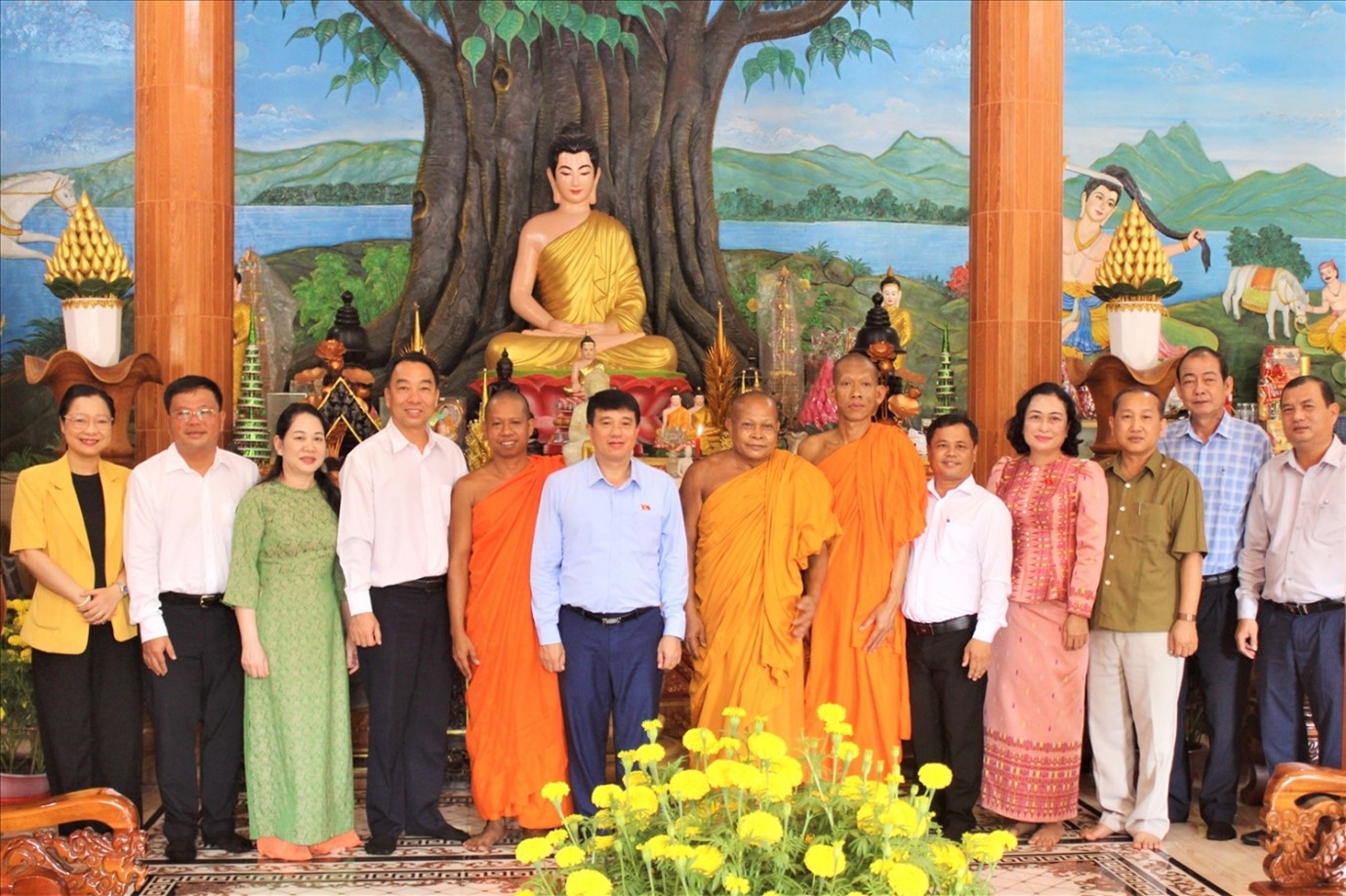 Chairman of the National Assembly’s Ethnic Council Y Thanh Ha Nie Kdam and Deputy Minister of Ethnic Minorities and Religion Nong Thi Ha, along with leaders of Vinh Long province, visited and extended congratulations to the abbots, senior monks and Buddhist clergy of the Khmer Theravada tradition on the occasion of the Chol Chnam Thmay New Year 2025
1. An overview of the Khmer people and Khmer Theravada Buddhism
The Khmer people are one of the 54 ethnic groups in the Vietnamese national community and have long lived in the southern region of our country, with approximately 1.3 million people, accounting for over 7% of the population. The main religion of the Khmer people in southwestern Vietnam is Theravada Buddhism. This religion is closely intertwined with the spiritual and cultural life of the Khmer people, as evidenced by their customs, festivals and worldview from birth to death. Throughout history, Theravada Buddhism has taken on distinctive characteristics that reflect the spiritual and cultural identity of the Khmer people, creating a unique identity that is difficult to confuse with the culture of any other ethnic group.
However, due to various reasons, the socio-economic development of the region remains slow, and the lives of the Khmer people are still fraught with difficulties; The grassroots political system is not yet truly strong; many pressing social issues have not been resolved promptly and decisively. Taking advantage of these difficulties, forces hostile to Vietnam, extremist groups and organizations among the Khmer exiles, especially the “Khmer Krom Federation” (KKF), have been carrying out various activities exploiting religious and ethnic issues in areas with large Khmer populations to oppose the Party and the State with many sophisticated and insidious schemes and tactics.
The main activity carried out by these individuals is to spread distorted information about the history of the Southwestern region of Vietnam and the economic, social, human rights, religious freedom situation in the Khmer area; and to falsely accuse Vietnam of suppressing and discriminating against the “Khmer Krom” people; Distorting the United Nations Declaration on the Rights of Indigenous Peoples, claiming that the Declaration is a “historical milestone” and “legal basis” for “local Khmer Krom” to rise up for independence, in order to incite narrow-minded nationalism, separatism, conspiring to establish the so-called “Khmer Kampuchia Krom State”.
Taking advantage of the close and enduring relationship between Theravada Buddhism and the lives of the Khmer people, these individuals also sought to organize activities to separate Khmer Theravada Buddhism from the Vietnam Buddhist Sangha, making it an “independent” sect, considering it the ideology for an “independent and autonomous Khmer Kampuchia Krom state”; At the same time, they spread distorted propaganda about the policies of the Party and the State, falsely accusing Vietnam of suppressing Khmer Theravada Buddhism, preventing Khmer people from practicing rituals, receiving training and freely engaging in religious activities… with the aim of inciting feelings of “national inferiority”. Recently, taking advantage of sensitive issues related to social conflicts and disputes over land, religion, ethnicity,… these individuals sought to distort the truth, misrepresent, and exaggerate the events, claiming it was an “injustice” against the Khmer Krom people, a violation of the principles of the United Nations Charter and calling on international human rights organizations to monitor and intervene, creating a trend of discontent among Khmer monks and Buddhists.
The aforementioned issues are identified as a form of ideological propaganda aimed at undermining ethnic minority communities, creating a basis for social stratification, gathering gullible and naive individuals with extremist views to form disguised groups, waiting for opportunities to incite the masses to revolt, carry out activities that disrupt security and order, cause riots in order to overthrow the government. From 2007 to the present, several disguised groups related to Khmer Theravada Buddhism have been observed in the southwestern provinces of Vietnam, such as: “Khmer Monks Association of Tra Vinh Province - UKS”; “Khmer Buddhist and Cultural Support Association of Tra Cu district”; “Jasmine Wreath Monks Association”…
2. Policies and guidelines of the Party and State towards the Khmer people
Based on a consistent viewpoint on national unity and the guarantee of freedom of belief and religion, the Party and the State have formulated many appropriate policies and guidelines to care for and improve the material and spiritual lives of the Khmer people. In practice, contrary to the distorted narratives propagated by those who spread misinformation, throughout history, the Khmer people have always been united and closely connected with the Kinh people and other ethnic groups in building and protecting their homeland. This is an important factor contributing to the successful implementation of the Party and Stat’s policy of national unity. Along with the reform process, the Party, State, and Government have issued many innovative guidelines and policies on ethnic and religious affairs in ethnic minority areas in general, the Khmer ethnic group practicing Theravada Buddhism in particular. These policies and guidelines have been implemented consistently and synchronously, demonstrating the superiority and special attention given by the Party and State to the Khmer people regarding religious and ethnic policies. Specifically:
The consistent policy of our Party and State is to always respect, guarantee and care for the freedom of religion and belief for the Khmer people. In order to meet the learning and training needs of religious leaders and monks, the State has also facilitated the construction of a Pali Intermediate School and the opening of a Khmer Theravada Buddhist Academy, providing Khmer Theravada Buddhist monks with favorable conditions to study Buddhist doctrines, precepts and learn the Pali language. Furthermore, at the Buddhist vocational school, depending on the abilities and needs of local Buddhists, the Buddhist Association also organizes cultural training, helping those who have left monastic life to acquire knowledge about society and actively participate in the construction and development of the local economy and culture.
As religious dignitaries, Khmer Theravada Buddhist monks and nuns are both the “steers” of the church and sect, and the guides of the followers’ thoughts. Therefore, they are considered part of the nation's intellectual elite, consequently, the training, nurturing and development of religious leaders and the training of successor human resources for Khmer Theravada Buddhism have always received special attention and support from the Party, the State and local authorities at all levels. Currently, there are over 100 Khmer Theravada Buddhist monks pursuing Master’s and Doctoral degrees in Buddhist studies in countries such as Thailand, Cambodia, Myanmar, Sri Lanka and India… Many Khmer Theravada Buddhist monks are studying at universities of social sciences and humanities, majoring in ethnic and religious studies at provincial political schools, English colleges, Southern Khmer Culture colleges, Southern Khmer Language and Literature universities, law universities, information technology universities and journalism schools in Ho Chi Minh City, Can Tho, Tra Vinh,... The printing and distribution of audio and video recordings and religious texts to serve the religious needs of the people also received special attention from the government, with many religious texts being published in the Khmer language within the country.
In some localities such as Vinh Long, Can Tho, Ca Mau, An Giang, the Party committees and authorities have paid attention to guiding, supporting, and coordinating with the Patriotic Buddhist Monks’ Solidarity Association in resolving the legitimate and rightful religious needs of the Khmer people; Proactively assisting Khmer pagodas in engraving seals, serving internal management activities, facilities and assets, thereby bringing joy and trust to the believers. Buddhist and ethnic cultural festivals such as Chol Chnam Thmay, Sene Dolta, Ok Om Bok, Kathina Robe Offering are ensured, contributing to the preservation and promotion of the cultural and traditional values of the Khmer people.
Notably, on November 4th-5th, 2024, the Royal Government of Cambodia selected Xoai Xiem Moi Pagoda (Ngai Xuyen commune, Tra Cu district, former Tra Vinh province) to participate in the Kathina robe offering ceremony, with the attendance of Mrs. Bun Rany, wife of former Cambodian Prime Minister Hun Sen. This program demonstrates the close relationship between Vietnam and Cambodia, therefore, in order to ensure the security and safety of this important event, the local authorities and relevant agencies and departments have exchanged views and reached an agreement with the Royal Cambodian Guard and have received the consent of the Provincial Patriotic Buddhist Monks’ Solidarity Association and the abbot, the Management Board along with the Buddhist followers of Xoai Siem Moi Pagoda, implemented various security measures to ensure order and safety for everyone attending the event.
Recognizing the correct position, role, and special importance of the pagoda to the Khmer ethnic people, and considering it a “cultural heritage”, the Party and State have implemented policies to preserve and promote the role of this religious architectural structure, turning it into a center for community cultural activities and a place for experimentation, application and transfer of science and technology to the people in the villages. Authorities have closely coordinated with local governments to select and rank pagodas as revolutionary historical relics and cultural historical relics. Most Khmer Theravada Buddhist temples have been renovated and are well-maintained, preserving their typical architectural features, they serve as repositories of the distinctive cultural heritage of the Khmer people and meet the religious needs of the community.
In addition, the review and issuance of land use right certificates for religious establishments in general, Khmer Theravada Buddhist pagodas in particular have been basically given attention by localities, implemented in accordance with legal regulations and achieved positive results. The legitimate land needs of Khmer Theravada Buddhism are being considered and addressed, creating reassurance and trust among religious leaders and followers in the leadership of the Party, the State and local authorities. Local authorities have proactively grasped the thoughts and aspirations of monks and Khmer people to promptly advise and propose solutions to Party committees and government authorities, resolving issues in a timely manner and preventing the emergence of complex security and order hotspots, thereby contributing to maintaining security, order and social safety.
The above evidence demonstrates the profound concern of the Party, the State and Party committees and authorities at all levels in consistently implementing ethnic policies and religious freedom policies. This vivid reality once again affirms that the Khmer people in Vietnam are always guaranteed the right to practice their religion, build temples, organize ethnic festivals and participate in Buddhist rituals without hindrance or restriction. The Vietnamese Party and State have always created favorable conditions for the protection and development of religious establishments, from granting construction permits and organizing religious activities to providing financial and human resource support, as a result, many Khmer pagodas have been restored and are thriving.
This objective reality serves as vivid evidence refuting the outdated and obsolete arguments put forth by hostile organizations and individuals who lack goodwill towards Vietnam. However, with their goal of undermining the Party and State's ethnic and religious policies remaining unchanged, in the coming period they will thoroughly employ every tactic to deceive public opinion and incite division within the national unity; the basis and premise for carrying out the plot to exploit religious issues to incite ethnic separatism in the Southwestern region of Vietnam.
Therefore, in addition to proactively improving institutions and policies, agencies, departments and local governments are striving to care for and develop the essential lives of the Khmer people; At the same time, raising public awareness by diversifying forms of propaganda, promoting the role of religious leaders and influential figures in Khmer communities, helping the people to enhance their vigilance, fully recognize conspiracies, tactics and harmful and toxic information; advising people not to believe or listen to contradictory information. On the other hand, it is essential to strengthen national unity, fostering solidarity and trust in the leadership of the Party and the State, creating momentum for the country to advance while fulfilling the task of protecting the national borders in the new era.
3. Conclusion
The vibrant reality of the lives of the Khmer people in Vietnam is the strongest evidence to refute all the distorted and fabricated arguments of hostile forces. The consistent policies of the Party and the State have not only remained on paper but have been profoundly realized in all aspects of life. In the face of separatist and divisive plots by extremist organizations such as the “Khmer Krom League”, the people’s trust in the leadership of the Party and the State is the most solid foundation for maintaining security and order, protecting the borders and leading the country into a new era of development and national reconciliation.
* People’s Security Academy
References
1. Constitution of the Socialist Republic of Vietnam (on the right to freedom of belief and religion).
2. Law on Beliefs and Religions of 2016 (regarding the management, training and use of religious land).
3. Resolution No. 24 of the Politburo, dated October 16th, 1990, “On strengthening religious work in the new situation”.
4. The United Nations Declaration on the Rights of local Peoples (comparison to refute distortions by extremist organizations).
5. Regulations on training of the Khmer Theravada Buddhist Academy and the Pali Intermediate School (regarding the training of religious officials).
6. Documentation on the ranking of historical and cultural relics of Khmer pagodas in Tra Vinh, Soc Trang and Kien Giang provinces.
7. Report on the current activities of the “Khmer Krom Federation” (KKF) and its conspiracy to exploit ethnic and religious issues to undermine the Vietnamese State, www.tapchicongsan.org.vn/web/guest/kinh-te/-/2018/820515/phat-trien-kinh-te---xa-hoi-ben-vung-cho-dong-bao-dan-toc-thieu-so.aspx
