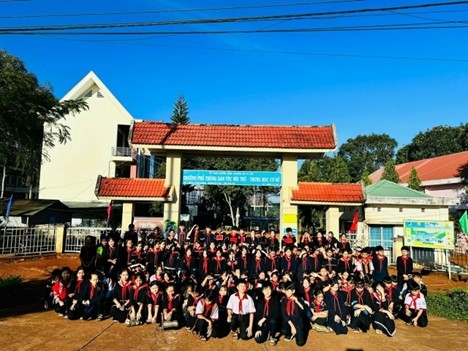
 One of the outstanding policies about the training of human resources from ethnic minorities is the policy of investing in the construction and development of a system of ethnic boarding schools (In the photo: Students of Ea H’leo Ethnic Boarding School, Dak Lak province)
Keywords: Human resources; Ethnic minorities; Education and training; Digital transformation.
1. Human resources and human resources of ethnic minorities
According to the labor economics approach, human resources are understood as the entire population of working age capable of participating in the production of goods and services, including: Physical strength, intellectual capacity, educational level, professional skills and work experience. This understanding emphasizes that people are a type of “capital” and training is an investment that increases the productivity and quality of this capital.
According to the development management approach, human resources are the group of people along with the knowledge, skills, attitudes, motivations and cultural values they bring to the development of the organization and society. This understanding emphasizes that human resources encompass not only labor but also qualities such as discipline, responsibility and creative ability.
From a human development perspective, human resources are a special national resource, encompassing the quantity, structure and quality of the working population, comprehensively developed in terms of intellect, skills, health and ethics, in order to meet the requirements of sustainable socio-economic development.
According to the public administration - state management approach, human resources are the entire labor potential of society, including those currently employed and those capable of participating in the labor force in the future, considered in terms of quantity, quality and structure.
From the above approaches, the human resources of ethnic minorities are understood as the segment of ethnic minority people of working age who are capable of participating in the socio-economic development process, including education level, vocational skills, health, local knowledge, cultural qualities and ability to adapt to the new development environment of digital transformation and economic integration. This approach has added elements of local knowledge and cultural capital, which are unique strengths of ethnic minorities, while allowing ethnic minorities to be viewed not as “beneficiaries”, but as the subject of development.
2. Policies and outcomes of human resource development for ethnic minorities
In the field of development science, human beings are both the goal and the driving force of all growth strategies. If natural resources determine the “starting point”, then the quality of human resources determines the “speed and destination” of a nation. Localities that achieve rapid breakthroughs often do not rely solely on land advantages or investment capital, but rather on the educational level, vocational skills and innovative capacity of their workforce. Therefore, human resource training is essentially the process of accumulating “human capital”. The greater this capital, the higher the labor productivity, the stronger the ability to absorb science and technology and the more competitive the economy becomes. Conversely, where the quality of human resources is low, it is easy to fall into a vicious cycle of poverty, unskilled labor and dependence. Ethnic minority and mountainous areas are currently underdeveloped areas of the country, including the issue of human resource quality. Therefore, training human resources from ethnic minority groups has always been a priority for our Party and State. Many major policies and directions have been set forth for education, training, and human resource development in ethnic minority and mountainous areas, such as: Eradicating illiteracy, universalizing preschool education for 5-year-old children, universalizing primary and lower secondary education; improving the quality of ethnic boarding and semi-boarding schools; supporting learning and living conditions for students in particularly disadvantaged areas; Policies on scholarship programs, preparatory university programs, and vocational training for ethnic minority students; Mechanisms and policies for addressing employment issues for ethnic minority youth after graduation; Support for ethnic minority students in terms of tuition fees, textbooks and ethnic minority language instruction; policies on tuition fee exemption and support, lunch support... have yielded very important results.
Firstly, preschool education and general education in ethnic minority and mountainous areas have had positive changes. The quality of education at boarding schools for ethnic minorities has gradually improved. The number of schools meeting national standards has increased, the system of ethnic boarding and semi-boarding schools has been expanded; equity in access to education has been ensured; the number of students dropping out of school has decreased; consolidating and maintaining the achievements of universal primary and lower secondary education, raise the intellectual level of the population and developing human resources for ethnic minorities.
Secondly, in higher education, regional universities have been established, including universities in the Northwest, Central Highlands and Southwest regions (such as Tay Nguyen University, Tay Bac University, Thai Nguyen University,...); Currently, there are four ethnic minority preparatory universities (Central, Sam Son, Nha Trang, and Ho Chi Minh City) and one Viet Bac Highland High School offering preparatory university programs, with approximately 3,000 students per year. In addition, there are preparatory university programs for ethnic minorities at some universities (Tay Nguyen University, Can Tho University, Tra Vinh University...). The scholarship program has contributed to achieving and ensuring equality in education and the goal of training and developing high-quality human resources, developing a team of intellectuals from ethnic minority groups in localities, especially the goal of developing human resources for ethnic minority groups with very small populations. Implementing the National Target Program for socio-economic development of ethnic minority and mountainous areas for the period of 2021-2030, Phase I from 2021-2025 (Program 1719), 843 students have received support to pursue university researchs; 315 students received support for master’s degree training; 18 doctoral candidates received support for doctoral training; 56,256 people received training in ethnic knowledge; 7,160 people received training in ethnic minority languages.
Thirdly, vocational education is being promoted using resources from three national target programs: Sustainable poverty reduction, New rural development and Socio-economic development of ethnic minority and mountainous areas. Many policies for vocational trainees have facilitated career guidance, promoted vocational education, and created sustainable jobs for trainees after graduation, such as: The policy prioritizes tuition fee exemptions and reductions for students graduating from lower secondary school who pursue vocational training and for those studying specialized professions that are difficult to recruit for but are in demand by society; policies to support vocational training for individuals from poor households with difficult circumstances and specific groups such as ethnic minority boarding students, demobilized soldiers, rural laborers,...; Policies on recruiting, employing, and honoring workers who have graduated from vocational education programs; policies prioritizing enrollment in continuing education programs for students who have won awards in national, regional and international skills competitions; policies on training for labor export...
The policies have created all the necessary conditions for learners to develop their abilities, providing a solid learning environment, strong knowledge and excellent skills, meeting the practical requirements and production technologies of businesses. Specifically, Program 1719 alone supported 1,901 vocational training models, with 115,575 workers participating; 5,385 workers received support to participate in training courses to improve vocational skills, foreign languages and procedures for working abroad under contract; 37,718 workers received support in being introduced to and advised on working abroad under contract; 8,424 officials working in sending workers abroad for fixed-term employment and grassroots communicators at all levels (province, district, commune, village) received support to improve their capacity... Many localities organize short-term vocational training programs linked to agricultural and forestry production, handicrafts, community tourism and services. Some training models tailored to business needs have shown remarkable effectiveness, with graduates finding employment immediately after graduation.
3. The need to continue promoting the training of human resources from ethnic minorities
Human development has always been identified as the highest goal and the direct driving force of national development. One of the three strategic breakthroughs identified at the 13th Party Congress was the breakthrough in human resources, which was inherited and implemented by the 14th Party Congress, but with new requirements: “Do it strongly, do it quickly, do it thoroughly, because these are the decisive levers for the country to break through” [1]. This shows that investing in human resources is an investment in long-term growth.
The documents of the 14th Party Congress emphasize: “Breakthroughs in human resources, especially high-quality human resources linked to science, technology and innovation. Fundamentally and comprehensively reform education and training; link training with labor market needs; enhancing digital capabilities. Forming a team of good managers, experts, entrepreneurs, scientists and high-skilled workers to meet the requirements of the country’s breakthrough development” [2].
The era of digital transformation, green economy, knowledge economy, and deep international integration is changing the structure of employment and labor standards. Many simple jobs will disappear, while the demand for skilled workers, those with foreign language skills and those capable of operating technology will increase sharply. Competition for human resources is becoming increasingly fierce. The new context places three key demands on the human resources of ethnic minorities: Possesses strong technical skills; with digital skills; capable of adapting and lifelong learning.
However, the gap in the quality of human resources from ethnic minorities compared to the national average remains significant. Educational attainment, vocational skills, professional expertise, technological capabilities and adaptability to the labor market are still limited. If the quality of training is not upgraded in a timely manner, a segment of the ethnic minority workforce risks being left behind in the development process. In that case, the gap between rich and poor would not only fail to narrow but could even widen. Therefore, training human resources for ethnic minorities is necessary, urgent and should be seen as a strategic investment for the future of the nation and for ethnic minority and mountainous areas.
For a long time, policies for training human resources from ethnic minorities have been primarily supportive, such as: tuition fee waivers, rice provision, subsidies and school construction… This approach was significant during the poverty reduction phase, but as the country enters a new stage of development, with science and technology, innovation, and national digital transformation identified as breakthroughs for national development in the new phase, in the spirit of Resolution No. 57-NQ/TW dated December 22nd, 2024, of the Politburo, the purely supportive approach has revealed its limitations, because support only helps maintain the school enrollment rate but does not necessarily guarantee that workers will find good jobs. If ethnic minorities are not provided with improved education, equipped with digital transformation skills, science and technology skills and foreign language skills to enhance their competitiveness, even service skills to exploit their ethnic cultural potential as a livelihood, they will find it difficult to escape poverty and rise above their circumstances.
Therefore, training human resources for ethnic minorities needs to shift to a development-oriented investment mindset, not only ensuring access to opportunities but also improving quality. It’s not enough to just teach knowledge; it's also necessary to hone skills. Training shouldn't be limited to what schools can supply, but should be tailored to the actual needs of the labor market. This shift is fundamental, from “giving a fishing rod” to “teaching how to use a fishing rod and finding markets for the fish”.
Based on the above arguments, an integrated approach to training human resources for ethnic minorities comprises three organically related pillars:
Firstly, ensuring equal accessing to education. This is the foundation for realizing human rights in the field of education and training. The government needs to continue investing in infrastructure and continue implementing policies to support learning costs, eradicate illiteracy and universalize education…
Secondly, improving the quality and relevance of training. Training programs for ethnic minority human resources need to be linked to local development needs and market trends. Increasing practical training, enhancing digital skills, soft skills and foreign languages. Training should be tailored to the specific needs of the job market.
Thirdly, creating sustainable livelihoods and jobs after training should be considered the most accurate measure of policy effectiveness. Training is only meaningful when it translates into stable income, economic independence and the ability to contribute back to family and community.
These three pillars operate as a continuous chain; if one link is missing, the training value chain will break. In the context of Vietnam’s efforts to achieve the goal of becoming a developed, high-income country by 2045, the training of human resources for ethnic minorities needs to be closely linked with science, technology, market economy, international integration and digital transformation.
4. Some solutions for training human resources for ethnic minorities
Resolution No. 71-NQ/TW dated August 22nd, 2025, of the Politburo on breakthroughs in education and training development requires: “Focus on ideological education, traditions, ethics, physical education, aesthetics, career guidance and soft skills; Increasing the time allocated to science, technology, computer science and arts subjects; research incorporating knowledge of digital skills and artificial intelligence into the general education curriculum”, “Completing the construction of a network of boarding schools in ethnic minority areas, disadvantaged areas, and border regions before 2030; Expanding the system of pre-university training for ethnic minority and mountainous students. Ensure that each province and city has at least one specialized educational institution up to the high school level”; “Developing and implementing high-quality vocational training programs for ethnic minorities in suitable occupations”.
From that perspective, training human resources for ethnic minorities requires, firstly, a review and adjustment of policies on scholarship programs, training scholarships and vocational training support, focusing on key areas. Prioritizing local sectors experiencing labor shortages: primary healthcare, education, tourism, high-tech agriculture and digital transformation.
Secondly, need to innovate the training model, shifting strongly towards training based on labor market needs. Schools, businesses and local authorities need to collaborate closely. Businesses participate in program development, internship placement and recruitment; increasing the duration of practical training to enhance the skills of the workforce.
Thirdly, promoting digital skills and modern vocational education. Strengthen the dissemination of knowledge in technology, e-commerce and online business skills among ethnic minority youth. Investing in vocational training centers linked to the strengths of ethnic minority and mountainous regions: agricultural product processing, community tourism, preservation and development of traditional crafts and digital services.
Fourthly, promoting community internal resources. Intellectuals, reputable people and ethnic minority entrepreneurs need to be encouraged to participate in leading the younger generation. Policies are merely a “boost”; unleashing internal strengths is the main driving force that determines the effectiveness of human resource training.
Fifthly, mobilizing social resources, promoting public-private partnerships and attracting businesses to invest in training and employing local workers. Developing scholarship funds and startup funds for human resources from ethnic minority groups.
5. Conclusion
Training human resources for ethnic minorities is a strategic, long-term, and urgent task. This is not just an educational issue, but a national development challenge, and a development problem for ethnic minority and mountainous areas. Human resources from ethnic minorities cannot be left behind in the development process. Therefore, improving the quality of human resources among ethnic minorities through training is crucial and always necessary and urgent to ensure the successful implementation of socio-economic development goals and tasks in ethnic minority and mountainous areas.
References
1. Government Electronic Newspaper (2026), Opening of the 14th National Congress: General Secretary To Lam presents the Report on the documents submitted to the 14th National Congress of the Communist Party of Vietnam, https://baochinhphu.vn/khai-mac-dai hoi-xiv-tong-bi-thu-to-lam-trinh-bay-bao-cao-ve cac-van-kien-trinh-dai-hoi-xiv-dang-cong-san-viet nam-102260120095647096.htm
2. Government (2025), Government Report No. 901/BC-CP dated October 10th, 2025 summarizing the National Target Program for socio-economic development of ethnic minority and mountainous areas in the period of 2021-2030, phase I from 2021 to 2025.
3. Government, Resolution No. 52/NQ-CP on promoting human resource development for ethnic minorities in the period of 2020-2026, with orientation to 2030.
4. Prof. Dr. Nguyen Thi Lan (2020), Training high-quality human resources to serve socio-economic development in ethnic minority and mountainous areas, Proceedings of the Workshop “Developing high-quality human resources in ethnic minority and mountainous areas in agriculture, new rural construction and sustainable poverty reduction.
