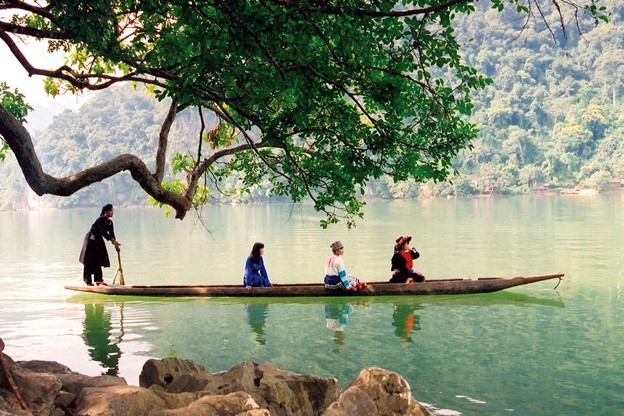
 Ba Be lake
In recent years, the northern mountainous region has witnessed a dramatic shift in the economic development mindset of its people. Previously, livelihoods were primarily based on small-scale farming, heavily dependent on nature. Now, however, many localities have proactively sought new approaches that suit their local advantages and market demands.
One of the most successful models is the development of community-based tourism linked to the preservation of traditional ethnic cultural identity. In many localities such as Sa Pa, Bac Ha, Mu Cang Chai (Lao Cai province); Sin Suoi Ho (Lai Chau province); Che Can village (Muong Phang commune, Dien Bien province), Ta Ko Khu village (Sin Thau commune, Dien Bien province), Men village (Thanh Nua commune, Dien Bien province), Moc Chau (Son La province), Dong Van, Meo Vac (Tuyen Quang province), Ba Be (Thai Nguyen province),… thousands of households have participated in homestay tourism, providing cultural experiences, culinary delights and traditional crafts.
From simple stilt houses, many families of the Mong, Dao, Tay, Thai and other ethnic groups have built effective business models, creating jobs for local workers and increasing their income. Some households earn hundreds of millions of dong annually from community-based tourism activities. Besides tourism, developing medicinal plants under the forest canopy is also becoming a promising direction. Plants such as Angelica sinensis, artichoke, Panax notoginseng, Amomum xanthioides, Polygonum multiflorum or ginseng (Lai Chau province) are not only suitable for the highland and mountainous climate conditions, but also have economic value many times higher than traditional food crops.
In particular, another model that is bringing positive results is the development of commodity agriculture associated with OCOP products. Ancient Shan Tuyet tea plantations in Tuyen Quang and Lao Cai provinces; Van Yen cinnamon (Lao Cai province); Moc Chau plums (Son La province); Bac Quang oranges (Tuyen Quang province) and Tai Nung pears in Lao Cai province,… are gradually building their brands in domestic and international markets.
Many cooperatives run by ethnic minorities have adopted clean production processes, traceability and e-commerce to enhance product value. As a result, people’s incomes have increased significantly, contributing to sustainable poverty reduction.
In particular, the forest economy is currently considered one of the most sustainable livelihood transformation directions. Many localities have effectively implemented policies on forest protection contracts, payment for forest environmental services and the development of products under the forest canopy. As a result, people have both a stable source of income and increased awareness of protecting natural resources. Many households have earned tens of millions of dong annually from payments for forest environmental services and forestry-related economic activities.
According to Dr. Tran Huu Son, former Director of the Department of Culture, Sports and Tourism of Lao Cai province: “The common point of successful livelihood models in the northern mountainous region is knowing how to exploit the advantages of local culture and resources. Effective livelihood transformation is not about completely replacing the old with the new, but about promoting the inherent values of the community with a modern development mindset. Ethnic culture, local knowledge, natural landscapes and local products are valuable resources that many places are exploiting very effectively”.
In reality, the most successful models are those that place people at the center of the development process. People are not only beneficiaries but also direct participants in production and business and benefit from support policies.
It is evident that livelihood transformation is becoming a crucial key to helping the northern mountainous region unleash its potential, strengths and gradually narrow the development gap with other regions in the country.
From remote mountainvillages, new livelihood models are gradually bringing hope for a sustainablefuture. It’s not just a story about increasing income or reducing poverty, butalso a journey of unleashing inner strength, preserving cultural identity andbuilding self-reliant, distinctive communities in the era of integration.
