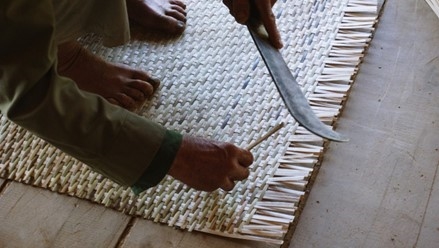
 The uniqueness of the local weaving craft begins right at the stage of selecting materials
 Amid the tide of the market economy, the market has been flooded with inexpensive and convenient plastic products and industrial household goods; consequently, the traditional weaving craft of Keo Village once faced the risk of fading away as the younger generation became captivated by new career opportunities. Driven by a love for their heritage and keen insight, the residents of Keo Village have found a new path to preserve their traditional craft. In order to safeguard this ancestral trade, the village established a traditional weaving club comprising over 20 members, primarily local elders. At the same time, the residents of Keo Village are gradually becoming accustomed to incorporating artistic elements into household items, transforming them into high-end interior décor pieces. Blending traditional values with a modern aesthetic sensibility is the key to ensuring the weaving craft does not fade away.
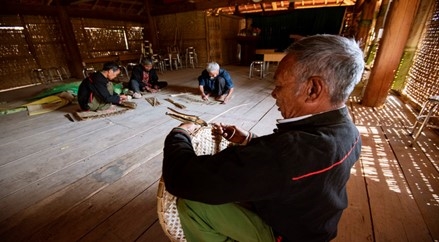 The traditional basket-weaving craft of the Kho-mu people is still maintained by the elderly to create various products and household items
 The uniqueness of wickerwork here starts right from the stage of choosing materials. Keo village workers have to go deep into the old forest to find slender but flexible sticky rattan trees or bamboo and bamboo trees of just the right age, not too old to avoid being brittle, not too young to avoid termites. The harvesting of raw materials also adheres to a philosophy of deep respect for nature: taking only what is needed and avoiding depletion, thereby allowing the forest space to regenerate.
The most distinctive feature setting the basketry products of the Kho-mu people in Keo Village apart from those of other regions is their masterful weaving technique and intricate patterns. Familiar items such as the “ep khau” (sticky rice container), “op” (fish basket) and “lu” (carrying basket) are not only durable but also highly aesthetic. The Kho-mu people’s “ep khau” (sticky rice basket) is a masterpiece of precision engineering, woven from two incredibly tight layers of bamboo strips that keep the fragrant sticky rice warm all day long without it becoming mushy or soggy from condensation. In particular, the post-production “kitchen-loft curing” process is a unique trade secret. Daily exposure to woodsmoke allows smoke to permeate every strand of the material, creating a natural protective layer against termites while imparting a lustrous, elegant reddish-brown hue, a finish that no industrial paint can replicate. The subtle scent of bamboo and cane, mingled with the aroma of kitchen smoke, creates a distinctive fragrance characteristic of the Kho-mu people’s woven products.
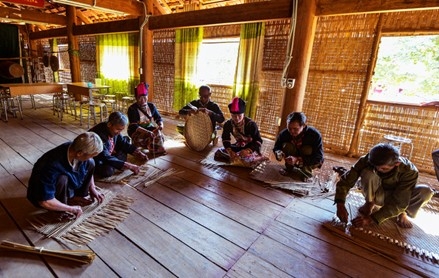 The traditional weaving club of the Kho-mu people in Keo Village
 Basket weaving in Keo Village has become the second most important source of income surpassed only by agricultural production and serves as the primary livelihood for many households with surplus labor or elderly members. A skilled artisan in Keo Village can weave two to three “ep khau” (sticky rice containers) per day. With retail prices ranging from 80,000 to 150,000 VND per piece (depending on size and intricacy), and after deducting material costs, artisans can earn between 150,000 and 300,000 VND per day. For products requiring a higher level of craftsmanship such as rattan chairs, decorative baskets or lanterns designed for restaurants and hotels, the price can range from 500,000 VND to several million VND per item. On average, a household regularly engaged in basket weaving can increase its income by 4-6 million VND per month. This is a significant amount for the local economy in highland areas, enabling residents to cover their children’s education expenses and purchase household amenities.
Preserving the weaving craft in Keo village is not merely about maintaining a livelihood; it is about safeguarding the cultural identity of the Kho-mu people. Each finished product stands as a testament to the enduring vitality of their ethnic culture in the face of the passage of time. Observing the elderly artisans diligently at work by their looms, one can believe that the bamboo strips of Keo Village will reach far and wide appearing within the cultural spheres of international friends as a beautiful symbol of the harmony between humanity and nature.
Today, Ban Keo remains fragrant with the scent of bamboo and filled with the lively sounds of bamboo splitting. These sounds signify continuity and pride in a traditional craft, one that helps showcase the local landscape, people, and potential, as well as the community’s exquisite handicrafts, all while driving local socio-economic development./.
