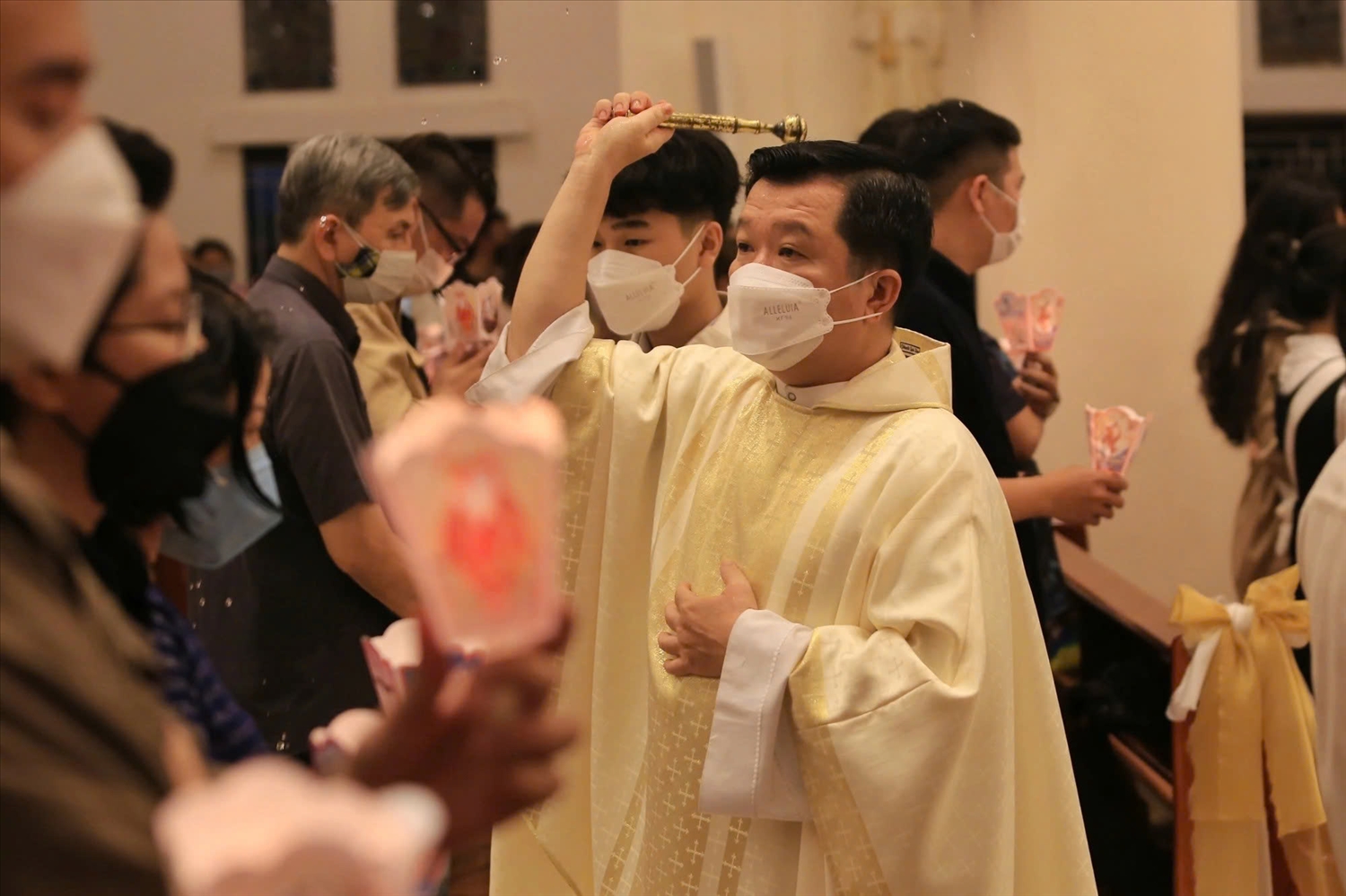
 A priest sprinkles holy water during the Easter service
Keywords: Easter; Catholicism; Religious rituals; Religious symbol; Vietnam.
1. Introduction
Easter is one of the most important holidays of the year and a focal point of the Christian faith. Consequently, since ancient times, its celebration has been marked by solemn and meaningful rituals that remind Christians of the joy and hope stemming from Jesus's victory over death, a triumph that paves the way for believers to enter into eternal, blissful life. Easter commemorates the resurrection of Jesus Christ following his crucifixion and typically takes place in the spring, around March or April each year. It was not until the 12th century that the Roman Catholic Church gradually standardized the rituals associated with the holiday. Easter is scheduled for a Sunday following the Jewish Passover, meaning the date changes each year. The Catholic Church observes Easter with great solemnity and uses the occasion to promote the spirit of forgiveness and fellowship among the faithful. Over time, various traditions associated with the holiday have emerged and endure to this day.
2. Easter rituals and practices around the world
2.1. Common religious rituals
Today, Easter is an occasion for Catholics to seek repentance and forgiveness, and to encourage friends to live in harmony. At the Vatican, the Pope presides over an Easter prayer service attended by hundreds of thousands of the faithful, praying for Rome and the world to enjoy a prosperous, warm and joyful new year.
2.2. Typical forms of practice
During this time, Christians around the world are holding numerous Easter celebrations and festivities. In Texas, USA, German immigrants founded the town of Fredericksburg. On the eve of Easter, residents light large bonfires to commemorate the peace treaty signed with the Comanche people in 1847. In Nordic towns, people also light Easter bonfires as an act of prayer. In the Philippines, elaborate Easter processions are held, serving as an occasion for the faithful to demonstrate their reverence and submission, both physical and spiritual to God. The highlights of Easter in Bermuda are the fluttering kites and the food. Traditionally, locals gather to watch the homemade kites flown by children on Good Friday. The Bermudian tradition originated when a British teacher in Bermuda made a kite to explain the Ascension of Christ to his students. During the holiday, parishioners often eat cross-shaped pastries and cod cakes. In Germany, Easter celebrations in the Bavarian village of Oberammergau are widely known for the Passion Play, a performance depicting the death of Christ. The event is held to give thanks to God for saving the local people from the bubonic plague, which threatened to wipe out the entire village in 1633. Religious leaders in Oberammergau plan to stage the event every ten years/one time. In Greece, a traditional ceremony takes place on Holy Saturday night, featuring mini-rockets and fireworks to signal the official start of Easter on Sunday. After the ceremony, people return home to eat magiritsa, a soup made with lamb tripe. While the main dinner features roast lamb. In central Spain, the Easter procession is one of the essential rituals of the holiday. The procession in Seville is among the most impressive. Religious statues, flowers and candles were carried through the streets amidst lively music and a massive, bustling crowd, creating a magnificent Easter procession. In Indonesia, Christianity was introduced by Dutch and Portuguese missionaries in the 16th century; since then, Easter has been observed with reenactments of the Crucifixion, serving to remind the faithful of the event and express their gratitude to God. A young man is selected to portray Christ, strapped to a cross and paraded through the streets alongside statues of Jesus and the Virgin Mary.
3. Easter symbols and customs
Every year at Easter, Christians traditionally gather to enjoy delicious meals and exchange Easter eggs and colorful Easter bunnies, sharing messages of love.
3.1. Easter eggs
The Easter egg is a universal symbol of Easter. Creation myths from many ancient cultures often speak of an egg from which the universe was born. Thus, the egg is a natural manifestation not only of creation but also a symbol of regeneration and resurrection. In ancient times, in Egypt and Persia, friends would exchange colorfully decorated eggs to mark the start of the new year at the spring equinox. These eggs symbolized fertility and abundance, as ancient people regarded the emergence of a living creature from an egg as a truly miraculous phenomenon. Christians in the Near East adopted this tradition, and the Easter egg became a religious symbol. The Easter egg represents the tomb from which Jesus emerged into new life. Consequently, during the time when the Church forbade the consumption of eggs during Lent, eggs became a prized food and a symbol of joy on Easter Sunday. Easter eggs are often given to children by placing them in baskets or hiding them for the children to find. Firstly, the eggs are boiled and then dyed in bright colors. In some places, the yolks and whites are removed, and the shells are painted with elaborate designs. In Russia, such exquisitely decorated Easter eggs are known as Fabergé eggs named after the master jeweler Peter Carl Fabergé, who was commissioned by the former Russian imperial family to craft them using precious metals and masterful artistry.
3.2. Easter Rabbit
Associated with fertility and proliferation, the rabbit has long been a symbol of new life. In ancient European culture, particularly in connection with Eostre, the goddess of spring, the rabbit is regarded as a creature embodying spring and rebirth. The Easter Bunny is often depicted carrying or hiding colored eggs, known as Easter eggs. Eggs symbolize new beginnings, while rabbits represent abundant life. Children are often told that Easter eggs come from the Easter Bunny. For Western cultures, the rabbit is a symbol of fertility.
3.3. Easter lily
The white, trumpet-shaped Easter lily, which blooms in the spring, was introduced by Mrs. Thomas P. Sargent from Bermuda in the Caribbean. It is commonly known as the “Easter lily” because it blooms during the Easter season; consequently, it is as closely associated with Easter as the red-leaved poinsettia is with Christmas. In early Christian art, the lily symbolized purity, owing to its delicate form and pristine white color; for this reason, it also became a symbol of the Resurrection. These deeply meaningful Easter customs and activities observed by Catholics have evolved into a beautiful practice that has spread throughout society, inspiring people around the world to adopt them.
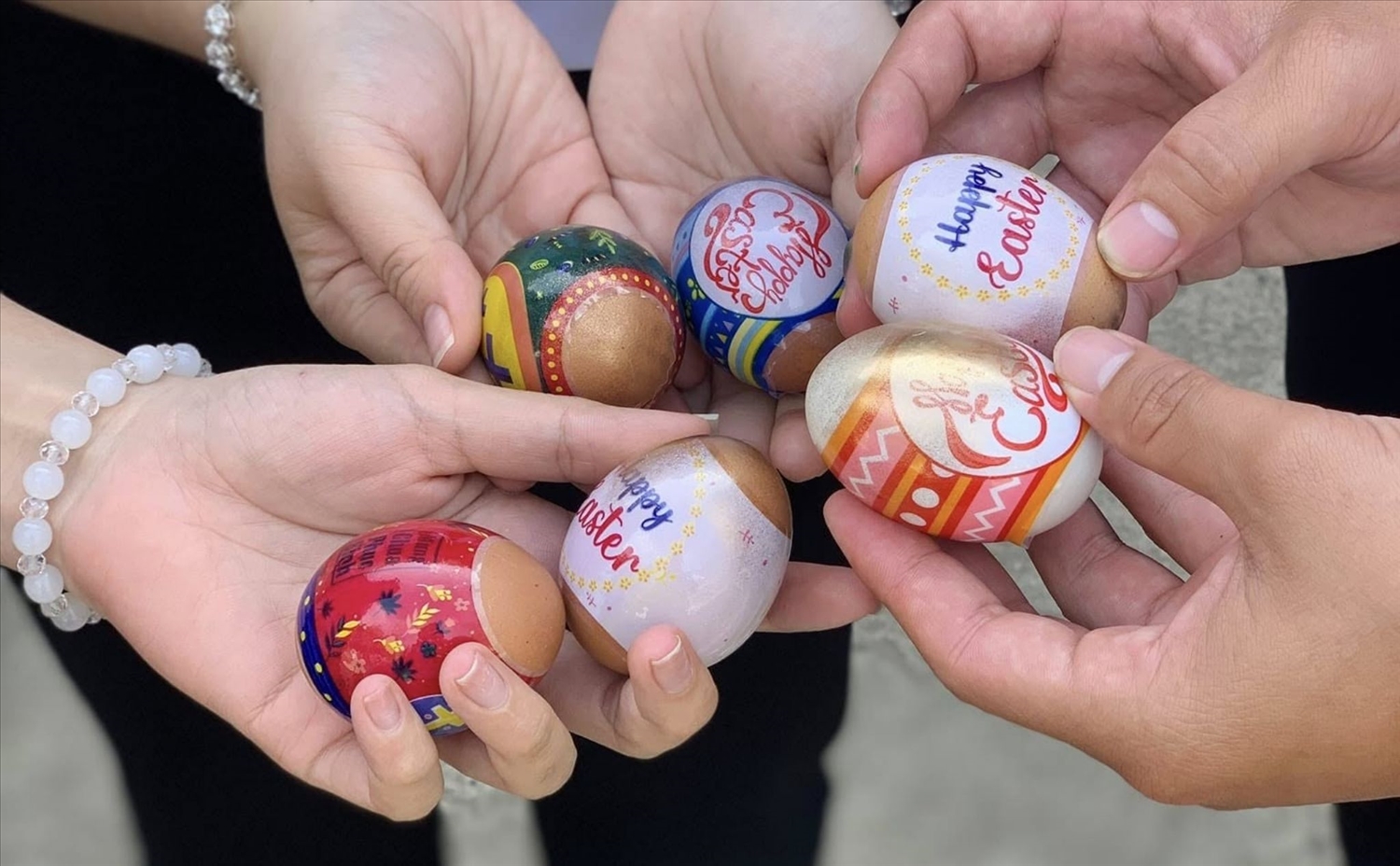 Easter eggs are a characteristic symbol of Easter, representing new life, rebirth and the resurrection of Jesus Christ
4. Easter among Vietnamese Catholics
In Vietnam, Catholics regard Easter as the most important feast in the liturgical year, the “Mother of all Sundays” commemorating and re-enacting the Paschal mystery of Christ. In order to prepare for Easter, the Catholic Church in Vietnam observes a forty-day period of spiritual preparation known as Lent (beginning on Ash Wednesday). These are days dedicated to repentance, prayer, fasting and acts of charity, as well as preparation for entry into the Christian faith. The Church also continues to celebrate Easter throughout the fifty-day Easter season, which concludes with Pentecost. During this season, the Catholic community holds daytime processions on two occasions. These are the Palm Sunday procession for the congregation and the Easter procession. During the Palm Sunday procession, each participant holds a leaf (coconut fronds in Vietnam, olive branches in the West). Leading the procession is a raised crucifix shaded by a golden canopy, followed by the Church flag and the flag of the Holy See shared by the global Catholic community, featuring yellow and white colors and a 2:3 rectangular ratio (with a 3x7m version flown atop the church) and then the Vietnamese national flag (the five-colored flag). Following next was a procession of young lay members—boys in white shirts and colored trousers (tucked in) and girls in ao dai - all maintaining a solemn demeanor. They were followed by the Eucharistic Youth group carrying coconut fronds, and then by a contingent bearing the Eight Treasures (Bat Buu) arranged in two rows; the bearers wore yellow robes with red sashes and traditional boots or black shoes. Following the procession of the Eight Treasures came the choir, women in white long shirt (for women) and men in white shirts (tucked in) with trousers or suits (in winter) followed by the incense bearers (two young male altar servers). Next came the presiding bishop, holding a cross woven from coconut palm fronds. The bishop wore a red vestment, the color of blood symbolizing the agony of death. Following the presiding bishop was the congregation of the faithful, holding palm fronds and dressed in white long shirt (for women) or white shirts tucked into trousers (for men); bringing up the rear were visitors from near and far. During the procession, the group continuously recited prayers and sang hymns, while church bells rang out in rapid, urgent succession as if beckoning the faithful creating an atmosphere that was at once solemn, majestic, sacred, and reverent; the entire community, from the presiding bishop to the religious and the laity, became united as one, turning their hearts toward God. The procession goes around the church or around the village, depending on the circumstances of each place.
Because Easter is the most important holiday of the year for Vietnamese Catholics, on this holiday, everyone and every Vietnamese Catholic family organizes lavish meals at home. A procession featuring the statue of Jesus is being held at the church. The majestic, towering statue of Jesus is placed within a golden palanquin, holding a square red flag; the palanquin is carried by four young men.
These men were carefully selected from various church communities and parishes based on their appearance, health and impeccable moral character. The presiding bishop wore golden vestments. Female congregants wore vibrant long shirt while the men wore dress shirts. Throughout the procession, hymns and sacred songs rang out ceaselessly, while church bells pealed in rapid, urgent succession, stirring the entire community and creating an atmosphere that was solemn, majestic, sacred and filled with fervent excitement. During the Easter Vigil service, every parishioner holds a candle. In Vietnam and many other countries, Easter eggs are sold during the Easter Vigil so that churchgoers can purchase them as gifts for others.
Catholics observe not only Easter Day but also the Easter Season. The Easter Season spans seven weeks, beginning on Easter Sunday and concluding on Pentecost Sunday. During the Easter season, Catholics recite the Gloria (accompanied by instrumental music when there is no singing), recite or sing the Alleluia (Praise the Lord), adorn the altar with abundant flowers and the celebrant wears white vestments. The Easter Octave comprises eight days, beginning with Easter Sunday. Funeral Masses, wedding Masses or other ritual Masses may not be celebrated on the Sundays of Easter, as these Sundays hold precedence over all other celebrations. The Church teaches that all the faithful, having received First Holy Communion and reached the age of reason, are obliged to confess their sins and receive Holy Communion at least once during the Easter season. Easter is not merely another feast day; it is the ‘Feast of Feasts”, just as the Eucharist is the “Sacrament of Sacraments”. During this season, Easter is celebrated with great joy and exultation, regarded as a single feast or rather, as a Great Sunday, an Easter lived in the light.
5. The significance and meaning of Easter
Easter is not only a religious event of central importance to the Catholic faith but also embodies profound values across ethical, cultural and social dimensions.
Firstly, from a religious perspective, Easter affirms the core Christian belief in the Resurrection of Jesus Christ, thereby strengthening the faithful's belief in eternal life and salvation. Through rituals such as repentance, prayer, attending Mass and receiving the sacraments, Catholics are reminded of the journey of inner purification, striving toward a holy life and a closer union with God.
Secondly, from an ethical perspective, Easter helps spread profound humanistic values such as selflessness, forgiveness, and the spirit of charity. Commemorating the sacrifice and resurrection of Jesus serves as a foundation for individuals to reflect on themselves, thereby guiding their behavior toward goodness and fostering a sense of responsibility toward the community and society.
Thirdly, from a social perspective, Easter plays a vital role in strengthening community cohesion. Religious activities and communal gatherings such as processions, attending Mass, parish events and family reunions not only create a shared space for religious observance but also foster connections among individuals within the community, thereby building a harmonious and stable social life.
From a cultural perspective, Easter exemplifies the interplay and flexible adaptation between Catholic doctrine and indigenous cultural elements. Symbols such as Easter eggs, the Easter rabit and Easter lilies along with the diverse ways the festival is celebrated across different nations have created a rich cultural tapestry that contributes to the enrichment of people’s spiritual lives. In Vietnam, Easter bears a distinct cultural imprint, evident in attire, rituals and forms of community life that reflects the processes of integration and indigenization of Catholicism.
In the context of modern society, Easter continues to affirm its value as a significant spiritual resource, helping to guide a positive lifestyle, strengthen faith, and promote moral values within the community. At the same time, it serves as an occasion for religious and cultural values to be preserved, upheld and disseminated in contemporary life.
6. Conclusion
Easter holds a central place in the life of faith for Catholics, not only for its significance in commemorating the resurrection of Jesus Christ but also for the profound theological values it embodies regarding salvation, eternal life and hope for humanity. Throughout its long history of formation and development, Easter has taken shape with a structured system of rituals, at the same time undergoing flexible adaptations across diverse cultural contexts, resulting in a wide variety of practices worldwide.
Research findings indicate that, beyond its core religious significance, Easter embodies important moral, cultural and social values. Rituals and symbols such as Easter eggs, the Easter Bunny, and Easter lilies not only reflect doctrinal teachings but also help give tangible form to faith, enabling believers to engage with and practice their religion in a vivid, meaningful way. At the same time, holiday activities have created a space to connect the community, strengthen spiritual life and spread positive human values in society.
In the Vietnamese context, the Catholic celebration of Easter clearly demonstrates the integration of religious doctrine and national culture. Observances such as Lent, Palm Sunday, processions and the Easter Vigil hold not only religious significance but also reflect cultural characteristics, thereby enriching both spiritual life and community activities. Thus, it can be affirmed that Easter is not merely a religious observance but also a socio-cultural phenomenon with widespread reach.
* Thai Nguyen Provincial School of Politics
Tài liệu tham khảo
1. The Catholic Church in Vietnam. The significance of Easter in Christianity.
2. Catholic Bishops’ Conference of Vietnam, Rites and Symbols of the Easter Season.
3. Nhan Dan Newspaper (2023), Easter and Western cultural symbols.
4. Journal of Religious Studies: Research articles on Christian symbols and rituals.
5. Journal of Culture and Arts. Animal symbols in Western culture.
